
WRITING TECHNIQUES AND DIFFICULTIES ENSP 1 Mr Xavier

- Slides: 17
WRITING TECHNIQUES AND DIFFICULTIES ENSP 1 Mr. Xavier Aquino Velasco Associate/Lecture III, FEU Tech Surio, Philippe Brianne G.
WHAT IS WRITING The activity or skill of marking coherent words on paper and composing text. A sequence of letters, words, or symbols marked on paper or some other surface. written work, especially with regard to its style or quality.
TYPES OF WRITING TECHNIQUE SOURCE: http: //classroom. synonym. com/types-writingtechniques-4410. html
DESCRIPTIVE Descriptive writing occurs when the writer uses very detailed information to explain the story.
FIRST-PERSON When using a first-person writing technique, the writer is able to incorporate his own ideas into the story. Instead of just presenting the facts, the writer can let his own opinions come out in the writing.
Narrative A narrative writing style tells a story. The writer introduces different characters and a setting to the readers, while keeping his or her own voice silent. Narrative stories present a problem that is played out and eventually solved. One of the most common examples of a narrative is a movie script, but narratives are also frequently used in short stories as well.
PERSUASIVE In a persuasive writing style, the author tries to change the reader's mind on a certain topic or issue. Writers present facts supporting their opinions and try to convince the reader to join in their beliefs. An example of this is often seen in newspaper and magazine columns, or in political speeches.
SUBJECTIVE A story written in a subjective writing technique displays facts from both sides of an issue or subject. The writer is able to use first-person terms such as the word "I", but does not choose one side to support. Writers simply list the pros and cons of the subject so the readers can develop their own informed opinions. Newspaper articles are often written in a subjective style.
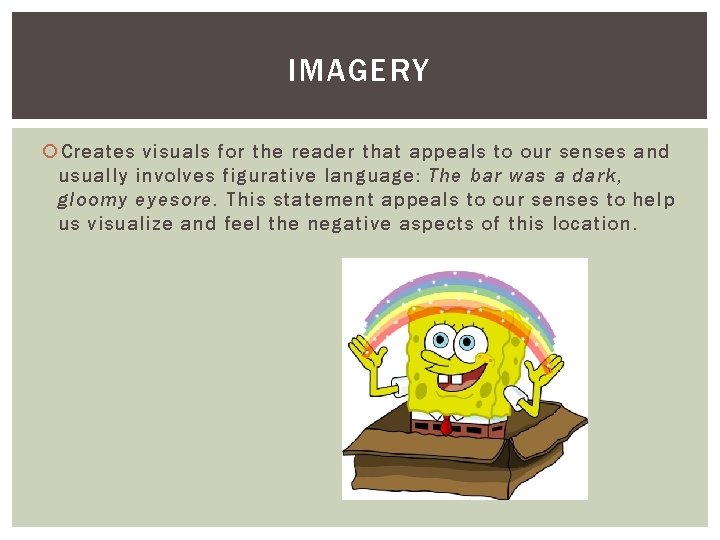
IMAGERY Creates visuals for the reader that appeals to our senses and usually involves figurative language: The bar was a dark, gloomy eyesore. This statement appeals to our senses to help us visualize and feel the negative aspects of this location.
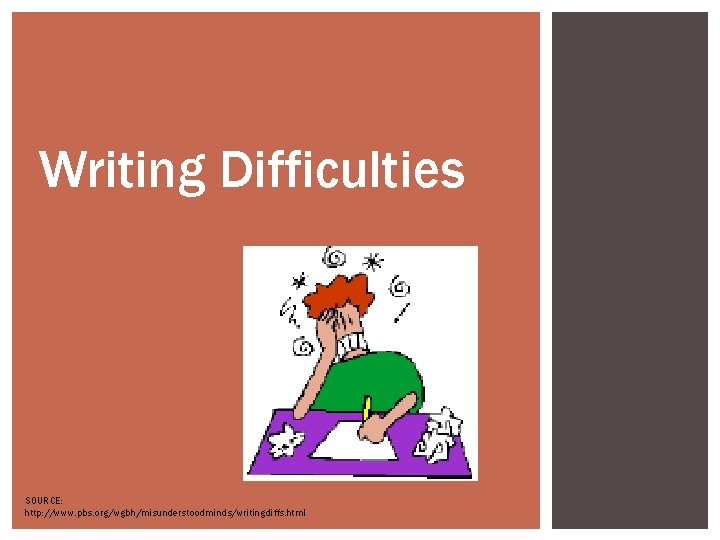
Writing Difficulties SOURCE: http: //www. pbs. org/wgbh/misunderstoodminds/writingdiffs. html
WHAT CAN INHIBIT WRITING DEVELOPMENT? Like all learning problems, difficulties in writing can be devastating to a child's education and self-esteem. As children progress through school, they are increasingly expected to express what they know about many different subjects through writing. If a child fails to develop certain basic skills, he will be unable to write with the speed and fluency required to excel as these demands increase. Indeed, for a child struggling with a writing problem, the writing process itself interferes with learning. Students faced with such difficult odds have trouble staying motivated.
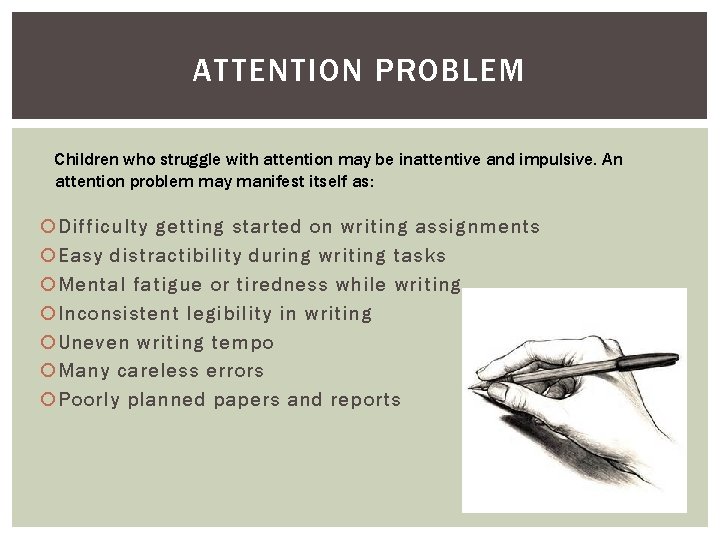
ATTENTION PROBLEM Children who struggle with attention may be inattentive and impulsive. An attention problem may manifest itself as: Difficulty getting started on writing assignments Easy distractibility during writing tasks Mental fatigue or tiredness while writing Inconsistent legibility in writing Uneven writing tempo Many careless errors Poorly planned papers and reports
SPATIAL ORDERING PROBLEM Children who struggle with spatial ordering have decreased awareness regarding the spatial arrangement of letters, words, or sentences on a page. A spatial ordering problem may manifest itself in a child's writing as: Poor use of lines on the paper Organizational problems Uneven spacing between letters Many misspelled words
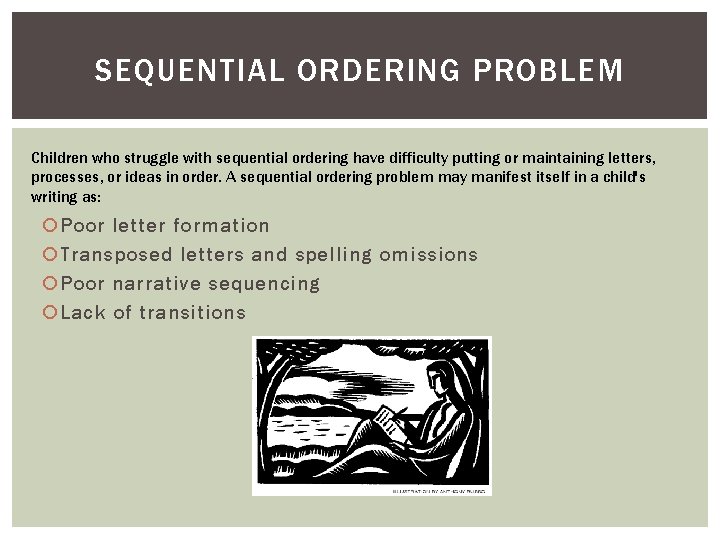
SEQUENTIAL ORDERING PROBLEM Children who struggle with sequential ordering have difficulty putting or maintaining letters, processes, or ideas in order. A sequential ordering problem may manifest itself in a child's writing as: Poor letter formation Transposed letters and spelling omissions Poor narrative sequencing Lack of transitions
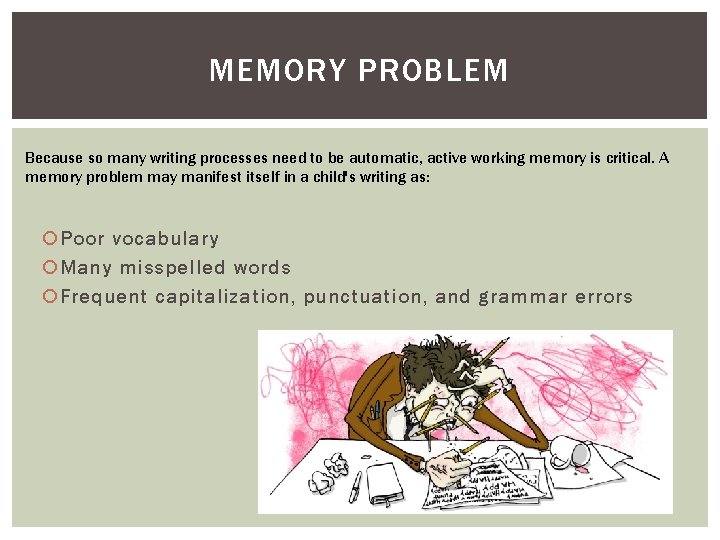
MEMORY PROBLEM Because so many writing processes need to be automatic, active working memory is critical. A memory problem may manifest itself in a child's writing as: Poor vocabulary Many misspelled words Frequent capitalization, punctuation, and grammar errors
LANGUAGE PROBLEM Good writing relies on a child's language abilities improving steadily over time. A language problem may manifest itself in a child's writing as: Poor vocabulary Awkward phrasing and unconventional grammar Inappropriate use of colloquial language Difficulty with sentence structure and word order Trouble reading back what is written Difficulty with word sounds, spelling, and meanings
END OF DISCUSSION