
Writing Style and Word Usage Graham Parkinson July
- Slides: 54
Writing Style and Word Usage Graham Parkinson July 6, 2016 ACS Style Guide 1
Contents of the ACS style guide Part 1. Scientific Communication 1. Ethics in Scientific Communication 2. Scientific Papers 3. The Editorial Process 4. Writing Style and Word Usage 5. Electronic Submission of Manuscripts Using Web-Based Systems 6. Peer Review 7. Copyright Basics 8. Markup Languages and the Datument Part 2. Style Guidelines 9. Grammar, Punctuation, and Spelling 10. Editorial Style 11. Numbers, Mathematics, and Units of Measure 12. Names and Numbers for Chemical Compounds 13. Conventions in Chemistry 2
Contents of the ACS style guide Part 1. Scientific Communication 1. Ethics in Scientific Communication 2. Scientific Papers 3. The Editorial Process 4. Writing Style and Word Usage 5. Electronic Submission of Manuscripts Using Web-Based Systems 6. Peer Review 7. Copyright Basics 8. Markup Languages and the Datument Part 2. Style Guidelines 9. Grammar, Punctuation, and Spelling 10. Editorial Style 11. Numbers, Mathematics, and Units of Measure 12. Names and Numbers for Chemical Compounds 13. Conventions in Chemistry 14. References 15. Figures 16. Tables 17. Chemical Structures 3
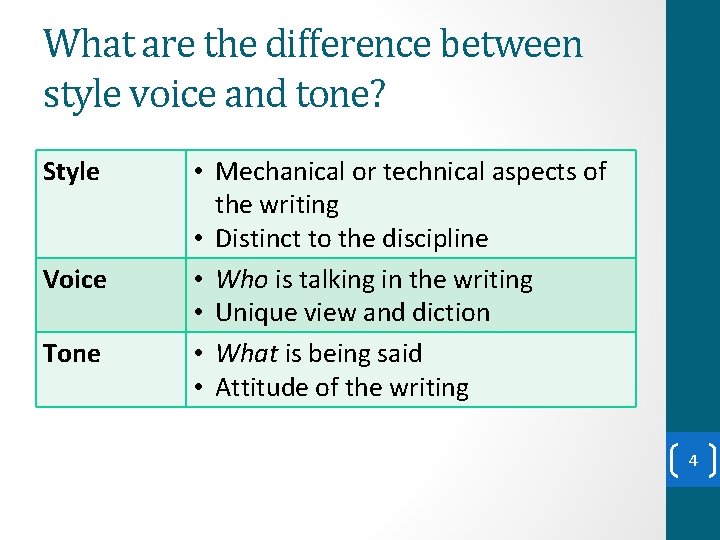
What are the difference between style voice and tone? Style Voice Tone • Mechanical or technical aspects of the writing • Distinct to the discipline • Who is talking in the writing • Unique view and diction • What is being said • Attitude of the writing 4
The tone is easy to perceive but difficult to explain. • Tone provides an interface between the arguments presented and the audience • Distinguish formal versus informal writing • Convey sincerity 5
Good writers develop a unique voice. • “Find your own voice” → Develop your voice • Many voices deviate from convention • Voice is your tool 6
All writers have personal style, but all good writing follows protocol. • Style is the way a writer writes. • Interplay of voice and tone • Diction and syntax • ACS seeks a consistent style hence the ACS Style Guide! • Guidelines from the Style Guide 7
Correct sentence structure is the first tool in creating good style. • Declarative sentences are strong • Too many in a row are monotonous • Build compound sentences • Bottom-up, not top-down • Independent clauses and dependent clauses 8
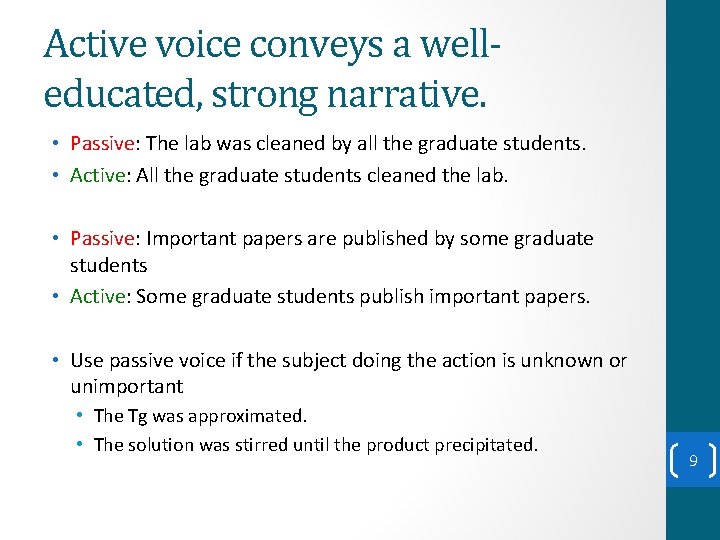
Active voice conveys a welleducated, strong narrative. • Passive: The lab was cleaned by all the graduate students. • Active: All the graduate students cleaned the lab. • Passive: Important papers are published by some graduate students • Active: Some graduate students publish important papers. • Use passive voice if the subject doing the action is unknown or unimportant • The Tg was approximated. • The solution was stirred until the product precipitated. 9
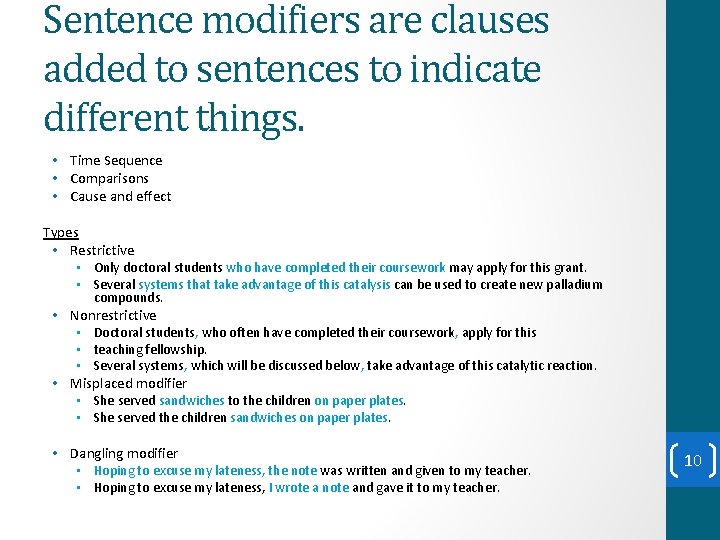
Sentence modifiers are clauses added to sentences to indicate different things. • Time Sequence • Comparisons • Cause and effect Types • Restrictive • Only doctoral students who have completed their coursework may apply for this grant. • Several systems that take advantage of this catalysis can be used to create new palladium compounds. • Nonrestrictive • Doctoral students, who often have completed their coursework, apply for this • teaching fellowship. • Several systems, which will be discussed below, take advantage of this catalytic reaction. • Misplaced modifier • She served sandwiches to the children on paper plates. • She served the children sandwiches on paper plates. • Dangling modifier • Hoping to excuse my lateness, the note was written and given to my teacher. • Hoping to excuse my lateness, I wrote a note and gave it to my teacher. 10
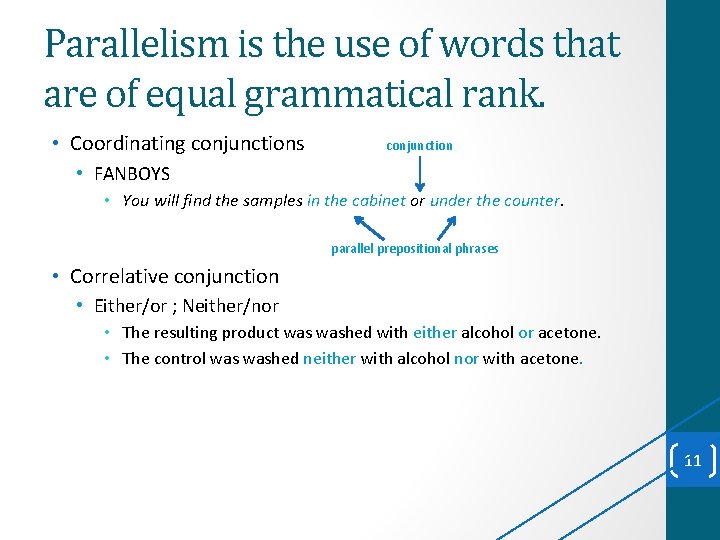
Parallelism is the use of words that are of equal grammatical rank. • Coordinating conjunctions conjunction • FANBOYS • You will find the samples in the cabinet or under the counter. parallel prepositional phrases • Correlative conjunction • Either/or ; Neither/nor • The resulting product washed with either alcohol or acetone. • The control washed neither with alcohol nor with acetone. 11
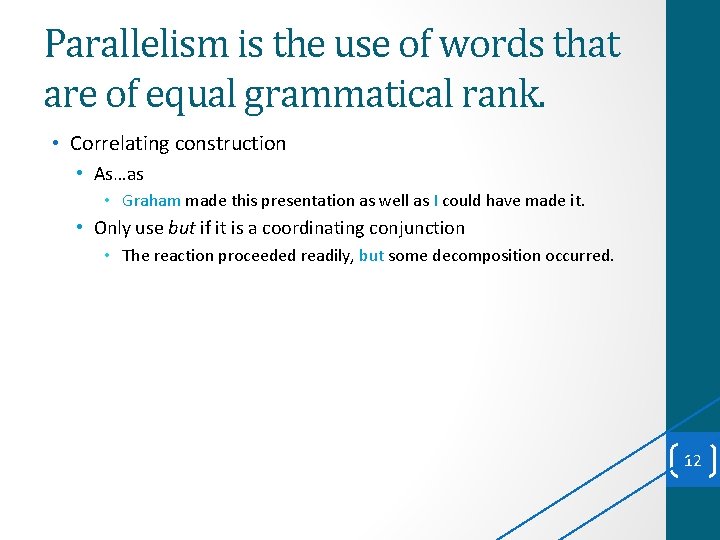
Parallelism is the use of words that are of equal grammatical rank. • Correlating construction • As…as • Graham made this presentation as well as I could have made it. • Only use but if it is a coordinating conjunction • The reaction proceeded readily, but some decomposition occurred. 12
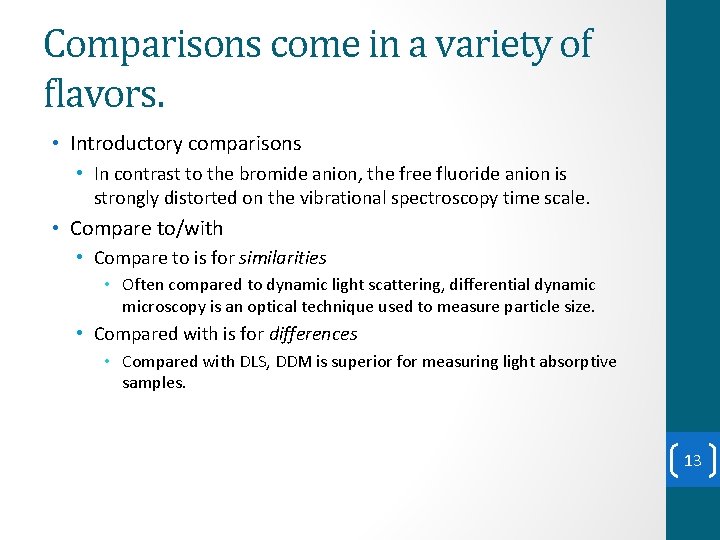
Comparisons come in a variety of flavors. • Introductory comparisons • In contrast to the bromide anion, the free fluoride anion is strongly distorted on the vibrational spectroscopy time scale. • Compare to/with • Compare to is for similarities • Often compared to dynamic light scattering, differential dynamic microscopy is an optical technique used to measure particle size. • Compared with is for differences • Compared with DLS, DDM is superior for measuring light absorptive samples. 13
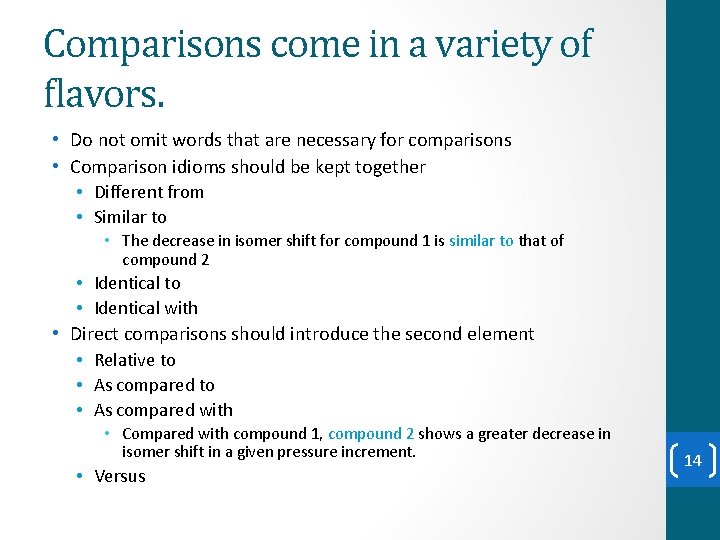
Comparisons come in a variety of flavors. • Do not omit words that are necessary for comparisons • Comparison idioms should be kept together • Different from • Similar to • The decrease in isomer shift for compound 1 is similar to that of compound 2 • Identical to • Identical with • Direct comparisons should introduce the second element • Relative to • As compared with • Compared with compound 1, compound 2 shows a greater decrease in isomer shift in a given pressure increment. • Versus 14
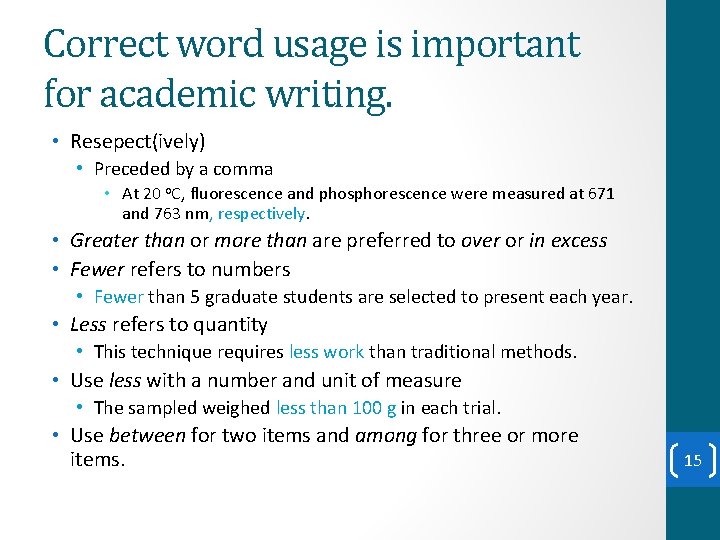
Correct word usage is important for academic writing. • Resepect(ively) • Preceded by a comma • At 20 o. C, fluorescence and phosphorescence were measured at 671 and 763 nm, respectively. • Greater than or more than are preferred to over or in excess • Fewer refers to numbers • Fewer than 5 graduate students are selected to present each year. • Less refers to quantity • This technique requires less work than traditional methods. • Use less with a number and unit of measure • The sampled weighed less than 100 g in each trial. • Use between for two items and among for three or more items. 15
Gender neutral language • Great effort for encouraging gender neutral language • Staff in place of manpower • Synthetic in place of man-made • Match the antecedent 16
COMBINING THESE ELEMENTS MAKES FOR STRONG WRITING. 17
References 1. 2. 3. Coghill, A. M. ; Garson, L. R. , The ACS Style Guide. American Chemical Society: 2006. Case Western Reserve University. The Difference Between Tone and Voice. https: //students. case. edu/academic/resources/writing/tone 1. html (accessed Jul 5, 2016). University of Maryland University College. A Word About Style, Voice, and Tone. http: //www. umuc. edu/writingcenter/onlineguide/tutorial/c hapter 3/ch 3 -21. html (accessed Jul 5, 2016). 18
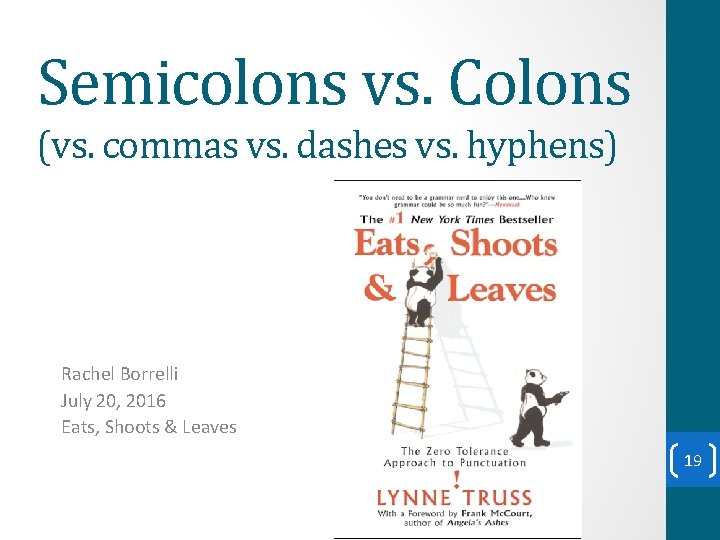
Semicolons vs. Colons (vs. commas vs. dashes vs. hyphens) Rachel Borrelli July 20, 2016 Eats, Shoots & Leaves 19
Semicolons vs. colons Here is the American essayist Lewis Thomas on the semicolon: The semicolon tells you that there is still some question about the preceding full sentence; something needs to be added […]The period tells you that is that; if you didn’t get all the meaning you wanted or expected, anyway you got all the writer intended to parcel out and now you have to move along. But with the semicolon there is more to come; read on; it will get clearer. (The Medusa and the Snail, 1979) 20
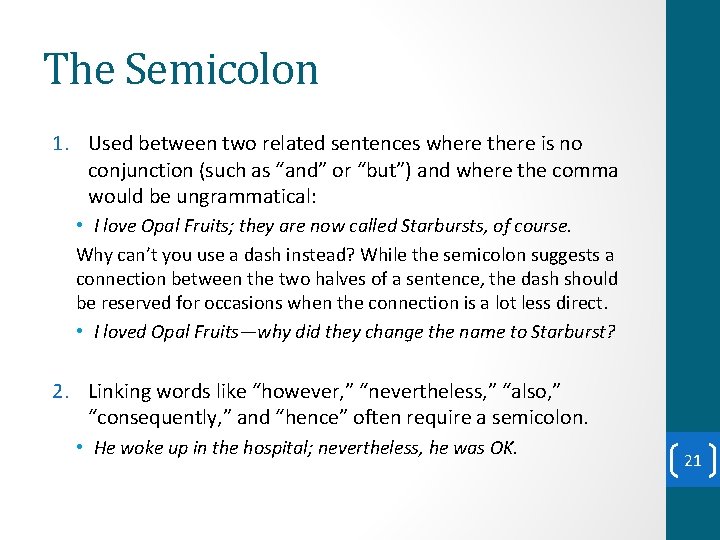
The Semicolon 1. Used between two related sentences where there is no conjunction (such as “and” or “but”) and where the comma would be ungrammatical: • I love Opal Fruits; they are now called Starbursts, of course. Why can’t you use a dash instead? While the semicolon suggests a connection between the two halves of a sentence, the dash should be reserved for occasions when the connection is a lot less direct. • I loved Opal Fruits—why did they change the name to Starburst? 2. Linking words like “however, ” “nevertheless, ” “also, ” “consequently, ” and “hence” often require a semicolon. • He woke up in the hospital; nevertheless, he was OK. 21
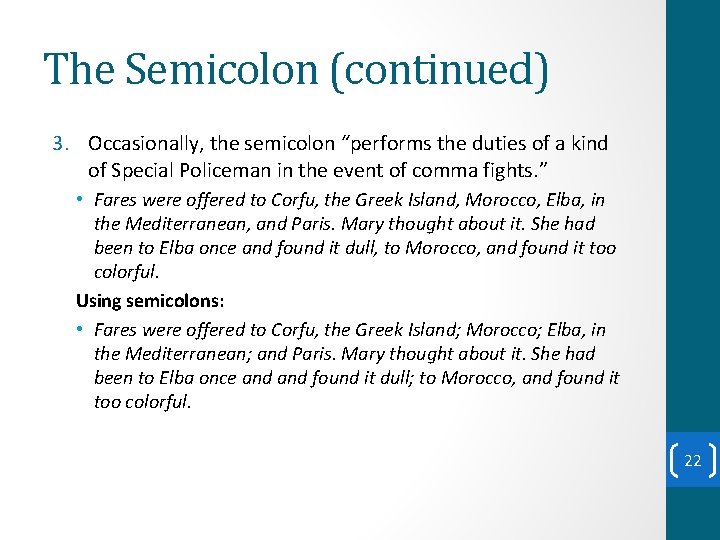
The Semicolon (continued) 3. Occasionally, the semicolon “performs the duties of a kind of Special Policeman in the event of comma fights. ” • Fares were offered to Corfu, the Greek Island, Morocco, Elba, in the Mediterranean, and Paris. Mary thought about it. She had been to Elba once and found it dull, to Morocco, and found it too colorful. Using semicolons: • Fares were offered to Corfu, the Greek Island; Morocco; Elba, in the Mediterranean; and Paris. Mary thought about it. She had been to Elba once and found it dull; to Morocco, and found it too colorful. 22
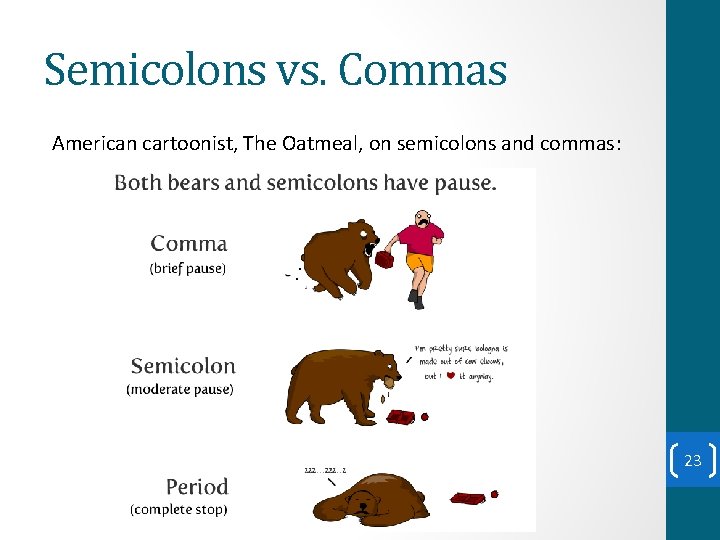
Semicolons vs. Commas American cartoonist, The Oatmeal, on semicolons and commas: 23
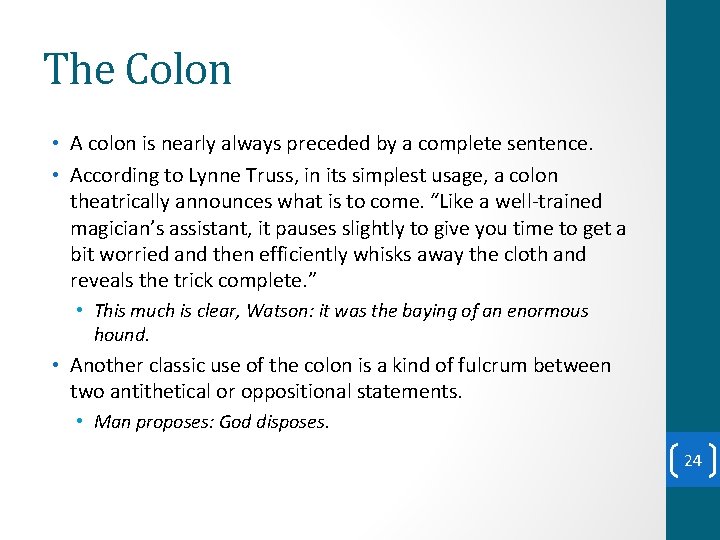
The Colon • A colon is nearly always preceded by a complete sentence. • According to Lynne Truss, in its simplest usage, a colon theatrically announces what is to come. “Like a well-trained magician’s assistant, it pauses slightly to give you time to get a bit worried and then efficiently whisks away the cloth and reveals the trick complete. ” • This much is clear, Watson: it was the baying of an enormous hound. • Another classic use of the colon is a kind of fulcrum between two antithetical or oppositional statements. • Man proposes: God disposes. 24
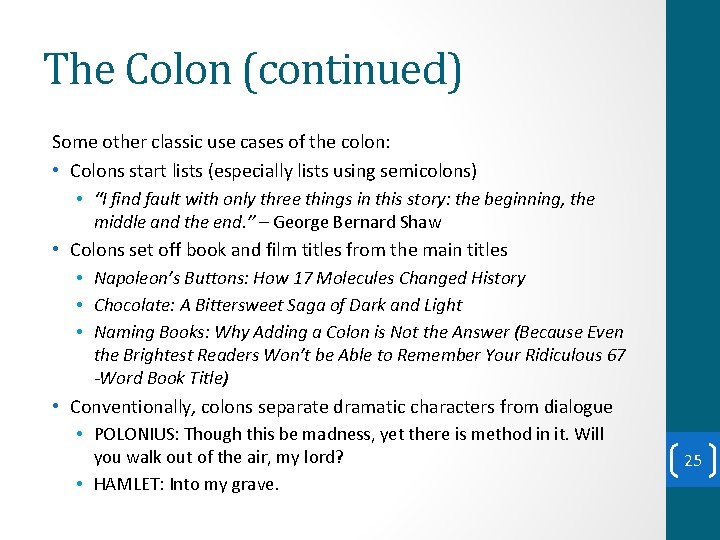
The Colon (continued) Some other classic use cases of the colon: • Colons start lists (especially lists using semicolons) • “I find fault with only three things in this story: the beginning, the middle and the end. ” – George Bernard Shaw • Colons set off book and film titles from the main titles • Napoleon’s Buttons: How 17 Molecules Changed History • Chocolate: A Bittersweet Saga of Dark and Light • Naming Books: Why Adding a Colon is Not the Answer (Because Even the Brightest Readers Won’t be Able to Remember Your Ridiculous 67 -Word Book Title) • Conventionally, colons separate dramatic characters from dialogue • POLONIUS: Though this be madness, yet there is method in it. Will you walk out of the air, my lord? • HAMLET: Into my grave. 25
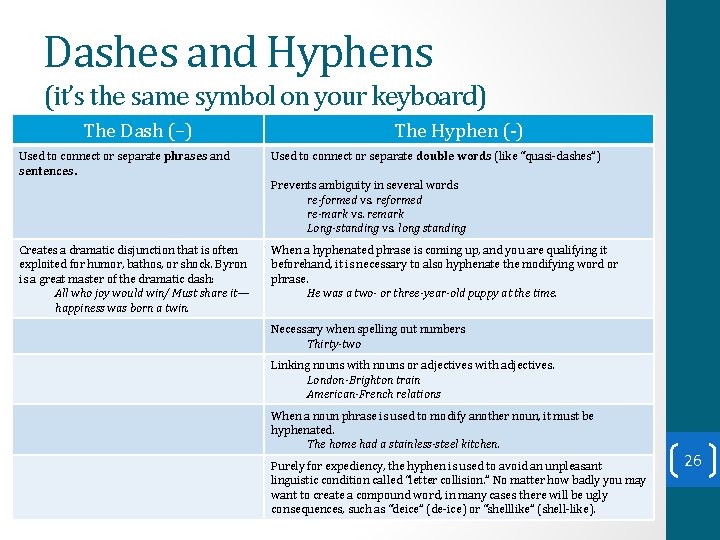
Dashes and Hyphens (it’s the same symbol on your keyboard) The Dash (–) Used to connect or separate phrases and sentences. The Hyphen (-) Used to connect or separate double words (like “quasi-dashes”) Prevents ambiguity in several words re-formed vs. reformed re-mark vs. remark Long-standing vs. long standing Creates a dramatic disjunction that is often exploited for humor, bathos, or shock. Byron is a great master of the dramatic dash: All who joy would win/ Must share it— happiness was born a twin. When a hyphenated phrase is coming up, and you are qualifying it beforehand, it is necessary to also hyphenate the modifying word or phrase. He was a two- or three-year-old puppy at the time. Necessary when spelling out numbers Thirty-two Linking nouns with nouns or adjectives with adjectives. London-Brighton train American-French relations When a noun phrase is used to modify another noun, it must be hyphenated. The home had a stainless-steel kitchen. Purely for expediency, the hyphen is used to avoid an unpleasant linguistic condition called “letter collision. ” No matter how badly you may want to create a compound word, in many cases there will be ugly consequences, such as “deice” (de-ice) or “shelllike” (shell-like). 26
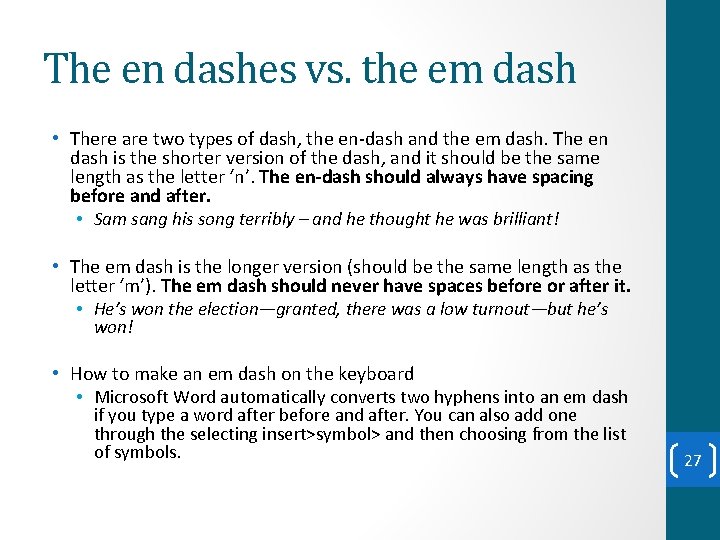
The en dashes vs. the em dash • There are two types of dash, the en-dash and the em dash. The en dash is the shorter version of the dash, and it should be the same length as the letter ‘n’. The en-dash should always have spacing before and after. • Sam sang his song terribly – and he thought he was brilliant! • The em dash is the longer version (should be the same length as the letter ‘m’). The em dash should never have spaces before or after it. • He’s won the election—granted, there was a low turnout—but he’s won! • How to make an em dash on the keyboard • Microsoft Word automatically converts two hyphens into an em dash if you type a word after before and after. You can also add one through the selecting insert>symbol> and then choosing from the list of symbols. 27
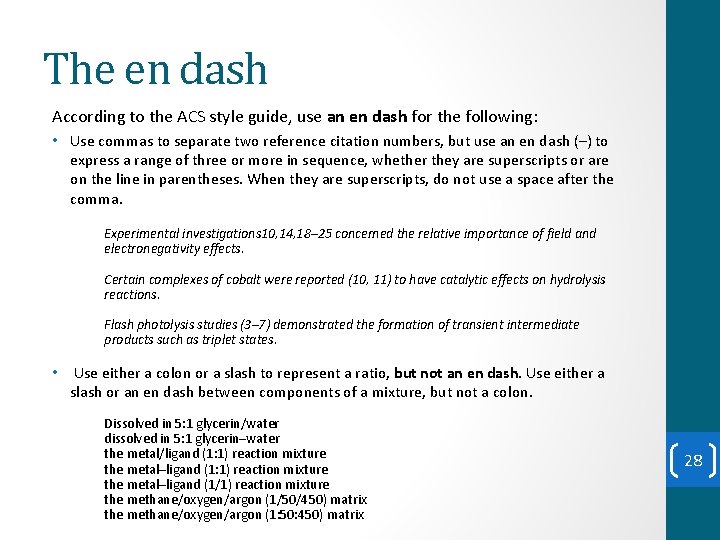
The en dash According to the ACS style guide, use an en dash for the following: • Use commas to separate two reference citation numbers, but use an en dash (–) to express a range of three or more in sequence, whether they are superscripts or are on the line in parentheses. When they are superscripts, do not use a space after the comma. Experimental investigations 10, 14, 18– 25 concerned the relative importance of field and electronegativity effects. Certain complexes of cobalt were reported (10, 11) to have catalytic effects on hydrolysis reactions. Flash photolysis studies (3– 7) demonstrated the formation of transient intermediate products such as triplet states. • Use either a colon or a slash to represent a ratio, but not an en dash. Use either a slash or an en dash between components of a mixture, but not a colon. Dissolved in 5: 1 glycerin/water dissolved in 5: 1 glycerin–water the metal/ligand (1: 1) reaction mixture the metal–ligand (1/1) reaction mixture the methane/oxygen/argon (1/50/450) matrix the methane/oxygen/argon (1: 50: 450) matrix 28
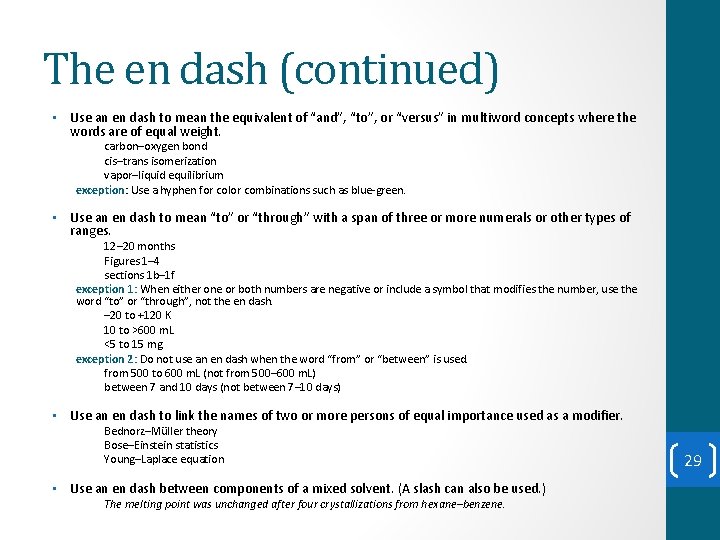
The en dash (continued) • Use an en dash to mean the equivalent of “and”, “to”, or “versus” in multiword concepts where the words are of equal weight. carbon–oxygen bond cis–trans isomerization vapor–liquid equilibrium exception: Use a hyphen for color combinations such as blue-green. • Use an en dash to mean “to” or “through” with a span of three or more numerals or other types of ranges. 12– 20 months Figures 1– 4 sections 1 b– 1 f exception 1: When either one or both numbers are negative or include a symbol that modifies the number, use the word “to” or “through”, not the en dash. – 20 to +120 K 10 to >600 m. L <5 to 15 mg exception 2: Do not use an en dash when the word “from” or “between” is used. from 500 to 600 m. L (not from 500– 600 m. L) between 7 and 10 days (not between 7– 10 days) • Use an en dash to link the names of two or more persons of equal importance used as a modifier. Bednorz–Müller theory Bose–Einstein statistics Young–Laplace equation • Use an en dash between components of a mixed solvent. (A slash can also be used. ) The melting point was unchanged after four crystallizations from hexane–benzene. 29
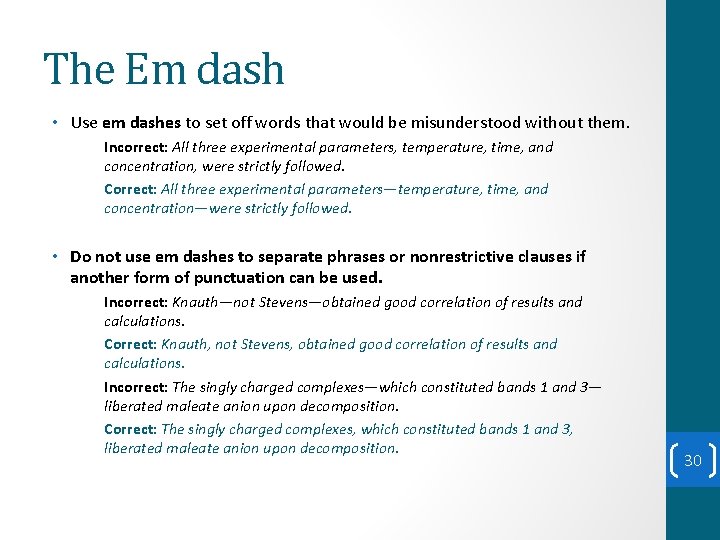
The Em dash • Use em dashes to set off words that would be misunderstood without them. Incorrect: All three experimental parameters, temperature, time, and concentration, were strictly followed. Correct: All three experimental parameters—temperature, time, and concentration—were strictly followed. • Do not use em dashes to separate phrases or nonrestrictive clauses if another form of punctuation can be used. Incorrect: Knauth—not Stevens—obtained good correlation of results and calculations. Correct: Knauth, not Stevens, obtained good correlation of results and calculations. Incorrect: The singly charged complexes—which constituted bands 1 and 3— liberated maleate anion upon decomposition. Correct: The singly charged complexes, which constituted bands 1 and 3, liberated maleate anion upon decomposition. 30
References 1. 2. Truss, Lynne. Eats, shoots & leaves: The zero tolerance approach to punctuation. Penguin, 2004. Coghill, A. M. ; Garson, L. R. , The ACS Style Guide. American Chemical Society: 2006. 31
Writing Style and Word Usage Drew Gorman July 27, 2016 32
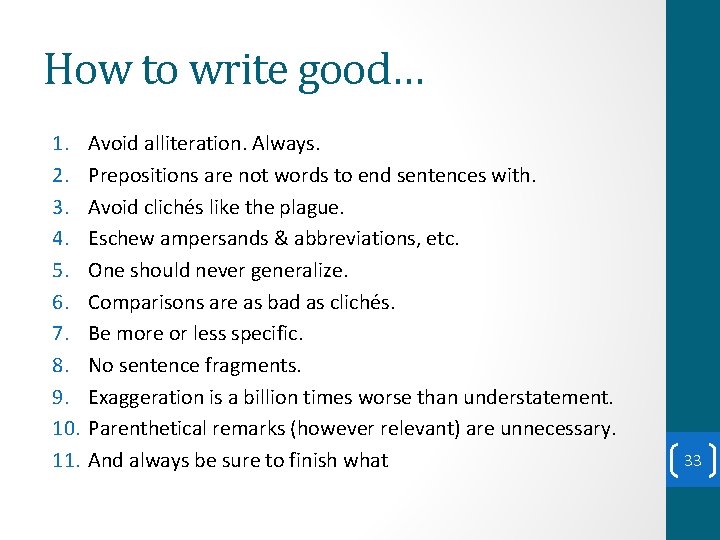
How to write good… 1. 2. 3. 4. 5. 6. 7. 8. 9. 10. 11. Avoid alliteration. Always. Prepositions are not words to end sentences with. Avoid clichés like the plague. Eschew ampersands & abbreviations, etc. One should never generalize. Comparisons are as bad as clichés. Be more or less specific. No sentence fragments. Exaggeration is a billion times worse than understatement. Parenthetical remarks (however relevant) are unnecessary. And always be sure to finish what 33
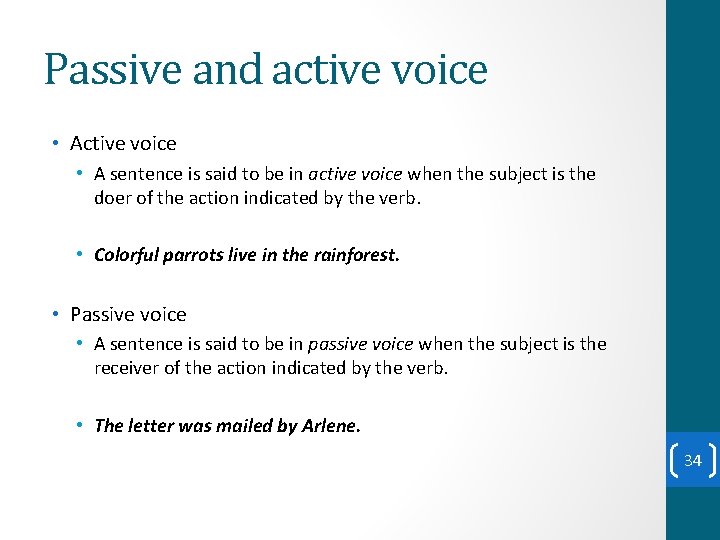
Passive and active voice • A sentence is said to be in active voice when the subject is the doer of the action indicated by the verb. • Colorful parrots live in the rainforest. • Passive voice • A sentence is said to be in passive voice when the subject is the receiver of the action indicated by the verb. • The letter was mailed by Arlene. 34
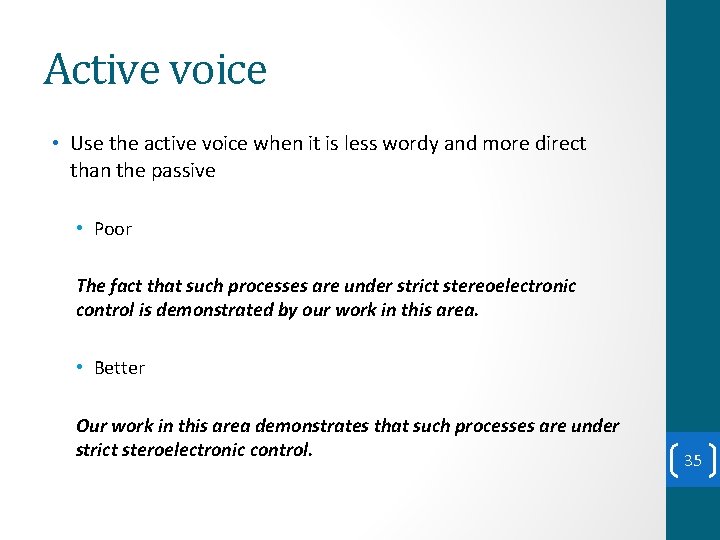
Active voice • Use the active voice when it is less wordy and more direct than the passive • Poor The fact that such processes are under strict stereoelectronic control is demonstrated by our work in this area. • Better Our work in this area demonstrates that such processes are under strict steroelectronic control. 35
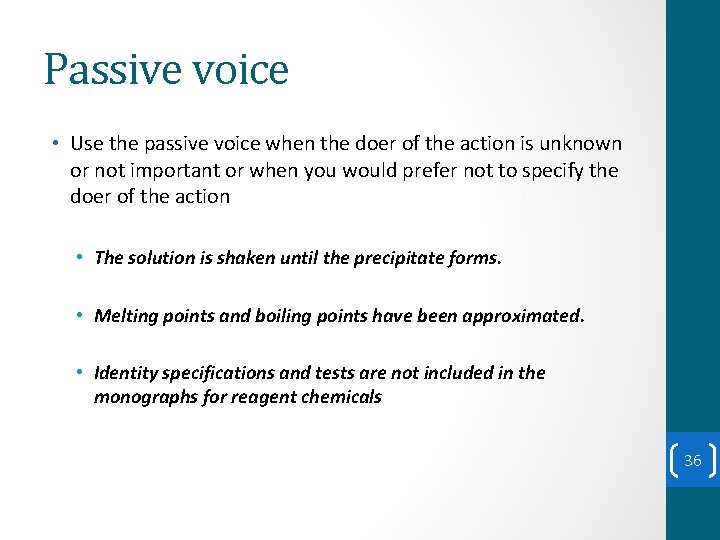
Passive voice • Use the passive voice when the doer of the action is unknown or not important or when you would prefer not to specify the doer of the action • The solution is shaken until the precipitate forms. • Melting points and boiling points have been approximated. • Identity specifications and tests are not included in the monographs for reagent chemicals 36
Past tense • Simple past tense is correct for stating what was done, either by others or by you. • The solutions were heated to boiling. • Jones reviewed the literature and gathered much of the this information. • We found that relativistic effects enhance the bond strength. 37
Present tense • Present tense is correct for statements of facts. . • Absolute rate constants for a wide variety of reactions are available. • Hyperbranched compounds are macromolecular compounds that contain a branching point in each structural repeat unit. 38
Past and present tense • Present and simple past tenses may both be correct for results, discussion and conclusions. • The use of present or simple past tense for results, discussion, and conclusions should be consistent within a paper. 39
Use of “a” and “an” • Choose the articles “a” and “an” according to the pronunciation of the words or abbreviations they precede. a nuclear magnetic resonance spectrometer An NMR spectrometer • Use “a” before an aspirated “h”; use “an” before the vowel sounds of a, e, I, o, “soft”, or “short” u, and y. a house, a history (BUT an hour, an hour) a union, a U-14 C (BUT an ultimate) a yard (BUT an ylide, an yttrium compound) 40
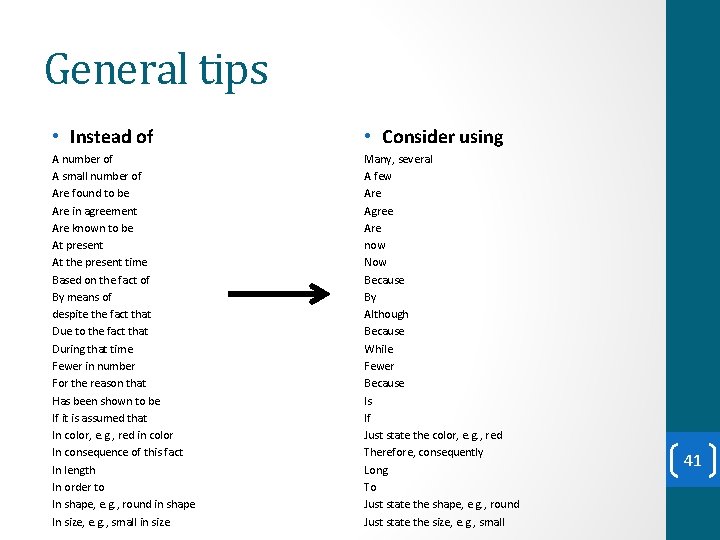
General tips • Instead of • Consider using A number of A small number of Are found to be Are in agreement Are known to be At present At the present time Based on the fact of By means of despite the fact that Due to the fact that During that time Fewer in number For the reason that Has been shown to be If it is assumed that In color, e. g. , red in color In consequence of this fact In length In order to In shape, e. g. , round in shape In size, e. g. , small in size Many, several A few Are Agree Are now Now Because By Although Because While Fewer Because Is If Just state the color, e. g. , red Therefore, consequently Long To Just state the shape, e. g. , round Just state the size, e. g. , small 41
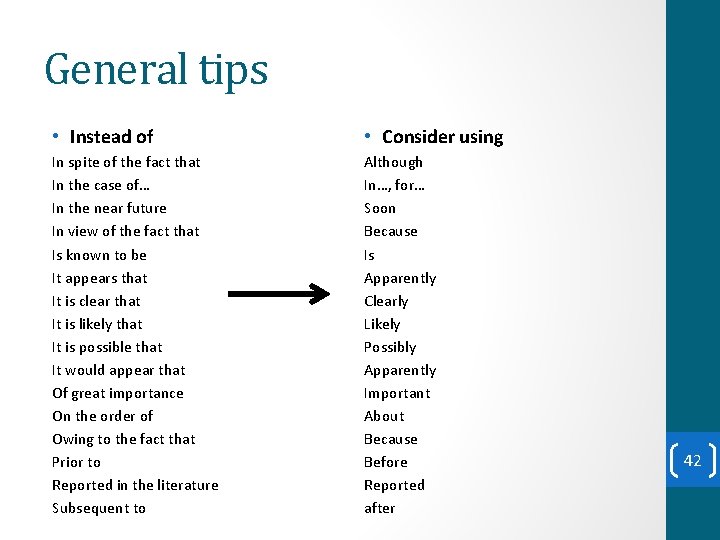
General tips • Instead of • Consider using In spite of the fact that In the case of… In the near future In view of the fact that Is known to be It appears that It is clear that It is likely that It is possible that It would appear that Of great importance On the order of Owing to the fact that Prior to Reported in the literature Subsequent to Although In…, for… Soon Because Is Apparently Clearly Likely Possibly Apparently Important About Because Before Reported after 42
The ACS Stylish Guide Chapter 7 Copyright Basics Russo Group Meeting Speaker 2 Paul Balding 10 th August 2016 43
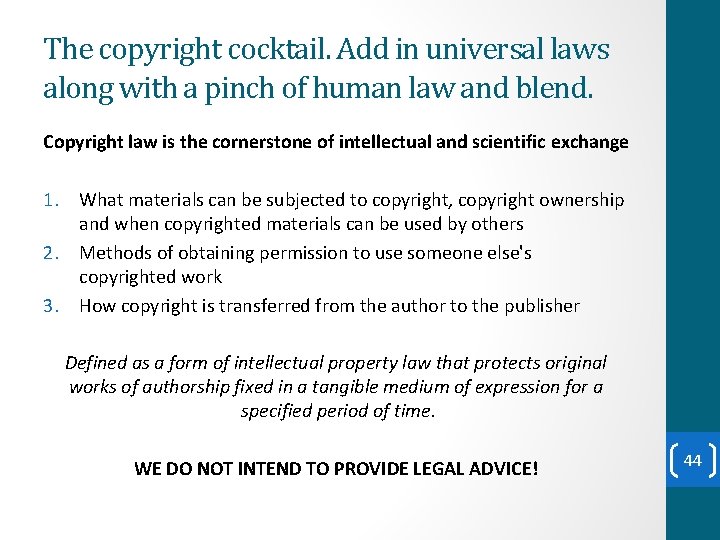
The copyright cocktail. Add in universal laws along with a pinch of human law and blend. Copyright law is the cornerstone of intellectual and scientific exchange 1. What materials can be subjected to copyright, copyright ownership and when copyrighted materials can be used by others 2. Methods of obtaining permission to use someone else's copyrighted work 3. How copyright is transferred from the author to the publisher Defined as a form of intellectual property law that protects original works of authorship fixed in a tangible medium of expression for a specified period of time. WE DO NOT INTEND TO PROVIDE LEGAL ADVICE! 44
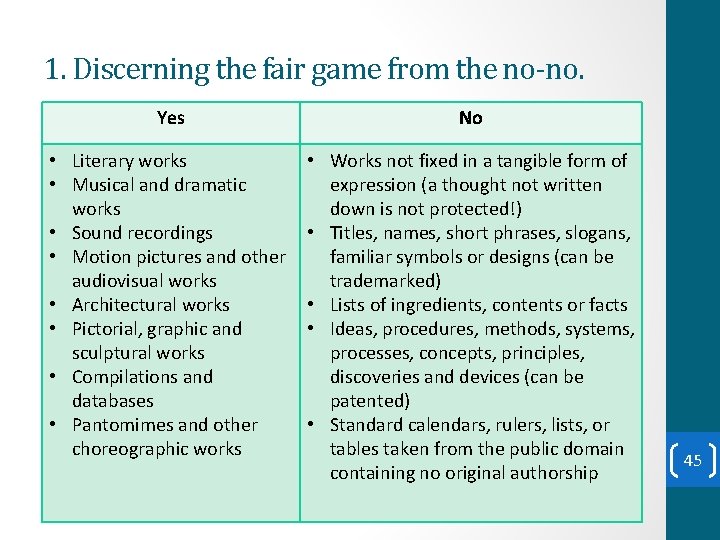
1. Discerning the fair game from the no-no. Yes No • Literary works • Musical and dramatic works • Sound recordings • Motion pictures and other audiovisual works • Architectural works • Pictorial, graphic and sculptural works • Compilations and databases • Pantomimes and other choreographic works • Works not fixed in a tangible form of expression (a thought not written down is not protected!) • Titles, names, short phrases, slogans, familiar symbols or designs (can be trademarked) • Lists of ingredients, contents or facts • Ideas, procedures, methods, systems, processes, concepts, principles, discoveries and devices (can be patented) • Standard calendars, rulers, lists, or tables taken from the public domain containing no original authorship 45
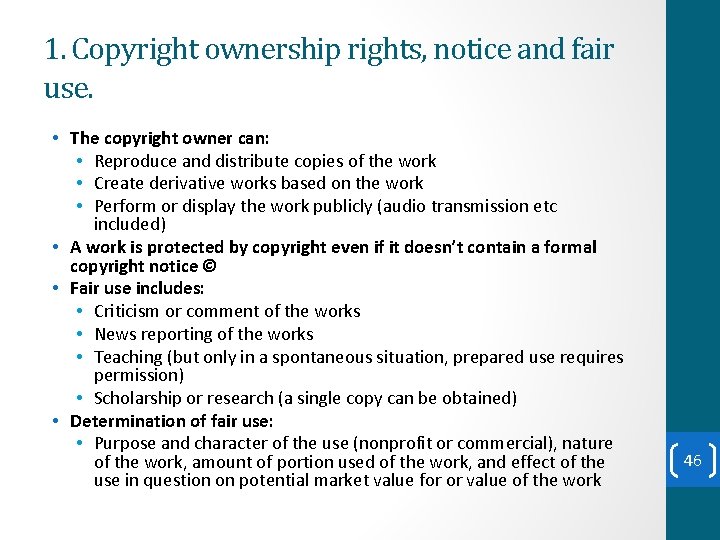
1. Copyright ownership rights, notice and fair use. • The copyright owner can: • Reproduce and distribute copies of the work • Create derivative works based on the work • Perform or display the work publicly (audio transmission etc included) • A work is protected by copyright even if it doesn’t contain a formal copyright notice © • Fair use includes: • Criticism or comment of the works • News reporting of the works • Teaching (but only in a spontaneous situation, prepared use requires permission) • Scholarship or research (a single copy can be obtained) • Determination of fair use: • Purpose and character of the use (nonprofit or commercial), nature of the work, amount of portion used of the work, and effect of the use in question on potential market value for or value of the work 46
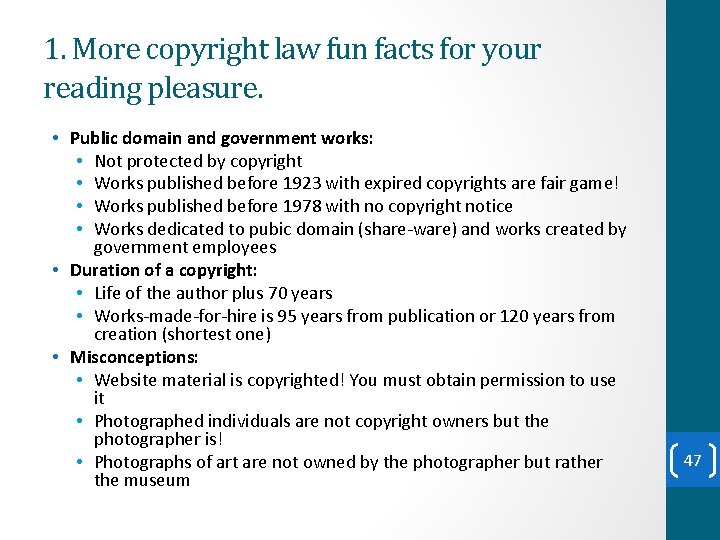
1. More copyright law fun facts for your reading pleasure. • Public domain and government works: • Not protected by copyright • Works published before 1923 with expired copyrights are fair game! • Works published before 1978 with no copyright notice • Works dedicated to pubic domain (share-ware) and works created by government employees • Duration of a copyright: • Life of the author plus 70 years • Works-made-for-hire is 95 years from publication or 120 years from creation (shortest one) • Misconceptions: • Website material is copyrighted! You must obtain permission to use it • Photographed individuals are not copyright owners but the photographer is! • Photographs of art are not owned by the photographer but rather the museum 47
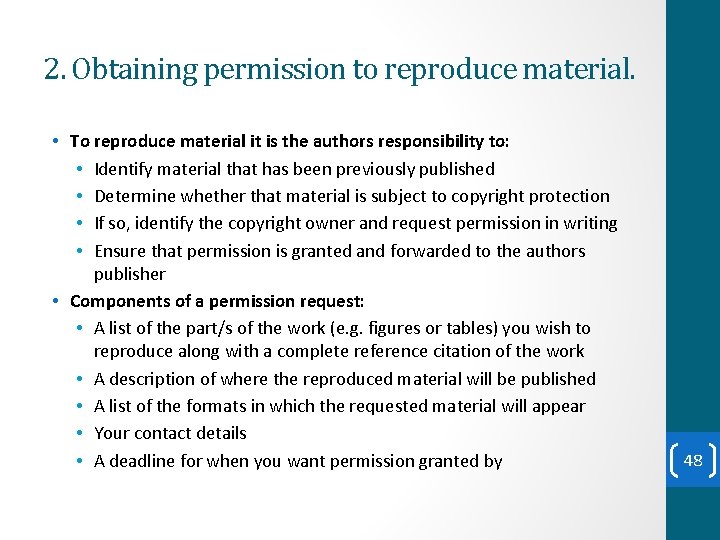
2. Obtaining permission to reproduce material. • To reproduce material it is the authors responsibility to: • Identify material that has been previously published • Determine whether that material is subject to copyright protection • If so, identify the copyright owner and request permission in writing • Ensure that permission is granted and forwarded to the authors publisher • Components of a permission request: • A list of the part/s of the work (e. g. figures or tables) you wish to reproduce along with a complete reference citation of the work • A description of where the reproduced material will be published • A list of the formats in which the requested material will appear • Your contact details • A deadline for when you want permission granted by 48
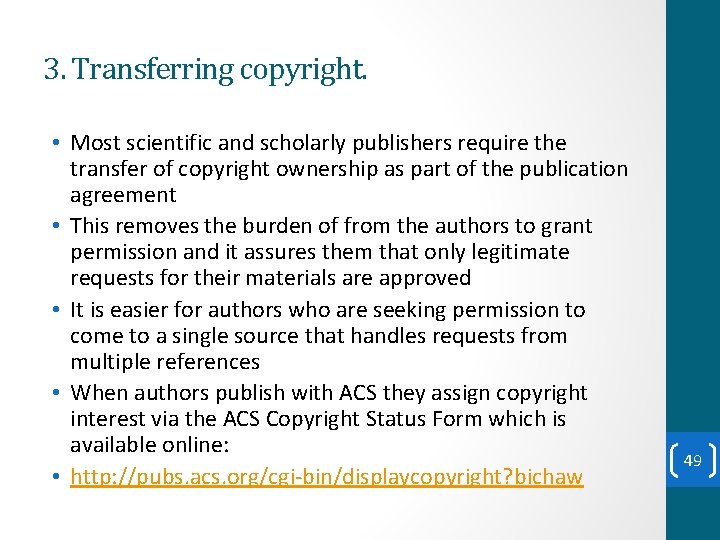
3. Transferring copyright. • Most scientific and scholarly publishers require the transfer of copyright ownership as part of the publication agreement • This removes the burden of from the authors to grant permission and it assures them that only legitimate requests for their materials are approved • It is easier for authors who are seeking permission to come to a single source that handles requests from multiple references • When authors publish with ACS they assign copyright interest via the ACS Copyright Status Form which is available online: • http: //pubs. acs. org/cgi-bin/displaycopyright? bichaw 49
Numbers, Mathematics, and Units of Measure Alyssa Blake July 20, 2016 ACS Style Guide 50
Contents of the ACS style guide Part 1. Scientific Communication 1. Ethics in Scientific Communication 2. Scientific Papers 3. The Editorial Process 4. Writing Style and Word Usage 5. Electronic Submission of Manuscripts Using Web-Based Systems 6. Peer Review 7. Copyright Basics 8. Markup Languages and the Datument Part 2. Style Guidelines 9. Grammar, Punctuation, and Spelling 10. Editorial Style 11. Numbers, Mathematics, and Units of Measure 12. Names and Numbers for Chemical Compounds 13. Conventions in Chemistry 51
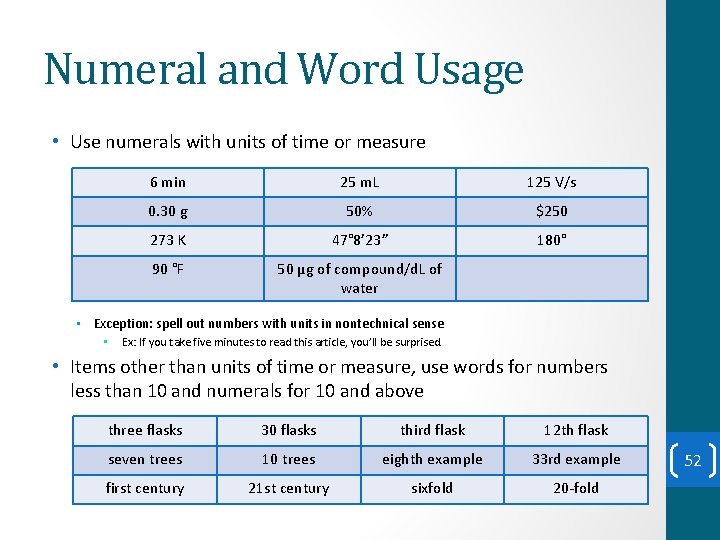
Numeral and Word Usage • Use numerals with units of time or measure 6 min 25 m. L 125 V/s 0. 30 g 50% $250 273 K 47° 8’ 23” 180° 90 °F 50 μg of compound/d. L of water • Exception: spell out numbers with units in nontechnical sense • Ex: If you take five minutes to read this article, you’ll be surprised. • Items other than units of time or measure, use words for numbers less than 10 and numerals for 10 and above three flasks 30 flasks third flask 12 th flask seven trees 10 trees eighth example 33 rd example first century 21 st century sixfold 20 -fold 52
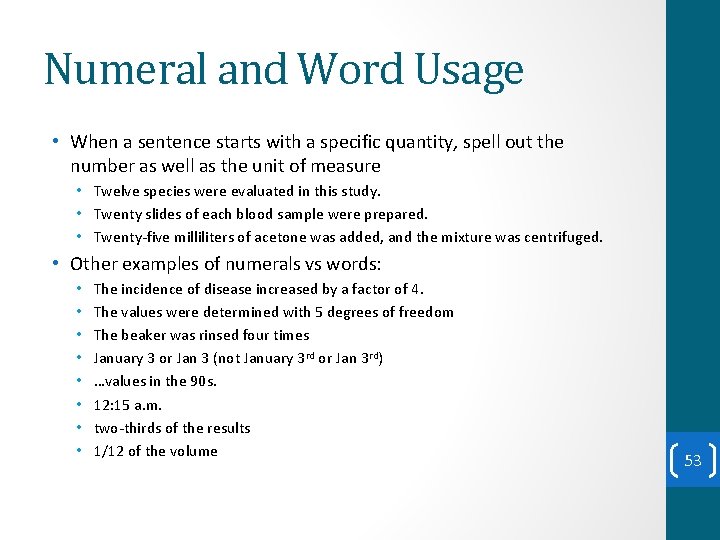
Numeral and Word Usage • When a sentence starts with a specific quantity, spell out the number as well as the unit of measure • Twelve species were evaluated in this study. • Twenty slides of each blood sample were prepared. • Twenty-five milliliters of acetone was added, and the mixture was centrifuged. • Other examples of numerals vs words: • • The incidence of disease increased by a factor of 4. The values were determined with 5 degrees of freedom The beaker was rinsed four times January 3 or Jan 3 (not January 3 rd or Jan 3 rd) …values in the 90 s. 12: 15 a. m. two-thirds of the results 1/12 of the volume 53
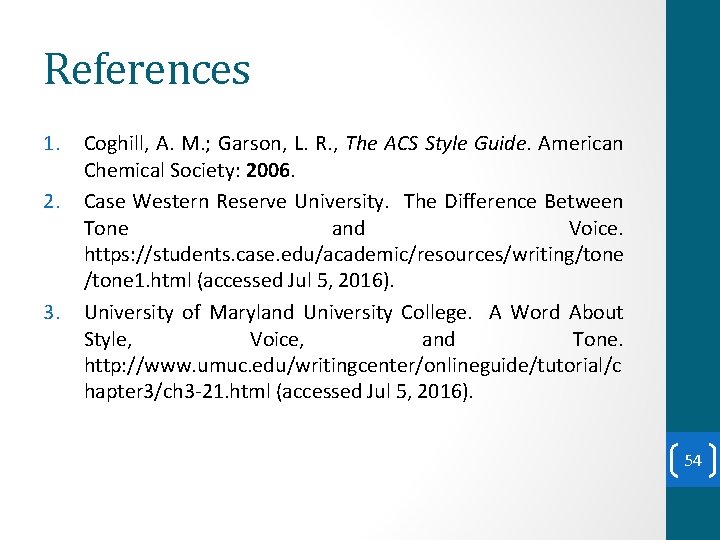
References 1. 2. 3. Coghill, A. M. ; Garson, L. R. , The ACS Style Guide. American Chemical Society: 2006. Case Western Reserve University. The Difference Between Tone and Voice. https: //students. case. edu/academic/resources/writing/tone 1. html (accessed Jul 5, 2016). University of Maryland University College. A Word About Style, Voice, and Tone. http: //www. umuc. edu/writingcenter/onlineguide/tutorial/c hapter 3/ch 3 -21. html (accessed Jul 5, 2016). 54