
Writing Style and Standards Use Clarity Conciseness Coherence
- Slides: 29
Writing Style and Standards Use Clarity, Conciseness, & Coherence § Paragraph Construction § Sentence Construction § Word Choice
Write Paragraphs That Are: l l l Clear – easy to follow, easy to understand; use transitions Concise – avoid inessential information Coherent – begin with a main idea supported, explained, and developed by the rest of the paragraph
CLARITY e. g. Each country has their own custom that can be mistaken for the others.
Write Sentences That Are: l Clear – easy to follow, easy to understand; use subject/verb/predicate order l Concise – avoid inessential information, subordinate clauses, or complex construction l Coherent – state the main idea first, use one idea at a time
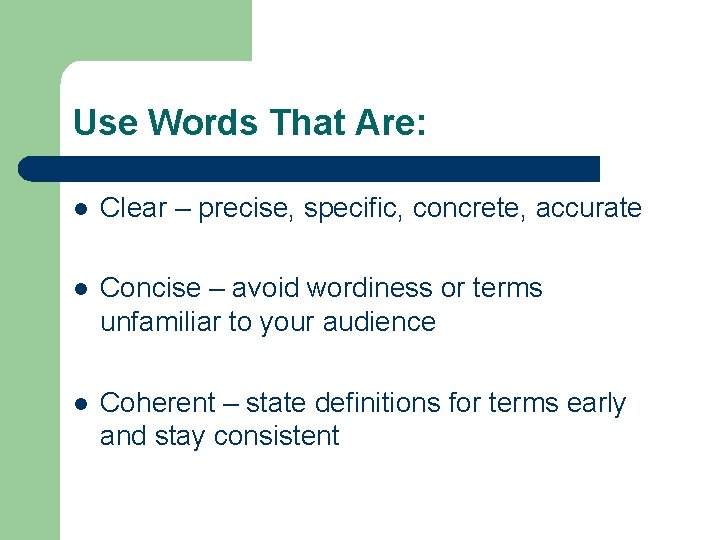
Use Words That Are: l Clear – precise, specific, concrete, accurate l Concise – avoid wordiness or terms unfamiliar to your audience l Coherent – state definitions for terms early and stay consistent
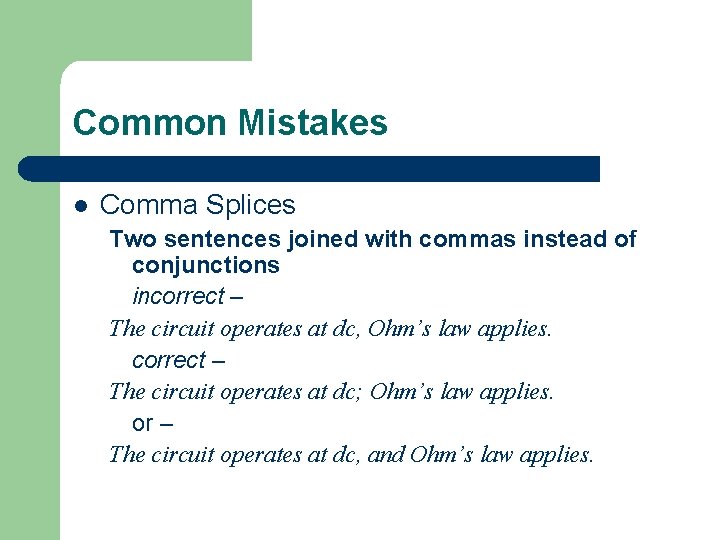
Common Mistakes l Comma Splices Two sentences joined with commas instead of conjunctions incorrect – The circuit operates at dc, Ohm’s law applies. correct – The circuit operates at dc; Ohm’s law applies. or – The circuit operates at dc, and Ohm’s law applies.
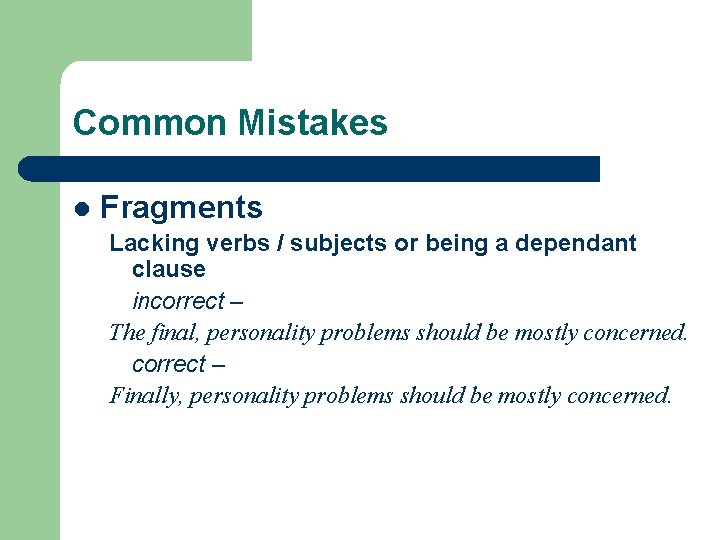
Common Mistakes l Fragments Lacking verbs / subjects or being a dependant clause incorrect – The final, personality problems should be mostly concerned. correct – Finally, personality problems should be mostly concerned.
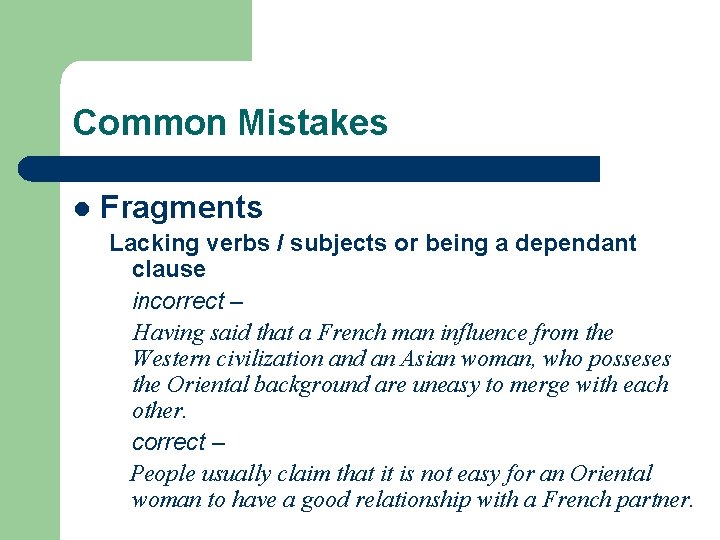
Common Mistakes l Fragments Lacking verbs / subjects or being a dependant clause incorrect – Having said that a French man influence from the Western civilization and an Asian woman, who posseses the Oriental background are uneasy to merge with each other. correct – People usually claim that it is not easy for an Oriental woman to have a good relationship with a French partner.
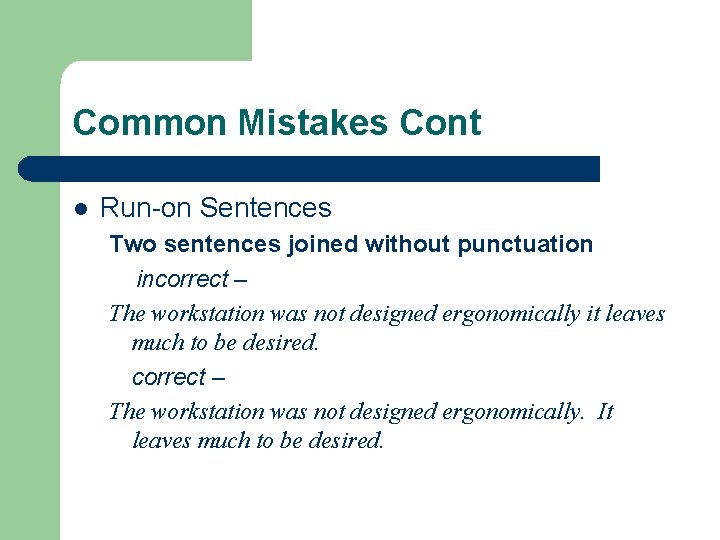
Common Mistakes Cont l Run-on Sentences Two sentences joined without punctuation incorrect – The workstation was not designed ergonomically it leaves much to be desired. correct – The workstation was not designed ergonomically. It leaves much to be desired.
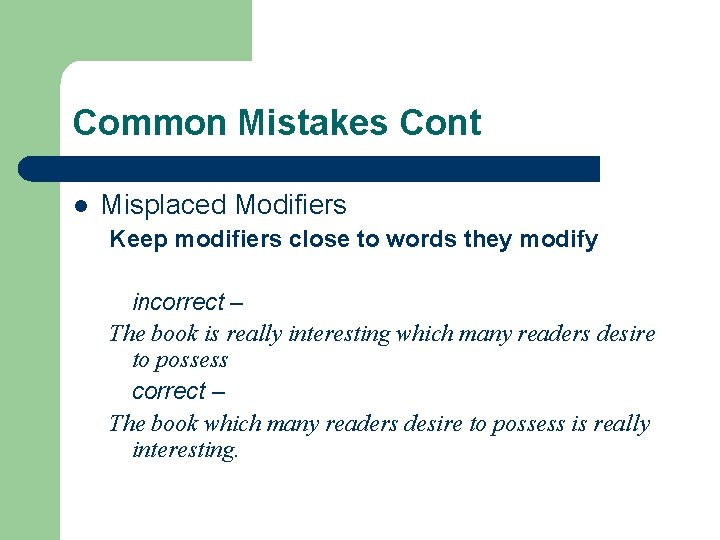
Common Mistakes Cont l Misplaced Modifiers Keep modifiers close to words they modify incorrect – The book is really interesting which many readers desire to possess correct – The book which many readers desire to possess is really interesting.
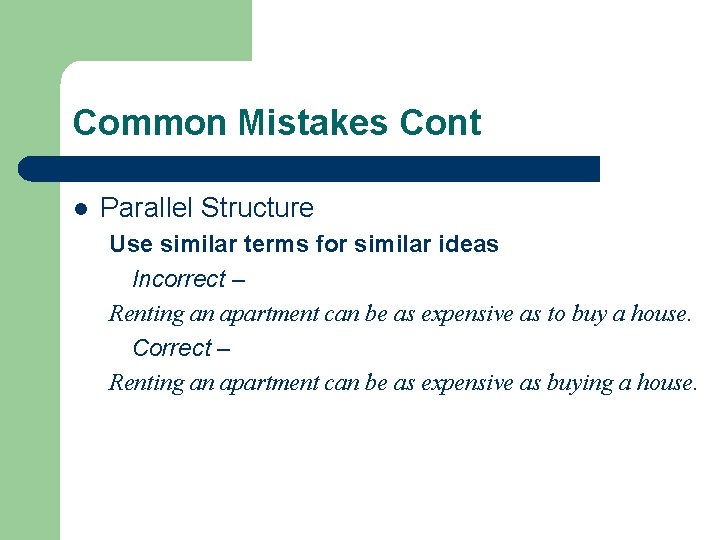
Common Mistakes Cont l Parallel Structure Use similar terms for similar ideas Incorrect – Renting an apartment can be as expensive as to buy a house. Correct – Renting an apartment can be as expensive as buying a house.
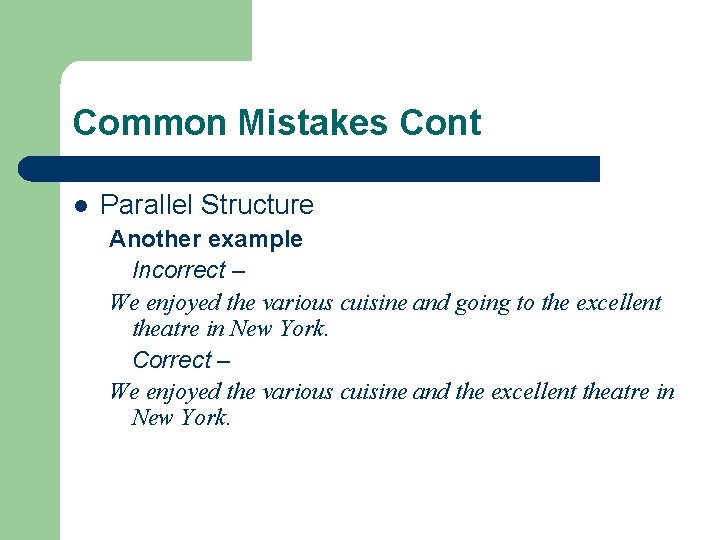
Common Mistakes Cont l Parallel Structure Another example Incorrect – We enjoyed the various cuisine and going to the excellent theatre in New York. Correct – We enjoyed the various cuisine and the excellent theatre in New York.
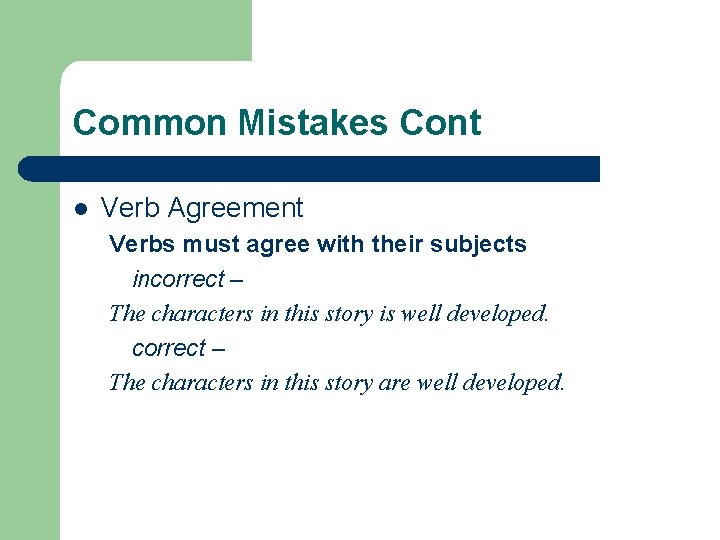
Common Mistakes Cont l Verb Agreement Verbs must agree with their subjects incorrect – The characters in this story is well developed. correct – The characters in this story are well developed.
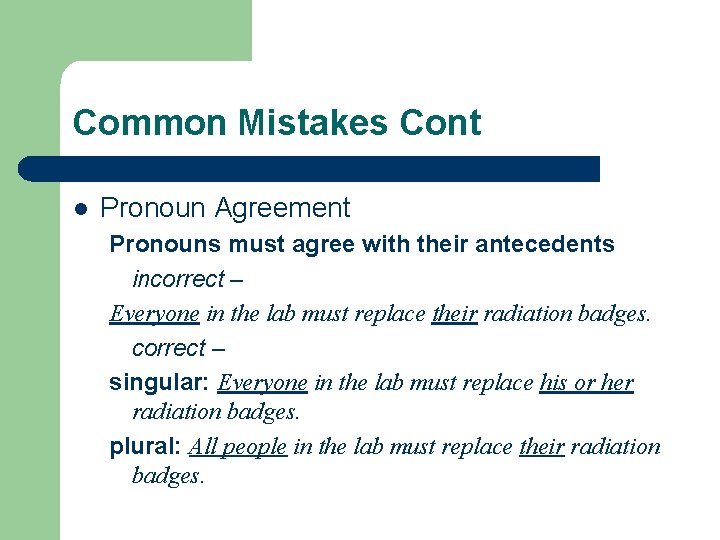
Common Mistakes Cont l Pronoun Agreement Pronouns must agree with their antecedents incorrect – Everyone in the lab must replace their radiation badges. correct – singular: Everyone in the lab must replace his or her radiation badges. plural: All people in the lab must replace their radiation badges.
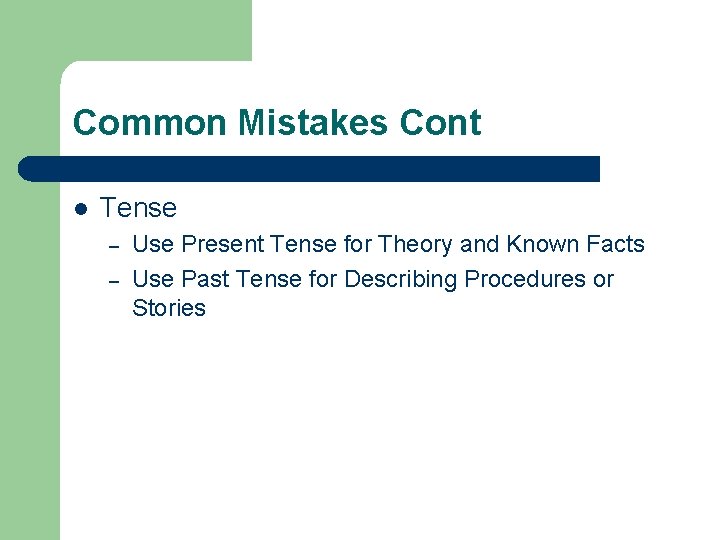
Common Mistakes Cont l Tense – – Use Present Tense for Theory and Known Facts Use Past Tense for Describing Procedures or Stories
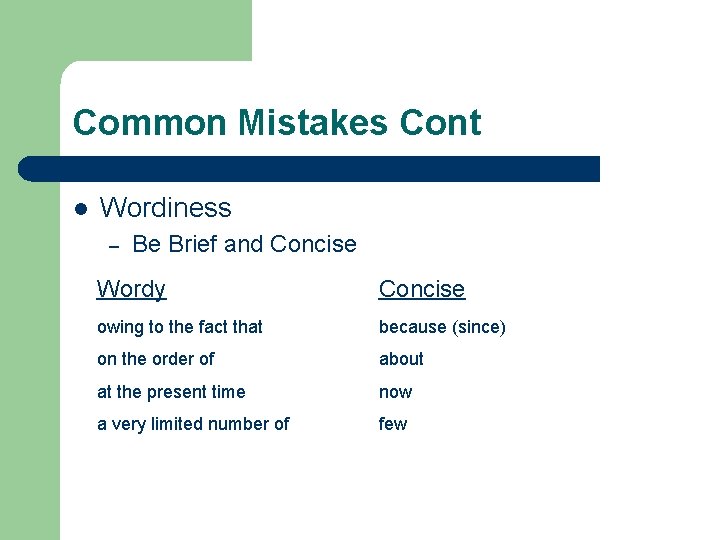
Common Mistakes Cont l Wordiness – Be Brief and Concise Wordy Concise owing to the fact that because (since) on the order of about at the present time now a very limited number of few
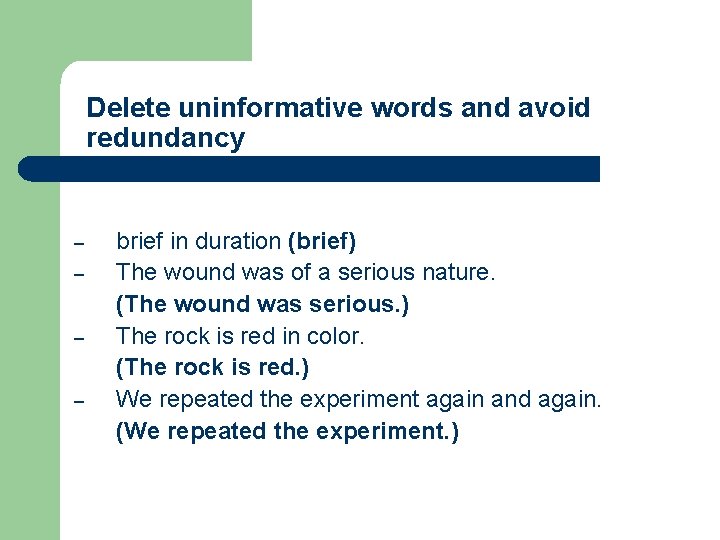
Delete uninformative words and avoid redundancy – – brief in duration (brief) The wound was of a serious nature. (The wound was serious. ) The rock is red in color. (The rock is red. ) We repeated the experiment again and again. (We repeated the experiment. )
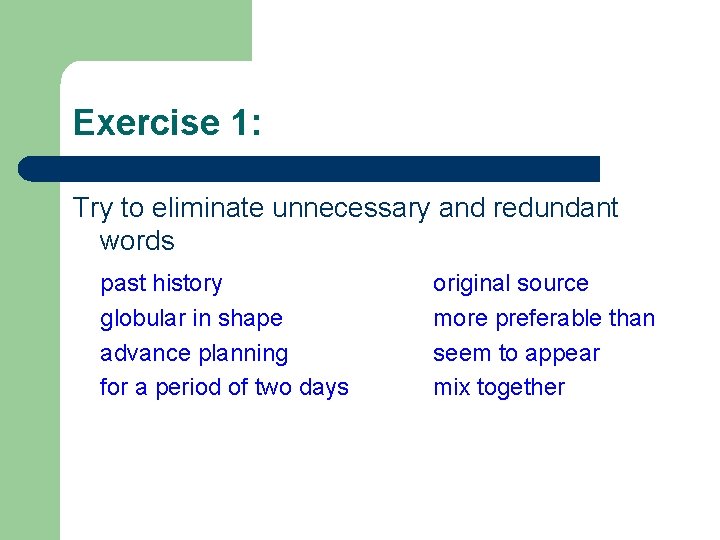
Exercise 1: Try to eliminate unnecessary and redundant words past history globular in shape advance planning for a period of two days original source more preferable than seem to appear mix together
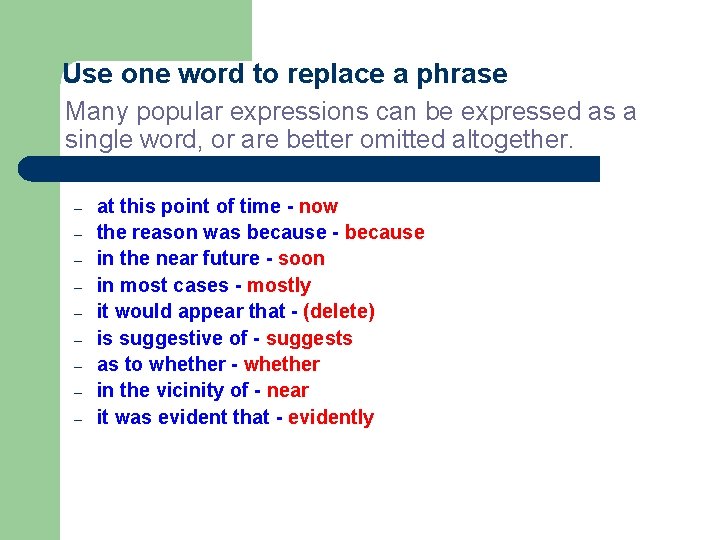
Use one word to replace a phrase Many popular expressions can be expressed as a single word, or are better omitted altogether. – – – – – at this point of time - now the reason was because - because in the near future - soon in most cases - mostly it would appear that - (delete) is suggestive of - suggests as to whether - whether in the vicinity of - near it was evident that - evidently
Avoid clichés and euphemisms – Clichés and euphemisms are rarely helpful and often cryptic (secret, with a hidden meaning or a meaning not easily seen).
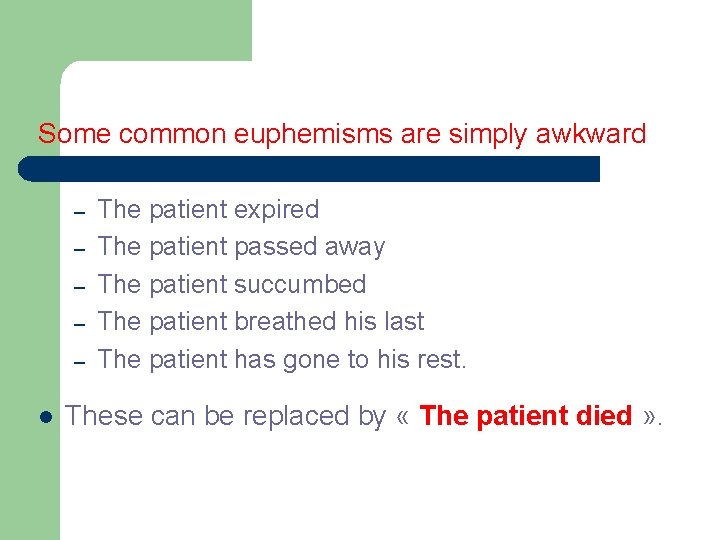
Some common euphemisms are simply awkward – – – l The patient expired The patient passed away The patient succumbed The patient breathed his last The patient has gone to his rest. These can be replaced by « The patient died » .
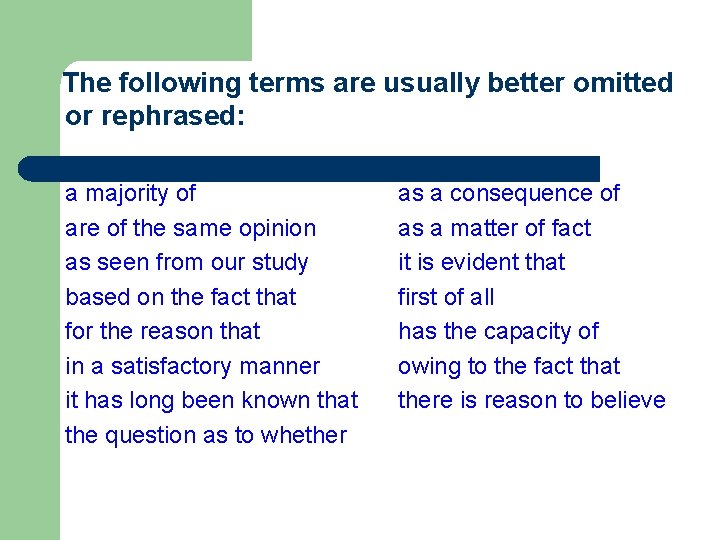
The following terms are usually better omitted or rephrased: a majority of are of the same opinion as seen from our study based on the fact that for the reason that in a satisfactory manner it has long been known that the question as to whether as a consequence of as a matter of fact it is evident that first of all has the capacity of owing to the fact that there is reason to believe
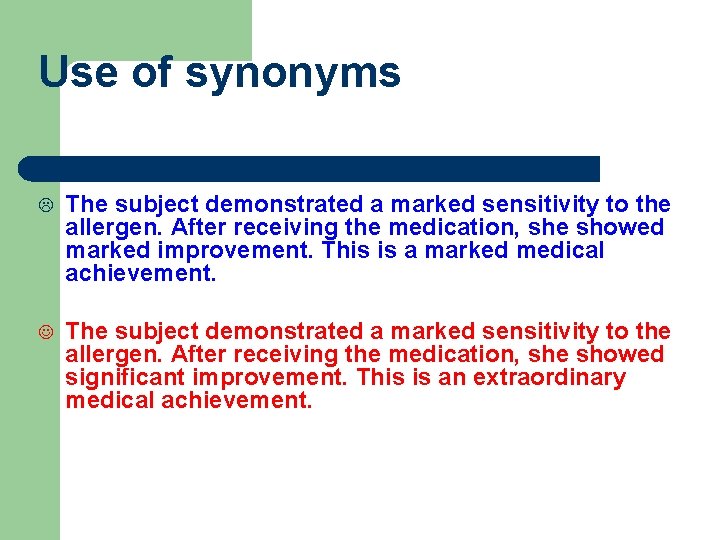
Use of synonyms L The subject demonstrated a marked sensitivity to the allergen. After receiving the medication, she showed marked improvement. This is a marked medical achievement. J The subject demonstrated a marked sensitivity to the allergen. After receiving the medication, she showed significant improvement. This is an extraordinary medical achievement.
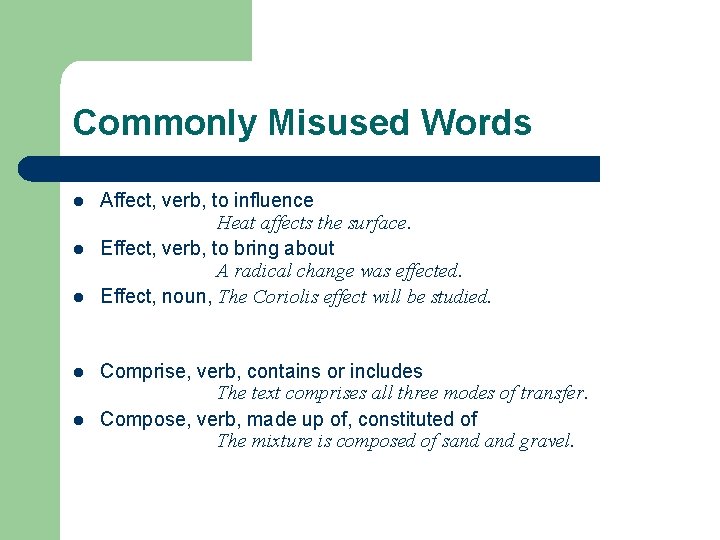
Commonly Misused Words l l l Affect, verb, to influence Heat affects the surface. Effect, verb, to bring about A radical change was effected. Effect, noun, The Coriolis effect will be studied. Comprise, verb, contains or includes The text comprises all three modes of transfer. Compose, verb, made up of, constituted of The mixture is composed of sand gravel.
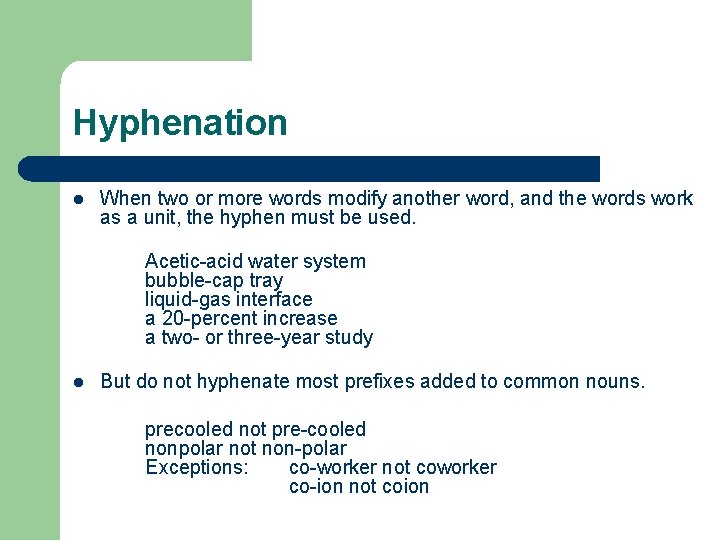
Hyphenation l When two or more words modify another word, and the words work as a unit, the hyphen must be used. Acetic-acid water system bubble-cap tray liquid-gas interface a 20 -percent increase a two- or three-year study l But do not hyphenate most prefixes added to common nouns. precooled not pre-cooled nonpolar not non-polar Exceptions: co-worker not coworker co-ion not coion
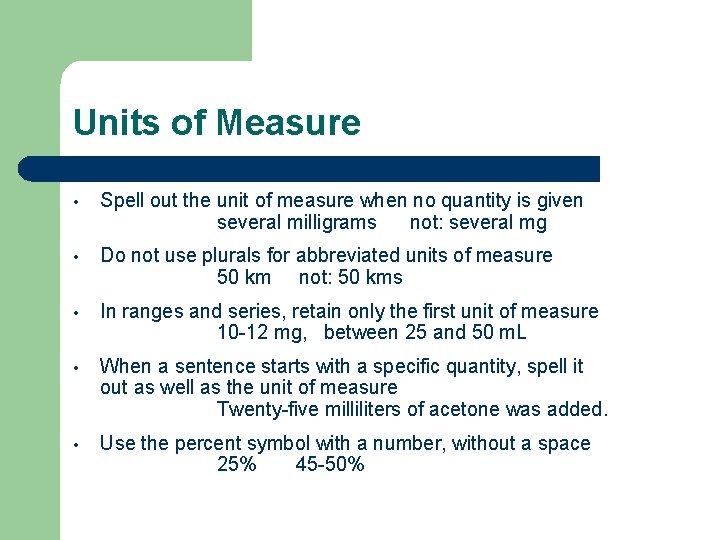
Units of Measure • Spell out the unit of measure when no quantity is given several milligrams not: several mg • Do not use plurals for abbreviated units of measure 50 km not: 50 kms • In ranges and series, retain only the first unit of measure 10 -12 mg, between 25 and 50 m. L • When a sentence starts with a specific quantity, spell it out as well as the unit of measure Twenty-five milliliters of acetone was added. • Use the percent symbol with a number, without a space 25% 45 -50%
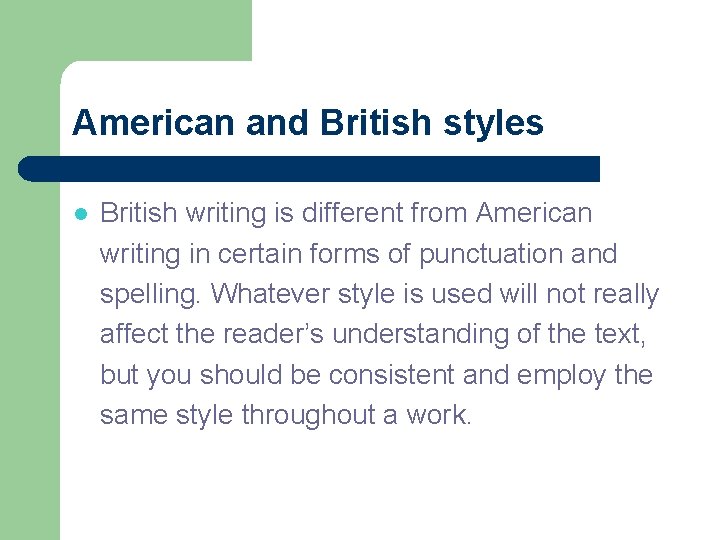
American and British styles l British writing is different from American writing in certain forms of punctuation and spelling. Whatever style is used will not really affect the reader’s understanding of the text, but you should be consistent and employ the same style throughout a work.
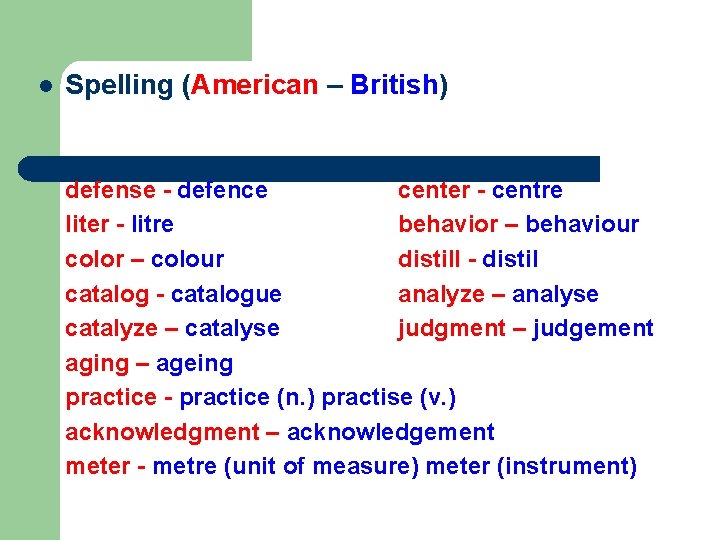
l Spelling (American – British) defense - defence center - centre liter - litre behavior – behaviour color – colour distill - distil catalog - catalogue analyze – analyse catalyze – catalyse judgment – judgement aging – ageing practice - practice (n. ) practise (v. ) acknowledgment – acknowledgement meter - metre (unit of measure) meter (instrument)
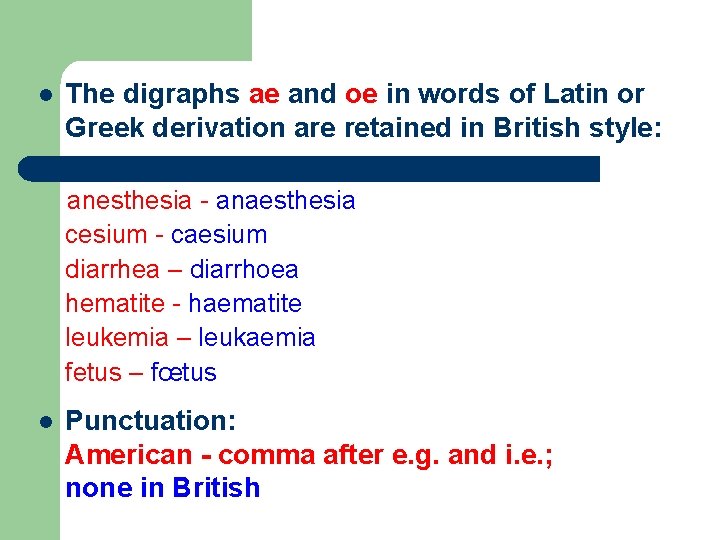
l The digraphs ae and oe in words of Latin or Greek derivation are retained in British style: anesthesia - anaesthesia cesium - caesium diarrhea – diarrhoea hematite - haematite leukemia – leukaemia fetus – fœtus l Punctuation: American - comma after e. g. and i. e. ; none in British