
WRITING STRENGTH BASED ASSESSMENT PERSON CENTERED SUPPORT PLANS
WRITING STRENGTH BASED ASSESSMENT & PERSON CENTERED SUPPORT PLANS Aleister Griffin and Alice Carmichael - Consultant Social Workers within Hackney Adult Social Care
Aims and Objectives ● Increase practitioners knowledge of what a strength based approach actually means. ● To explore what a strengths based approach is, in the context of adult social care? ● To develop further understanding of how a strengths based approach relates to adult social care law. ● Consider what makes a good assessment and support plan. ● To increase awareness of models for strength based working.
What is strengths based practice in social care? ● ● ● Strengths-based practice is holistic and multidisciplinary and works with individuals to promote their wellbeing. Strengths-based (or asset-based) approaches focus on individuals’ strengths. This includes personal strengths, social and community networks. The focus is on what people can do, not what they cannot do. It is outcome led and not service led. Strength-based practice is a collaborative process between the service user and those supporting them. When using a strengths-based approach, risk is looked at as an enabler, not as a barrier. Risks should be explored with the individual and from their point of view. The role of the professional is not solely to ‘reduce risks’ but to support the individual in managing risks. https: //assets. publishing. service. gov. uk/government/uploads/system/uploads/attachment_data/file/778134/stengths-based-approachpractice-framework-and-handbook. pdf
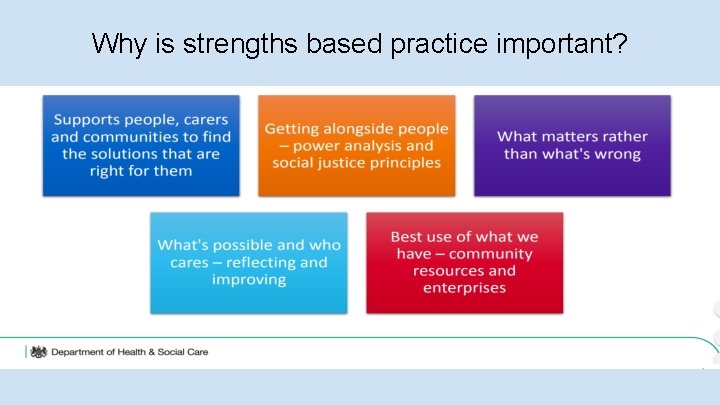
Why is strengths based practice important?
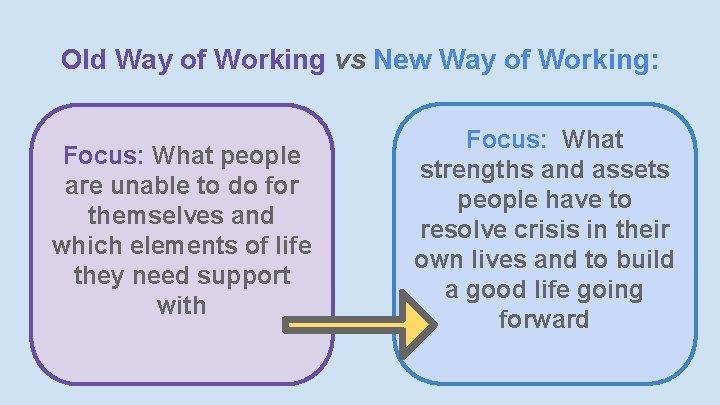
Old Way of Working vs New Way of Working: Focus: What people are unable to do for themselves and which elements of life they need support with Focus: What strengths and assets people have to resolve crisis in their own lives and to build a good life going forward
A message from the chief social worker for adults ‘Excellent social work is about emphasising the use of professional engagement and judgement, as opposed to procedural approaches, with a focus on the individual, taking a holistic and co-productive approach to keeping the person at the centre of all decisions, identifying what matters to them and how best outcomes can be achieved. It is about enabling people to find the best solutions for themselves, to support them in making independent decisions about how they live. I wholeheartedly believe in taking a strengths and asset based approach to supporting individuals and empower people to live the lives they want. ’ Lyn Romeo
Policy and law ● ● ● The Care Act 2014. Care and support statutory guidance Human Rights Act 1998 Mental Capacity Act 2005, enforced 2007. Safeguarding Policy and Procedure - ‘Making Safeguarding Personal’. Transforming Care for People with Learning Disabilities 2015. The Department of Health and Social Care have developed: ● A Strengths-based approach: Practice Framework and Practice Handbook, published 2019. This handbook shows what strength based practice is and how it fits with law. https: //assets. publishing. service. gov. uk/government/uploads/system/uploads/attachment_data/file/778134/stengths-based-approachpractice-framework-and-handbook. pdf
Key messages from the Care Act 2014 ● ● The Care Act 2014 requires local authorities to ‘consider the person’s own strengths and capabilities, and what support might be available from their wider support network or within the community to help’ in considering ‘what else other than the provision of care and support might assist the person in meeting the outcomes they want to achieve’. Local authorities should identify the individual’s strengths – personal, community and social networks – and maximise those strengths to enable them to achieve their desired outcomes, thereby meeting their needs and improving or maintaining their wellbeing. Any suggestion that support could be available from family and friends should be considered in the light of their appropriateness, willingness and ability to provide any additional support and the impact on them of doing so. This is also subject to the agreement of the adult or carer in question (see 6. 64 of the Care Act guidance). The objective of the strengths-based approach is to protect the individual’s independence, resilience, ability to make choices and wellbeing. Supporting the person’s strengths can help address needs (whether or not they are eligible) for support in a way that allows the person to lead, and be in control of, an ordinary and independent day-to-day life as much as possible. It may also help delay the development of further needs.
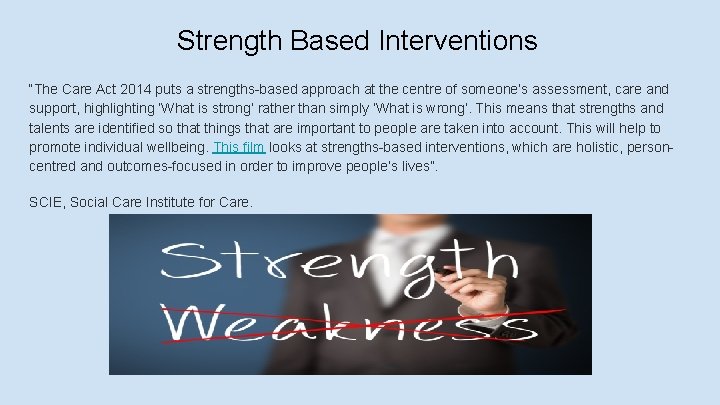
Strength Based Interventions “The Care Act 2014 puts a strengths-based approach at the centre of someone’s assessment, care and support, highlighting ‘What is strong’ rather than simply ‘What is wrong’. This means that strengths and talents are identified so that things that are important to people are taken into account. This will help to promote individual wellbeing. This film looks at strengths-based interventions, which are holistic, personcentred and outcomes-focused in order to improve people’s lives”. SCIE, Social Care Institute for Care.
Discussion time!
Preparing for an assessment ● ● ● ● Gather information and background on the individual’s circumstances. Determine, jointly with the individual, how the assessment will be conducted in terms of appropriateness and proportionality. Agree on who should contribute to the assessment other than the individual and how this will be done. The may need to take place over more than one "assessment visit or assessment meeting" What is the impact on the whole family? Should there be a carer’s assessment? What information and advice would be helpful? What preventative measures (to prevent, delay or reduce needs) will you consider? In preparing for the assessment, what additional issues or obstacles need to be considered (if any) – and how can they be dealt with? Ensure you have appropriate knowledge and expertise. If an assessment visit or meeting will take place: ● ● ● Has everybody who needs to be there been informed (i. e. care professionals, carers, other family members, friends, etc. )? Have they confirmed their attendance? Do you have all the information and paperwork you need? Have you done research on related community services and activities?
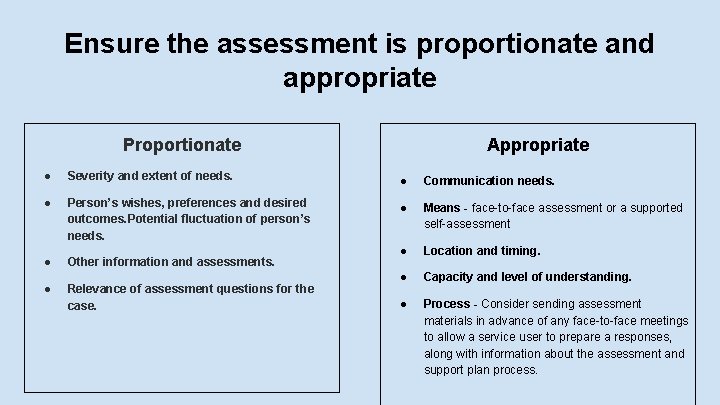
Ensure the assessment is proportionate and appropriate Appropriate Proportionate ● Severity and extent of needs. ● Communication needs. ● Person’s wishes, preferences and desired outcomes. Potential fluctuation of person’s needs. ● Means - face-to-face assessment or a supported self-assessment ● Other information and assessments. ● Location and timing. ● Relevance of assessment questions for the case. ● Capacity and level of understanding. ● Process - Consider sending assessment materials in advance of any face-to-face meetings to allow a service user to prepare a responses, along with information about the assessment and support plan process.
What makes a good assessment? ● Be flexible and perceptive of an individual’s situation and needs around the assessment process. ● Follow a holistic/whole-person approach. ● Be professional, honest, open and approachable.
The importance of communication ● Different people will need different communication approaches such as interpreters, sign language, easy read documents. It is vital to find the most appropriate method of communication for the individual so that they can be fully involved in the strengths-based conversations. ● If the person has difficulty in engaging in the process then independent advocacy must be arranged. ● Consider motivational interviewing techniques. Hold an open conversation, listen carefully, reflect back thoughts or statements that the person has made. ● When health and social workers or social care professionals in the community carry out conversations using a consistent approach, it can provide good support for people realising their own capabilities, resources and strengths. ● Be mindful of language - avoid using jargon.
The importance of communication continued 'I've noticed how often service users and carers can feel powerless when they get involved with professionals. Social workers often think they know best, even when they don't, and impose their way of thinking or their beliefs on users' and carers' lives. I think it's really important that we recognise and respect people's expertise and views about their own situation. And be really up front and honest with them about our views and concerns. We're then much better equipped to develop a shared understanding of an agreement about what the aim of the work is. ' SCIE Communication skills in social work
The Care Act 2014 statutory guidance Section 6. 1 “The assessment should be designed to reflect the wishes of the person being assessed, taking into account their presenting need and their circumstances. An assessment process which benefits an individual in one instance may not necessarily be as effective for another. Local authorities should recognise this and in order to maintain a person-centred approach, local authorities must ensure that assessments are flexible to each individual case”. Section 6. 2 “The assessment process starts from when local authorities begin to collect information about the person, and will be an integral part of the person’s journey through the care and support system as their needs change. It should not just be seen as a gateway to care and support, but should be a critical intervention in its own right, which can help people to understand their situation and the needs they have, to reduce or delay the onset of greater needs, and to access support when they require it. It can also help people to understand their strengths and capabilities, and the support available to them in the community and through other networks and services”.
Statutory guidance continued. . . Section 6. 5 “The aim of the assessment is to identify what needs the person may have and what outcomes they are looking to achieve to maintain or improve their wellbeing. The outcome of the assessment is to provide a full picture of the individual’s needs so that a local authority can provide an appropriate response at the right time to meet the level of the person’s needs”. https: //www. scie. org. uk/strengths-based-approaches/guidance The Department of Health and Social Care “The assessment is not the document or form. The assessment is a holistic intervention. ‘The process of gathering information’ which can consist on various visits, several conversations, reading documents etc”. https: //assets. publishing. service. gov. uk/government/uploads/system/uploads/attachment_data/file/778134/stengths-based-approachpractice-framework-and-handbook. pdf
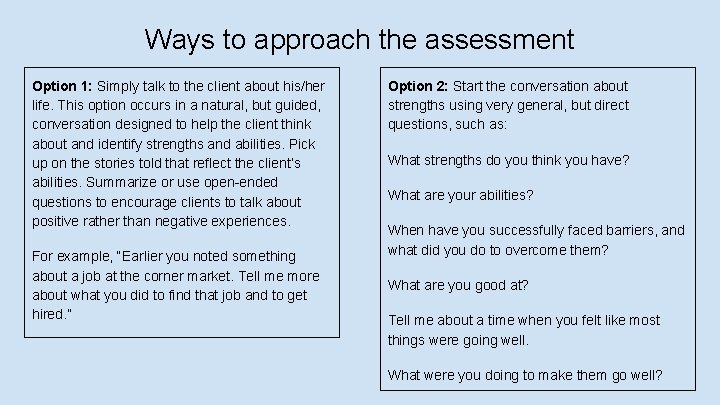
Ways to approach the assessment Option 1: Simply talk to the client about his/her life. This option occurs in a natural, but guided, conversation designed to help the client think about and identify strengths and abilities. Pick up on the stories told that reflect the client’s abilities. Summarize or use open-ended questions to encourage clients to talk about positive rather than negative experiences. For example, “Earlier you noted something about a job at the corner market. Tell me more about what you did to find that job and to get hired. ” Option 2: Start the conversation about strengths using very general, but direct questions, such as: What strengths do you think you have? What are your abilities? When have you successfully faced barriers, and what did you do to overcome them? What are you good at? Tell me about a time when you felt like most things were going well. What were you doing to make them go well?
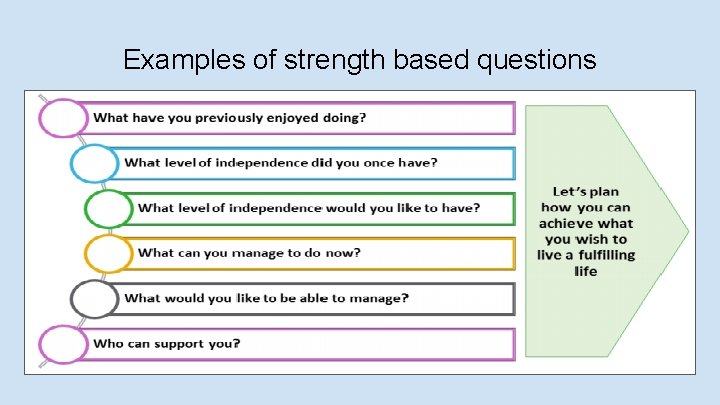
Examples of strength based questions
Concept of a strengths-based approach under the Care Act 2014 https: //www. youtube. com/watch? v=i_0 ZPJv. IZy. I&feature=youtu. be
Discussion time!
Developing strength based care and support plans ● This should be person led. ● The plan should be jointly developed with the local authority, alone or with family, friends or whoever a person may wish to involve. ● Is there a need for advocacy support? ● How does eligibility impact this approach? ● Consider what a person can do for themselves and how can they meet their own outcomes? ● Take account of the eligible needs, which cannot be met from a person’s own resources. ● Strengths based does not necessarily mean cheaper. ● This should be outcome led not service led. ● Strength based approaches do not mean ignoring problems.
Writing strength based care and support plans ● Narrative of events and persons life up to this point. ● Reflect the identity of person, not just problems. ● Avoiding using jargon and acronyms, abbreviations - remember this is their support plan not yours! ● This must be accessible to the person and others, i. e. family. ● This should be outcome focused, with a focus on what is important to the person. ● This should reflect their wishes and strengths. ● A clear plan of how these outcomes can be met and by whom. ● Consider mental capacity, principles of best interest and deprivation of liberty safeguards. https: //www. youtube. com/watch? v=y. Z 2 zd. Jw. Q 694&nohtml 5=False
Care Act 2014 guidance Production of the plan 10. 33 The plan should be person-centred, with an emphasis on the individual having every reasonable opportunity to be involved in the planning to the extent that they choose and are able. This requires the local authority to ensure that information is available in a way that is meaningful to the person, and that they have support and time to consider their options. A named contact or lead professional should be considered both as part of care planning, and in the final plan, so that the person knows how to contact the local authority. The planning choices offered should range from support for the person, to jointly develop their plan with the local authority alone or with their family, friends or whoever they may wish to involve (this might include web-based resources, written information and peer support), through to one-toone support from a paid professional, such as a social worker which may be the same person who undertook the assessment.
Three Conversations - Hackney Adult Social Care’s Model of Strengths Based Working
What is the 3 Conversations Approach? ● The ‘ 3 conversations’ approach is an innovative and highly personalised approach to working with individuals. ● It focuses primarily on people's strengths ● It looks at the assets available within the local community ● It focuses on promoting independence ● It promotes prevention - supporting people to keep healthy and well ● It supports frontline professionals to have three distinct and specific conversations with residents ● It recognises that people go into crisis, and that they need different support at this time in their lives ● It moves away from traditional approaches to assessment and care planning ● It represents a complete change in the way in which we work
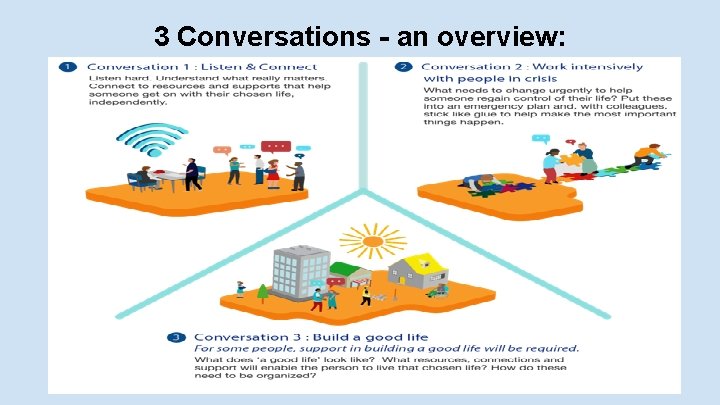
3 Conversations - an overview:
Why are LBH Adult Services adopting the 3 Conversations Approach? ● Other Local Authorities have tried this approach and they tell us it works! ● Other local authorities have told us that it is better for people - our residents - as it is personalised, outcomes are better and their experience of their interactions with the council is better ● Having good quality conversations with people will help us to ensure that people have the right support at the right time - which we hope will get better outcomes for people and help us to save money in the long term ● It is better for staff! Other authorities have told us that their staff get a lot of job satisfaction as they are able to ‘go back’ to professional roots
Why are LBH Adult Services adopting the 3 Conversations Approach? ● Other Local Authorities have tried this approach and they tell us it works! ● Other local authorities have told us that it is better for people - our residents - as it is personalised, outcomes are better and their experience of their interactions with the council is better ● Having good quality conversations with people will help us to ensure that people have the right support at the right time - which we hope will get better outcomes for people and help us to save money in the long term ● It is better for staff! Other authorities have told us that their staff get a lot of job satisfaction as they are able to ‘go back’ to professional roots
Discussion time!
Further reading https: //www. scie. org. uk/strengths-based-approaches/guidance https: //assets. publishing. service. gov. uk/government/uploads/system/uploads/attachment_data/file/778134/stengths-basedapproach-practice-framework-and-handbook. pdf Care Act 2014 http: //www. legislation. gov. uk/ukpga/2014/23/contents/enacted Mental Capacity Act 2005 https: //www. scie. org. uk/mca/introduction/mental-capacity-act-2005 -at-a-glance Care and support statutory guidance https: //www. gov. uk/guidance/care-and-supportstatutory-guidance Common Core Principles to support self-care Skills for Care http: //www. skillsforcare. org. uk/Topics/Self-Care/Self-care. aspx Developing a Wellbeing and Strengths-based approach to Social Work Practice: Changing Culture: http: //www. thinklocalactpersonal. org. uk/Latest/Resource/? cid=11017 Think Local, Act Personal • Building community capacity https: //www. thinklocalactpersonal. org. uk/Browse/Building. Community. Capacity/ How motivational interviewing works https: //www. rcn. org. uk/clinical-topics/supporting-behaviourchange/motivationalinterviewing Stanley, T. (2016) A practice framework to support the Care Act 2014 The Journal of Adult Protection 18: 1 , 53 -64
- Slides: 31