
Writing Strategies Part 1 Identifying Purpose and Audience
- Slides: 15
Writing Strategies Part 1
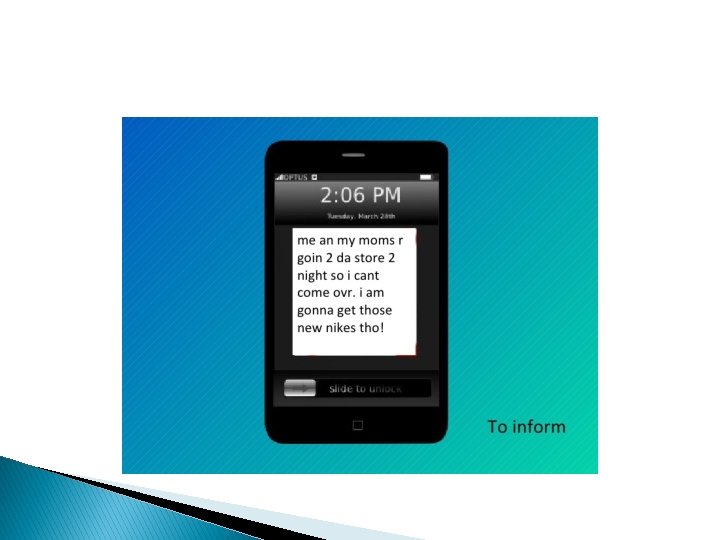
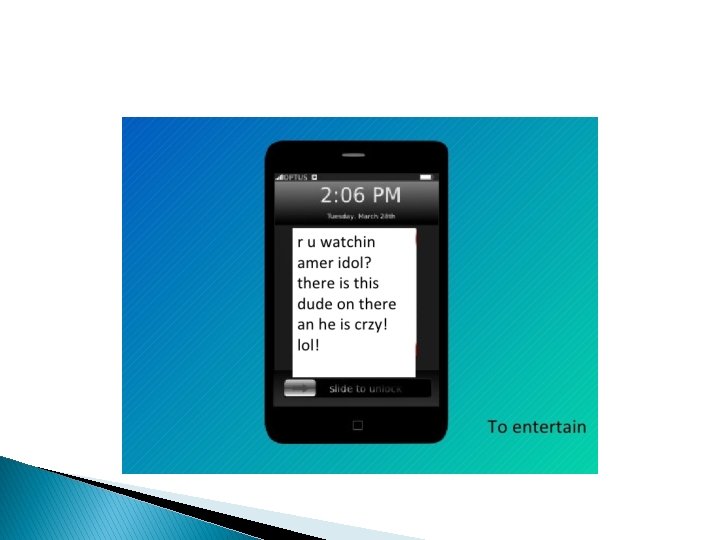
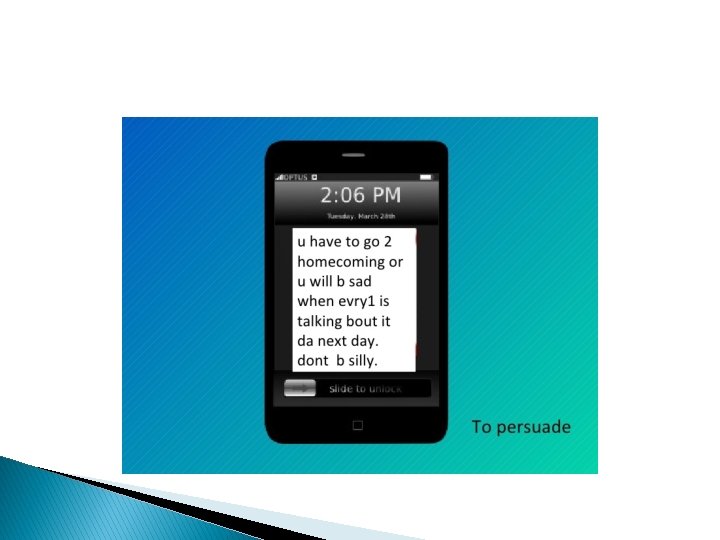
Identifying Purpose and Audience � What is this for? Who is this for? � To entertain, to recount, to describe, to evaluate, to inform, to argue, to persuade, to instruct
Group Activity � After watching the video, in groups of two, answer the following questions: ◦ ◦ What is the intended purpose of the video? How do you know? What is the intended audience of this video? How do you know?
� Read the article and identify the purpose as well as the audience. Give evidence to back up your reasoning.
Pre-Writing and Organizing Ideas Strategies � Benefits of pre-writing and organizing ideas: ◦ It can help focus intellectually and clear distractions while opening your mind to ideas within your subject ◦ Narrow and define topics for your paper and begin the process of translating research into your own words. ◦ Provide a context for "project management“ to further define the topic, set timelines, identify gaps in information, etc.
Pre-writing and Organizing Ideas Strategies 1. � � Focused free writing: Use a blank piece of paper or a blank computer screen and set a time limit of 5 15 minutes. Just write. Write anything that comes to mind on the subject. Don’t pause and don’t review until the end. Review. Look at the information, are there any ideas you can grab on to and use? Is there a main idea in the sequence of ideas?
Pre-writing and Organizing Ideas Strategies Brainstorming: � Use a blank paper or computer screen and set a time limit of 5 - 15 minutes � Write down everything that comes to mind to generate a free flow of thought: 2. ◦ Think of ideas related to this topic, the crazier the better: be wild and amuse yourself; eliminate nothing ◦ Make up questions and answers about the topic, no matter how strange: Why am I doing this? What could be interesting about this to me? Why don't I like this? What color is it? What would my friend say about it?
Pre-writing and Organizing Ideas Strategies Brainstorming continued: � Review: Are there words or ideas you can grab onto for the topic? Is there a main idea within this sequence of ideas?
Pre-writing and Organizing Ideas Strategies 3. Mindmapping: � Think in terms of key words or symbols that represent ideas and words � Take a pencil (you'll be erasing!) and a blank (nonlined) big piece of paper or use a blackboard and (colored) chalk � Write down the most important word or short phrase or symbol in the center. Think about it; circle it. � Write other important words outside the circle. Draw over-lapping circles to connect items, or use arrows to connect them (think of linking pages in a web site). Leave white space to grow your map for ◦ further development ◦ explanations ◦ action items
Pre-writing and Organizing Ideas Strategies 3. Mind mapping continued: � Work quickly without analyzing your work � Edit this first phase Think about the relation of outside items to the center. Erase and replace and shorten words for these key ideas Relocate important items closer to each other for better organization. Use color to organize information Link concepts with words to clarify the relationship � Continue working outward Freely and quickly add other key words and ideas (you can always erase!). Think weird: tape pages together to expand your map; break boundaries. Develop in directions the topic takes you--don't bet limited by the size of the paper. As you expand your map, tend to become more specific or detailed
Pre-writing and Organizing Ideas Strategies � 4. This is a more structured and sequential overview of your research to date. You may also outline to organize topics built from free writing, brainstorming, or mind mapping: � Arrange items or topics, usually without punctuation or complete sentences � List topics and phrases them in a grammatically similar or parallel structure (subjects, verbs, etc. ) � Sequence topics in importance, defining what "level" of importance they are. Items of equal importance are at the same level
Pre-writing and Organizing Ideas Strategies � Try two of the 4 pre-writing and organizing strategies on two of the following topics: ◦ Social Networking Sites ◦ Uniforms in School