
Writing Strategies for Success The journey continues Socrative
- Slides: 21
Writing Strategies for Success The journey continues….
Socrative Question What are three types of writing? www. socrative. com Enter room number: a 035 d 276
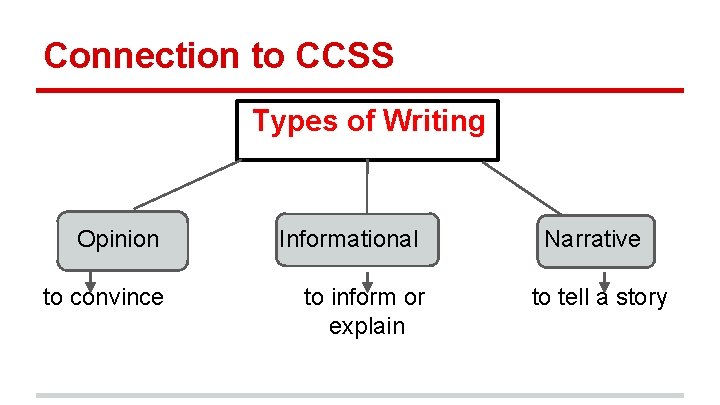
Connection to CCSS Types of Writing Opinion to convince Informational to inform or explain Narrative to tell a story
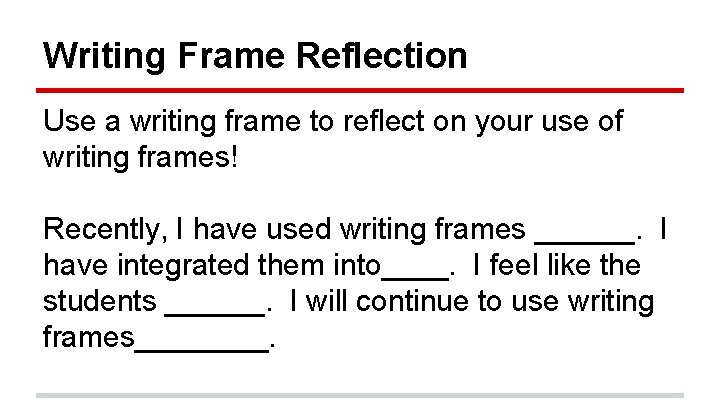
Writing Frame Reflection Use a writing frame to reflect on your use of writing frames! Recently, I have used writing frames ______. I have integrated them into____. I feel like the students ______. I will continue to use writing frames____.
Writing Frame Examples Scholastic site examples http: //rhondafriesen. weebly. com/uploads/2/9/8/ 7/2987791/writing_frames. pdf Take a few minutes to look through the examples and talk at your table how you can use these in your classroom
Examples • • • Admit and exit tickets Informal notes/scribbles Margin notes List of facts, steps, ideas Set of instructions or directions Filling in a graphic organizer, complete notes Free-writing One- paragraph summary Generate a question • • KWL chart Write a definition Draw, label, or explain pictures/diagrams Short-answer questions 1 - to 2 - sentence reflections Sentence combining Short communication with someone else (note, email, tweet, text message)
Quick Writes TPT- Ranking Activity Rank the quick writes from 1 -16, 1 being the quick write that you are most familiar with and use the most in your classroom, and 16 being the quick write that you are least familiar with and use least in your classroom.
Table Talk Discuss the quick writes that you ranked. Share out
Quick Write- Free Write • What is writing? • Remember, a Free Write is having students write on a topic for a short, specified amount of time (brain dump) • 2 minutes
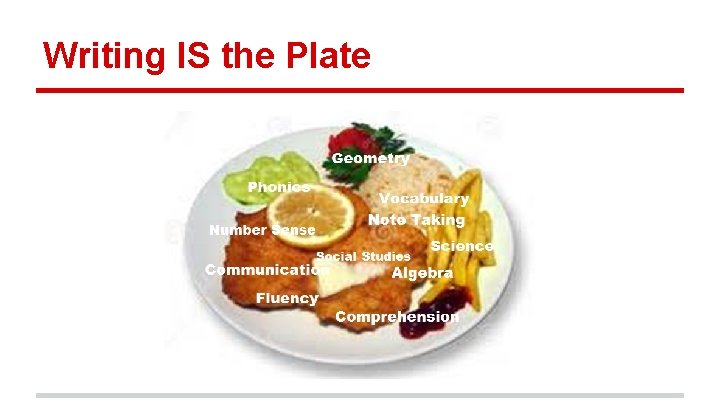
Writing IS the Plate
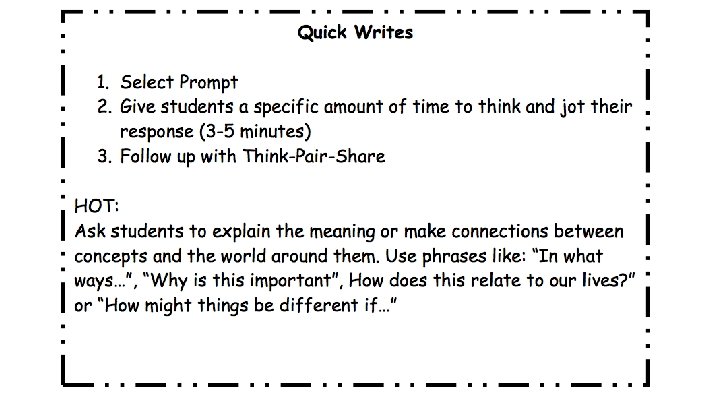
Quick Writes • • • Short, informal, done quickly Cross-curricular Help us remember, organize, and manage information Like sketching with words Can be used at any point in a lesson to help students communicate their own thoughts, experiences, and reactions to a topic or question Does not need to be collected or graded
Quick Writes ● Does not need to be collected or graded. ● Let students know grammar, spelling and other convention errors are not scored because it is an informal draft.
Quick Write Examples • • • Write a list of step-by-step instructions for calculating the volume of a box. Circle the 3 most challenging words on this list, then create a word map for 2 of them. Write out the definitions of weathering and erosion, then describe an example of each Exit ticket: write out your goal for the next Writer’s Workshop lesson Admit ticket: describe a character trait you learned about the main character in your reading last night. In 10 sentences or less, summarize the 5 stages in human development
Quick Writes W #10 - Write routinely over extended time frames (time for research, reflection and revision) and shorter time frames (a single sitting or a day or two) for a range of tasks, purposes, and audiences. The CCSS expect students at all grades to write routinely. However, many content teachers feel that there is not enough time for students to complete lengthy, formal writing tasks on a regular basis…. . or to grade a large number of student papers. -Keys to Literacy, Joan Sedita
What Can Be Done With Quick Writes? ● Students work in pairs ● Students share their quick write with another student ● Randomly select a few to read to the class ● Collect and use as formative feedback ● Collect / Shuffle / Redistribute / Share out (No names) -
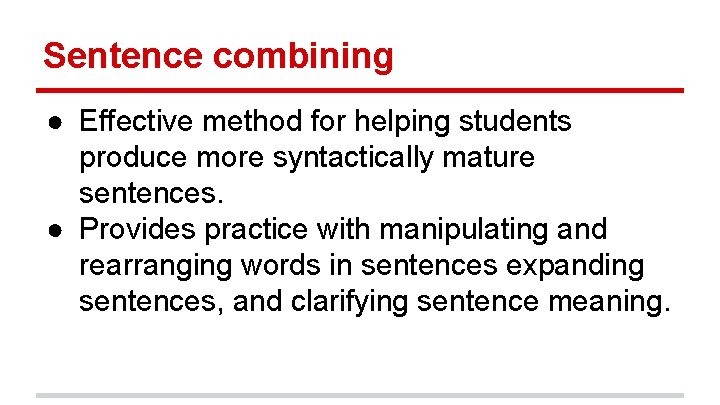
Sentence combining ● Effective method for helping students produce more syntactically mature sentences. ● Provides practice with manipulating and rearranging words in sentences expanding sentences, and clarifying sentence meaning.
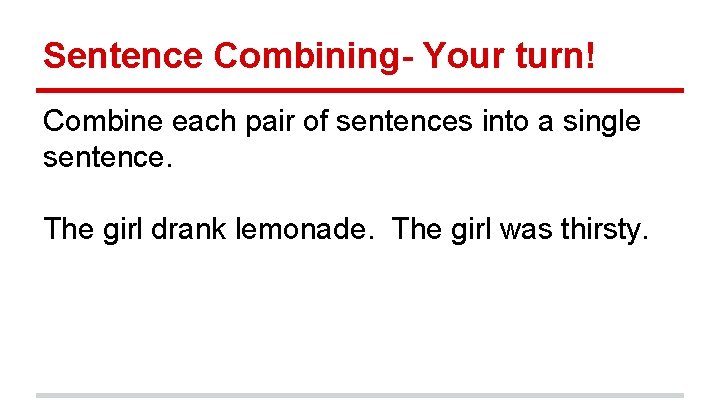
Sentence Combining- Your turn! Combine each pair of sentences into a single sentence. The girl drank lemonade. The girl was thirsty.
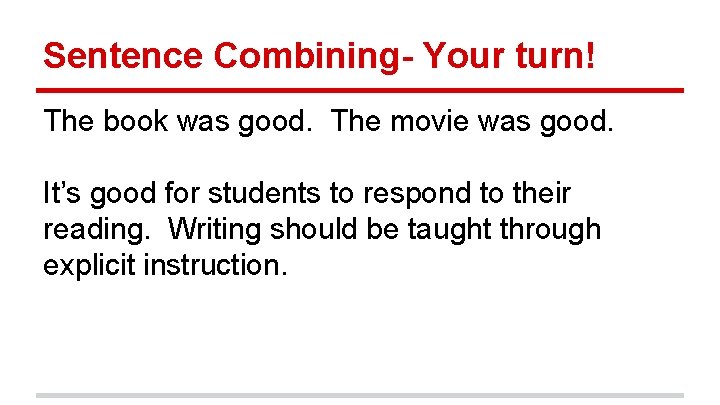
Sentence Combining- Your turn! The book was good. The movie was good. It’s good for students to respond to their reading. Writing should be taught through explicit instruction.
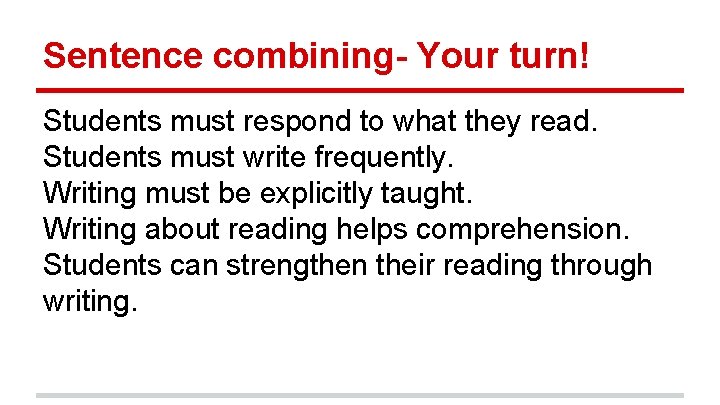
Sentence combining- Your turn! Students must respond to what they read. Students must write frequently. Writing must be explicitly taught. Writing about reading helps comprehension. Students can strengthen their reading through writing.
Reflection Quick Write- List of Facts, Steps, and Ideas On the Padlet, List three new things you learned today. 1. 2. 3.