
Writing Small and Large Numbers in Scientific Notation
Writing Small and Large Numbers in Scientific Notation By Lauren Link
Background Information Grade 8 Level of ELLs: intermediate, basic math skills vary Duration of lesson: 40 -45 minutes Previous lessons were on Laws of Exponents (adding, subtracting, multiplying, & dividing exponents)
CCLS: Math 8. EE. 4 Perform operations with numbers expressed in scientific notation, including problems where both decimal and scientific notation are used. Use scientific notation and choose units of appropriate size for measurements of very large or very small quantities (e. g. , use millimeters per year for seafloor spreading). Interpret scientific notation that has been generated by technology.

Content Objective Students will use scientific notation to write large and small numbers. Language Objective Students will be able to write the steps of how to represent a number in scientific notation.

Yesterday we… added, subtracted, multiplied & divided monomials with exponents. Today we will… Write large and small numbers in scientific notation.
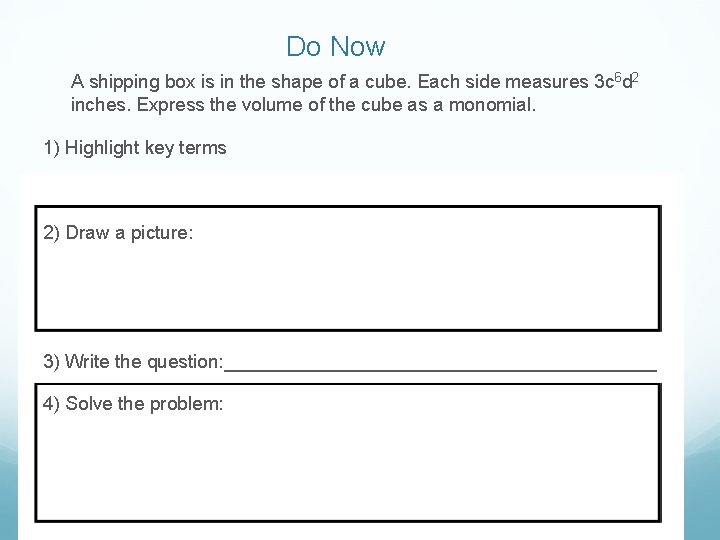
Do Now A shipping box is in the shape of a cube. Each side measures 3 c 6 d 2 inches. Express the volume of the cube as a monomial. 1) Highlight key terms 2) Draw a picture: 3) Write the question: _____________________ 4) Solve the problem:
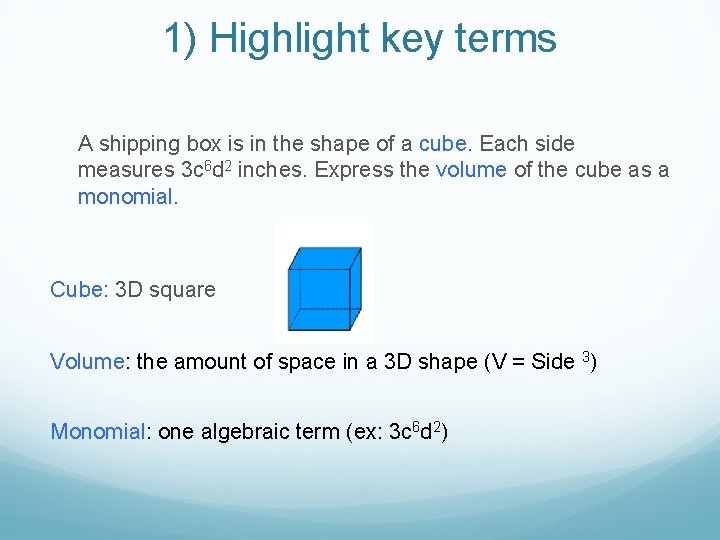
1) Highlight key terms A shipping box is in the shape of a cube. Each side measures 3 c 6 d 2 inches. Express the volume of the cube as a monomial. Cube: 3 D square Volume: the amount of space in a 3 D shape (V = Side 3) Monomial: one algebraic term (ex: 3 c 6 d 2)
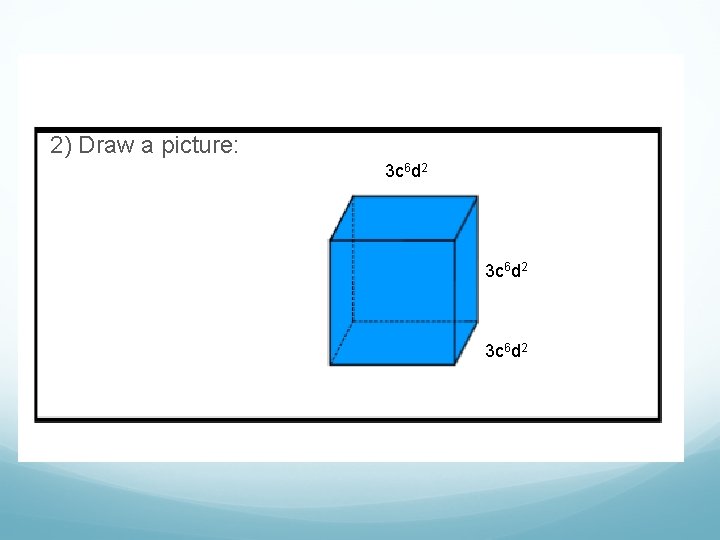
2) Draw a picture: 3 c 6 d 2
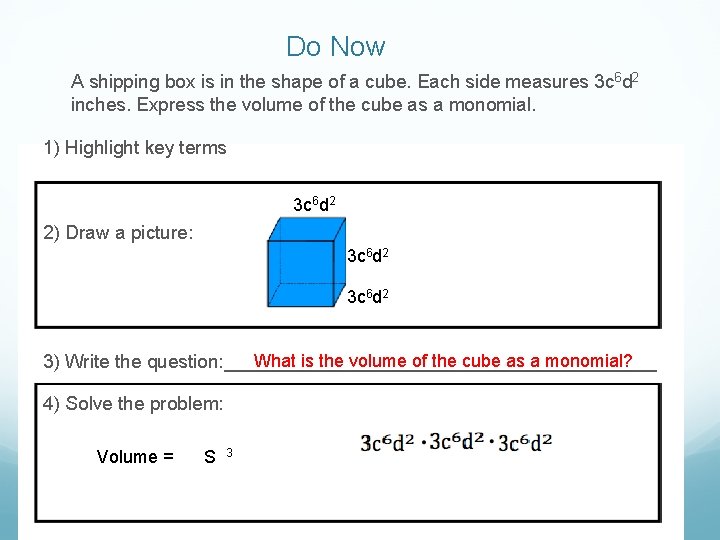
Do Now A shipping box is in the shape of a cube. Each side measures 3 c 6 d 2 inches. Express the volume of the cube as a monomial. 1) Highlight key terms 3 c 6 d 2 2) Draw a picture: 3 c 6 d 2 What is the volume of the cube as a monomial? 3) Write the question: _____________________ 4) Solve the problem: Volume = S 3
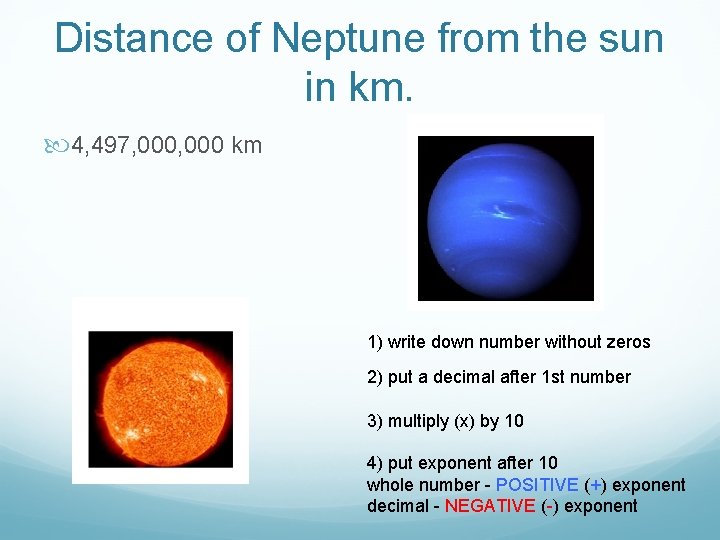
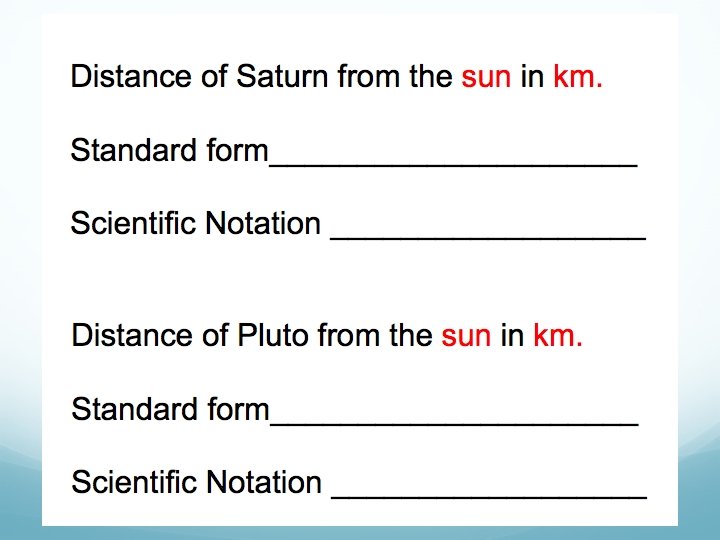
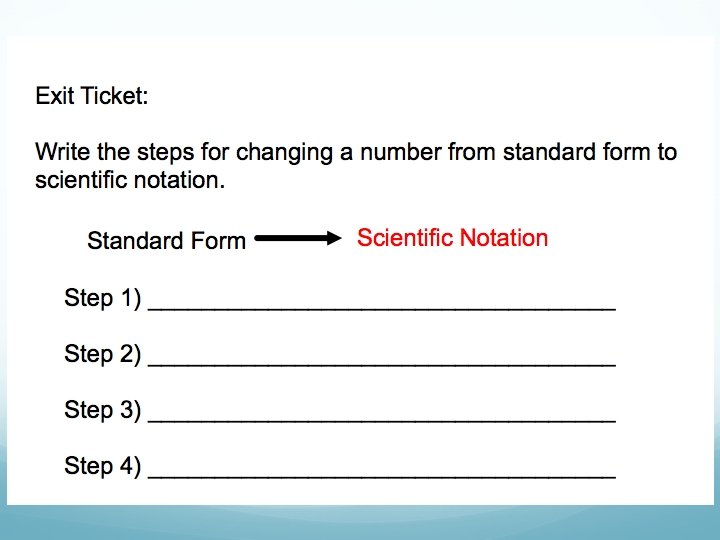
Distance of Neptune from the sun in km. 4, 497, 000 km 1) write down number without zeros 2) put a decimal after 1 st number 3) multiply (x) by 10 4) put exponent after 10 whole number - POSITIVE (+) exponent decimal - NEGATIVE (-) exponent
- Slides: 16