
WRITING SKILLS Lecture 12 Teaching the English Script
- Slides: 23
WRITING SKILLS Lecture 12
Teaching the English Script 12. 1 The needs of the learners • All students whose native language does not use the Latin script will have to be taught the symbols needed for writing English. • In some circumstances you may also want to improve the handwriting of those who already use the Latin script. • In order to be able to do this effectively and, no les important, sympathetically, you will need to inform yourself of the learners’ areas of difficulty.
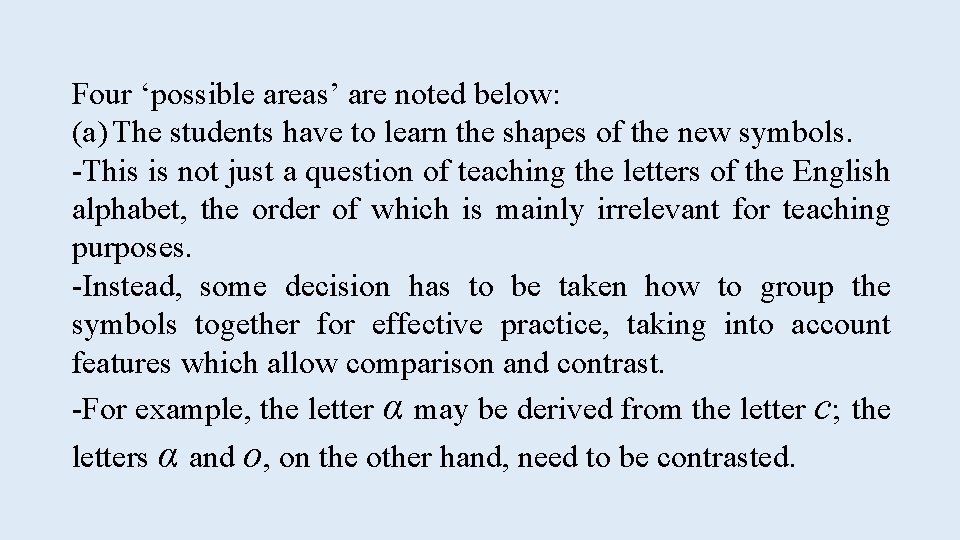
Four ‘possible areas’ are noted below: (a) The students have to learn the shapes of the new symbols. -This is not just a question of teaching the letters of the English alphabet, the order of which is mainly irrelevant for teaching purposes. -Instead, some decision has to be taken how to group the symbols together for effective practice, taking into account features which allow comparison and contrast. -For example, the letter α may be derived from the letter c; the letters α and o, on the other hand, need to be contrasted.
(b) The students have to learn two sets of symbols: lower and upper case (that is, small letters and capitals). -Again, a decision has to be made whether to teach both sets of symbols together or whether to teach first the small letters and the capitals. (c) The students have to learn to write in a new direction: that is, from left to right to left. This will only apply to certain groups of letters (for example, to Arab students but not to those whose native language employs one of the Devanagari scripts of the North Indian languages). -This physical aspect of mastering the new script is not to be underestimated.
(d) The students may have to learn the position of the symbols of the script in relation to the rules lines. -Essentially the English script may be viewed as sitting on the line and extending upwards and downwards, while the symbols in the Devanagari scripts, for example, ‘hang’ from the line above. -Another key factor will, of course, be the age of the learners. -Adult learners will want (and will probably need) to learn more quickly and will therefore require concentrated practice, which to a large extent, given the right guidance, they can provide for themselves out of class.
-For children, the programme should be spread over a much longer period. -While it is assumed that they will already have mastered their native language script, they will probably still have some handwriting difficulties and not all their motor skills will be equally well developed. -Hence the need for copying activities. -Young learners will also benefit a good deal from handwriting activities that give them the opportunity to play, and they will almost certainly need some kind of workbook.
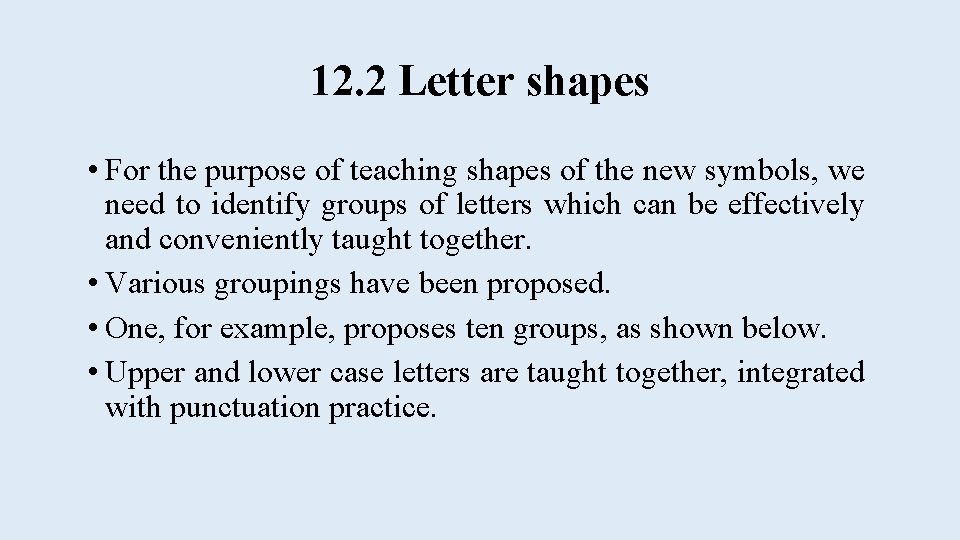
12. 2 Letter shapes • For the purpose of teaching shapes of the new symbols, we need to identify groups of letters which can be effectively and conveniently taught together. • Various groupings have been proposed. • One, for example, proposes ten groups, as shown below. • Upper and lower case letters are taught together, integrated with punctuation practice.
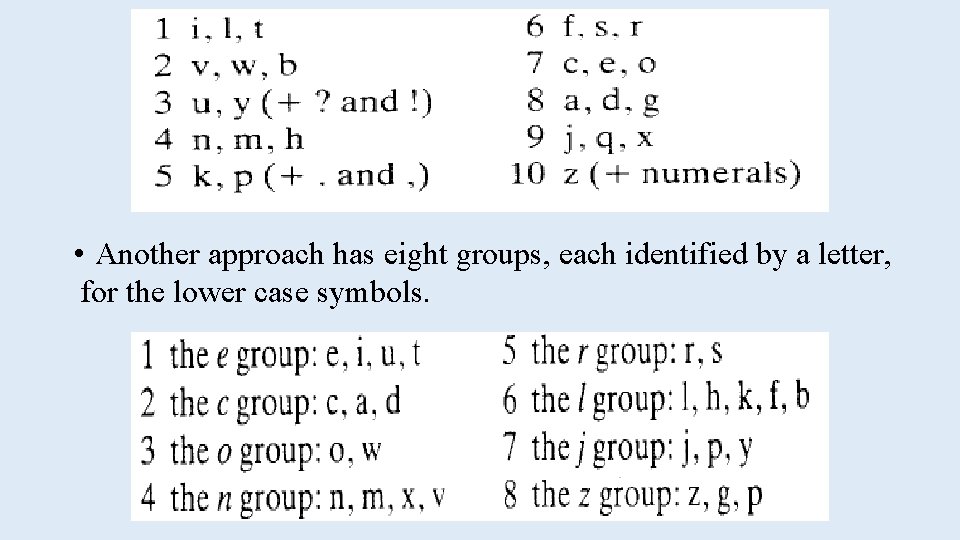
• Another approach has eight groups, each identified by a letter, for the lower case symbols.
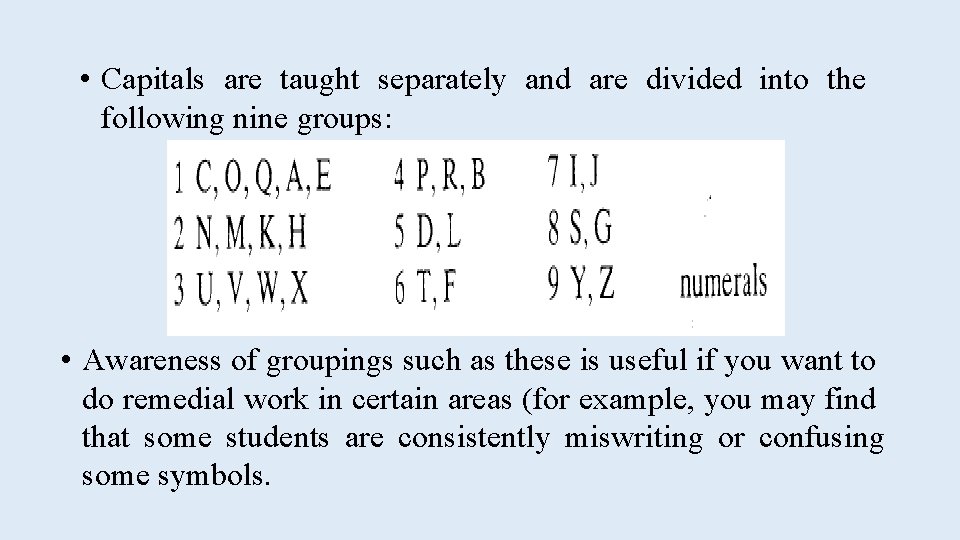
• Capitals are taught separately and are divided into the following nine groups: • Awareness of groupings such as these is useful if you want to do remedial work in certain areas (for example, you may find that some students are consistently miswriting or confusing some symbols.
12. 3 Procedures for teaching script • At the start, most students will need to be made aware of some of the important differences between writing the English script and writing in their native language. • For this purpose, if they are asked to write something in their own language and to note some of the essential movements, a broad comparison can be made between this and writing in English. • You will also need to draw attention to the positioning of the right forearm on the desk, at something like 80 o and the flexible movements of the wrist to produce anti-clockwise motions, which sometimes give students a lot of difficulty.
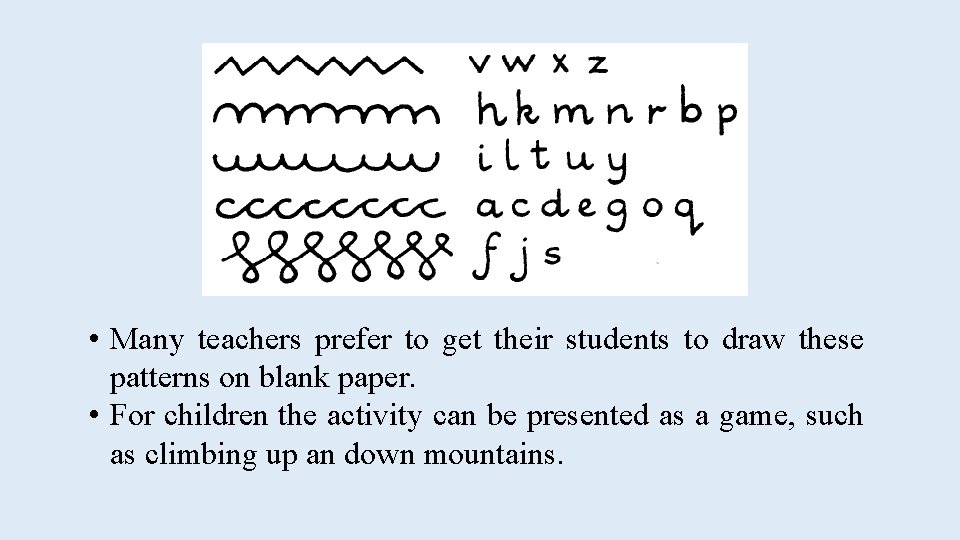
• You must be prepared to demonstrate these points. • Two ‘warm up’ activities should also be noted: (a) Rhythmic patterns -To get the students used to some of the characteristic shapes of the English script and the movements needed for making them, you can ask them to draw rhythmic patterns like those shown in the example. -They are particularly important for students who are having to learn to write from left to right (for whom even drawing horizontal lines across the page is a useful activity). -Rhythmic patterns can relate to some of the basic shapes of the letters, as in the example.
• Many teachers prefer to get their students to draw these patterns on blank paper. • For children the activity can be presented as a game, such as climbing up an down mountains.
(b) Writing in air • It generally helps, whatever the age of the students, to practice tracing the shape of the letters in the air. • This helps them to concentrate on the way a letter is formed and enables them to go on practising as long as they like. • For this activity draw a large version of the letter on the board, with arrows indicating the directions to be followed, and then demonstrate the movements yourself. • The students can make large movements first of all, gradually making smaller ones.
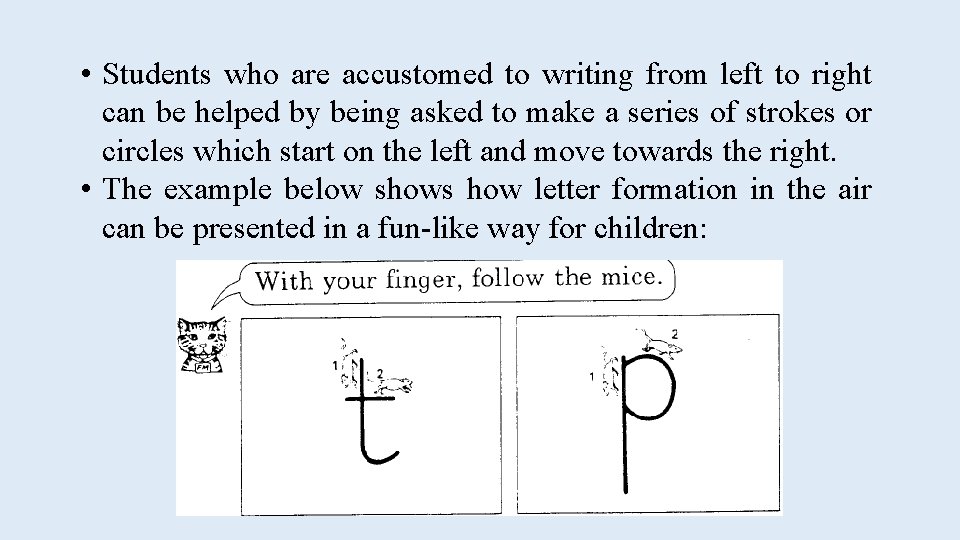
• Students who are accustomed to writing from left to right can be helped by being asked to make a series of strokes or circles which start on the left and move towards the right. • The example below shows how letter formation in the air can be presented in a fun-like way for children:
12. 3. 1 Some basic procedures for teaching script (a) Give the students clear and carefully made models to follow. • Draw these on the board if a workbook is not available. • In any case, a model on the board, drawn by you, will help to concentrate attention. • You must always be prepared to demonstrate script.
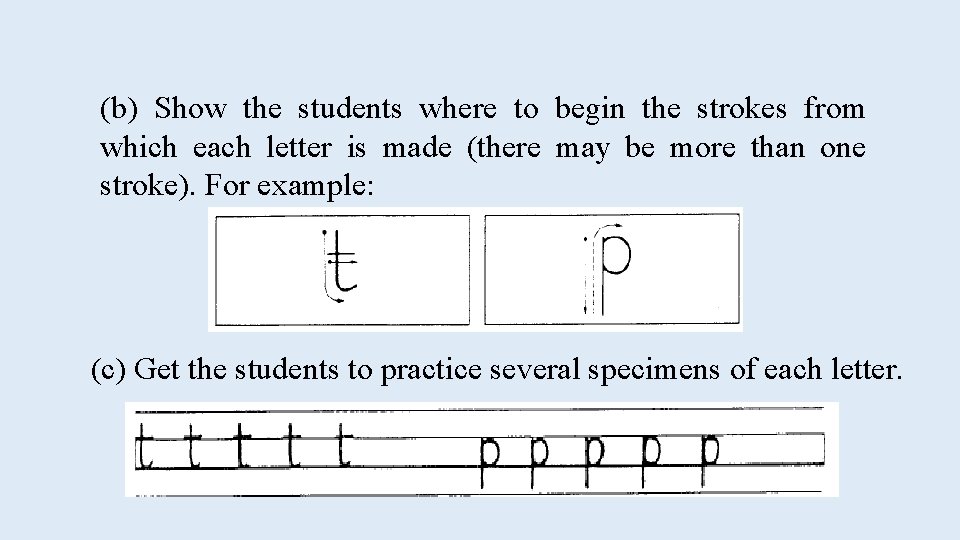
(b) Show the students where to begin the strokes from which each letter is made (there may be more than one stroke). For example: (c) Get the students to practice several specimens of each letter.
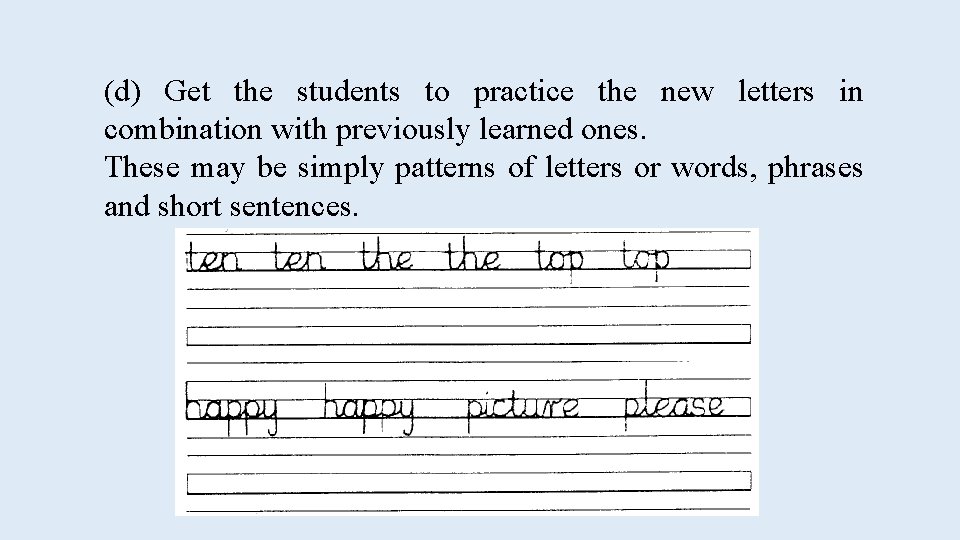
(d) Get the students to practice the new letters in combination with previously learned ones. These may be simply patterns of letters or words, phrases and short sentences.
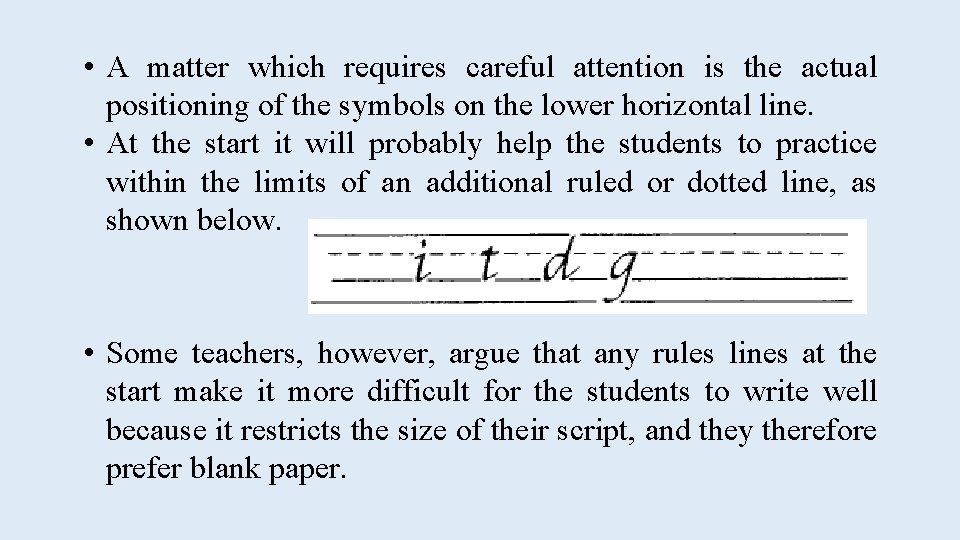
• A matter which requires careful attention is the actual positioning of the symbols on the lower horizontal line. • At the start it will probably help the students to practice within the limits of an additional ruled or dotted line, as shown below. • Some teachers, however, argue that any rules lines at the start make it more difficult for the students to write well because it restricts the size of their script, and they therefore prefer blank paper.
• On the whole, it would seem better to separate the teaching of capitals from lower case symbols. • This permits the kind of grouping according to shape. • It also takes into account the many differences between a lower case letter and its upper case counterpart (for example, r and R, g and G). • In addition, there are some other factors which need to be considered.
• In the first place, we shall need to decide how early in the course to introduce writing practice. • Should we get the students to practice making the shapes of the letters very early on, even before they can read, perhaps as a break from oral work, or should we wait until they are familiar with the symbols through some form of reading recognition practice? • Although there is clearly no one answer to this question, on the whole, if there is time for this activity, which is essentially a kind of drawing exercise, it would seem a good idea to introduce the students to the mechanical problems of actually making the symbols as soon as possible.
• Younger learners enjoy this kind of activity, while adult students may actually need to have accelerated instruction in both reading and writing in order to become literate in the foreign language as quickly as possible. • The pace of that part of the writing programme where the students are being taught the symbols will relate to the age level of the learners. • The work of younger learners, for example, should be carefully supervised in class, although this does not rule out a certain amount of practice as homework.
• Adult students, on the other hand, might well be given cyclostyled sheets containing appropriate copying material, so that an introduction to the items to be practiced, they continue to work on their own out of class. • We must also decide what kind of script we are going to teach. • Do we teach them some form of cursive writing from the start or do we delay the introduction of this until they have learned to print? • Again, the age factor is relevant: younger learners are probably best taught the printed form first.
• On the other hand, there is no great harm in introducing from the start a kind of modified cursive, of a kind which is easy to write and easy to read and which stands very close to the printed form. • In making a decision, we have to take the needs of the learners into account: adult students, for example, would probably be intolerant of anything less than cursive, since this is the only form they can envisage themselves using.