
Writing Scientific Papers Scientific Soft Skill Seminar Petr
- Slides: 31
Writing Scientific Papers Scientific Soft Skill Seminar Petr Kmoch CGG MFF UK
Writing Scientific Papers § Why bother? § Publish or perish § Publication Invention security § Research success measure § Academic (tenure-track) ranking § Knowledge dissemination § 21. 4. 2009 Petr Kmoch, Computer Graphics Group, MFF UK 2
Presentation Outline § Writing procedure § Scientific writing § Tips 21. 4. 2009 Petr Kmoch, Computer Graphics Group, MFF UK 3
Presentation Outline § Writing procedure § Scientific writing § Tips 21. 4. 2009 Petr Kmoch, Computer Graphics Group, MFF UK 4
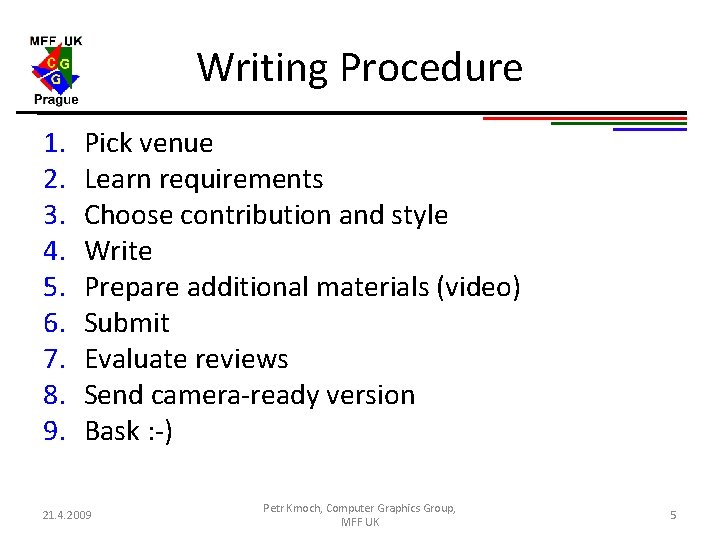
Writing Procedure 1. 2. 3. 4. 5. 6. 7. 8. 9. Pick venue Learn requirements Choose contribution and style Write Prepare additional materials (video) Submit Evaluate reviews Send camera-ready version Bask : -) 21. 4. 2009 Petr Kmoch, Computer Graphics Group, MFF UK 5
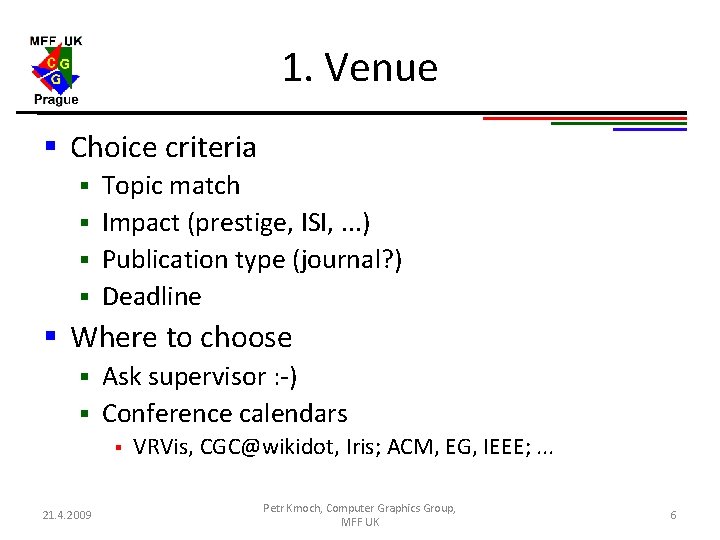
1. Venue § Choice criteria Topic match § Impact (prestige, ISI, . . . ) § Publication type (journal? ) § Deadline § § Where to choose Ask supervisor : -) § Conference calendars § § 21. 4. 2009 VRVis, CGC@wikidot, Iris; ACM, EG, IEEE; . . . Petr Kmoch, Computer Graphics Group, MFF UK 6
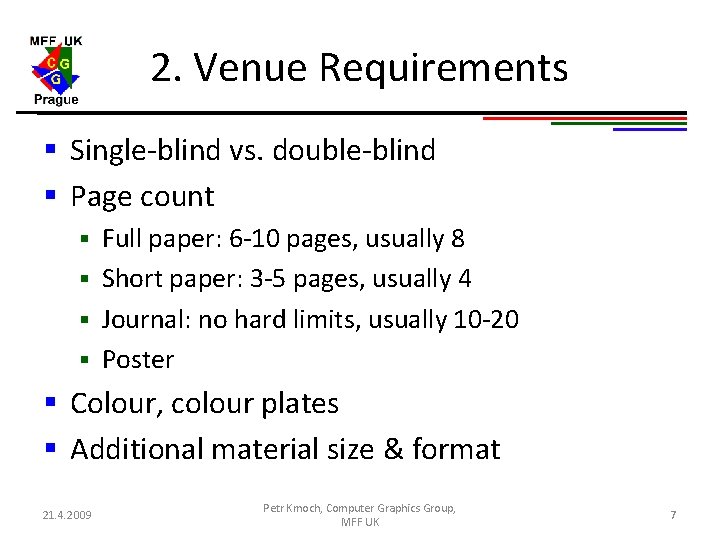
2. Venue Requirements § Single-blind vs. double-blind § Page count Full paper: 6 -10 pages, usually 8 § Short paper: 3 -5 pages, usually 4 § Journal: no hard limits, usually 10 -20 § Poster § § Colour, colour plates § Additional material size & format 21. 4. 2009 Petr Kmoch, Computer Graphics Group, MFF UK 7
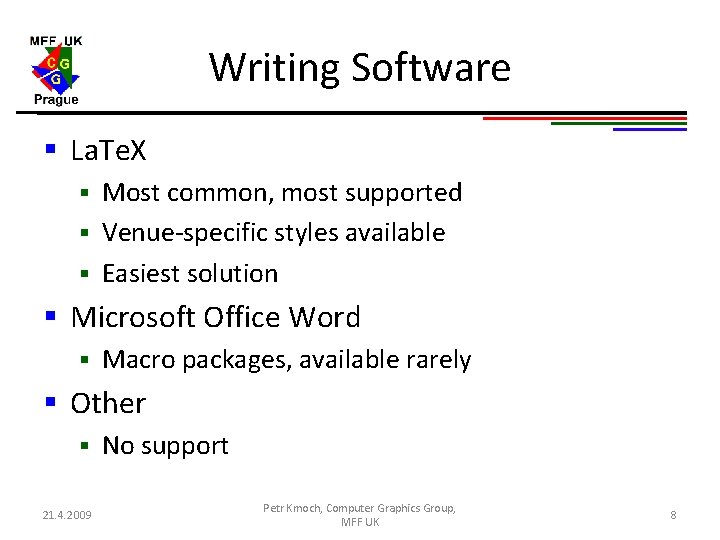
Writing Software § La. Te. X Most common, most supported § Venue-specific styles available § Easiest solution § § Microsoft Office Word § Macro packages, available rarely § Other § 21. 4. 2009 No support Petr Kmoch, Computer Graphics Group, MFF UK 8
3. Contribution and Style § What do I present? Match conference topic § Keep focused § § How do I present it? § Compilation, incremental, break-through, critique § Output: Weighted paper structure § What to include, what to reference § 21. 4. 2009 Petr Kmoch, Computer Graphics Group, MFF UK 9
4. Write § Later. . . 21. 4. 2009 Petr Kmoch, Computer Graphics Group, MFF UK 10
5. Additional Materials § Graphics-specific § Very rare in image processing § Video “Sells” the paper § Artistic effect important § § § Quality models, script, professional score, . . . Include in application design § Scriptable camera § Images, screenshots 21. 4. 2009 Petr Kmoch, Computer Graphics Group, MFF UK 11
6. Submission § Electronic uploading systems PDF, Post. Script § Sometimes La. Te. X as well § Additional materials § § Metadata § Contribution, reader benefit, keywords, . . . § Abstract submission Some conferences only § 1 -2 weeks before paper submission § 21. 4. 2009 Petr Kmoch, Computer Graphics Group, MFF UK 12
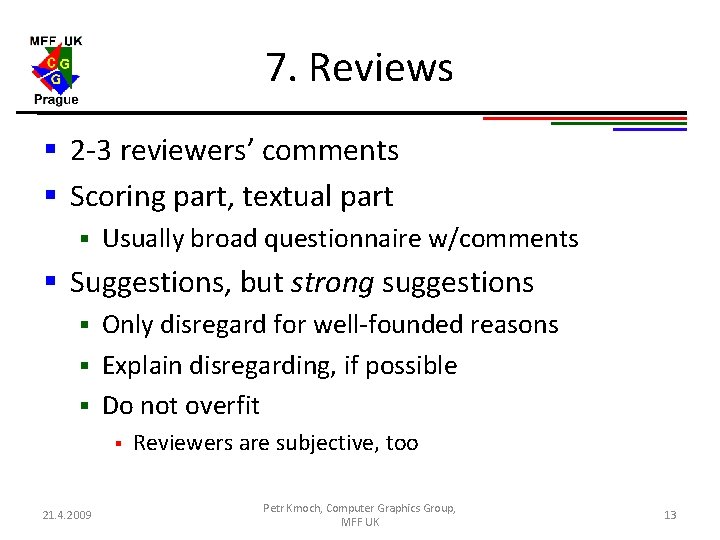
7. Reviews § 2 -3 reviewers’ comments § Scoring part, textual part § Usually broad questionnaire w/comments § Suggestions, but strong suggestions Only disregard for well-founded reasons § Explain disregarding, if possible § Do not overfit § § 21. 4. 2009 Reviewers are subjective, too Petr Kmoch, Computer Graphics Group, MFF UK 13
Presentation Outline § Writing procedure § Scientific writing § Tips 21. 4. 2009 Petr Kmoch, Computer Graphics Group, MFF UK 14
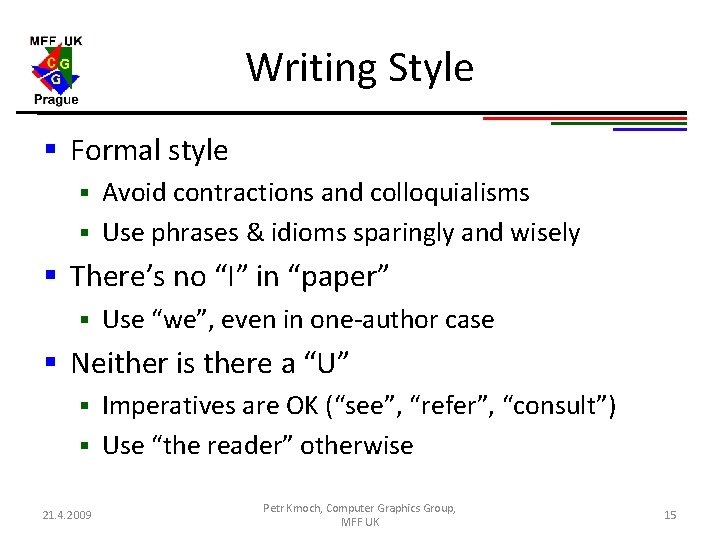
Writing Style § Formal style Avoid contractions and colloquialisms § Use phrases & idioms sparingly and wisely § § There’s no “I” in “paper” § Use “we”, even in one-author case § Neither is there a “U” Imperatives are OK (“see”, “refer”, “consult”) § Use “the reader” otherwise § 21. 4. 2009 Petr Kmoch, Computer Graphics Group, MFF UK 15
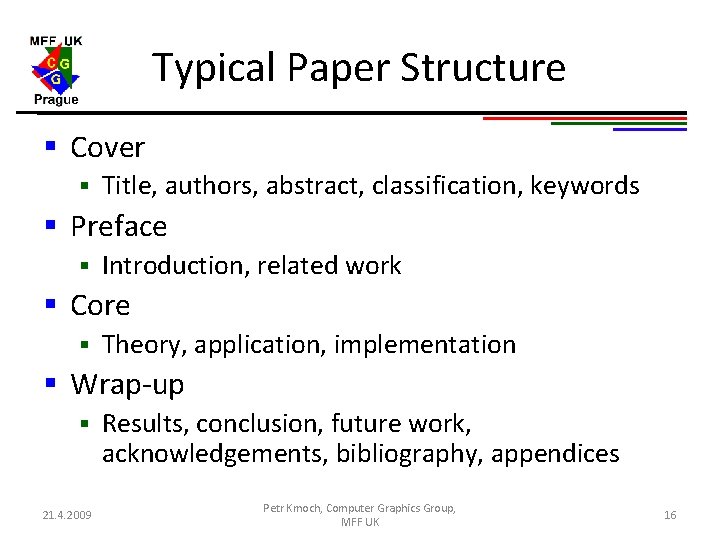
Typical Paper Structure § Cover § Title, authors, abstract, classification, keywords § Preface § Introduction, related work § Core § Theory, application, implementation § Wrap-up § 21. 4. 2009 Results, conclusion, future work, acknowledgements, bibliography, appendices Petr Kmoch, Computer Graphics Group, MFF UK 16
Cover § Title Include important keywords § Do not be overly general/overly specific § Keep it short § § Authors First author most important § Last author ~ general supervisor § Mind paper length § 21. 4. 2009 Petr Kmoch, Computer Graphics Group, MFF UK 17
Abstract § Around 200 words Problem description § Contribution summary § Stress on novel parts § § Written first or last § ACM classification: I. 3 through I. 5 § 3 -5 keywords § 21. 4. 2009 Do not repeat title or ACM class Petr Kmoch, Computer Graphics Group, MFF UK 18
Introduction § Problem description Why problem is important § What’s difficult about it § § Contribution summary What’s new § What its benefits are § § Paper outline § 21. 4. 2009 Throwback to tradition Petr Kmoch, Computer Graphics Group, MFF UK 19
Related work § Ultra-brief summary of existing methods § § § 0. 5 - 2 sentences each Include latest work Include ideas’ original authors State negatives calmly and mildly Use names or “the author(s)”, if necessary Avoid “they”, “(s)he” § Keep it de-personalized § 21. 4. 2009 Petr Kmoch, Computer Graphics Group, MFF UK 20
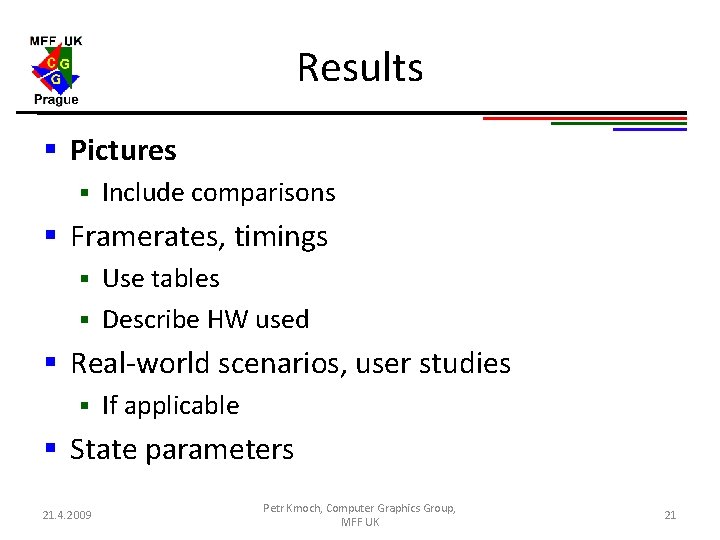
Results § Pictures § Include comparisons § Framerates, timings Use tables § Describe HW used § § Real-world scenarios, user studies § If applicable § State parameters 21. 4. 2009 Petr Kmoch, Computer Graphics Group, MFF UK 21
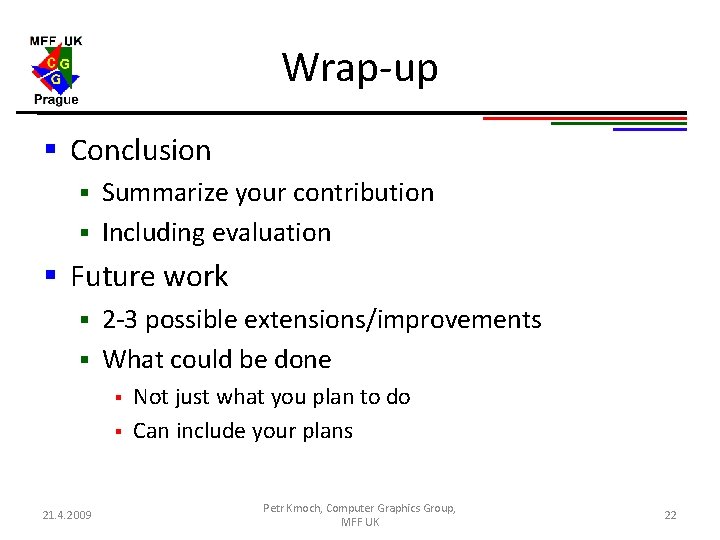
Wrap-up § Conclusion Summarize your contribution § Including evaluation § § Future work 2 -3 possible extensions/improvements § What could be done § § § 21. 4. 2009 Not just what you plan to do Can include your plans Petr Kmoch, Computer Graphics Group, MFF UK 22
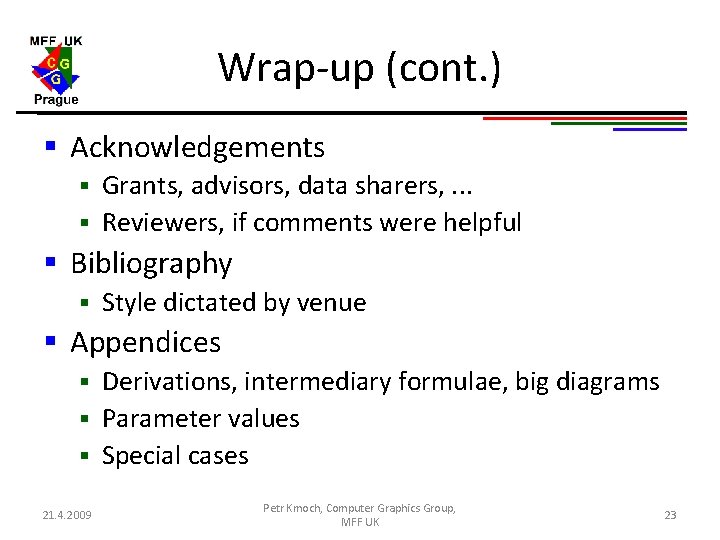
Wrap-up (cont. ) § Acknowledgements Grants, advisors, data sharers, . . . § Reviewers, if comments were helpful § § Bibliography § Style dictated by venue § Appendices Derivations, intermediary formulae, big diagrams § Parameter values § Special cases § 21. 4. 2009 Petr Kmoch, Computer Graphics Group, MFF UK 23
Presentation Outline § Writing procedure § Scientific writing § Tips 21. 4. 2009 Petr Kmoch, Computer Graphics Group, MFF UK 24
Readability § Employ eye candy Use teaser images § Sneak an image to the early pages § § Keep it legible and readable Minimize footnote use § Avoid overlong paragraphs § Refer to figures and equations § Use traditional notations § 21. 4. 2009 Petr Kmoch, Computer Graphics Group, MFF UK 25
Formal Aspects § Capitalize internal references “see Figure 1; by Algorithm 2; refer to Section 3. 1” § Do not refer to “Subsection 3. 1” or “ 3. 1” § § Max. 2 levels of numbering § Lesser headings possible, but without numbers § Avoid [] citations as sentence subjects § Use formal linking words § 21. 4. 2009 Therefore, whereas, however, hereinafter, . . . Petr Kmoch, Computer Graphics Group, MFF UK 26
Shortening § Every author’s nightmare § Typical candidates: 1. 2. 3. 4. 5. Related work Introduction Bibliography entries Theory description Referencable parts § Three-phase shortening 21. 4. 2009 Petr Kmoch, Computer Graphics Group, MFF UK 27
1. Rational Phase § High-level approach § Remove superfluous text § Probably no information § Reformulate wordy phrases 21. 4. 2009 Petr Kmoch, Computer Graphics Group, MFF UK 28
2. Lossless Phase § Low-level § Shorten bibliography entries § Pages, months, editors; abbreviations § Short paragraph-ending lines § Language-based shortening § Can save up to ½ page 21. 4. 2009 Petr Kmoch, Computer Graphics Group, MFF UK 29
3. Lossy Phase § If all else fails. . . § § § § 21. 4. 2009 Remove headings Join paragraphs Cut down on explanation Reference non-vital parts Remove references Remove data Shrink figures Inline simple equations Petr Kmoch, Computer Graphics Group, MFF UK 30
Thank you Questions & discussion 21. 4. 2009 Petr Kmoch, Computer Graphics Group, MFF UK 31