
Writing Scientific Manuscripts Table of Contents Introduction Part
Writing Scientific Manuscripts
Table of Contents • Introduction • Part I: Publication & Peer Review – – – – Deciding to Publish Submitting Your Paper After Submission Overview of Peer Review Purpose of Peer Review How It Works The Role of Editor Limitations and Issues
Table of Contents Cont’d • Part II: Writing a Scientific Manuscript – – – – The Scientific Manuscript Word Choice The Abstract The Introduction The Methods & Materials Section The Results Section The Discussion Section Figures, Tables, Equations, and References
Introduction Welcome to JYI’s Guide to Reporting Scientific Research! This is a free presentation (based off the guidebook), written and distributed by the Journal of Young Investigators, an international science research journal run entirely by undergraduates, for undergraduates. Copyright 2005, Journal of Young Investigators, Inc.
Part I: Publication & Peer Review:
Deciding to Publish and Submitting Your Paper • What to publish? – abstract vs. full report • Choosing your forum – Which type of journal is best for you? – What audience are you targeting? • Research the journal – Publication guidelines – Article style
After Submission • Publication Procedure (6 -12 months) – – – – – Author submits Editor is assigned to manuscript Editor assigns reviewers (associate editors) to inspect Reviewers decide on whether to review paper Several reviewers inspect and edit Editor decides on accuracy of revisions and whether to accept paper If accepted, editor sends paper back to author with revisions Author revises paper and sends it back Possibility of second review process Publication!
What is Peer Review? • Review process for scientists by scientists • Purpose – To filter what is published as “science” – To provide researchers with perspective • Where is peer review used? – Scientific publication – Grant review – Tenure promotion
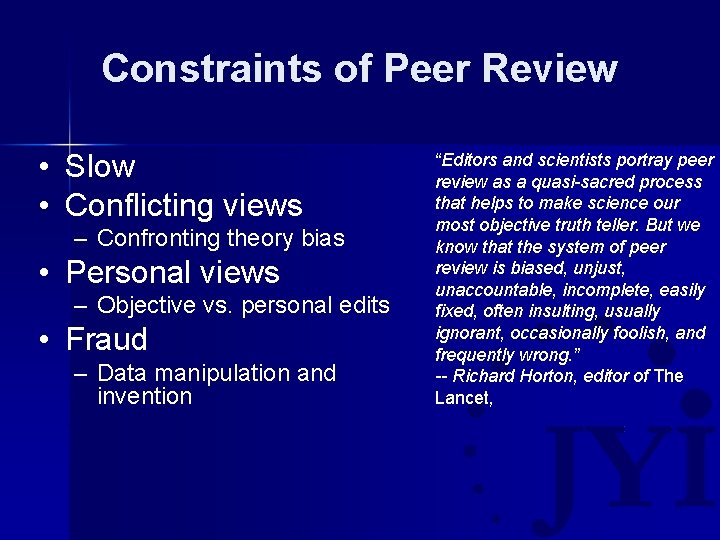
Constraints of Peer Review • Slow • Conflicting views – Confronting theory bias • Personal views – Objective vs. personal edits • Fraud – Data manipulation and invention “Editors and scientists portray peer review as a quasi-sacred process that helps to make science our most objective truth teller. But we know that the system of peer review is biased, unjust, unaccountable, incomplete, easily fixed, often insulting, usually ignorant, occasionally foolish, and frequently wrong. ” -- Richard Horton, editor of The Lancet,
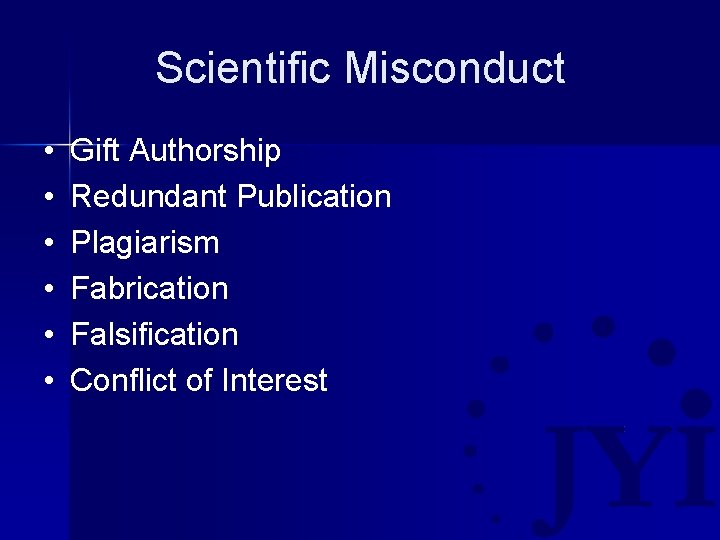
Scientific Misconduct • • • Gift Authorship Redundant Publication Plagiarism Fabrication Falsification Conflict of Interest
Part II: Writing a Scientific Manuscript Copyright 2005, Journal of Young Investigators, Inc.
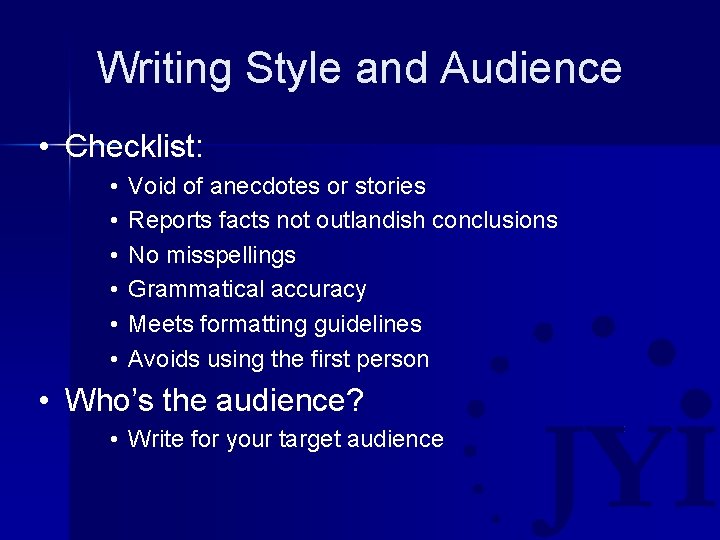
Writing Style and Audience • Checklist: • • • Void of anecdotes or stories Reports facts not outlandish conclusions No misspellings Grammatical accuracy Meets formatting guidelines Avoids using the first person • Who’s the audience? • Write for your target audience
Word Choice • Examine vs. Analyze – Activity to gain knowledge vs. Describing the analysis of that knowledge • Bloom’s Taxonomy – – – Knowledge Comprehension Application Analysis Synthesis Evaluation Copyright 2005, Journal of Young Investigators, Inc.
Word Choice • Bloom’s Taxonomy – Knowledge: Recitation of fact • Found, identified, labeled – Comprehension: State a problem or interpret fact • Discuss, predict, compare – Application: Apply old information to solve new problems • Solve, show, examine, classify – Analysis: Used to explain patterns or meaning • Analyze, investigate, compare, contrast – Synthesis: Making predictions or discussing possibilities • Predict, plan, devise, propose – Evaluation: Drawing conclusions, making recommendations • Justify, verify, argue, recommend, determine
Manuscript Structure • • Abstract Introduction Body of Article Results Discussion and Conclusions Acknowledgements References Figures and Tables
Abstract • Summary of Manuscript (200 -300 Words) • • • Problem investigated Purpose of Research Methods Results Conclusion
Abstract • Common Mistakes – – Too much background or methods information Figures or images References to other literature, figures or images Abbreviations or acronyms
Introduction • Broad information on topic – Previous research • Narrower background information – Need for study • Focus of paper – Hypothesis • Summary of problem (selling point) • Overall 300 -500 words
Introduction • Common Mistakes – – – Too much or not enough information Unclear purpose Lists Confusing structure First-Person anecdotes
Methods and Materials • Provides instruction on exactly how to repeat experiment – – – – Subjects Sample preparation techniques Sample origins Field site description Data collection protocol Data analysis techniques Any computer programs used Description of equipment and its use
Methods and Materials • Common Mistakes – – Too little information Information from Introduction Verbosity Results/ sources of error reported
Results • Objective presentation of experiment results – Summary of data • NOT a Discussion!
Results • Common mistakes – – – Raw data Redundancy Discussion and interpretation of data No figures or tables Methods/materials reported
Discussion • Interpret results – Did the study confirm/deny the hypothesis? – If not, did the results provide an alternative hypothesis? What interpretation can be made? – Do results agree with other research? Sources of error/anomalous data? – Implications of study for field – Suggestions for improvement and future research? • Relate to previous research
Discussion • Common Mistakes – – – Combined with Results New results discussed Broad statements Incorrectly discussing inconclusive results Ambiguous data sources Missing information
Figures and Tables • Tables – Presents lists of numbers/ text in columns • Figures – Visual representation of results or illustration of concepts/methods (graphs, images, diagrams, etc. ) • Captions – Must be stand-alone
Figures and Tables • Guidelines for Figures and Tables – – – High resolution Neat, legible labels Simple Clearly formatted Indicate error Detailed captions
References • Check specific referencing style of journal • Should reference: – Peer-reviewed journal articles, abstracts, books • Should not reference: – Non-peer-reviewed works, textbooks, personal communications

References • Common Mistakes – Format, Format • (Figures & Tables, Equations, and References) – Redundant Information • Text, Figures, Tables, and Captions – Type of Reference
- Slides: 30