
WRITING ROUTINE REQUESTS POSITIVE MESSAGES CHAPTER 10 For
- Slides: 16
WRITING ROUTINE REQUESTS & POSITIVE MESSAGES CHAPTER 10
For routine requests and positive messages • Use a Direct Order DIRECT ORDER • Direct Order- message starts with the most important point and then moves into additional supporting information.
ROUTINE REQUEST GUIDELINE 1. State the request or main idea • Getting right to the point should not be interpreted as license to be abrupt or tactless. • Pay attention to tone. Instead of demanding action (“Send me the latest version of the budget spreadsheet”), show respect by using words such as please and I would appreciate. • Be specific. State precisely what you want. Ex- when you request for the latest market data from your research department, be sure to say whether you want a 1 -page summary or 100 pages of raw data.
ROUTINE REQUEST GUIDELINE 2. Give necessary details explain & justifying your request • Use the body of your message to explain your request, as needed. • If complying with the request could benefit the reader, be sure to mention that. • If you have multiple requests or questions, ask the most important questions first and deal with only one topic per question. • Use bullet points/numbers/paragraphs for each successive one • If you have an unusual or complex request, break it down and make sure to explain in thoroughly. Or else the reader might be left confused as to the nature of the request.
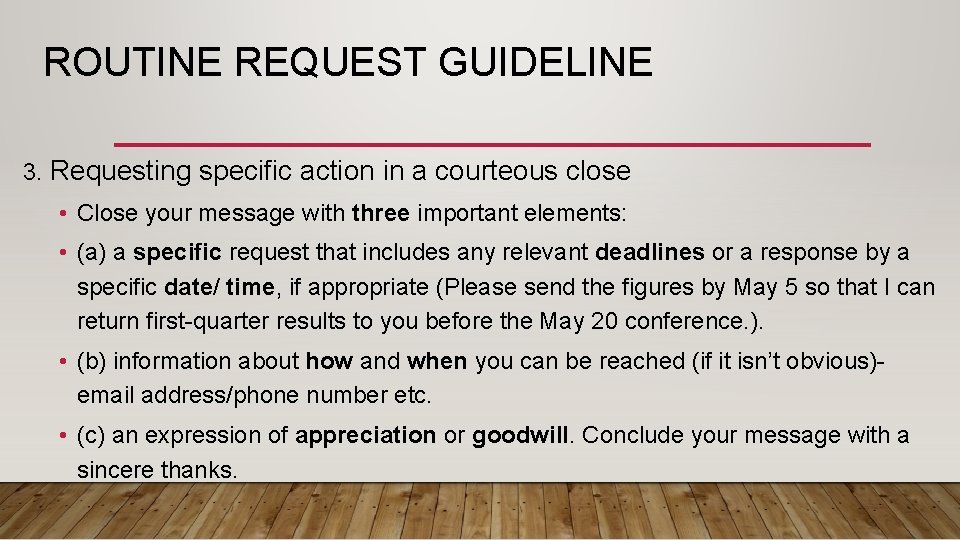
ROUTINE REQUEST GUIDELINE 3. Requesting specific action in a courteous close • Close your message with three important elements: • (a) a specific request that includes any relevant deadlines or a response by a specific date/ time, if appropriate (Please send the figures by May 5 so that I can return first-quarter results to you before the May 20 conference. ). • (b) information about how and when you can be reached (if it isn’t obvious)email address/phone number etc. • (c) an expression of appreciation or goodwill. Conclude your message with a sincere thanks.
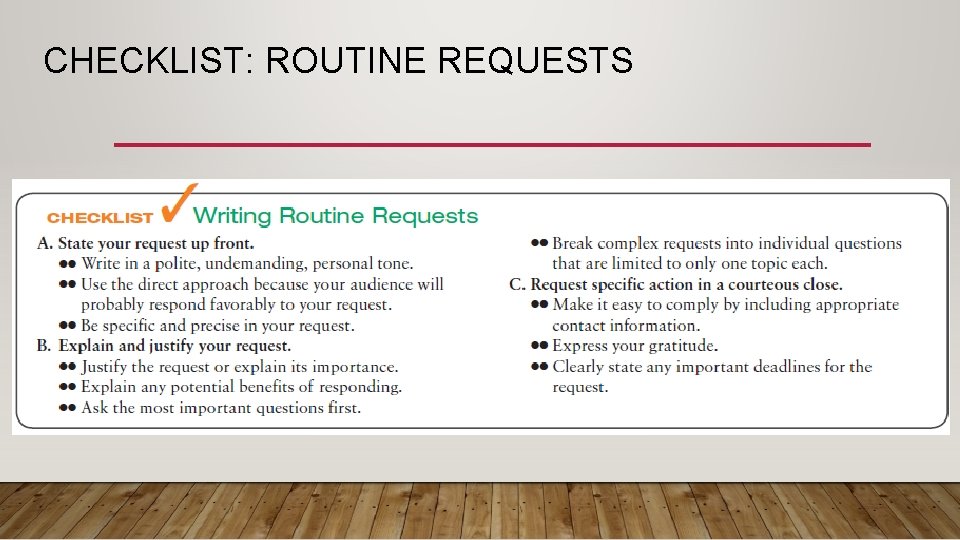
CHECKLIST: ROUTINE REQUESTS
ROUTINE REQUESTS 1. Routine Matters/Inquiries 2. Claims/Request for Adjustments
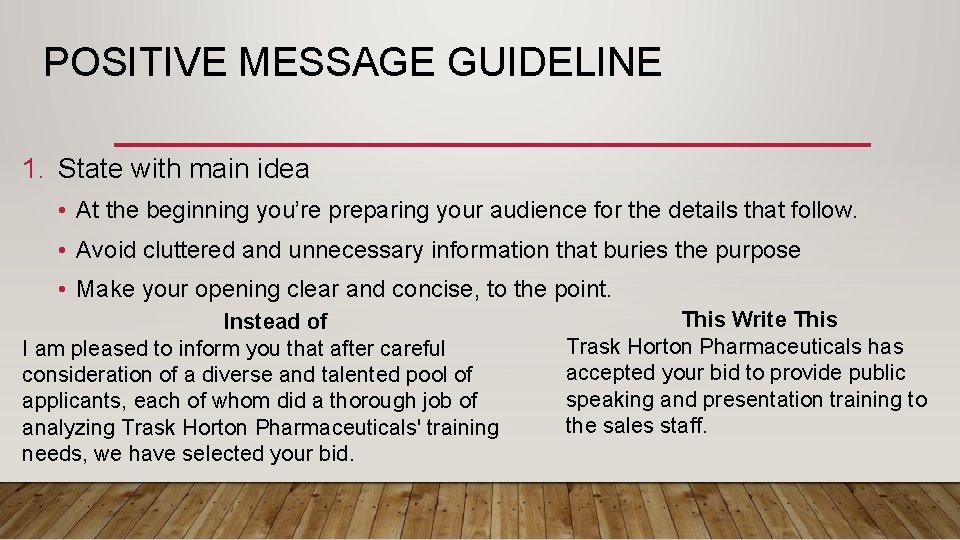
POSITIVE MESSAGE GUIDELINE 1. State with main idea • At the beginning you’re preparing your audience for the details that follow. • Avoid cluttered and unnecessary information that buries the purpose • Make your opening clear and concise, to the point. Instead of I am pleased to inform you that after careful consideration of a diverse and talented pool of applicants, each of whom did a thorough job of analyzing Trask Horton Pharmaceuticals' training needs, we have selected your bid. This Write This Trask Horton Pharmaceuticals has accepted your bid to provide public speaking and presentation training to the sales staff.
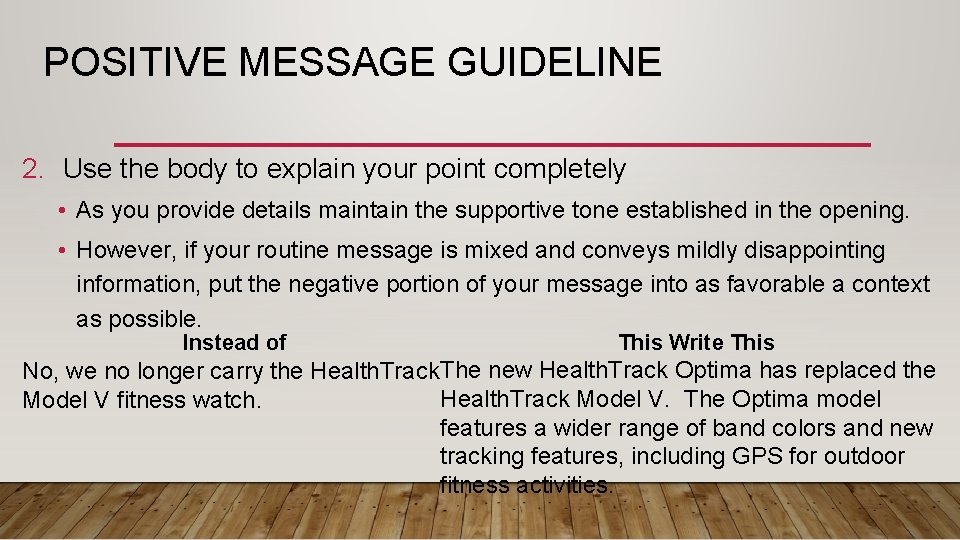
POSITIVE MESSAGE GUIDELINE 2. Use the body to explain your point completely • As you provide details maintain the supportive tone established in the opening. • However, if your routine message is mixed and conveys mildly disappointing information, put the negative portion of your message into as favorable a context as possible. Instead of This Write This No, we no longer carry the Health. Track. The new Health. Track Optima has replaced the Health. Track Model V. The Optima model Model V fitness watch. features a wider range of band colors and new tracking features, including GPS for outdoor fitness activities.
POSITIVE MESSAGE GUIDELINE 3. End with a courteous close • The close is usually short and simple because you’re leaving things on a neutral or positive note and not usually asking for the reader to do anything. • A simple thank you is all you need. • However, if follow-up action is required or expected, use the close to identify who will do what and when that action will take place.
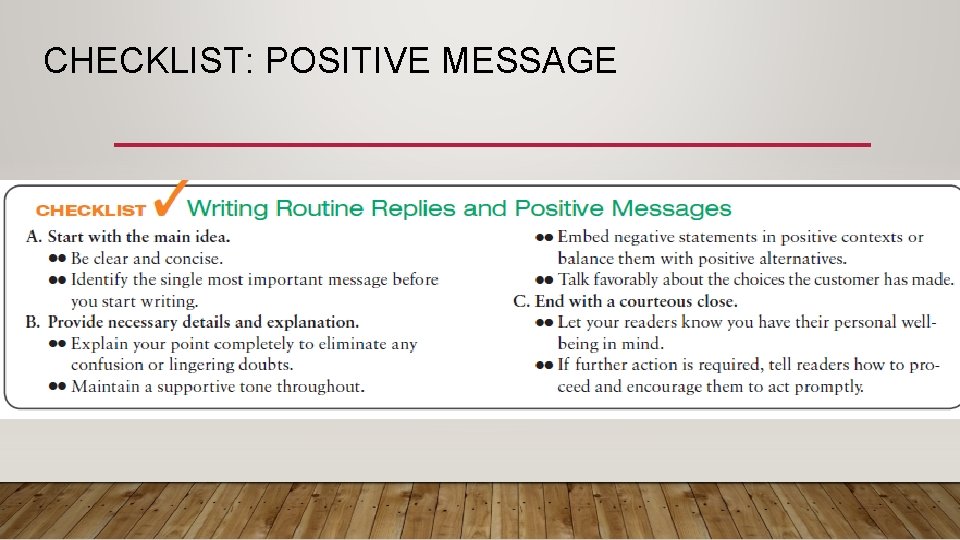
CHECKLIST: POSITIVE MESSAGE
POSITIVE MESSAGES 3. Favorable responses 4. Adjustment grants 5. Fostering Goodwill 6. Operational communications
FAVORABLE RESPONSE Favorable Responses are positive answers to inquiries. 1. Identify the message being answered—in the beginning or subject line. (Since it is a response to another message) 2. Begin with the answer or state you are complying with the request. 3. Logically answer the questions- If there is only one question just answer that. If more than one then arrange them. 4. Skillfully handle the negatives- Handle the bad news with care. Do not put it in the very beginning or end. Choose language considering the rules we learnt in previous chapters. Consider including extras-Any additional information that might be valuable, any alternatives. 5. End with goodwill.
ADJUSTMENT GRANTS Adjustment grants are when a company acknowledges their error and corrects for it by giving the customer an adjustment. 1. Acknowledge receipt of the customer’s claim or complain. 2. Take responsibility and let client know that their adjustment is being granted. Be aware of company policies, and use them as guidelines. 3. Explain precisely the plan to resolve the situation. 4. Acknowledge the customer’s inconvenience. Give an explanation/mention the corrective action that will be taken/the precautionary measures. 5. Have a courteous close.
FOSTERING GOODWILL Some business messages are written specifically to build goodwill. These notes often have no direct business purpose However they enhance relationships with customers, colleagues, and other businesses. 1. Congratulating someone- Taking note of significant events in someone’s personal life. 2. Sending message of appreciation- An effective message of appreciation documents a person’s contributions. Your praise does more than just make the person feel good; it encourages further excellence. 3. Offering condolences-The primary purpose of condolence messages is to let the audience know that you and the organization you represent care about the person’s loss.
OPERATIONAL COMMUNICATION The internal communications needed in a company’s work. 1. Casual • Quick responses to immediate work needs • Usually sent between peers 2. Moderately formal • More carefully constructed direct messages • The messages that we looked at in this chapter 3. Highly formal • Messages about policies and procedures • Formal documents that require professional vetting