
Writing Process Body Paragraphs The Writing Process Lets
Writing Process: Body Paragraphs
The Writing Process Let’s look at how far we’ve come… Brainstorming Thesis Outline What’s next? Rough Draft
Body Paragraphs The body paragraphs are often referred to as the meat of the essay because they are the most important part of the essay. Since this is the most important part, you must organize your body paragraph with careful thought. Your outline should help you during this process.
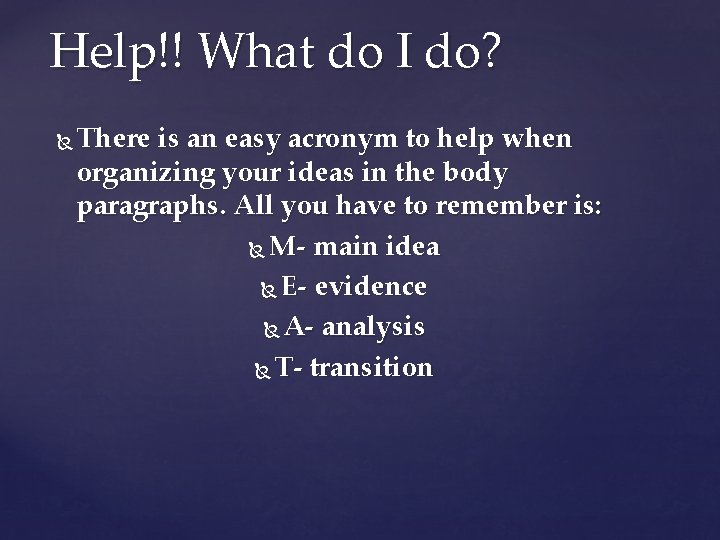
Help!! What do I do? There is an easy acronym to help when organizing your ideas in the body paragraphs. All you have to remember is: M- main idea E- evidence A- analysis T- transition
M: Main Idea The first sentence in your body paragraph is your topic sentence. (Main Idea) You have already written your topic sentence, so you shouldn’t have any trouble placing this in your rough draft.
E: Evidence After the Topic Sentence, introduce and state your evidence. WARNING! You need to introduce your evidence, especially if it is a quotation. You may need to explain some context of the evidence to your reader, but don’t get carried away. You don’t want to get off track!
A: Analysis After your have provided your evidence, you want to analyze (unpack, break down) your evidence to your reader. Explain why this evidence is important AND relate it back to your topic sentence. ***Always make sure you show your evidence supports your main idea.
T: Transition Lastly, transition into a new piece of evidence, or transition into a new paragraph. Make smooth transitions between ideas within the same paragraphs by showing how both ideas relate to the same topic sentence. When transitioning to a new paragraph, you want to create a concluding sentence that summarizes the main idea of that body paragraph.
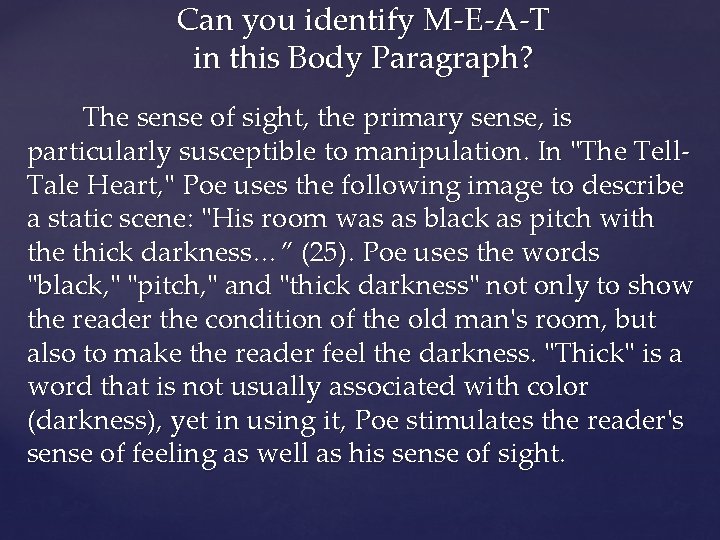
Can you identify M-E-A-T in this Body Paragraph? The sense of sight, the primary sense, is particularly susceptible to manipulation. In "The Tell. Tale Heart, " Poe uses the following image to describe a static scene: "His room was as black as pitch with the thick darkness…” (25). Poe uses the words "black, " "pitch, " and "thick darkness" not only to show the reader the condition of the old man's room, but also to make the reader feel the darkness. "Thick" is a word that is not usually associated with color (darkness), yet in using it, Poe stimulates the reader's sense of feeling as well as his sense of sight.
- Slides: 9