
Writing Numbers in Scientific Notation 12 340 1
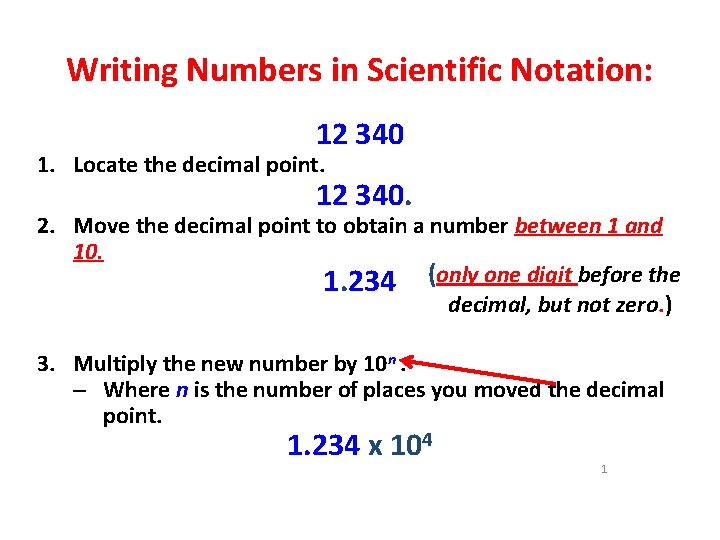
Writing Numbers in Scientific Notation: 12 340 1. Locate the decimal point. 12 340. 2. Move the decimal point to obtain a number between 1 and 10. 1. 234 (only one digit before the decimal, but not zero. ) 3. Multiply the new number by 10 n. – Where n is the number of places you moved the decimal point. 1. 234 x 104 1
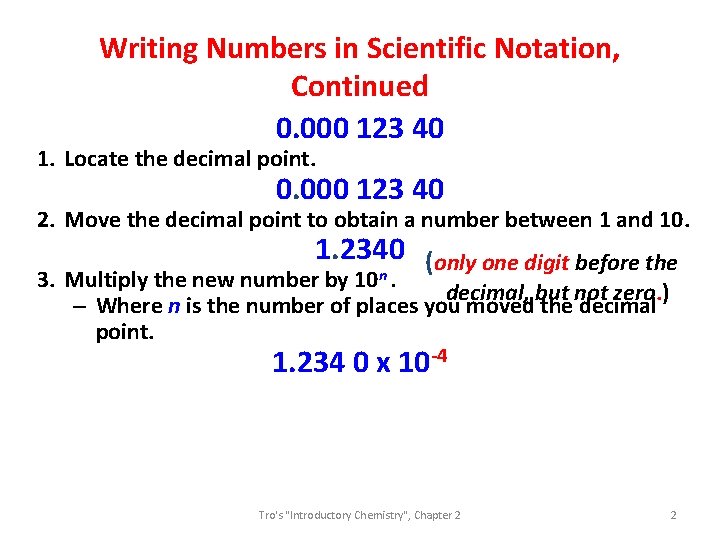
Writing Numbers in Scientific Notation, Continued 0. 000 123 40 1. Locate the decimal point. 0. 000 123 40 2. Move the decimal point to obtain a number between 1 and 10. 1. 2340 (only one digit before the n 3. Multiply the new number by 10. decimal, but not zero. ) – Where n is the number of places you moved the decimal point. 1. 234 0 x 10 -4 Tro's "Introductory Chemistry", Chapter 2 2
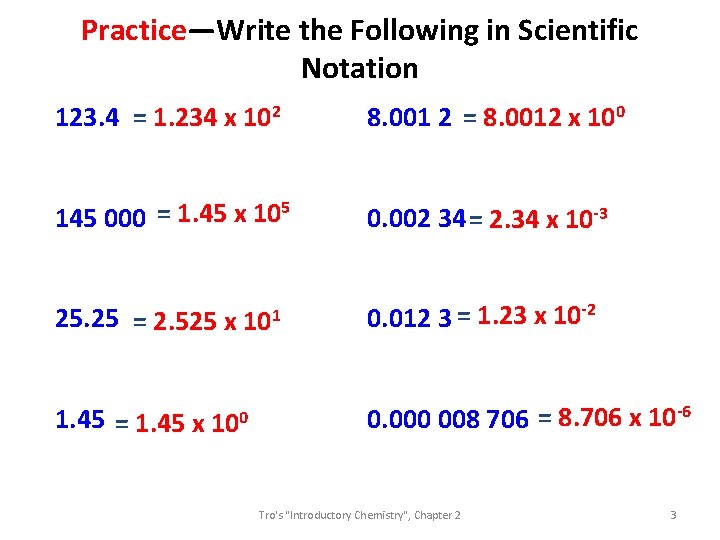
Practice—Write the Following in Scientific Notation 123. 4 = 1. 234 x 102 8. 001 2 = 8. 0012 x 100 145 000 = 1. 45 x 105 0. 002 34 = 2. 34 x 10 -3 25. 25 = 2. 525 x 101 0. 012 3 = 1. 23 x 10 -2 1. 45 = 1. 45 x 100 0. 000 008 706 = 8. 706 x 10 -6 Tro's "Introductory Chemistry", Chapter 2 3
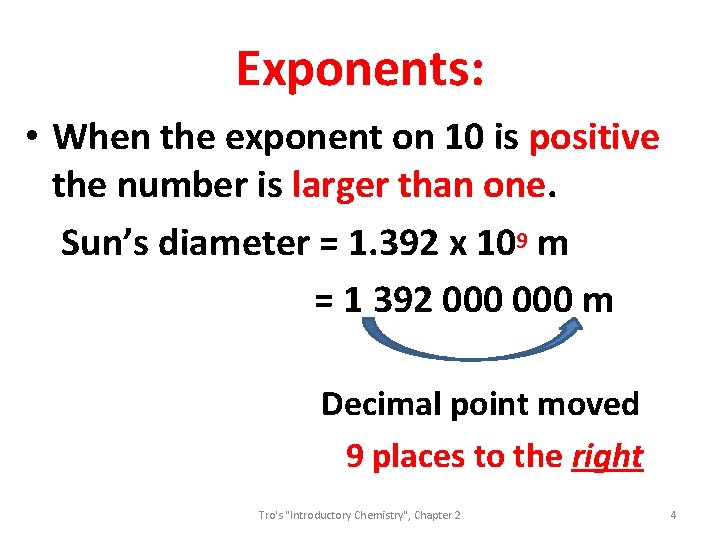
Exponents: • When the exponent on 10 is positive the number is larger than one. Sun’s diameter = 1. 392 x 109 m = 1 392 000 m Decimal point moved 9 places to the right Tro's "Introductory Chemistry", Chapter 2 4
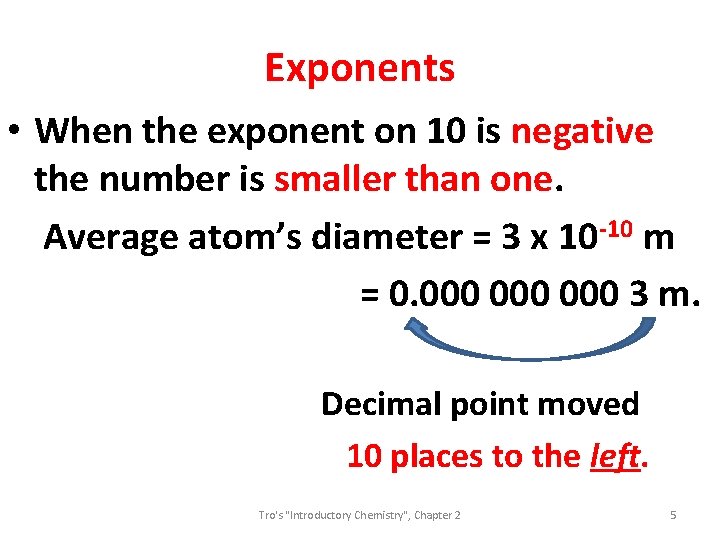
Exponents • When the exponent on 10 is negative the number is smaller than one. Average atom’s diameter = 3 x 10 -10 m = 0. 000 000 3 m. Decimal point moved 10 places to the left. Tro's "Introductory Chemistry", Chapter 2 5
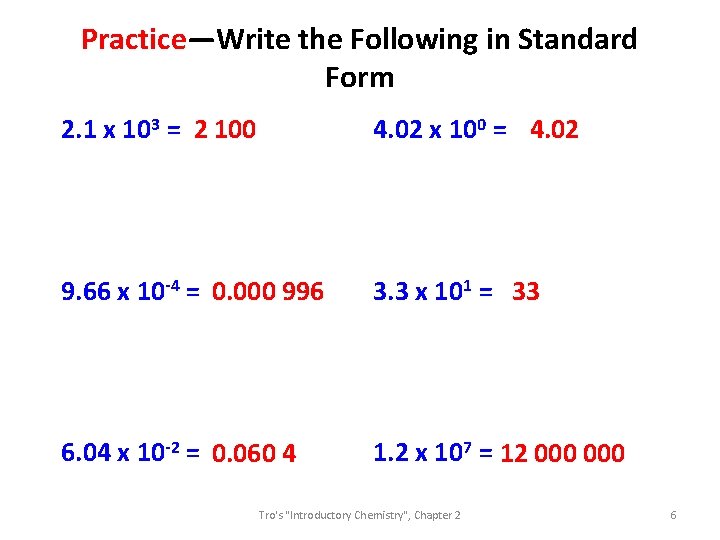
Practice—Write the Following in Standard Form 2. 1 x 103 = 2 100 4. 02 x 100 = 4. 02 9. 66 x 10 -4 = 0. 000 996 3. 3 x 101 = 33 6. 04 x 10 -2 = 0. 060 4 1. 2 x 107 = 12 000 Tro's "Introductory Chemistry", Chapter 2 6
- Slides: 6