
WRITING NONFICTION Example question and how to get
- Slides: 1
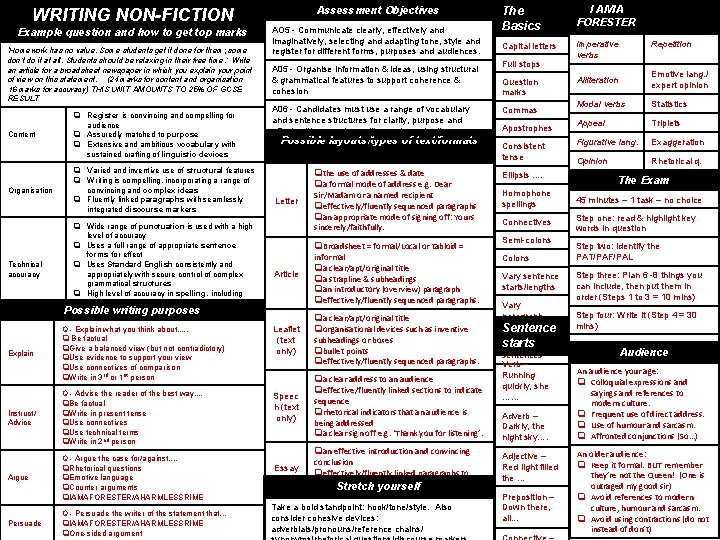
WRITING NON-FICTION Example question and how to get top marks ‘Homework has no value. Some students get it done for them; some don’t do it at all. Students should be relaxing in their free time. ’ Write an article for a broadsheet newspaper in which you explain your point of view on this statement. (24 marks for content and organisation 16 marks for accuracy) THIS UNIT AMOUNTS TO 25% OF GCSE RESULT q Register is convincing and compelling for audience Content q Assuredly matched to purpose q Extensive and ambitious vocabulary with Assessment Objectives AO 5 - Communicate clearly, effectively and imaginatively, selecting and adapting tone, style and register for different forms, purposes and audiences. A 05 - Organise information & ideas, using structural & grammatical features to support coherence & cohesion A 06 - Candidates must use a range of vocabulary and sentence structures for clarity, purpose and effect, with accurate spelling and punctuation. Possible layouts/types of text/formats sustained crafting of linguistic devices q Varied and inventive use of structural features q Writing is compelling, incorporating a range of Organisation convincing and complex ideas q Fluently linked paragraphs with seamlessly integrated discourse markers qthe use of addresses & date qa formal mode of address e. g. Dear Letter q Wide range of punctuation is used with a high level of accuracy q Uses a full range of appropriate sentence Technical accuracy forms for effect q Uses Standard English consistently and appropriately with secure control of complex grammatical structures q High level of accuracy in spelling, including ambitious vocabulary Possible writing purposes q Extensive and ambitious use of vocabulary q. Broadsheet = formal/Local or tabloid = Article Q - Explain what you think about. . . q Be factual q. Give a balanced view (but not contradictory) q. Use evidence to support your view q. Use connectives of comparison q. Write in 3 rd or 1 st person Leaflet (text only) Instruct/ Advice Q - Advise the reader of the best way. . q. Be factual q. Write in present tense q. Use connectives q. Use technical terms q. Write in 2 nd person Speec h (text only) Argue Q - Argue the case for/against. . q. Rhetorical questions q. Emotive language q. Counter arguments q. IAMAFORESTER/AHARMLESSRIME Explain Persuade Q - Persuade the writer of the statement that. . . q. IAMAFORESTER/AHARMLESSRIME q. One-sided argument Sir/Madam or a named recipient qeffectively/fluently sequenced paragraphs qan appropriate mode of signing off: Yours sincerely/faithfully. informal qa clear/apt/original title qa strapline & subheadings qan introductory (overview) paragraph qeffectively/fluently sequenced paragraphs. qa clear/apt/original title qorganisational devices such as inventive subheadings or boxes qbullet points qeffectively/fluently sequenced paragraphs. qa clear address to an audience qeffective/fluently linked sections to indicate sequence qrhetorical indicators that an audience is being addressed qa clear sign off e. g. ‘Thank you for listening’. qan effective introduction and convincing Essay conclusion qeffectively/fluently linked paragraphs to sequence a rangeyourself of ideas. Stretch Take a bold standpoint: hook/tone/style. Also consider cohesive devices: adverbials/pronouns/reference chains/ The Basics I AM A FORESTER Capital letters Imperative verbs Full stops Question marks Commas Apostrophes Consistent tense Ellipsis. . Repetition Alliteration Emotive lang. / expert opinion Modal verbs Statistics Appeal Triplets Figurative lang. Exaggeration Opinion Rhetorical q. The Exam Homophone spellings 45 minutes – 1 task – no choice Connectives Step one: read & highlight key words in question Semi-colons Colons Vary sentence starts/lengths Vary paragraph lengths Sentence starts Topic sentences Verb – Running quickly, she …… Adverb – Darkly, the night sky…. Adjective – Red light filled the … Preposition – Down there, all. . . Step two: Identify the PAT/PAF/PAL Step three: Plan 6 -8 things you can include, then put them in order (Steps 1 to 3 = 10 mins) Step four: Write it (Step 4 = 30 mins) Step five (MOST IMPORTANT): Audience Lip check (Step 5 = 5 minutes) An audience your age: q Colloquial expressions and sayings and references to modern culture. q Frequent use of direct address. q Use of humour and sarcasm. q Affronted conjunctions (So…) An older audience: q Keep it formal. BUT remember they’re not the Queen! (One is outraged my good sir) q Avoid references to modern culture, humour and sarcasm. q Avoid using contractions (do not instead of don’t)