
Writing ModelCheckers for Boolean Recursive Programs using a

Writing Model-Checkers for Boolean Recursive Programs using a Fixed-Point Calculus Gennaro Parlato - UIUC Joint work with Madhusudan - UIUC Salvatore La Torre – U. of Salerno, Italy
What this talk is about A framework to implement symbolic model-checking algorithms for Boolean programs (tool GETAFIX) • Easy – to implement and debug – to experiment with variants • High level formalism – express algorithms in fixed-point calculus – hide details unrelated to the algorithmic aspects of solutions • Efficient – competitive with mature model-checkers
Using traditional programming languages (e. g. , C or Java) • It is a complex task – – memory management caching management variable ordering (BDD). . • A typical model checker spans over thousand lines of code – Hard to check the correctness • Small changes in the algorithms may require redesigning large portions of code – usually hard to try new ideas
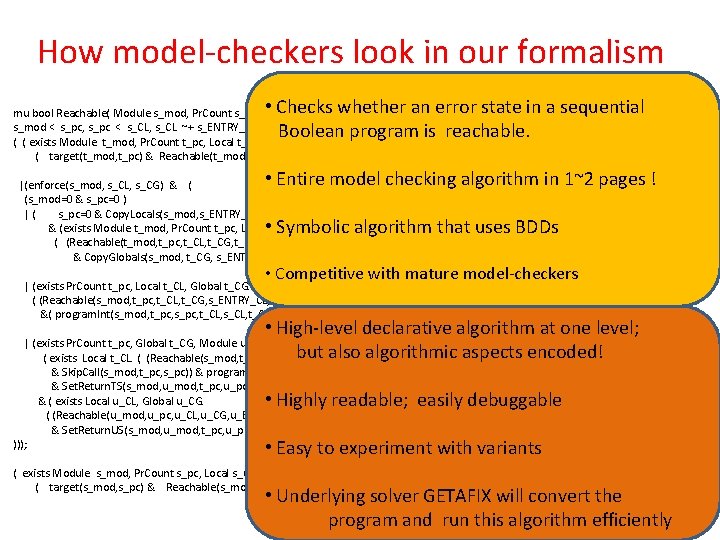
How model-checkers look in our formalism • Checks whether an error state in a sequential Boolean program is reachable. mu bool Reachable( Module s_mod, Pr. Count s_pc, Local s_CL, Global s_CG, Local s_ENTRY_CL, Global s_ENTRY_CG) s_mod < s_pc, s_pc < s_CL, s_CL ~+ s_ENTRY_CL, s_CL < s_CG, s_CG ~+ s_ENTRY_CG /* BDD ordering */ ( ( exists Module t_mod, Pr. Count t_pc, Local t_CL, Global t_CG, Local t_ENTRY_CL, Global t_ENTRY_CG. ( target(t_mod, t_pc) & Reachable(t_mod, t_pc, t_CL, t_CG, t_ENTRY_CL, t_ENTRY_CG) ) ) Entire • Entire model checking algorithm in 1~2 pages ! |(enforce(s_mod, s_CL, s_CG) & ( model(s_mod=0 & s_pc=0 ) |( s_pc=0 & Copy. Locals(s_mod, s_ENTRY_CL, s_CL) & (exists Module t_mod, Pr. Count t_pc, Local • t_CL, Global t_CG, algorithm Local t_ENTRY_CL, Global t_ENTRY_CG. Symbolic that uses BDDschecking ( (Reachable(t_mod, t_pc, t_CL, t_CG, t_ENTRY_CL, t_ENTRY_CG) & Copy. Globals(s_mod, t_CG, s_CG) ) & Copy. Globals(s_mod, t_CG, s_ENTRY_CG) & program. Call(t_mod, s_mod, t_pc, t_CL, s_CL, t_CG))))algorithm! • Competitive with mature model-checkers | (exists Pr. Count t_pc, Local t_CL, Global t_CG. ( (Reachable(s_mod, t_pc, t_CL, t_CG, s_ENTRY_CL, s_ENTRY_CG) & !Calling(s_mod, t_pc)) &( program. Int(s_mod, t_pc, s_pc, t_CL, s_CL, t_CG, s_CG)))) • High-level declarative algorithm at one level; but also algorithmic aspects encoded! | (exists Pr. Count t_pc, Global t_CG, Module u_mod, Pr. Count u_pc, Local u_ENTRY_CL. ( exists Local t_CL. ( (Reachable(s_mod, t_pc, t_CL, t_CG, s_ENTRY_CL, s_ENTRY_CG) & Skip. Call(s_mod, t_pc, s_pc)) & program. Call(s_mod, u_mod, t_pc, t_CL, u_ENTRY_CL, t_CG) & Set. Return. TS(s_mod, u_mod, t_pc, u_pc, t_CL, s_CL, t_CG, s_CG))) & ( exists Local u_CL, Global u_CG. ( (Reachable(u_mod, u_pc, u_CL, u_CG, u_ENTRY_CL, t_CG) & Exit(u_mod, u_pc)) & Set. Return. US(s_mod, u_mod, t_pc, u_CL, s_CL, u_CG, s_CG)))) ))); • Highly readable; easily debuggable • Easy to experiment with variants ( exists Module s_mod, Pr. Count s_pc, Local s_CL, Global s_CG, Local s_ENTRY_CL, Global s_ENTRY_CG. ( target(s_mod, s_pc) & Reachable(s_mod, s_pc, s_CL, s_CG, s_ENTRY_CL, s_ENTRY_CG) ); • Underlying solver GETAFIX will convert the program and run this algorithm efficiently
Boolean programs are recursive imperative programs where – variables ranges over the Boolean domain only – can use non-determinism – recursive function calls – tuple of return values –…
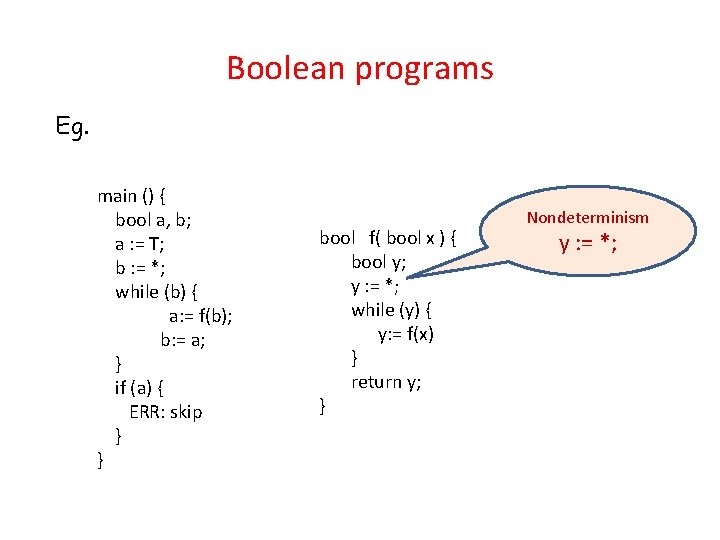
Boolean programs Eg. main () { bool a, b; a : = T; b : = *; while (b) { a: = f(b); b: = a; } if (a) { ERR: skip } } bool f( bool x ) { bool y; y : = *; while (y) { y: = f(x) } return y; } Nondeterminism y : = *;
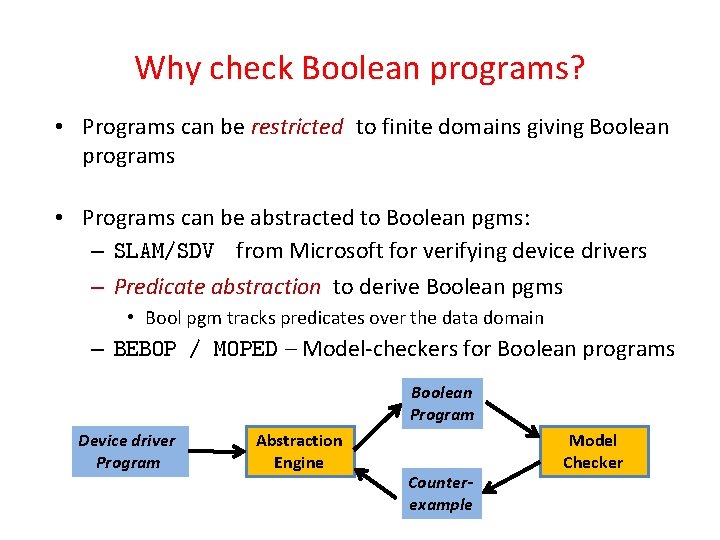
Why check Boolean programs? • Programs can be restricted to finite domains giving Boolean programs • Programs can be abstracted to Boolean pgms: – SLAM/SDV from Microsoft for verifying device drivers – Predicate abstraction to derive Boolean pgms • Bool pgm tracks predicates over the data domain – BEBOP / MOPED – Model-checkers for Boolean programs Boolean Program Device driver Program Abstraction Engine Counterexample Model Checker
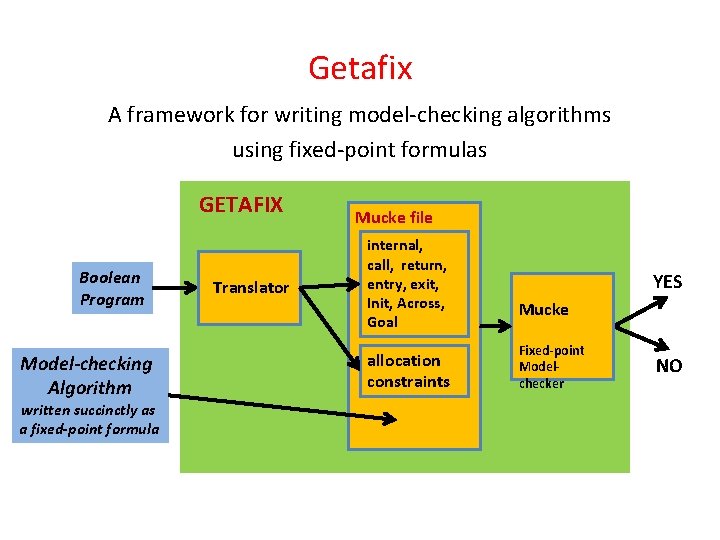
Getafix A framework for writing model-checking algorithms using fixed-point formulas GETAFIX Boolean Program Model-checking Algorithm written succinctly as a fixed-point formula Translator Mucke file internal, call, return, entry, exit, Init, Across, Goal allocation constraints YES Mucke Fixed-point Modelchecker NO
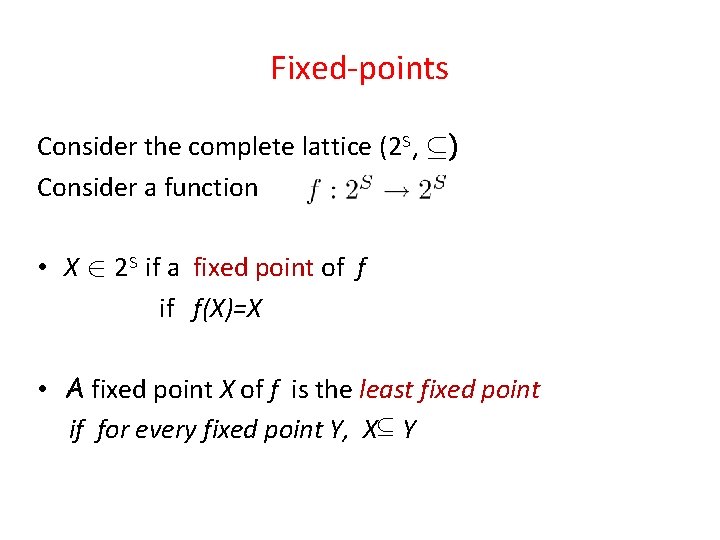
Fixed-points Consider the complete lattice (2 S, µ) Consider a function • X 2 2 S if a fixed point of f if f(X)=X • A fixed point X of f is the least fixed point if for every fixed point Y, Xµ Y
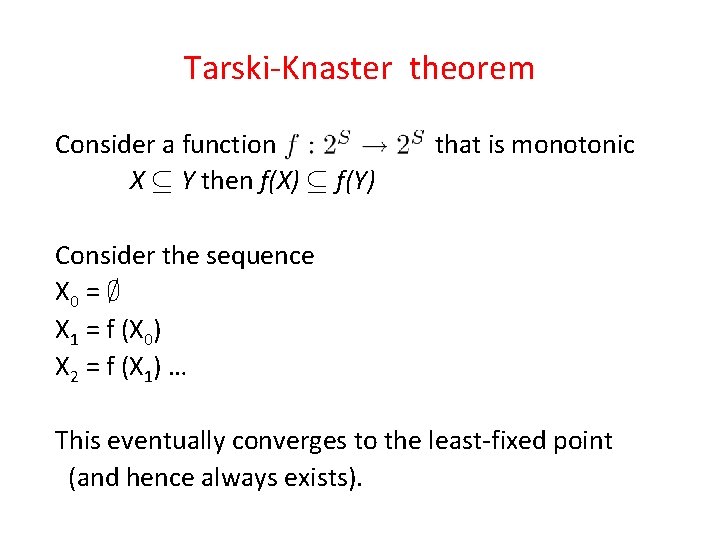
Tarski-Knaster theorem Consider a function X µ Y then f(X) µ f(Y) that is monotonic Consider the sequence X 0 = ; X 1 = f (X 0) X 2 = f (X 1) … This eventually converges to the least-fixed point (and hence always exists).
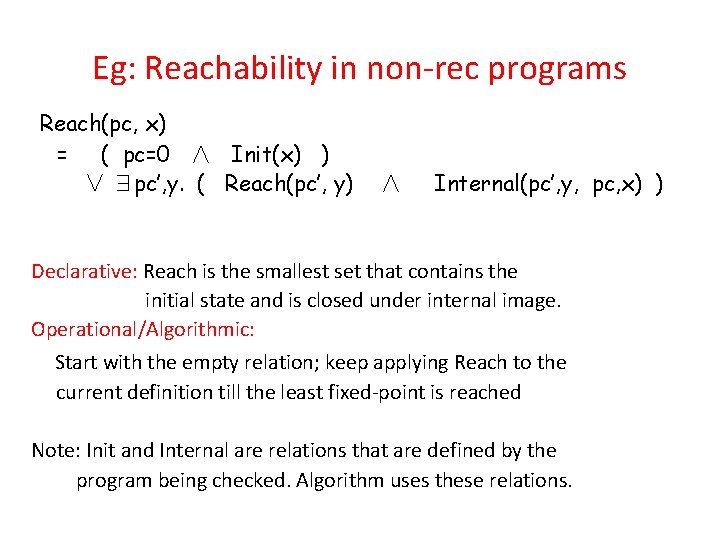
Eg: Reachability in non-rec programs Reach(pc, x) = ( pc=0 ∧ Init(x) ) ∨ ∃pc’, y. ( Reach(pc’, y) ∧ Internal(pc’, y, pc, x) ) Declarative: Reach is the smallest set that contains the initial state and is closed under internal image. Operational/Algorithmic: Start with the empty relation; keep applying Reach to the current definition till the least fixed-point is reached Note: Init and Internal are relations that are defined by the program being checked. Algorithm uses these relations.
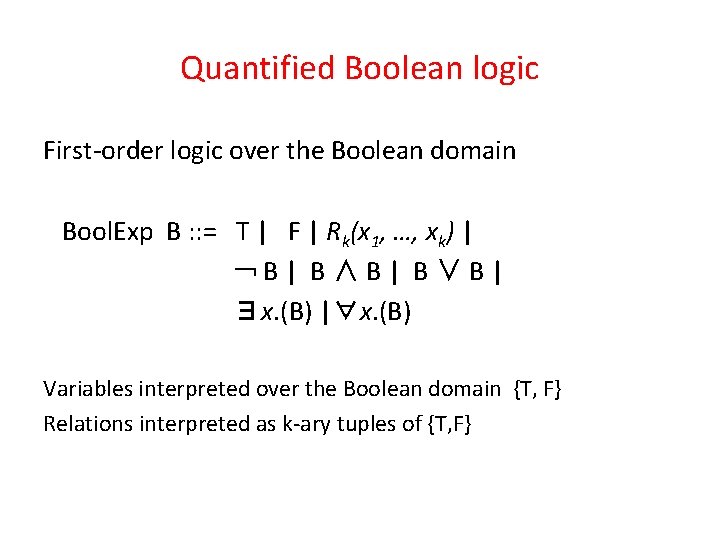
Quantified Boolean logic First-order logic over the Boolean domain Bool. Exp B : : = T | F | Rk(x 1, …, xk) | ¬B| B∧B| B∨B| ∃x. (B) |∀x. (B) Variables interpreted over the Boolean domain {T, F} Relations interpreted as k-ary tuples of {T, F}
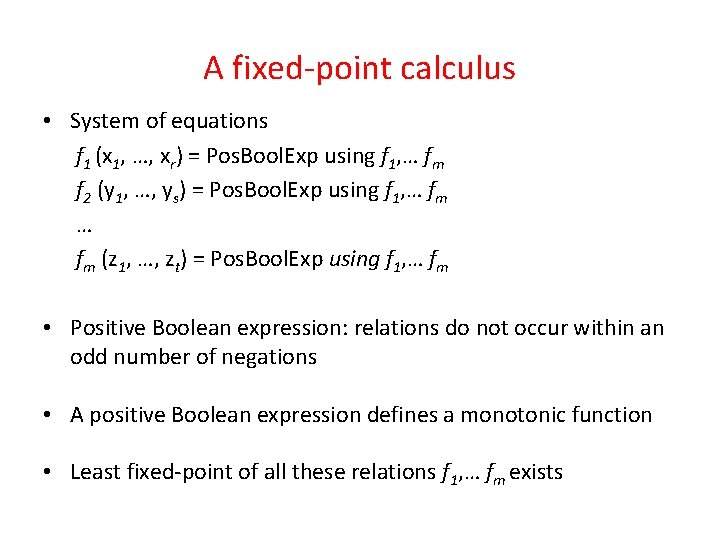
A fixed-point calculus • System of equations f 1 (x 1, …, xr) = Pos. Bool. Exp using f 1, … fm f 2 (y 1, …, ys) = Pos. Bool. Exp using f 1, … fm (z 1, …, zt) = Pos. Bool. Exp using f 1, … fm • Positive Boolean expression: relations do not occur within an odd number of negations • A positive Boolean expression defines a monotonic function • Least fixed-point of all these relations f 1, … fm exists
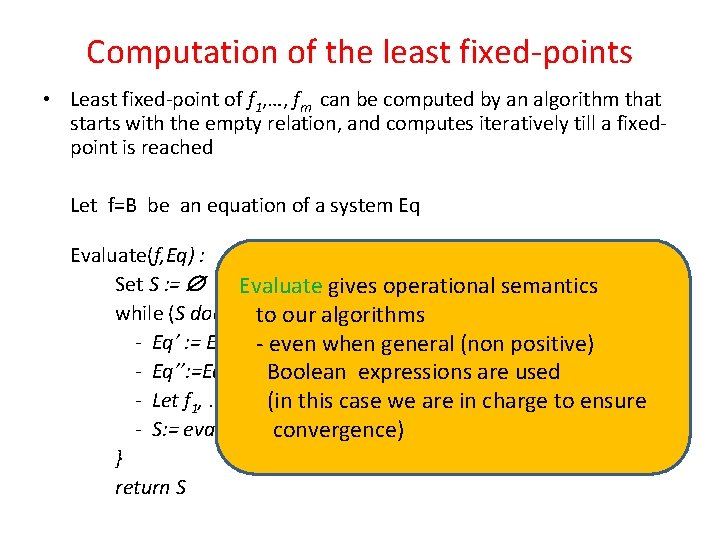
Computation of the least fixed-points • Least fixed-point of f 1, …, fm can be computed by an algorithm that starts with the empty relation, and computes iteratively till a fixedpoint is reached Let f=B be an equation of a system Eq Evaluate(f, Eq) : Set S : = Evaluate gives operational semantics while (S does nottostabilize) { our algorithms - Eq’ : = Eq f -=even B when general (non positive) - Eq’’: =Eq’ [f Boolean S] expressions are used - Let f 1, . . . , fr occur in B case do: Swe (in this are in charge i : = Evaluate(f i, Eq’’)to ensure - S: = evaluationconvergence) of B[f 1 S 1, . . , fr Sr, f S] } return S
Getafix for sequential Boolean programs
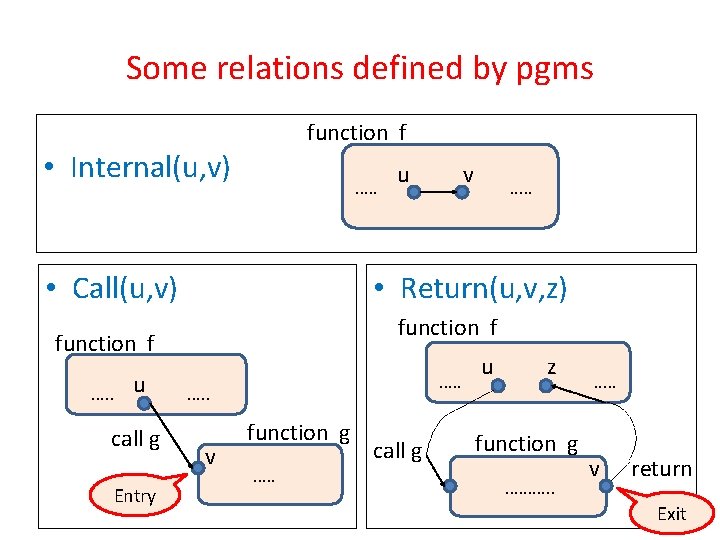
Some relations defined by pgms function f • Internal(u, v) . . . • Call(u, v) u call g Entry v . . . • Return(u, v, z) function f. . . u . . v function g. . . call g u z function g. . . . v return Exit
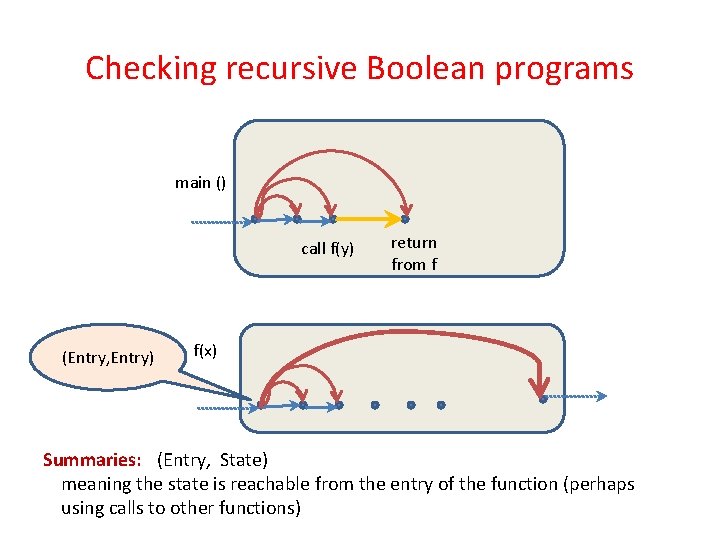
Checking recursive Boolean programs main () call f(y) (Entry, Entry) return from f f(x) Summaries: (Entry, State) meaning the state is reachable from the entry of the function (perhaps using calls to other functions)
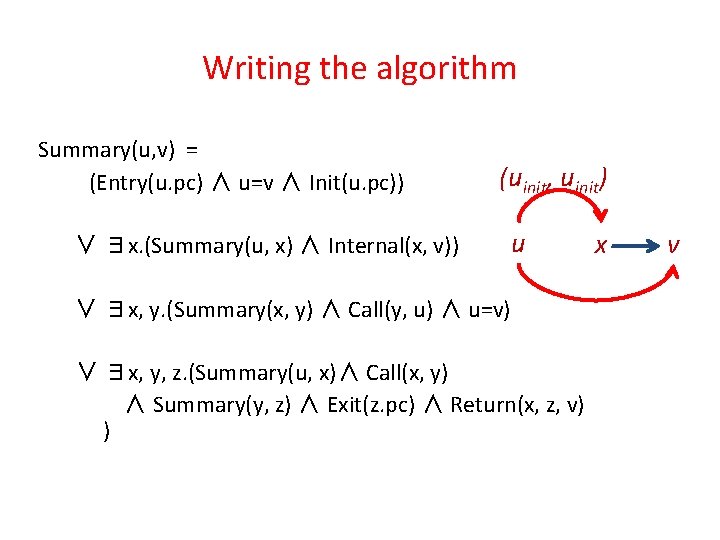
Writing the algorithm Summary(u, v) = (Entry(u. pc) ∧ u=v ∧ Init(u. pc)) (uinit, uinit) ∨ ∃x. (Summary(u, x) ∧ Internal(x, v)) u ∨ ∃x, y. (Summary(x, y) ∧ Call(y, u) ∧ u=v) ∨ ∃x, y, z. (Summary(u, x)∧ Call(x, y) ∧ Summary(y, z) ∧ Exit(z. pc) ∧ Return(x, z, v) ) x v
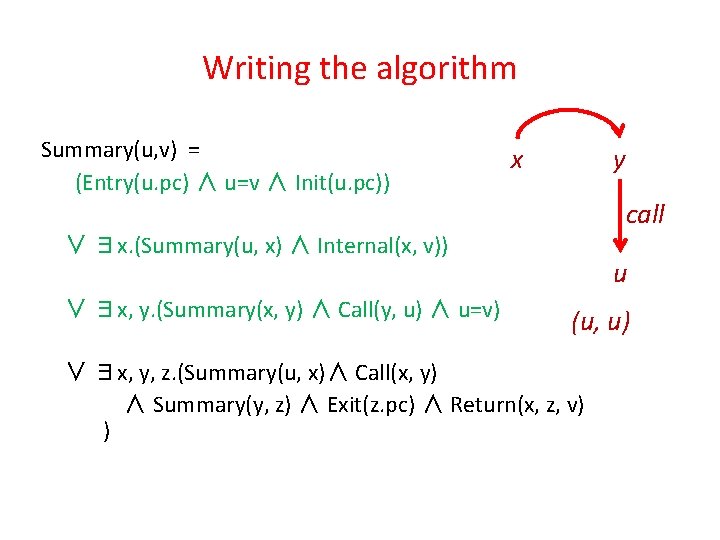
Writing the algorithm Summary(u, v) = (Entry(u. pc) ∧ u=v ∧ Init(u. pc)) x y call ∨ ∃x. (Summary(u, x) ∧ Internal(x, v)) ∨ ∃x, y. (Summary(x, y) ∧ Call(y, u) ∧ u=v) u (u, u) ∨ ∃x, y, z. (Summary(u, x)∧ Call(x, y) ∧ Summary(y, z) ∧ Exit(z. pc) ∧ Return(x, z, v) )
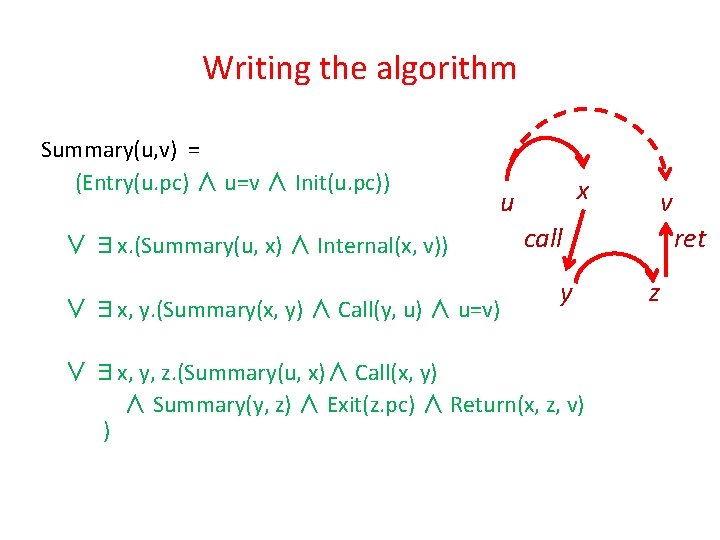
Writing the algorithm Summary(u, v) = (Entry(u. pc) ∧ u=v ∧ Init(u. pc)) x u ∨ ∃x. (Summary(u, x) ∧ Internal(x, v)) ∨ ∃x, y. (Summary(x, y) ∧ Call(y, u) ∧ u=v) v call y ∨ ∃x, y, z. (Summary(u, x)∧ Call(x, y) ∧ Summary(y, z) ∧ Exit(z. pc) ∧ Return(x, z, v) ) ret z
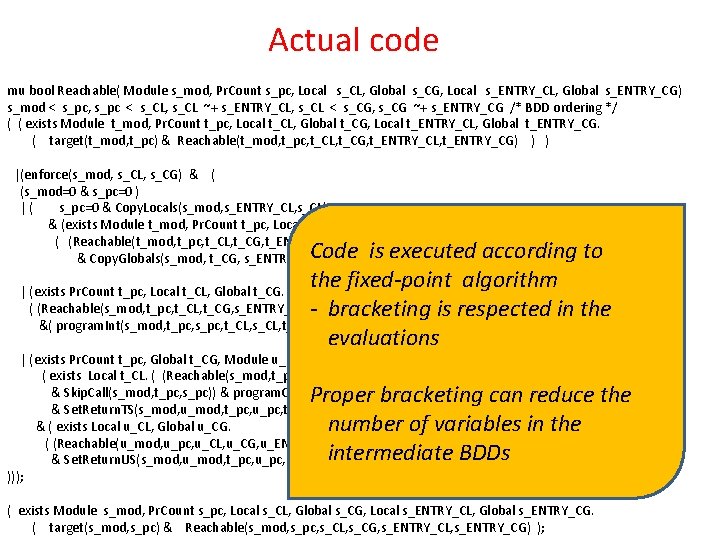
Actual code mu bool Reachable( Module s_mod, Pr. Count s_pc, Local s_CL, Global s_CG, Local s_ENTRY_CL, Global s_ENTRY_CG) s_mod < s_pc, s_pc < s_CL, s_CL ~+ s_ENTRY_CL, s_CL < s_CG, s_CG ~+ s_ENTRY_CG /* BDD ordering */ ( ( exists Module t_mod, Pr. Count t_pc, Local t_CL, Global t_CG, Local t_ENTRY_CL, Global t_ENTRY_CG. ( target(t_mod, t_pc) & Reachable(t_mod, t_pc, t_CL, t_CG, t_ENTRY_CL, t_ENTRY_CG) ) ) |(enforce(s_mod, s_CL, s_CG) & ( (s_mod=0 & s_pc=0 ) |( s_pc=0 & Copy. Locals(s_mod, s_ENTRY_CL, s_CL) & (exists Module t_mod, Pr. Count t_pc, Local t_CL, Global t_CG, Local t_ENTRY_CL, Global t_ENTRY_CG. ( (Reachable(t_mod, t_pc, t_CL, t_CG, t_ENTRY_CL, t_ENTRY_CG) & Copy. Globals(s_mod, t_CG, s_CG) ) & Copy. Globals(s_mod, t_CG, s_ENTRY_CG) & program. Call(t_mod, s_mod, t_pc, t_CL, s_CL, t_CG)))) Code is executed according to the fixed-point algorithm | (exists Pr. Count t_pc, Local t_CL, Global t_CG. ( (Reachable(s_mod, t_pc, t_CL, t_CG, s_ENTRY_CL, s_ENTRY_CG) & !Calling(s_mod, t_pc)) - bracketing is respected in the &( program. Int(s_mod, t_pc, s_pc, t_CL, s_CL, t_CG, s_CG)))) evaluations | (exists Pr. Count t_pc, Global t_CG, Module u_mod, Pr. Count u_pc, Local u_ENTRY_CL. ( exists Local t_CL. ( (Reachable(s_mod, t_pc, t_CL, t_CG, s_ENTRY_CL, s_ENTRY_CG) & Skip. Call(s_mod, t_pc, s_pc)) & program. Call(s_mod, u_mod, t_pc, t_CL, u_ENTRY_CL, t_CG) & Set. Return. TS(s_mod, u_mod, t_pc, u_pc, t_CL, s_CL, t_CG, s_CG))) & ( exists Local u_CL, Global u_CG. ( (Reachable(u_mod, u_pc, u_CL, u_CG, u_ENTRY_CL, t_CG) & Exit(u_mod, u_pc)) & Set. Return. US(s_mod, u_mod, t_pc, u_CL, s_CL, u_CG, s_CG)))) ))); Proper bracketing can reduce the number of variables in the intermediate BDDs ( exists Module s_mod, Pr. Count s_pc, Local s_CL, Global s_CG, Local s_ENTRY_CL, Global s_ENTRY_CG. ( target(s_mod, s_pc) & Reachable(s_mod, s_pc, s_CL, s_CG, s_ENTRY_CL, s_ENTRY_CG) );
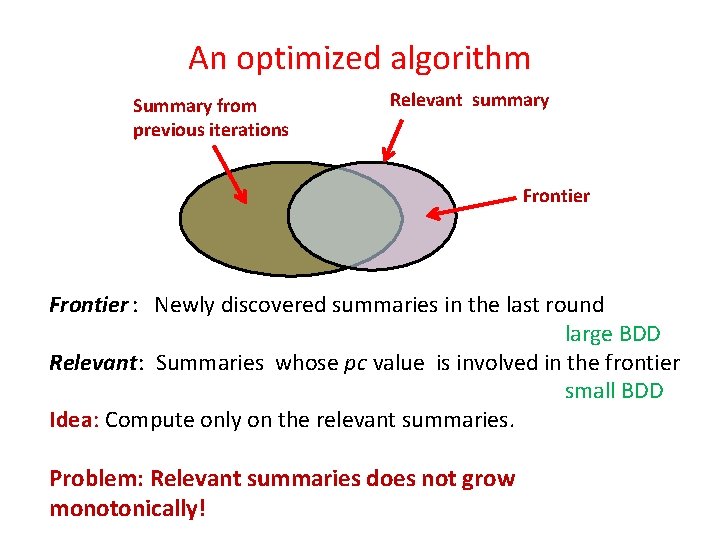
An optimized algorithm Summary from previous iterations Relevant summary Frontier : Newly discovered summaries in the last round large BDD Relevant: Summaries whose pc value is involved in the frontier small BDD Idea: Compute only on the relevant summaries. Problem: Relevant summaries does not grow monotonically!
Tarski-Knaster iteration Forget the least fixed-point. Forget theorem. Just use the algorithmic semantics of computation of finding a fixed-point Convergence of the algorithm is up to you!
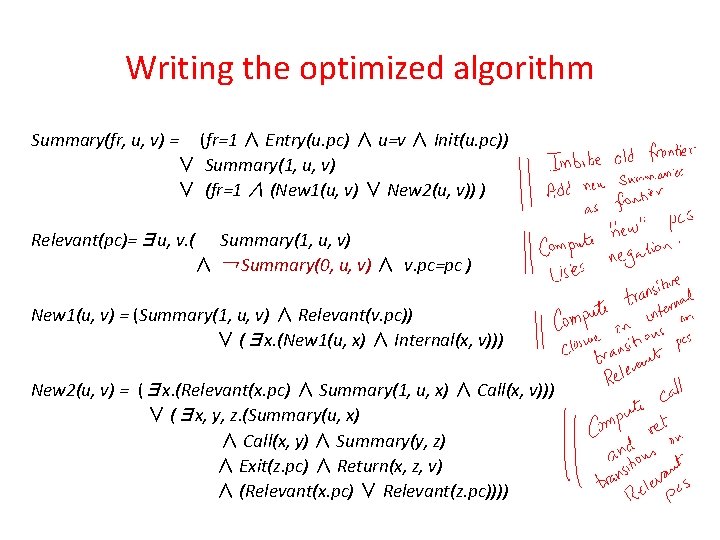
Writing the optimized algorithm Summary(fr, u, v) = (fr=1 ∧ Entry(u. pc) ∧ u=v ∧ Init(u. pc)) ∨ Summary(1, u, v) ∨ (fr=1 ∧ (New 1(u, v) ∨ New 2(u, v)) ) Relevant(pc)= ∃u, v. ( Summary(1, u, v) ∧ ¬ Summary(0, u, v) ∧ v. pc=pc ) New 1(u, v) = (Summary(1, u, v) ∧ Relevant(v. pc)) ∨ (∃x. (New 1(u, x) ∧ Internal(x, v))) New 2(u, v) = (∃x. (Relevant(x. pc) ∧ Summary(1, u, x) ∧ Call(x, v))) ∨ (∃x, y, z. (Summary(u, x) ∧ Call(x, y) ∧ Summary(y, z) ∧ Exit(z. pc) ∧ Return(x, z, v) ∧ (Relevant(x. pc) ∨ Relevant(z. pc))))
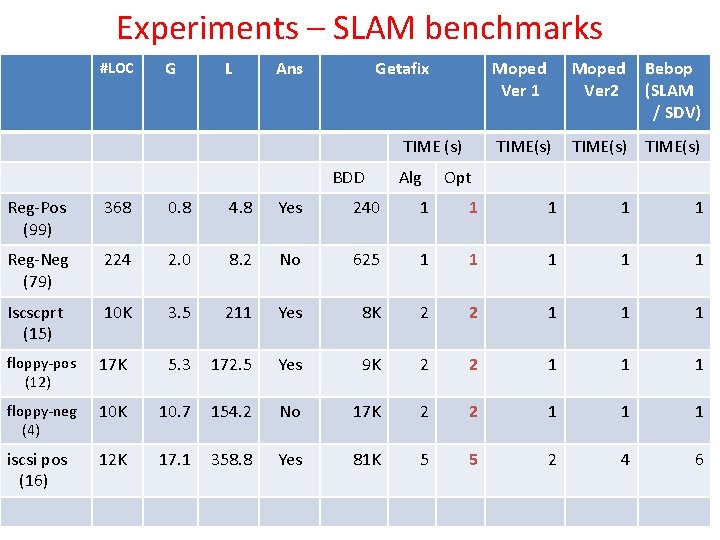
Experiments – SLAM benchmarks #LOC G L Ans Getafix TIME (s) BDD Alg Moped Ver 1 Moped Ver 2 Bebop (SLAM / SDV) TIME(s) Opt Reg-Pos (99) 368 0. 8 4. 8 Yes 240 1 1 1 Reg-Neg (79) 224 2. 0 8. 2 No 625 1 1 1 Iscscprt (15) 10 K 3. 5 211 Yes 8 K 2 2 1 1 1 floppy-pos (12) 17 K 5. 3 172. 5 Yes 9 K 2 2 1 1 1 floppy-neg (4) 10 K 10. 7 154. 2 No 17 K 2 2 1 1 1 iscsi pos (16) 12 K 17. 1 358. 8 Yes 81 K 5 5 2 4 6
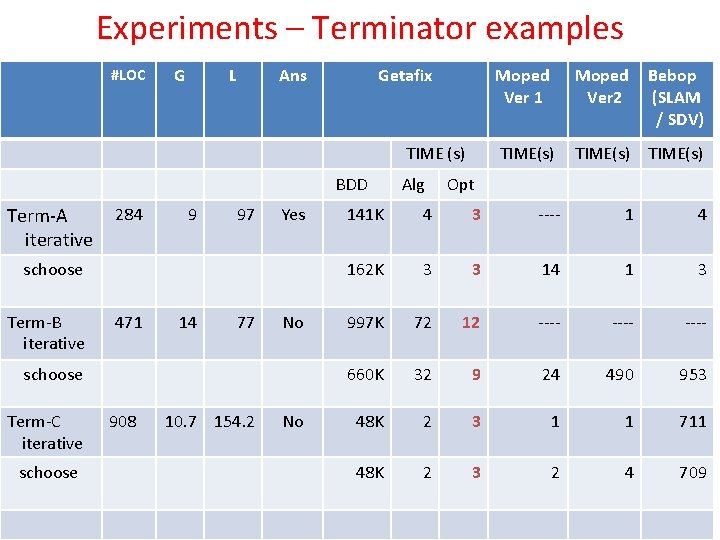
Experiments – Terminator examples #LOC G L Ans Getafix TIME (s) BDD Term-A iterative 284 9 97 Yes schoose Term-B iterative 471 14 77 No schoose Term-C iterative schoose 908 10. 7 154. 2 No Alg Moped Ver 1 Moped Ver 2 Bebop (SLAM / SDV) TIME(s) Opt 141 K 4 3 ---- 1 4 162 K 3 3 14 1 3 997 K 72 12 ---- 660 K 32 9 24 490 953 48 K 2 3 1 1 711 48 K 2 3 2 4 709
Getafix for parameterized concurrent Boolean programs
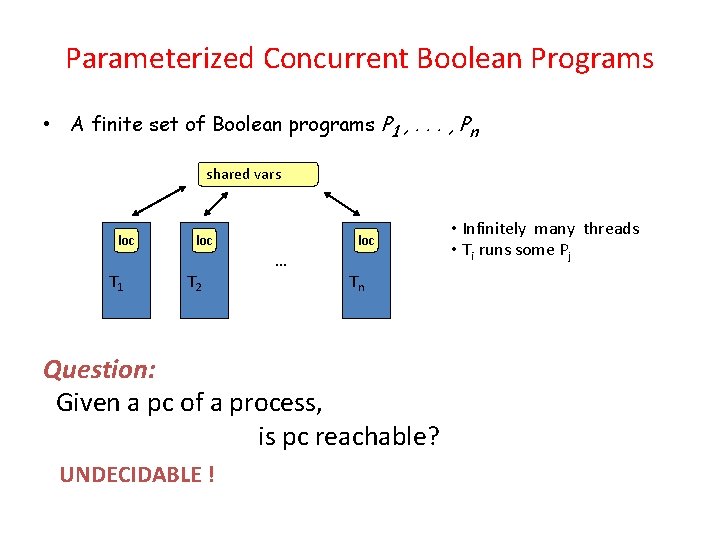
Parameterized Concurrent Boolean Programs • A finite set of Boolean programs P 1 , . . . , Pn shared vars loc T 1 loc T 2 loc … Tn Question: Given a pc of a process, is pc reachable? UNDECIDABLE ! • Infinitely many threads • Ti runs some Pj
Bounded round-robin schedules Fix k. Is an error (pc) reachable within k round-robin rounds? [Atig – Bouajjani – Qadeer ’ 09]: Decidable. Context-bounded analysis for concurrent programs with dynamic creation of threads. High computational complexity No implementation for this problem
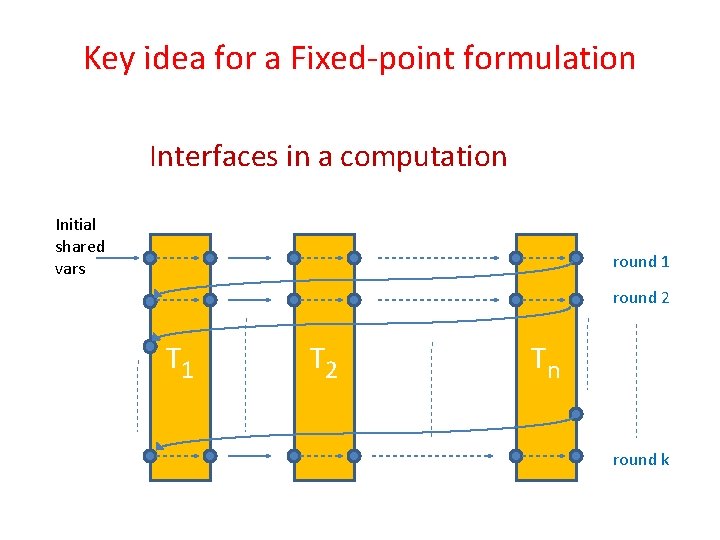
Key idea for a Fixed-point formulation Interfaces in a computation Initial shared vars round 1 round 2 T 1 T 2 Tn round k
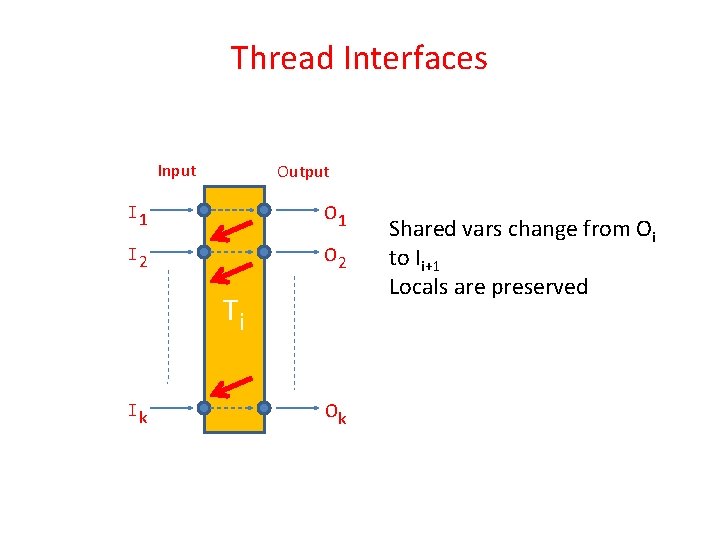
Thread Interfaces Input Output I 1 O 1 I 2 O 2 Ti Ik Ok Shared vars change from Oi to Ii+1 Locals are preserved
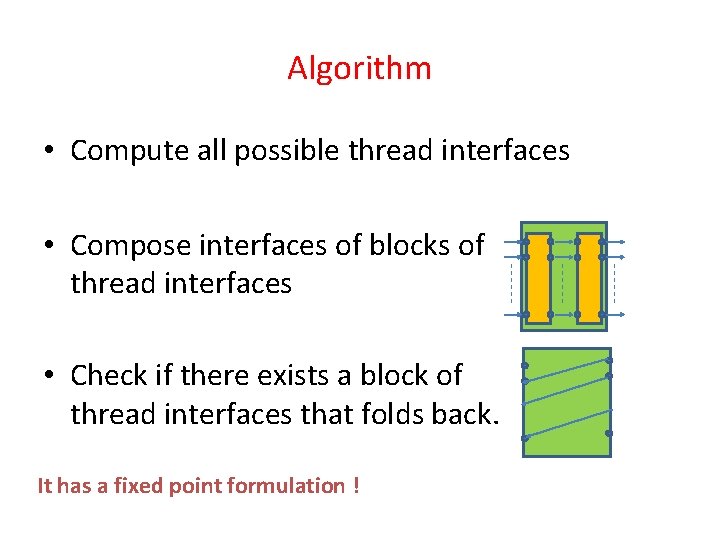
Algorithm • Compute all possible thread interfaces • Compose interfaces of blocks of thread interfaces • Check if there exists a block of thread interfaces that folds back. It has a fixed point formulation !
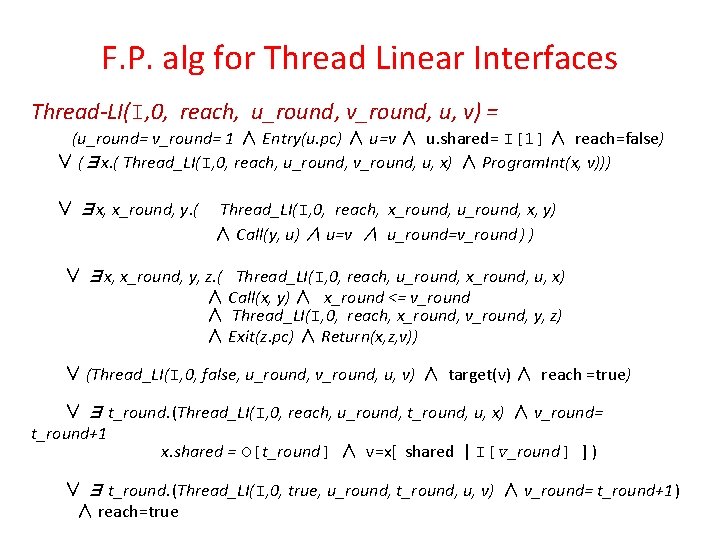
F. P. alg for Thread Linear Interfaces Thread-LI(I, 0, reach, u_round, v_round, u, v) = (u_round= v_round= 1 ∧ Entry(u. pc) ∧ u=v ∧ u. shared= I[1] ∧ reach=false) ∨ (∃x. ( Thread_LI(I, 0, reach, u_round, v_round, u, x) ∧ Program. Int(x, v))) ∨ ∃x, x_round, y. ( Thread_LI(I, 0, reach, x_round, u_round, x, y) ∧ Call(y, u) ∧ u=v ∧ u_round=v_round ) ) ∨ ∃x, x_round, y, z. ( Thread_LI(I, 0, reach, u_round, x_round, u, x) ∧ Call(x, y) ∧ x_round <= v_round ∧ Thread_LI(I, 0, reach, x_round, v_round, y, z) ∧ Exit(z. pc) ∧ Return(x, z, v)) ∨ (Thread_LI(I, 0, false, u_round, v_round, u, v) ∧ target(v) ∧ reach =true) ∨ ∃ t_round. (Thread_LI(I, 0, reach, u_round, t_round, u, x) ∧ v_round= t_round+1 x. shared = O[t_round] ∧ v=x[ shared | I[v_round] ] ) ∨ ∃ t_round. (Thread_LI(I, 0, true, u_round, t_round, u, v) ∧ v_round= t_round+1 ) ∧ reach=true
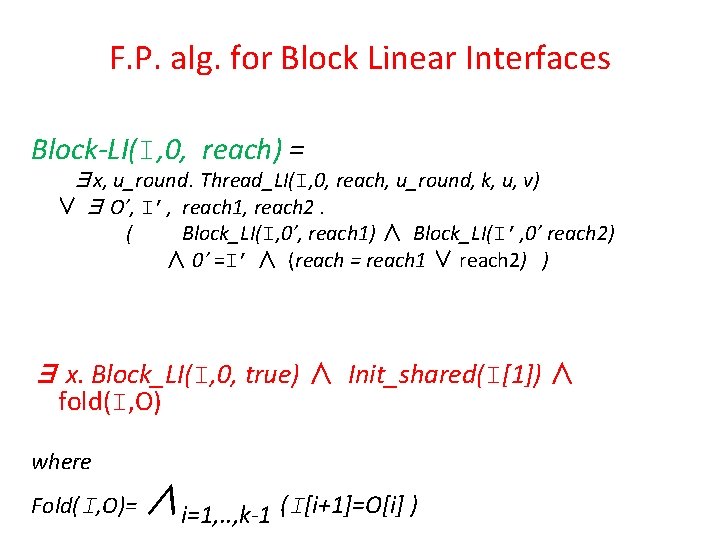
F. P. alg. for Block Linear Interfaces Block-LI(I, 0, reach) = ∃x, u_round. Thread_LI(I, 0, reach, u_round, k, u, v) ∨ ∃ O’, I’, reach 1, reach 2. ( Block_LI(I, 0’, reach 1) ∧ Block_LI(I’, 0’ reach 2) ∧ 0’ =I’ ∧ (reach = reach 1 ∨ reach 2) ) ∃ x. Block_LI(I, 0, true) ∧ Init_shared(I[1]) ∧ fold(I, O) where Fold(I, O)= ∧i=1, . . , k-1 (I[i+1]=O[i] )
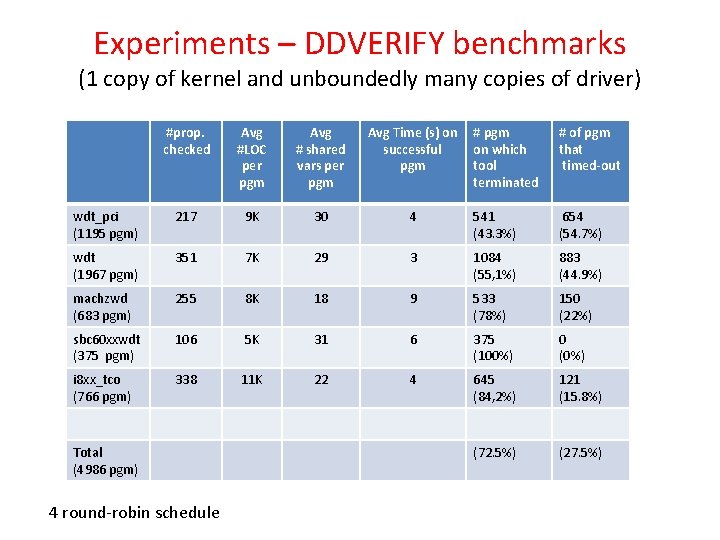
Experiments – DDVERIFY benchmarks (1 copy of kernel and unboundedly many copies of driver) #prop. checked Avg #LOC per pgm Avg # shared vars per pgm Avg Time (s) on successful pgm # pgm on which tool terminated # of pgm that timed-out wdt_pci (1195 pgm) 217 9 K 30 4 541 (43. 3%) 654 (54. 7%) wdt (1967 pgm) 351 7 K 29 3 1084 (55, 1%) 883 (44. 9%) machzwd (683 pgm) 255 8 K 18 9 533 (78%) 150 (22%) sbc 60 xxwdt (375 pgm) 106 5 K 31 6 375 (100%) 0 (0%) i 8 xx_tco (766 pgm) 338 11 K 22 4 645 (84, 2%) 121 (15. 8%) (72. 5%) (27. 5%) Total (4986 pgm) 4 round-robin schedule

Think using fixed-points. Try Getafix www. cs. uiuc. edu/~madhu/getafix
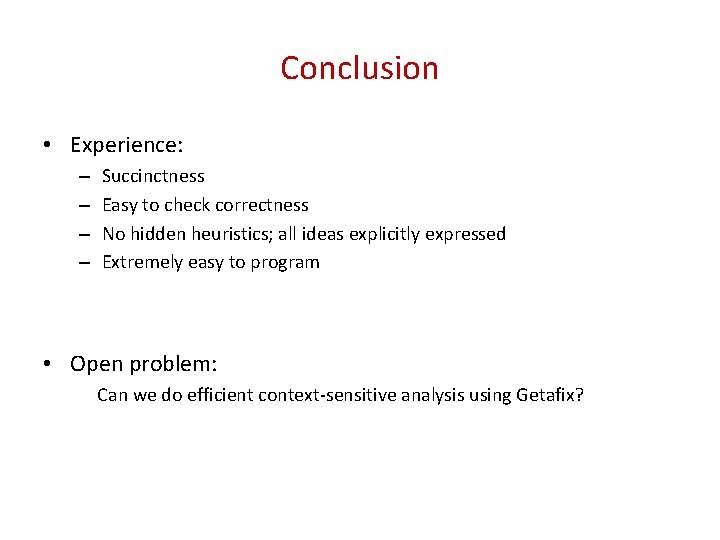
Conclusion • Experience: – – Succinctness Easy to check correctness No hidden heuristics; all ideas explicitly expressed Extremely easy to program • Open problem: Can we do efficient context-sensitive analysis using Getafix?
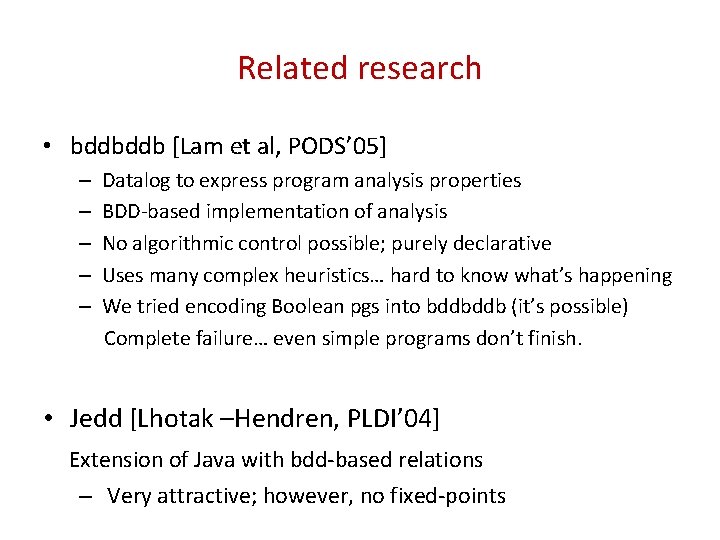
Related research • bddbddb [Lam et al, PODS’ 05] – – – Datalog to express program analysis properties BDD-based implementation of analysis No algorithmic control possible; purely declarative Uses many complex heuristics… hard to know what’s happening We tried encoding Boolean pgs into bddbddb (it’s possible) Complete failure… even simple programs don’t finish. • Jedd [Lhotak –Hendren, PLDI’ 04] Extension of Java with bdd-based relations – Very attractive; however, no fixed-points
- Slides: 38