
Writing Metasploit Plugins from vulnerability to exploit Saumil
Writing Metasploit Plugins from vulnerability to exploit Saumil Shah ceo, net-square hack. lu - Luxembourg 2006
# who am i 16: 08 up 4: 26, 1 user, load averages: 0. 28 0. 40 0. 33 USER TTY FROM LOGIN@ IDLE WHAT saumil console 11: 43 0: 05 bash • Saumil Shah - “krafty” ceo, net-square solutions saumil@saumil. net author: “Web Hacking - Attacks and Defense” © Saumil Shah

From Vulnerability to Exploit Fuzzing EIP = 0 x 4141 Debugger Attack Vector Reliable EIP return address Final Shellcode Bad characters Working exploit Test Shellcode (INT 3) Shellcode Handling INT 3? © Saumil Shah
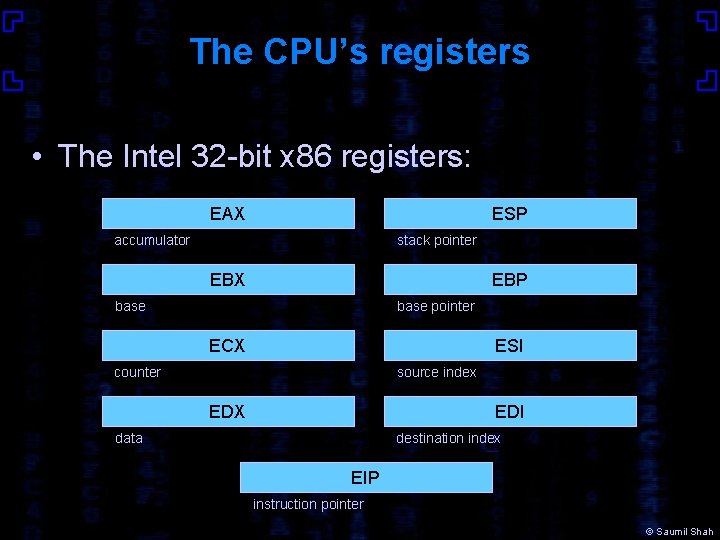
The CPU’s registers • The Intel 32 -bit x 86 registers: EAX ESP accumulator stack pointer EBX EBP base pointer ECX ESI counter source index EDX EDI data destination index EIP instruction pointer © Saumil Shah
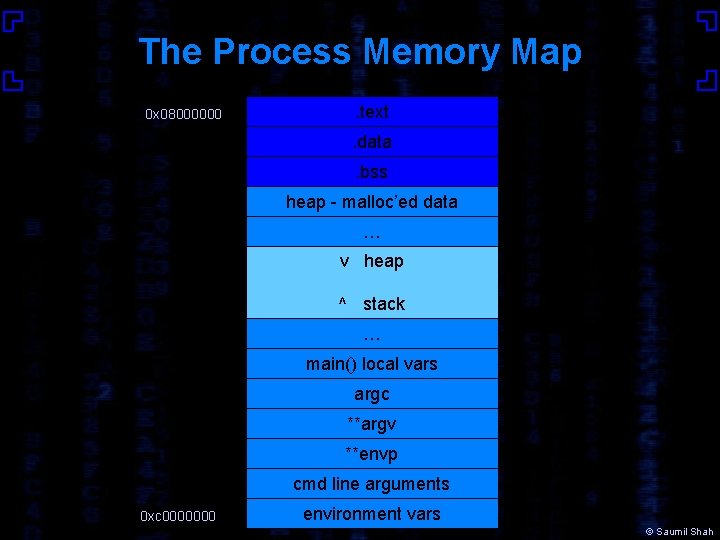
The Process Memory Map 0 x 08000000 . text. data. bss heap - malloc’ed data … v heap ^ stack … main() local vars argc **argv **envp cmd line arguments 0 xc 0000000 environment vars © Saumil Shah
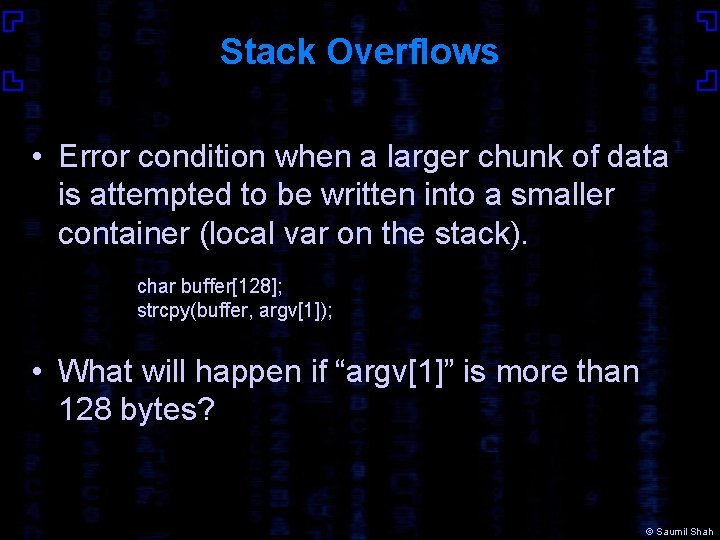
Stack Overflows • Error condition when a larger chunk of data is attempted to be written into a smaller container (local var on the stack). char buffer[128]; strcpy(buffer, argv[1]); • What will happen if “argv[1]” is more than 128 bytes? © Saumil Shah
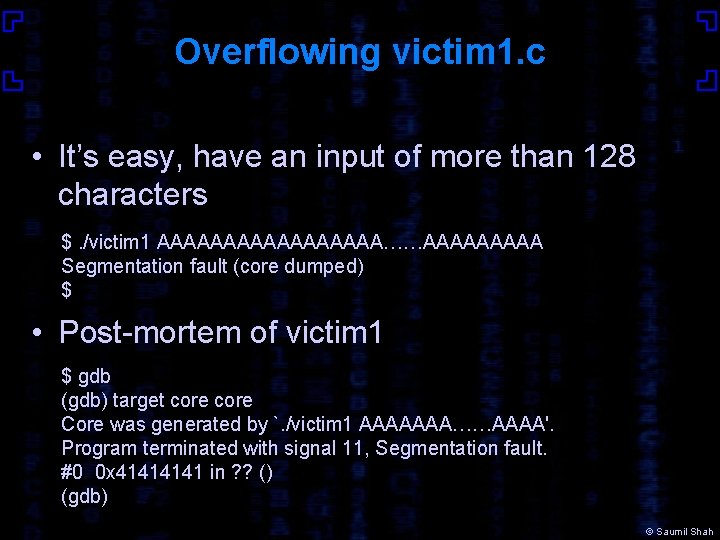
Overflowing victim 1. c • It’s easy, have an input of more than 128 characters $. /victim 1 AAAAAAAAA……AAAAA Segmentation fault (core dumped) $ • Post-mortem of victim 1 $ gdb (gdb) target core Core was generated by `. /victim 1 AAAAAAA……AAAA'. Program terminated with signal 11, Segmentation fault. #0 0 x 4141 in ? ? () (gdb) © Saumil Shah
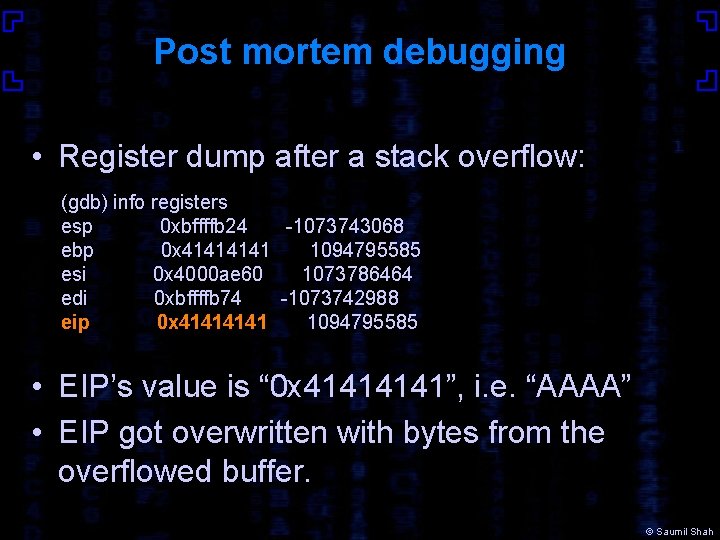
Post mortem debugging • Register dump after a stack overflow: (gdb) info registers esp 0 xbffffb 24 -1073743068 ebp 0 x 4141 1094795585 esi 0 x 4000 ae 60 1073786464 edi 0 xbffffb 74 -1073742988 eip 0 x 4141 1094795585 • EIP’s value is “ 0 x 4141”, i. e. “AAAA” • EIP got overwritten with bytes from the overflowed buffer. © Saumil Shah
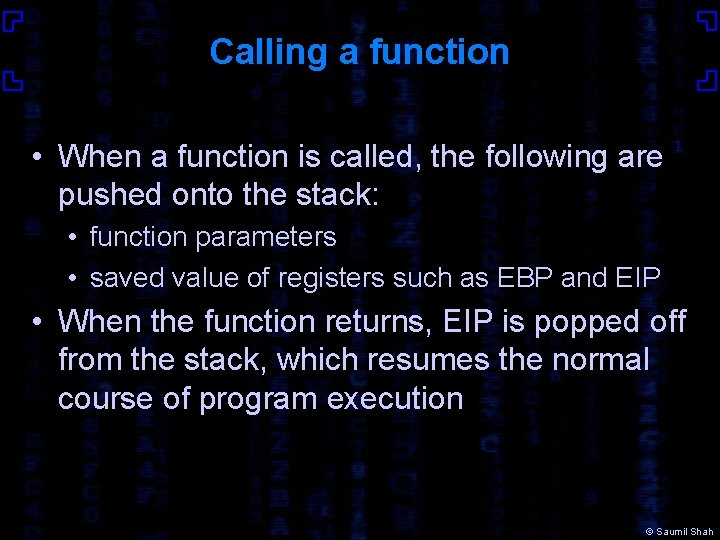
Calling a function • When a function is called, the following are pushed onto the stack: • function parameters • saved value of registers such as EBP and EIP • When the function returns, EIP is popped off from the stack, which resumes the normal course of program execution © Saumil Shah
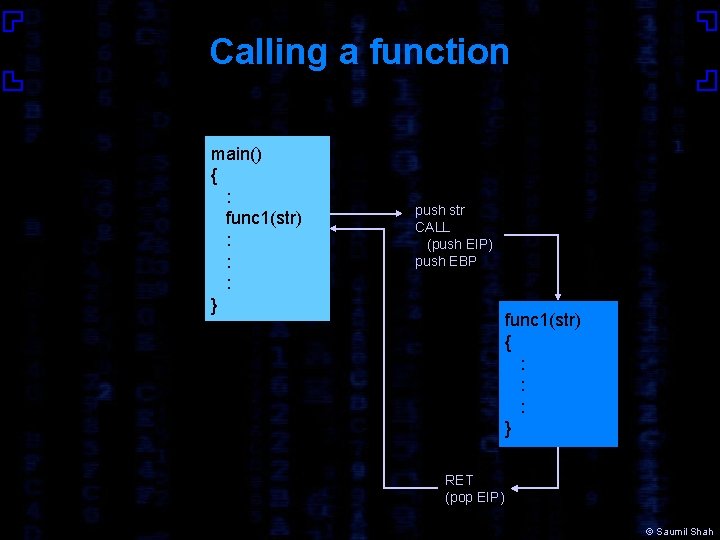
Calling a function main() { : func 1(str) : : : } push str CALL (push EIP) push EBP func 1(str) { : : : } RET (pop EIP) © Saumil Shah
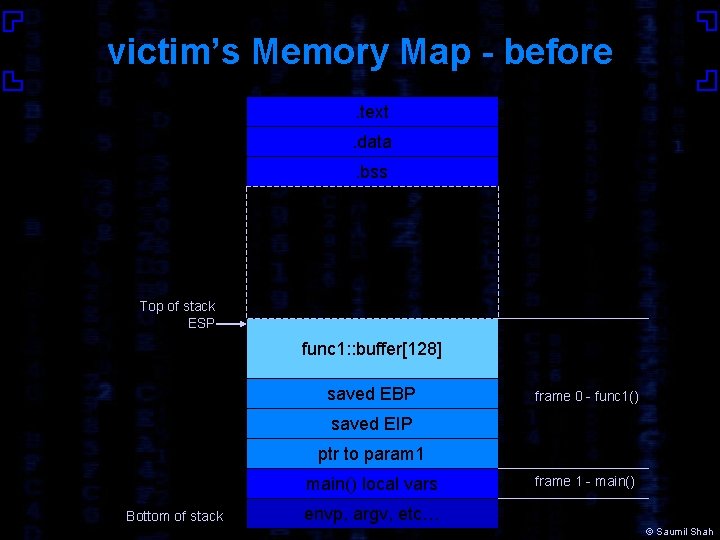
victim’s Memory Map - before. text. data. bss Top of stack ESP func 1: : buffer[128] saved EBP frame 0 - func 1() saved EIP ptr to param 1 main() local vars Bottom of stack frame 1 - main() envp, argv, etc… © Saumil Shah
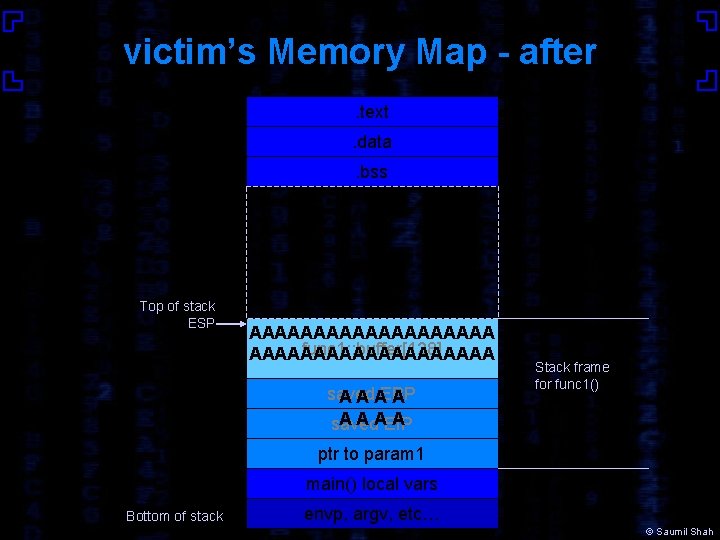
victim’s Memory Map - after. text. data. bss Top of stack ESP AAAAAAAAAA func 1: : buffer[128] AAAAAAAAAA saved A A AEBP A AEIP A saved Stack frame for func 1() ptr to param 1 main() local vars Bottom of stack envp, argv, etc… © Saumil Shah
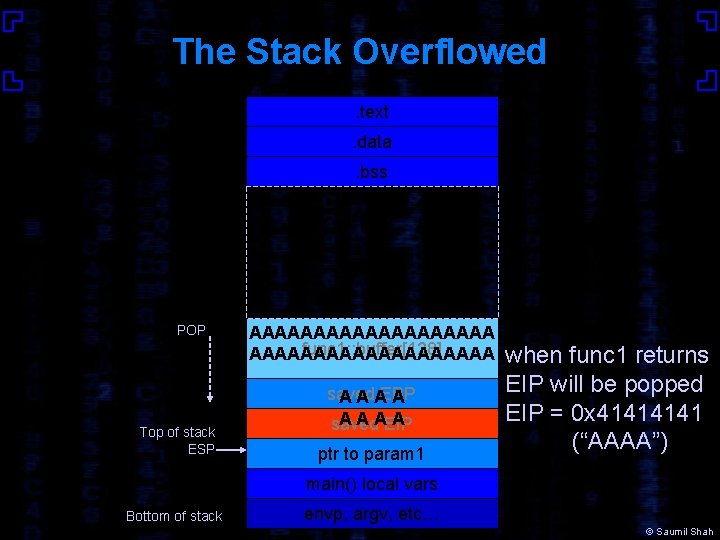
The Stack Overflowed. text. data. bss POP Top of stack ESP AAAAAAAAAA func 1: : buffer[128] AAAAAAAAAA saved A A AEBP A AEIP A saved ptr to param 1 when func 1 returns EIP will be popped EIP = 0 x 4141 (“AAAA”) main() local vars Bottom of stack envp, argv, etc… © Saumil Shah
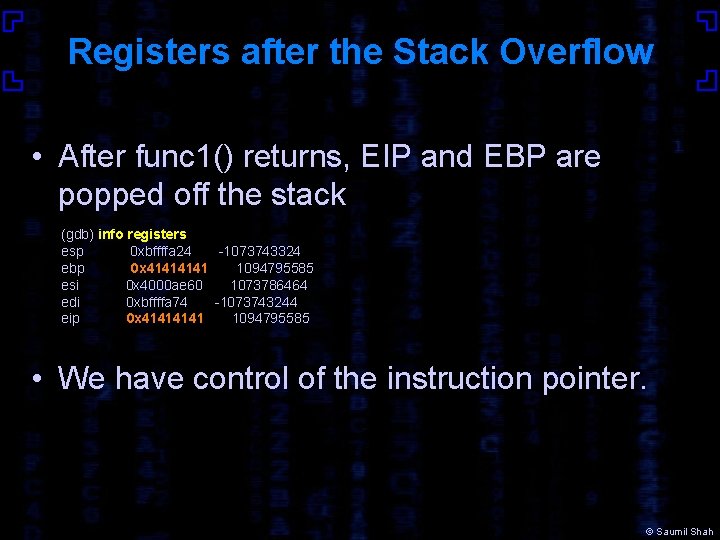
Registers after the Stack Overflow • After func 1() returns, EIP and EBP are popped off the stack (gdb) info registers esp 0 xbffffa 24 -1073743324 ebp 0 x 4141 1094795585 esi 0 x 4000 ae 60 1073786464 edi 0 xbffffa 74 -1073743244 eip 0 x 4141 1094795585 • We have control of the instruction pointer. © Saumil Shah
Controlling EIP • Vulnerabilities may lead to EIP control. • We can set the instruction pointer to go to wherever we want… • …the question is, “where do we want to go? ” • Can we inject our own code, and make EIP jump to it? • And, where do we inject our code? © Saumil Shah
Introducing Metasploit • An advanced open-source exploit research and development framework. • http: //metasploit. com • Current stable version: 2. 6 • Written in Perl, runs on Unix and Win 32 (cygwin) • 160+ exploits, 77 payloads, 13 encoders • Brand new 3. 0 beta 1 • Complete rewrite in Ruby © Saumil Shah
Introducing Metasploit • • Generate shellcode. Shellcode encoding. Shellcode handlers. Scanning binaries for specific instructions: • e. g. POP/RET, JMP ESI, etc. • Ability to add custom exploits, shellcode, encoders. • …and lots more. © Saumil Shah
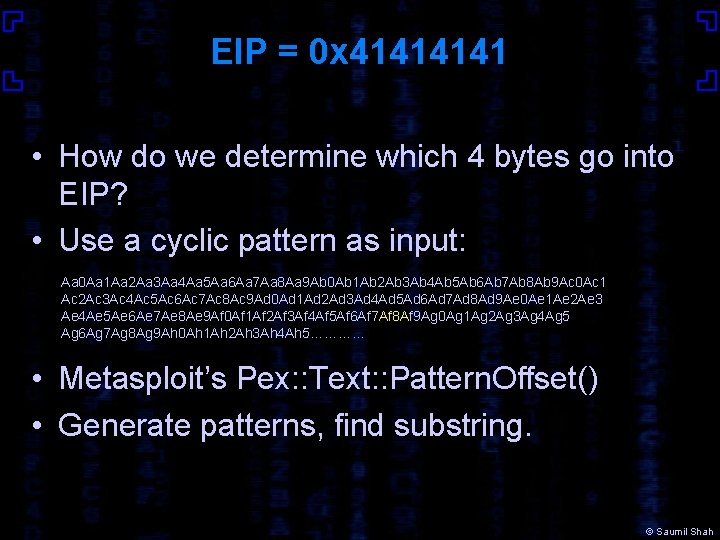
EIP = 0 x 4141 • How do we determine which 4 bytes go into EIP? • Use a cyclic pattern as input: Aa 0 Aa 1 Aa 2 Aa 3 Aa 4 Aa 5 Aa 6 Aa 7 Aa 8 Aa 9 Ab 0 Ab 1 Ab 2 Ab 3 Ab 4 Ab 5 Ab 6 Ab 7 Ab 8 Ab 9 Ac 0 Ac 1 Ac 2 Ac 3 Ac 4 Ac 5 Ac 6 Ac 7 Ac 8 Ac 9 Ad 0 Ad 1 Ad 2 Ad 3 Ad 4 Ad 5 Ad 6 Ad 7 Ad 8 Ad 9 Ae 0 Ae 1 Ae 2 Ae 3 Ae 4 Ae 5 Ae 6 Ae 7 Ae 8 Ae 9 Af 0 Af 1 Af 2 Af 3 Af 4 Af 5 Af 6 Af 7 Af 8 Af 9 Ag 0 Ag 1 Ag 2 Ag 3 Ag 4 Ag 5 Ag 6 Ag 7 Ag 8 Ag 9 Ah 0 Ah 1 Ah 2 Ah 3 Ah 4 Ah 5………… • Metasploit’s Pex: : Text: : Pattern. Offset() • Generate patterns, find substring. © Saumil Shah
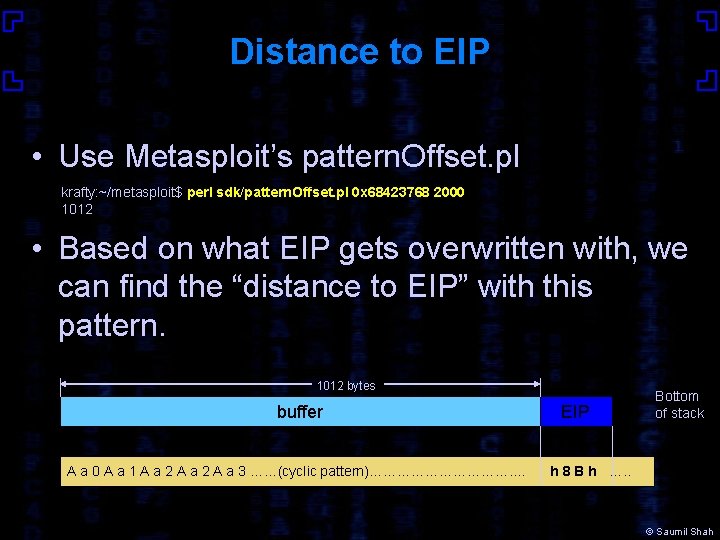
Distance to EIP • Use Metasploit’s pattern. Offset. pl krafty: ~/metasploit$ perl sdk/pattern. Offset. pl 0 x 68423768 2000 1012 • Based on what EIP gets overwritten with, we can find the “distance to EIP” with this pattern. 1012 bytes buffer A a 0 A a 1 A a 2 A a 3 ……(cyclic pattern)……………. … EIP Bottom of stack h 8 B h …. . © Saumil Shah
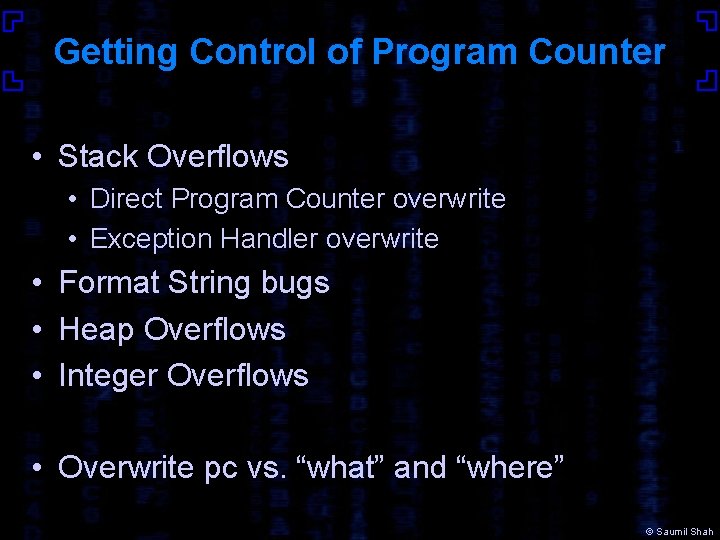
Getting Control of Program Counter • Stack Overflows • Direct Program Counter overwrite • Exception Handler overwrite • Format String bugs • Heap Overflows • Integer Overflows • Overwrite pc vs. “what” and “where” © Saumil Shah
Enter Shellcode • Code assembled in the CPU’s native instruction set. • Injected as a part of the buffer that is overflowed. • Most typical function of the injected code is to “spawn a shell” - ergo “shellcode”. • A buffer containing shellcode is termed as “payload”. © Saumil Shah
Writing Shellcode • Need to know the CPU’s native instruction set: • e. g. x 86 (ia 32), x 86 -64 (ia 64), ppc, sparc, etc. • • Tight assembly language. OS specific system calls. Shellcode libraries and generators. Metasploit Framework. © Saumil Shah
Injecting the shellcode • Easiest way is to pack it in the buffer overflow data itself. • Place it somewhere in the payload data. • Need to figure out where it will reside in the memory of the target process. © Saumil Shah
Where do you want to go…today? • EIP can be made to: • Return to Stack Jump directly into the payload. (reliability issues - addr jitter, stack protection) • Return to Shared library Jump through registers. Requires certain conditions to be meet. (highly stable technique) © Saumil Shah
![Return to Stack func 1(str) 0 xbffff 790 0 xbffff 81 c buffer[128] EIP](http://slidetodoc.com/presentation_image_h/0c98e1b12162f3392e180b916a334b7b/image-25.jpg "Return to Stack func 1(str) 0 xbffff 790 0 xbffff 81 c buffer[128] EIP")
Return to Stack func 1(str) 0 xbffff 790 0 xbffff 81 c buffer[128] EIP func 1() returns - pop EIP 0 xbffff 7 c 0 0 xbffff 790 nop nop nop 0 xbffff 7 c 0 nop nop nop …… shellcode ……. … 0 xbffff 7 c 0 buffer[128] Bottom of stack 0 xbffff 7 c 0 EIP execute shellcode ……. … 0 xbffff 7 c 0 buffer[128] 0 xbffff 7 c 0 EBP 0 xbffff 7 c 0 EIP © Saumil Shah
![Jump through Register frame 0 frame 1…. buffer[] EIP Bottom of stack strcpy(buffer, s)](http://slidetodoc.com/presentation_image_h/0c98e1b12162f3392e180b916a334b7b/image-26.jpg "Jump through Register frame 0 frame 1…. buffer[] EIP Bottom of stack strcpy(buffer, s)")
Jump through Register frame 0 frame 1…. buffer[] EIP Bottom of stack strcpy(buffer, s) saved EIP overwritten AAAAAAAAAAAAAAAAAAAAA EAX ESP EBX EBP ECX ESI EDX EDI AAAA EBX points within the buffer (in this case) ESP points beyond the saved EIP © Saumil Shah
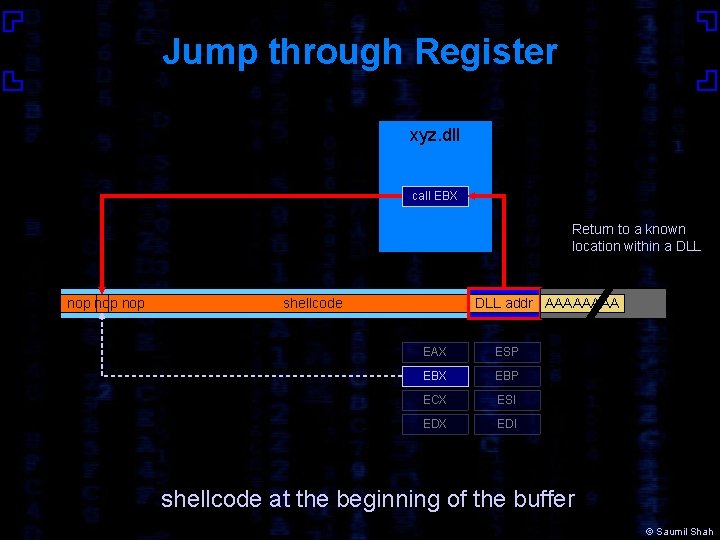
Jump through Register xyz. dll call EBX Return to a known location within a DLL nop nop DLL addr AAAA EIP shellcode EAX ESP EBX EBP ECX ESI EDX EDI shellcode at the beginning of the buffer © Saumil Shah
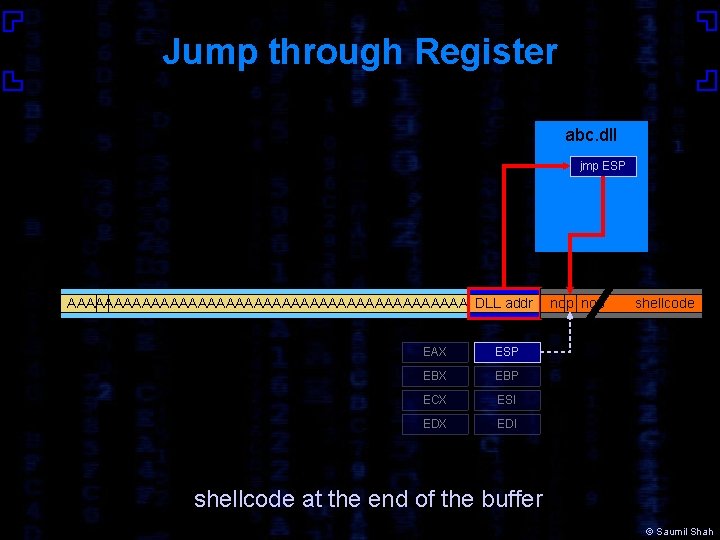
Jump through Register abc. dll jmp ESP AAAAAAAAAAAAAAAAAAAAAA DLL addr EIP EAX ESP EBX EBP ECX ESI EDX EDI nop shellcode at the end of the buffer © Saumil Shah
Looking for CALL or JMP instructions • We need to find locations in memory which contain CALL or JMP instructions, at fixed addresses. • Shared libraries get loaded at fixed addresses within the process memory. • Ideal for finding CALLs, JMPs. • We can try manual pattern searching with opcodes, using a debugger… • …or we can use msfpescan or msfelfscan. © Saumil Shah
msfpescan, msfelfscan • Utilities to scan binaries (executables or shared libraries). • Support for ELF and PE binaries. • Uses metasploit’s built-in disassemblers. • Can find CALLs, JMPs, or POP/RET instruction sets. • Can be used to find instruction groups specified by regular expressions. © Saumil Shah
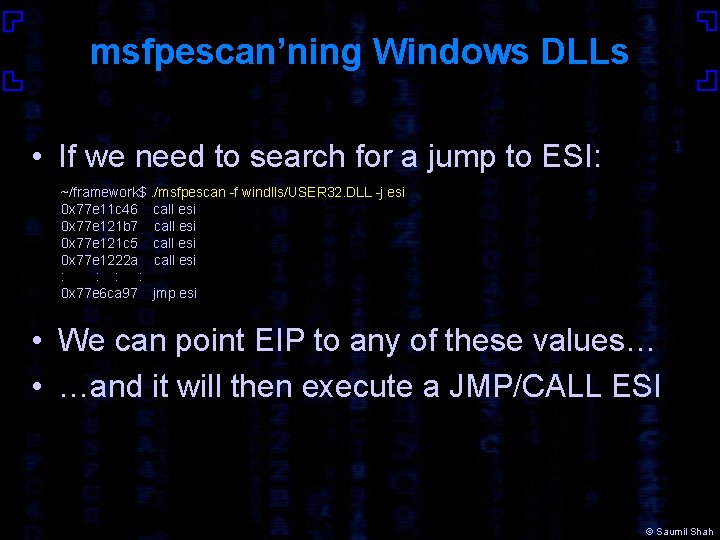
msfpescan’ning Windows DLLs • If we need to search for a jump to ESI: ~/framework$. /msfpescan -f windlls/USER 32. DLL -j esi 0 x 77 e 11 c 46 call esi 0 x 77 e 121 b 7 call esi 0 x 77 e 121 c 5 call esi 0 x 77 e 1222 a call esi : : 0 x 77 e 6 ca 97 jmp esi • We can point EIP to any of these values… • …and it will then execute a JMP/CALL ESI © Saumil Shah
Candidate binaries • First, search the executing binary itself. • Independent of Kernel, Service Packs, libs. • Second, search shared libraries or DLLs included with the software itself. (e. g. in_mp 3. dll for Winamp) • Last, search default shared libraries that get included from the OS: • e. g. KERNEL 32. DLL, libc. so, etc. • Makes the exploit OS kernel, SP specific. © Saumil Shah
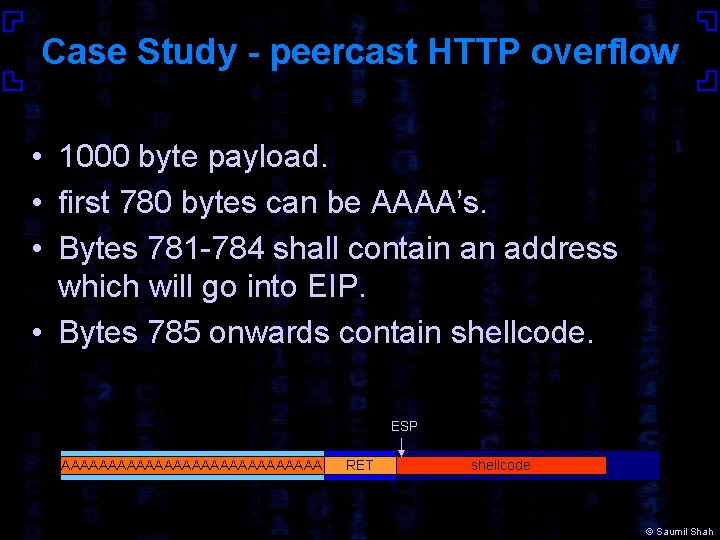
Case Study - peercast HTTP overflow • 1000 byte payload. • first 780 bytes can be AAAA’s. • Bytes 781 -784 shall contain an address which will go into EIP. • Bytes 785 onwards contain shellcode. ESP AAAAAAAAAAAAAA RET EIP shellcode © Saumil Shah
A little about shellcode • Types of shellcode: • • Bind shell Exec command Reverse shell Staged shell, etc. • Advanced techniques: • Meterpreter • Uploading and running DLLs “in-process” • …etc. © Saumil Shah
Payload Encoders • Payload encoders create encoded shellcode, which meets certain criteria. • e. g. Alpha 2 generates resultant shellcode which is only alphanumeric. • Allows us to bypass any protocol parsing mechanisms / byte filters. • An extra “decoder” is added to the beginning of the shellcode. • size may increase. © Saumil Shah
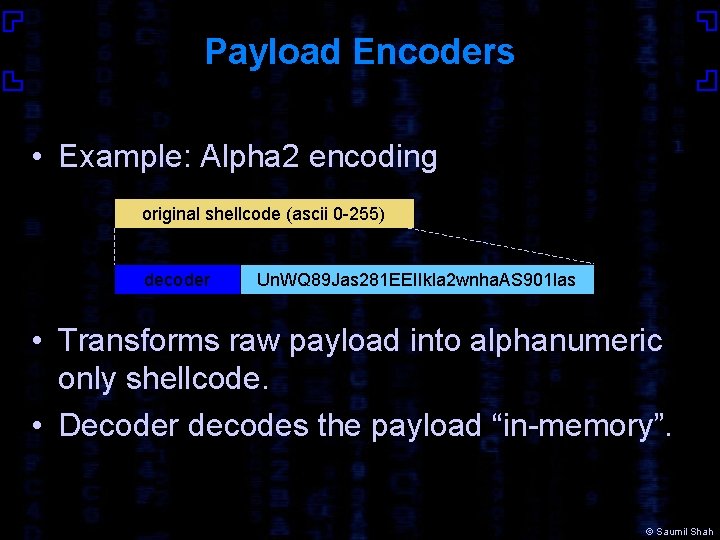
Payload Encoders • Example: Alpha 2 encoding original shellcode (ascii 0 -255) decoder Un. WQ 89 Jas 281 EEIIkla 2 wnha. AS 901 las • Transforms raw payload into alphanumeric only shellcode. • Decoder decodes the payload “in-memory”. © Saumil Shah
Payload Encoders • Metasploit offers many types of encoders. • Work around protocol parsing • e. g. avoid CR, LF, NULL • toupper(), tolower(), etc. • Defeat IDS • Polymorphic Shellcode • Shikata Ga Nai © Saumil Shah
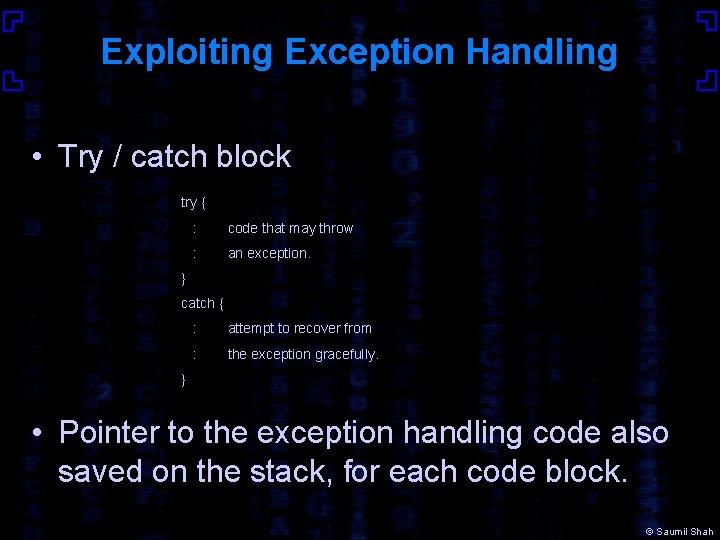
Exploiting Exception Handling • Try / catch block try { : code that may throw : an exception. } catch { : attempt to recover from : the exception gracefully. } • Pointer to the exception handling code also saved on the stack, for each code block. © Saumil Shah
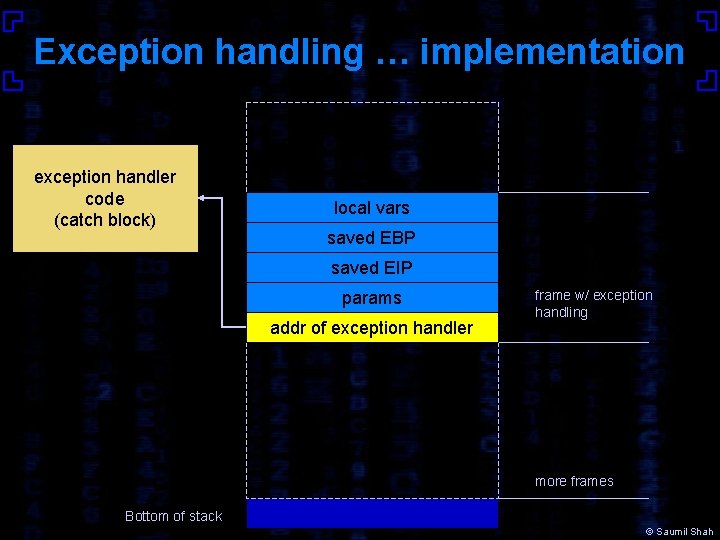
Exception handling … implementation exception handler code (catch block) local vars saved EBP saved EIP params addr of exception handler frame w/ exception handling more frames Bottom of stack © Saumil Shah
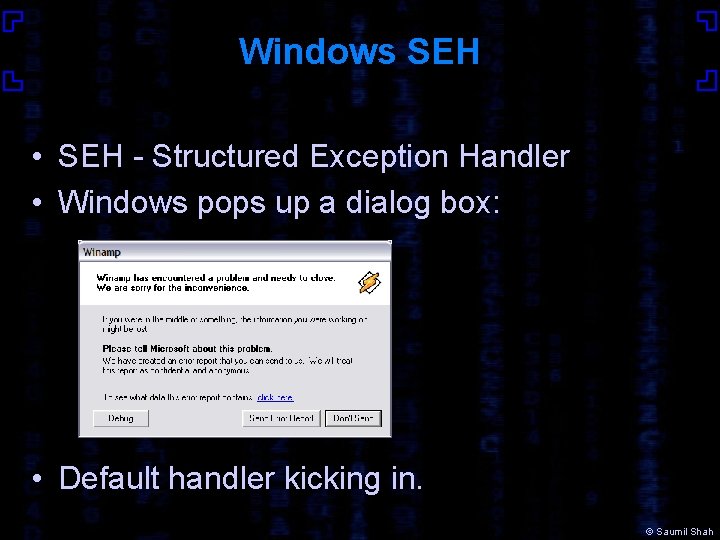
Windows SEH • SEH - Structured Exception Handler • Windows pops up a dialog box: • Default handler kicking in. © Saumil Shah
Custom exception handlers • Default SEH should be the last resort. • Many languages including C++ provide exception handling coding features. • Compiler generates links and calls to exception handling code in accordance with the underlying OS. • In Windows, exception handlers form a LINKED LIST chain on the stack. © Saumil Shah
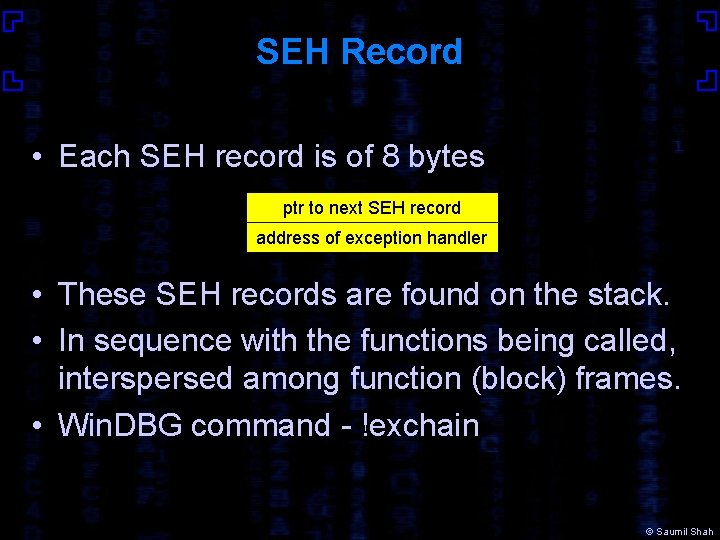
SEH Record • Each SEH record is of 8 bytes ptr to next SEH record address of exception handler • These SEH records are found on the stack. • In sequence with the functions being called, interspersed among function (block) frames. • Win. DBG command - !exchain © Saumil Shah
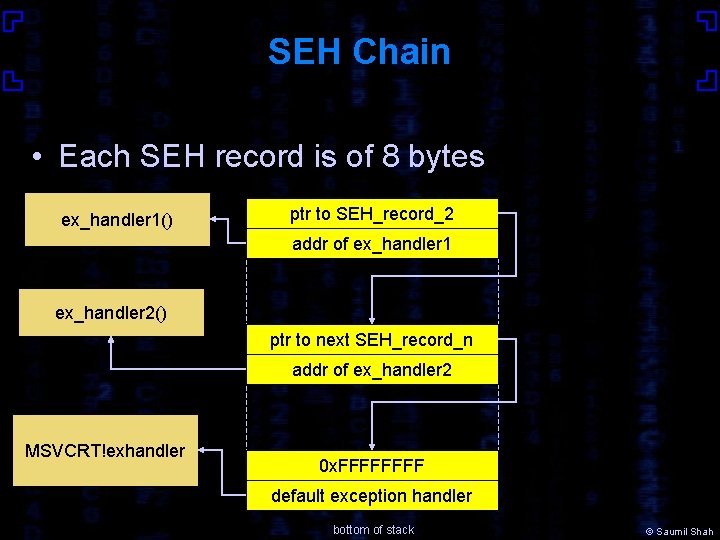
SEH Chain • Each SEH record is of 8 bytes ex_handler 1() ptr to SEH_record_2 addr of ex_handler 1 ex_handler 2() ptr to next SEH_record_n addr of ex_handler 2 MSVCRT!exhandler 0 x. FFFF default exception handler bottom of stack © Saumil Shah
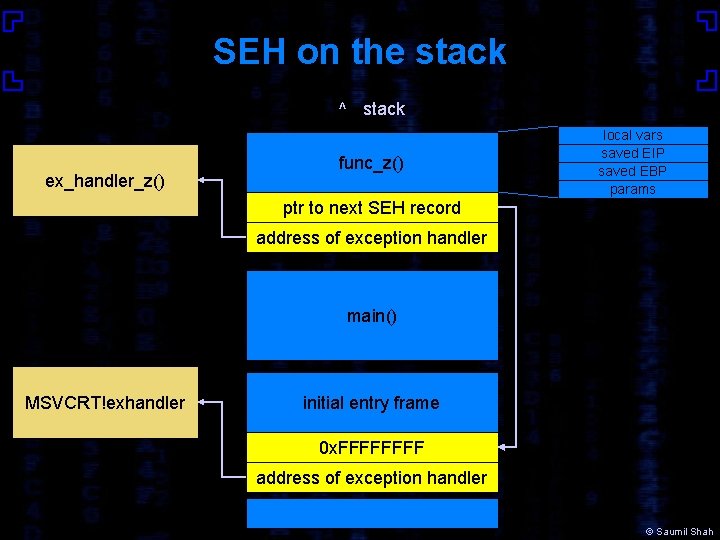
SEH on the stack ^ stack ex_handler_z() func_z() local vars saved EIP saved EBP params ptr to next SEH record address of exception handler main() MSVCRT!exhandler initial entry frame 0 x. FFFF address of exception handler © Saumil Shah
Yet another way of getting EIP • Overwrite one of the addresses of the registered exception handlers… • …and, make the process throw an exception! • If no custom exception handlers are registered, overwrite the default SEH. • Might have to travel way down the stack… • …but in doing so, you get a long buffer! © Saumil Shah
![Overwriting SEH buffer[12] ex_handler() saved EIP saved EBP params ptr to next SEH record](http://slidetodoc.com/presentation_image_h/0c98e1b12162f3392e180b916a334b7b/image-46.jpg "Overwriting SEH buffer[12] ex_handler() saved EIP saved EBP params ptr to next SEH record")
Overwriting SEH buffer[12] ex_handler() saved EIP saved EBP params ptr to next SEH record address of exception handler © Saumil Shah
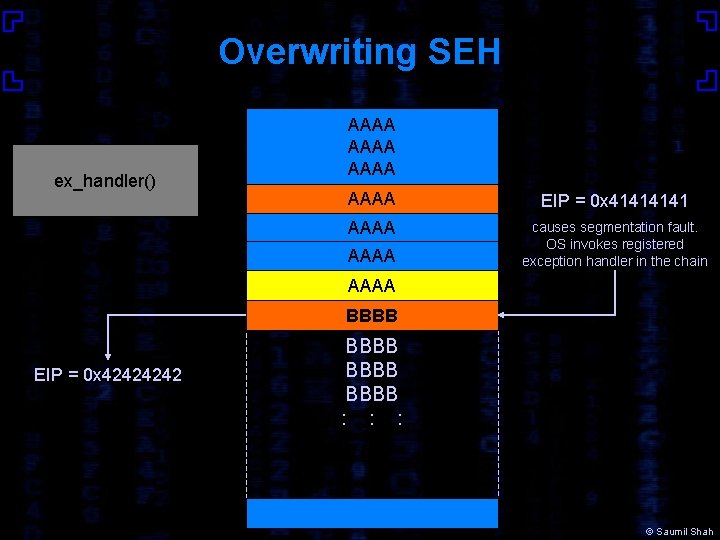
Overwriting SEH ex_handler() AAAA EIP = 0 x 4141 AAAA causes segmentation fault. OS invokes registered exception handler in the chain AAAA BBBB EIP = 0 x 4242 BBBB : : : © Saumil Shah
Case study - sip. Xtapi CSeq overflow • sip. Xtapi library - popular open source Vo. IP library. • Used in many soft phones • AOL Triton soft phone uses sip. Xtapi. • 24 byte buffer overflow in the CSeq SIP header. • Too small for any practical shellcode. • We can hack it up by overwriting SEH. © Saumil Shah
Writing Metasploit exploit modules • • Integration within the Metasploit framework. Multiple target support. Dynamic payload selection. Dynamic payload encoding. Built-in payload handlers. Can use advanced payloads. …a highly portable, flexible and rugged exploit! © Saumil Shah
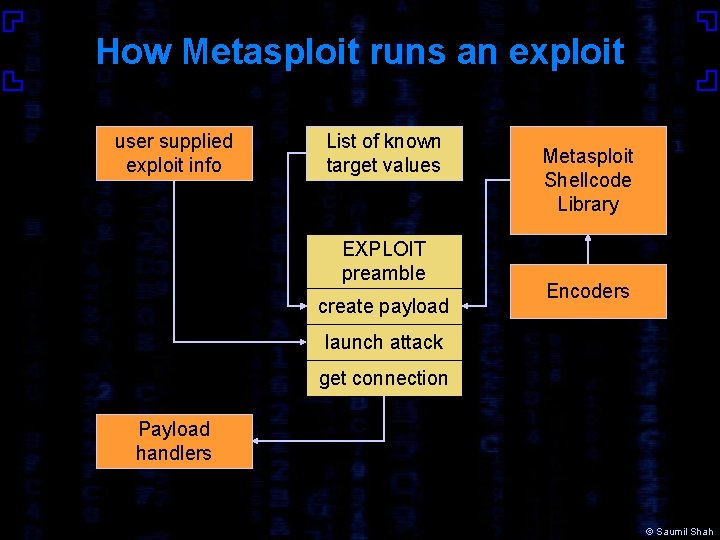
How Metasploit runs an exploit user supplied exploit info List of known target values EXPLOIT preamble create payload Metasploit Shellcode Library Encoders launch attack get connection Payload handlers © Saumil Shah
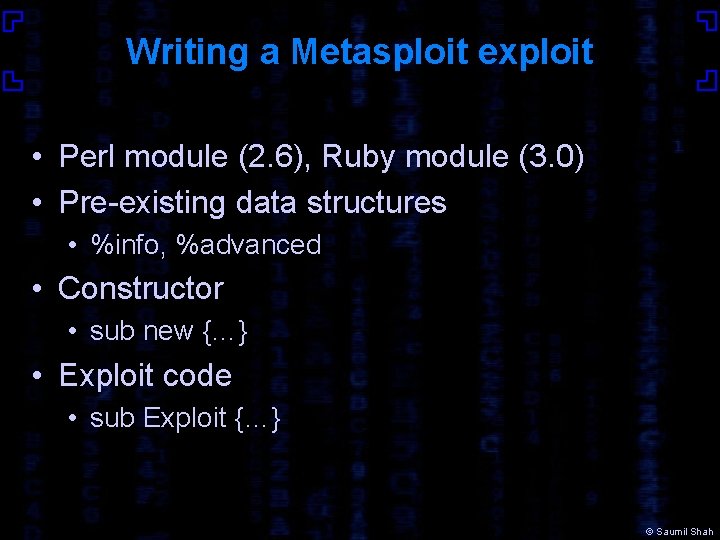
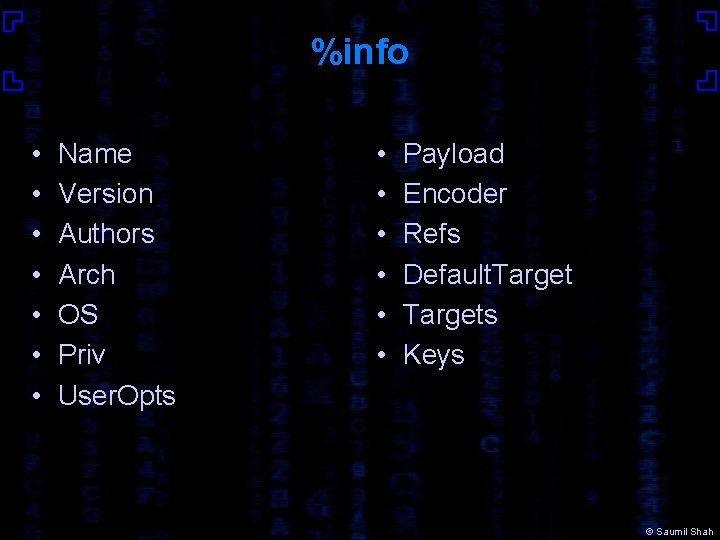
Writing a Metasploit exploit • Perl module (2. 6), Ruby module (3. 0) • Pre-existing data structures • %info, %advanced • Constructor • sub new {…} • Exploit code • sub Exploit {…} © Saumil Shah
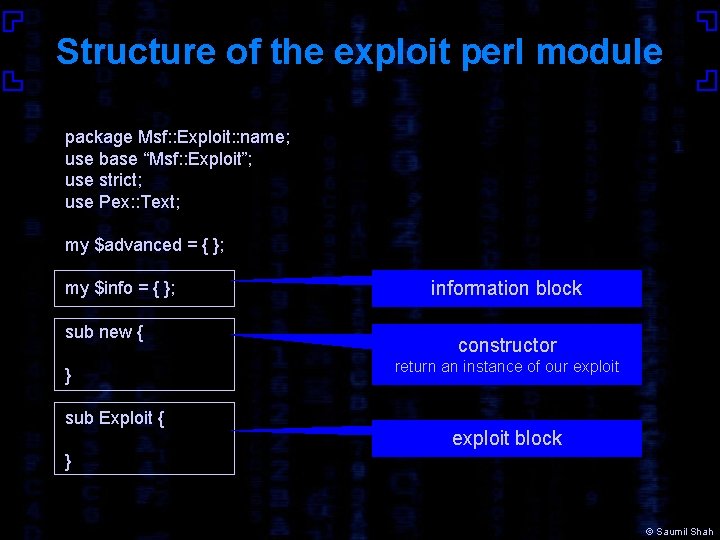
Structure of the exploit perl module package Msf: : Exploit: : name; use base “Msf: : Exploit”; use strict; use Pex: : Text; my $advanced = { }; my $info = { }; sub new { } sub Exploit { information block constructor return an instance of our exploit block } © Saumil Shah
%info • • Name Version Authors Arch OS Priv User. Opts • • • Payload Encoder Refs Default. Targets Keys © Saumil Shah
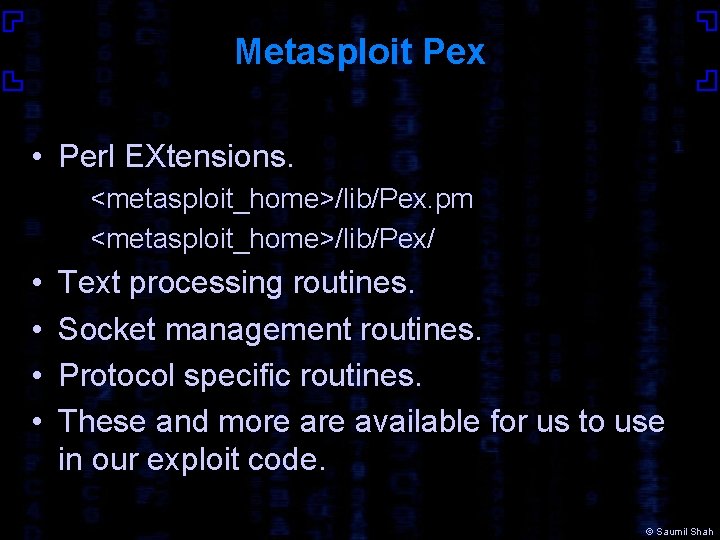
Metasploit Pex • Perl EXtensions. <metasploit_home>/lib/Pex. pm <metasploit_home>/lib/Pex/ • • Text processing routines. Socket management routines. Protocol specific routines. These and more available for us to use in our exploit code. © Saumil Shah
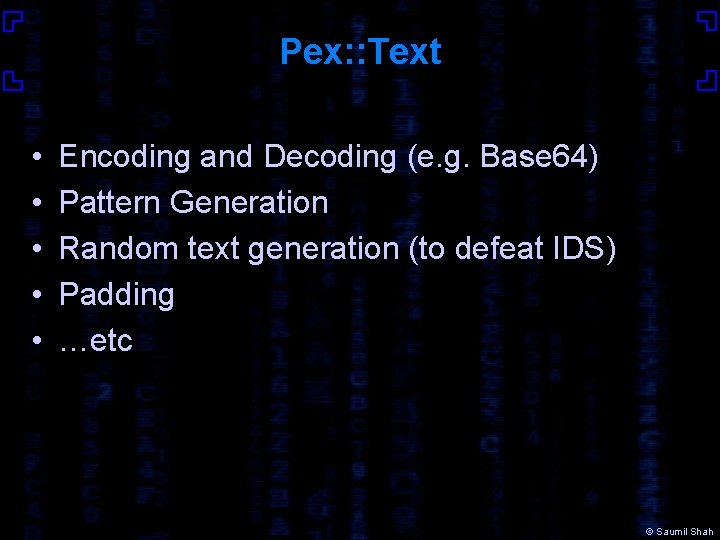
Pex: : Text • • • Encoding and Decoding (e. g. Base 64) Pattern Generation Random text generation (to defeat IDS) Padding …etc © Saumil Shah
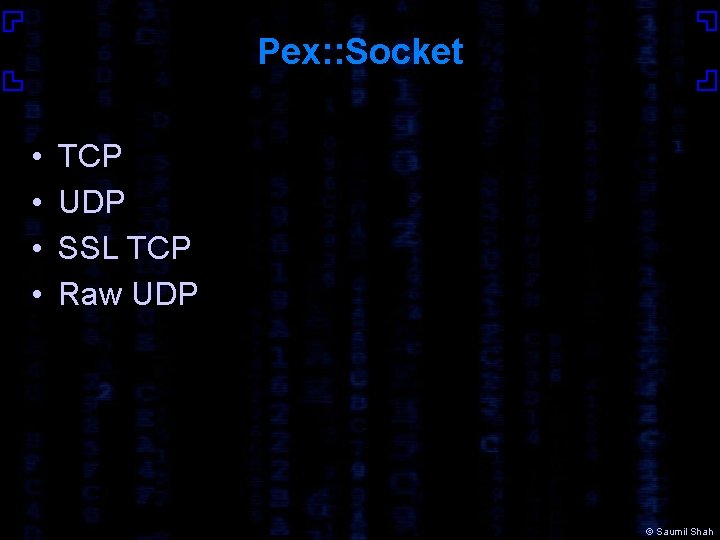
Pex: : Socket • • TCP UDP SSL TCP Raw UDP © Saumil Shah
Pex - protocol specific utilities • • • SMB DCE RPC Sun. RPC MSSQL …etc © Saumil Shah
Pex - miscellaneous utilities • • Pex: : Utils Array and hash manipulation Bit rotates Read and write files Format String generator Create Win 32 PE files Create Javascript arrays …a whole lot of miscellany! © Saumil Shah
metasploit_skel. pm • A skeleton exploit module. • Walk-through. • Can use this skeleton to code up exploit modules. • Place finished exploit modules in: <path_to_metasploit>/exploits/ © Saumil Shah
Finished examples • my_peercast. pm • my_sipxtapi. pm © Saumil Shah
Some command line Metasploit tools • msfcli • Metasploit command line interface. • Can script up metasploit framework actions in a non-interactive manner. • msfpayload • Generate payload with specific options. • msfencode • Encode generated payload. © Saumil Shah
More command line Metasploit tools • msfweb • Web interface to the Metasploit framework. • msfupdate • Live update for the Metasploit framework. © Saumil Shah
New in Version 3. 0 • msfd • Metasploit daemon, allows for client-server operation of Metasploit. • msfopcode • command line interface to Metasploit’s online opcode database. • msfwx • a GUI interface using wxruby. © Saumil Shah
New in Version 3. 0 • • • New payloads, new encoders. Ruby extension - Rex (similar to Pex) NASM shell. Back end Database support. …whole lot of goodies here and there. © Saumil Shah

Thank You! Saumil Shah saumil@saumil. net http: //net-square. com +91 98254 31192
- Slides: 65