
Writing in the EYFS Overview Discuss the importance


- Slides: 29
Writing in the EYFS
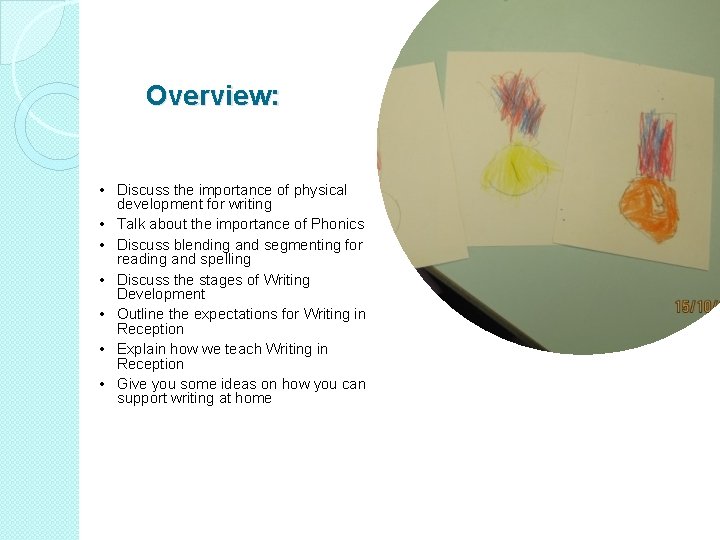
Overview: • Discuss the importance of physical development for writing • Talk about the importance of Phonics • Discuss blending and segmenting for reading and spelling • Discuss the stages of Writing Development • Outline the expectations for Writing in Reception • Explain how we teach Writing in Reception • Give you some ideas on how you can support writing at home
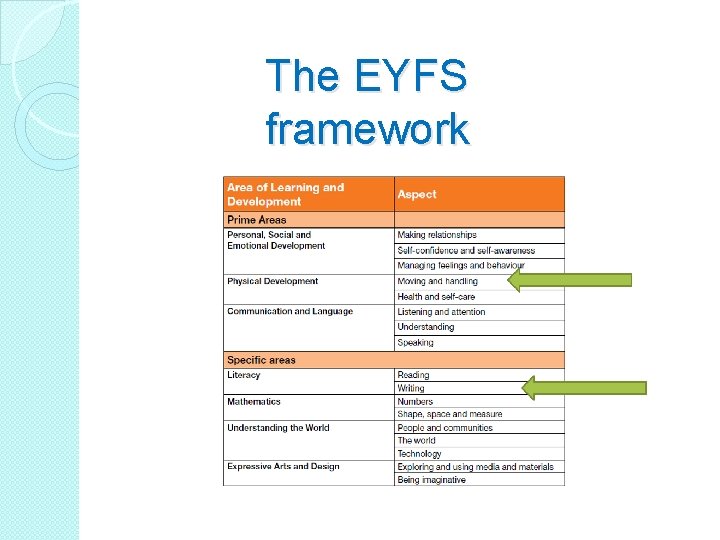
The EYFS framework
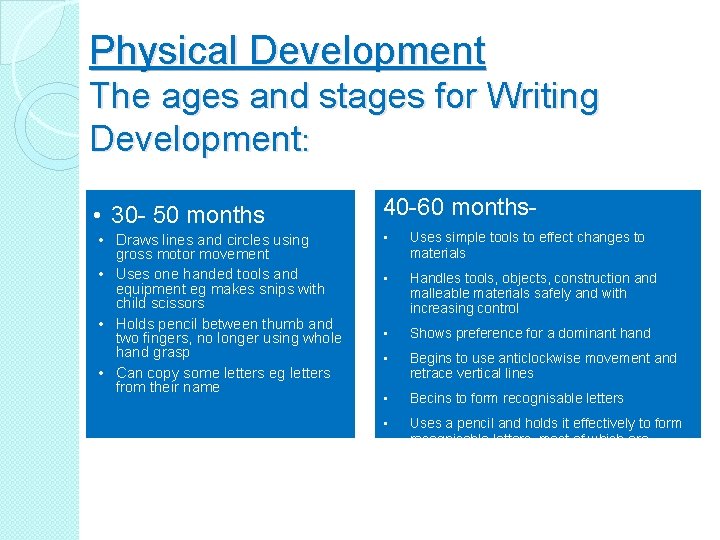
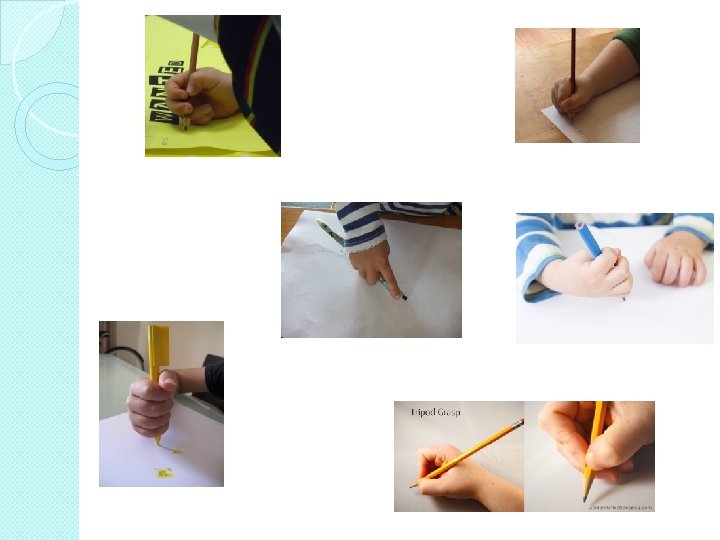
Physical Development The ages and stages for Writing Development: • 30 - 50 months • Draws lines and circles using gross motor movement • Uses one handed tools and equipment eg makes snips with child scissors • Holds pencil between thumb and two fingers, no longer using whole hand grasp • Can copy some letters eg letters from their name 40 -60 months • Uses simple tools to effect changes to materials • Handles tools, objects, construction and malleable materials safely and with increasing control • Shows preference for a dominant hand • Begins to use anticlockwise movement and retrace vertical lines • Becins to form recognisable letters • Uses a pencil and holds it effectively to form recognisable letters, most of which are correctly formed
At the end of Reception, children shoul Handle equipment and tools correctly, including pencils for writing.
Letter formation �When your child begins to show signs of being ready to write, please encourage the correct letter formation. �Please encourage your child to use lower case letters (with exception of initial letter of their name). Capital letters should only be introduced when your child is beginning to write sentences with some confidence and they are aware of upper case letters from their learning in phonics. �Bad habits are very difficult to ‘un-learn’ – let’s get it right from the very beginning!
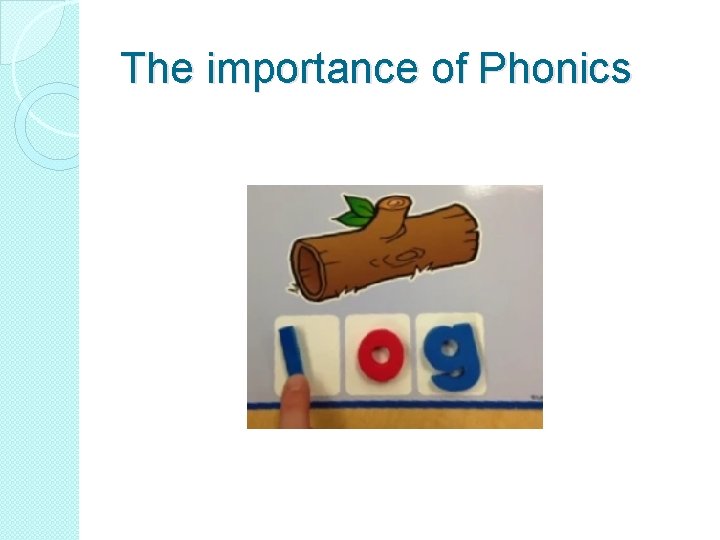
The importance of Phonics
Why is Phonics important? �Children have daily Phonics sessions in school. �They are introduced to sounds such as ‘j’ ‘k’ and ‘p’. This helps them to read and write simple words. �Phonics teaches children what sound each letter makes and helps them to read and write words. �Phonics helps children to apply skills when reading and writing. �We follow the Letters and Sounds framework.
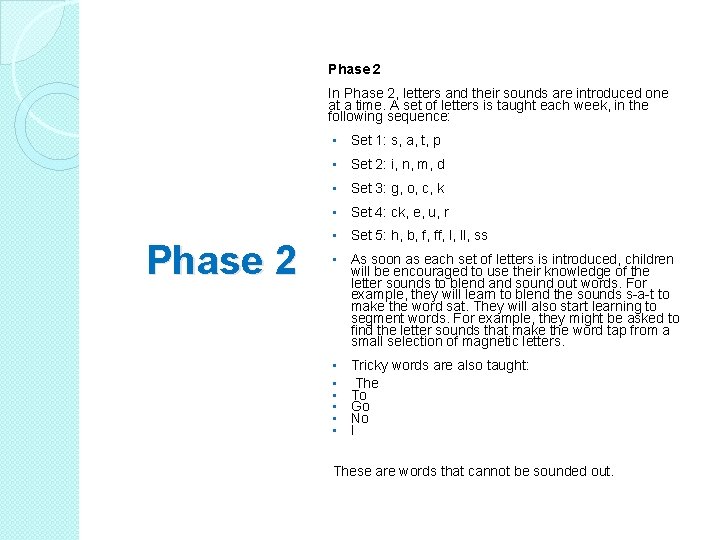
Phase 2 In Phase 2, letters and their sounds are introduced one at a time. A set of letters is taught each week, in the following sequence: Phase 2 • Set 1: s, a, t, p • Set 2: i, n, m, d • Set 3: g, o, c, k • Set 4: ck, e, u, r • Set 5: h, b, f, ff, l, ll, ss • As soon as each set of letters is introduced, children will be encouraged to use their knowledge of the letter sounds to blend and sound out words. For example, they will learn to blend the sounds s-a-t to make the word sat. They will also start learning to segment words. For example, they might be asked to find the letter sounds that make the word tap from a small selection of magnetic letters. • Tricky words are also taught: The To Go No I • • • These are words that cannot be sounded out.
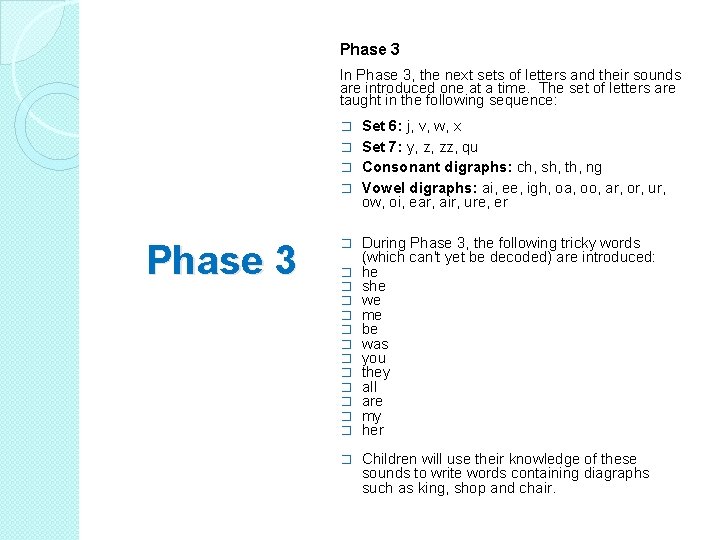
Phase 3 In Phase 3, the next sets of letters and their sounds are introduced one at a time. The set of letters are taught in the following sequence: Set 6: j, v, w, x � Set 7: y, z, zz, qu � Consonant digraphs: ch, sh, th, ng � Vowel digraphs: ai, ee, igh, oa, oo, ar, or, ur, ow, oi, ear, air, ure, er � Phase 3 � � � � During Phase 3, the following tricky words (which can't yet be decoded) are introduced: he she we me be was you they all are my her Children will use their knowledge of these sounds to write words containing diagraphs such as king, shop and chair.
Blending and Segmenting �Blending and segmenting are both important skills for early reading and writing �Children use their knowledge of sounds to blend and segment simple words for reading/ writing
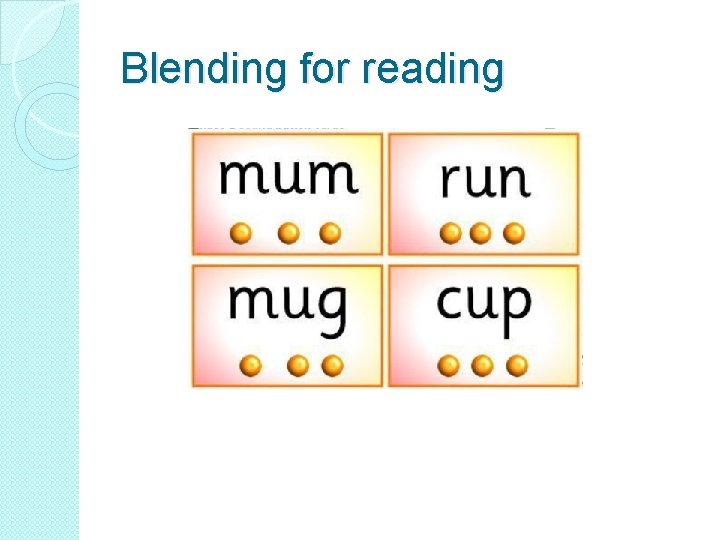
Blending for reading
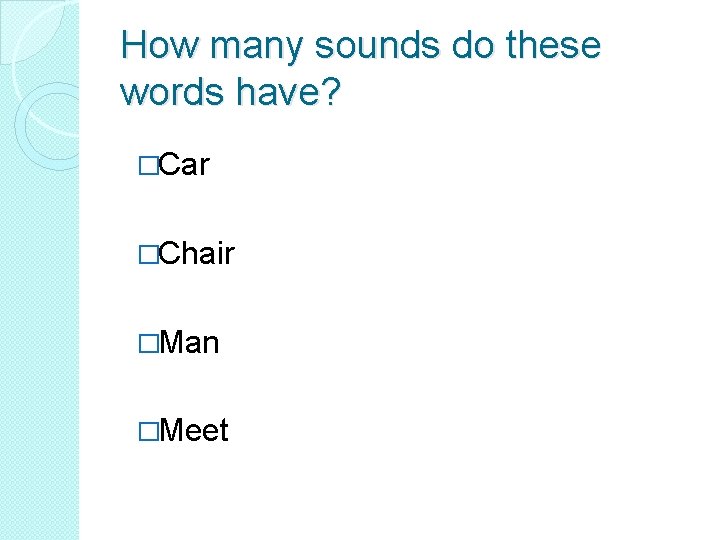
How many sounds do these words have? �Car �Chair �Man �Meet
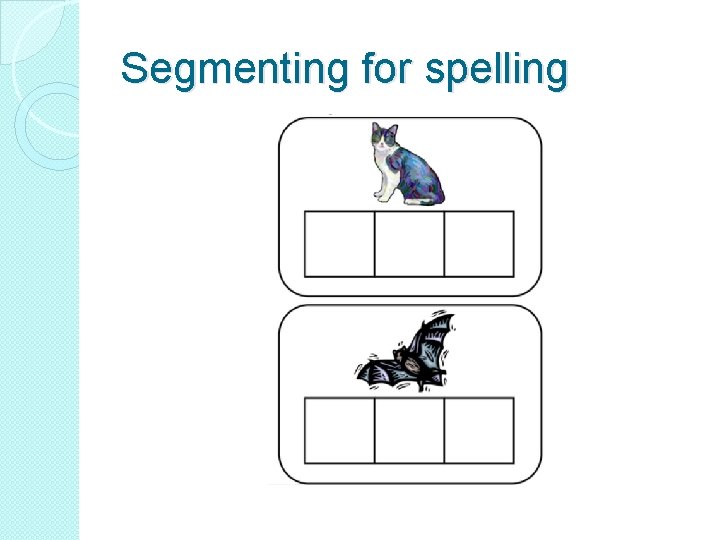
Segmenting for spelling
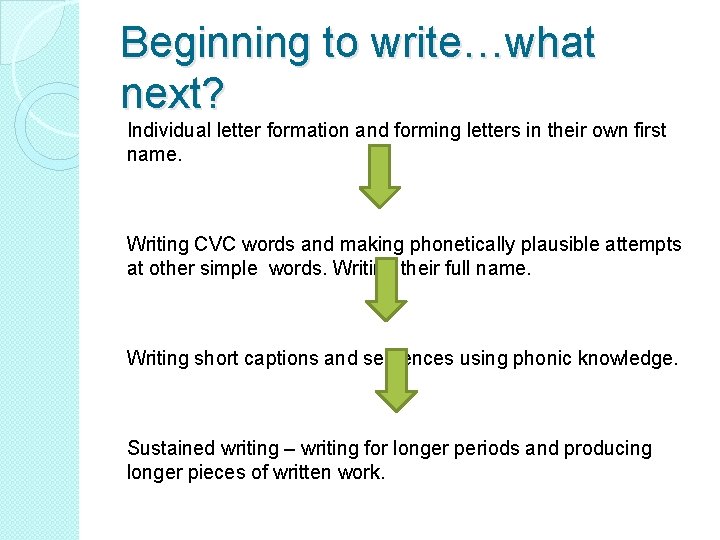
Beginning to write…what next? Individual letter formation and forming letters in their own first name. Writing CVC words and making phonetically plausible attempts at other simple words. Writing their full name. Writing short captions and sentences using phonic knowledge. Sustained writing – writing for longer periods and producing longer pieces of written work.
The stages of writing
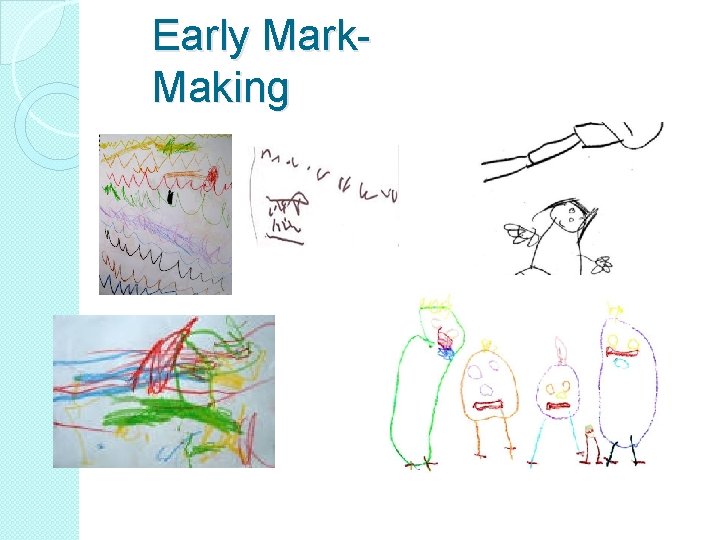
Early Mark. Making
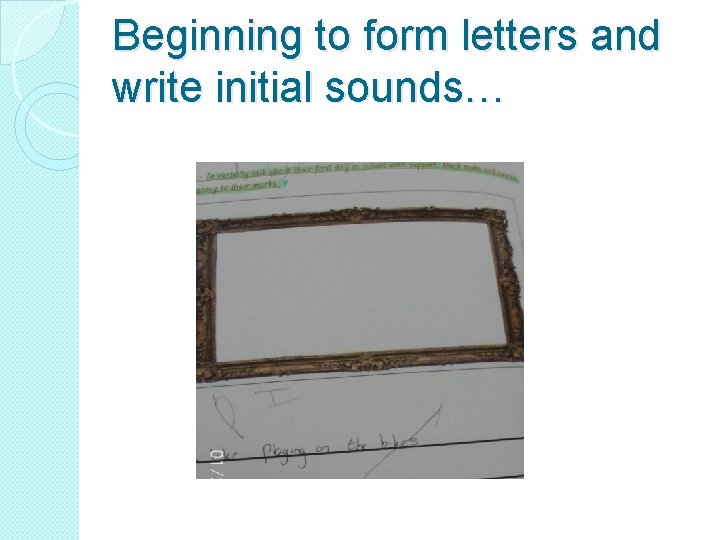
Beginning to form letters and write initial sounds…
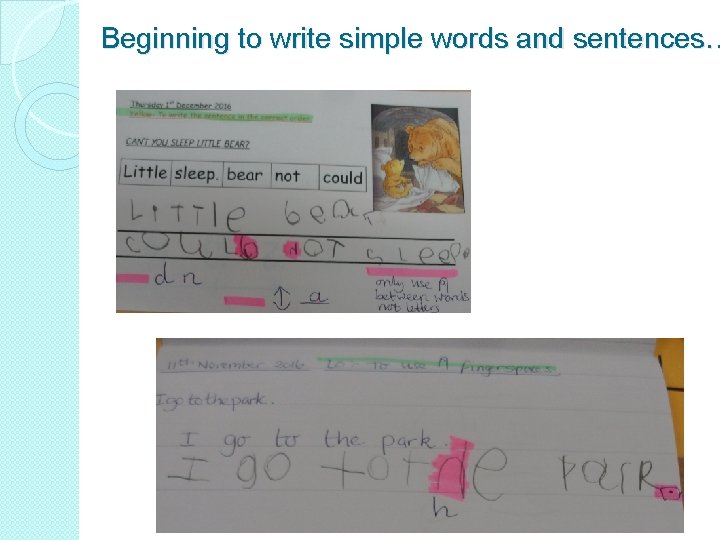
Beginning to write simple words and sentences…
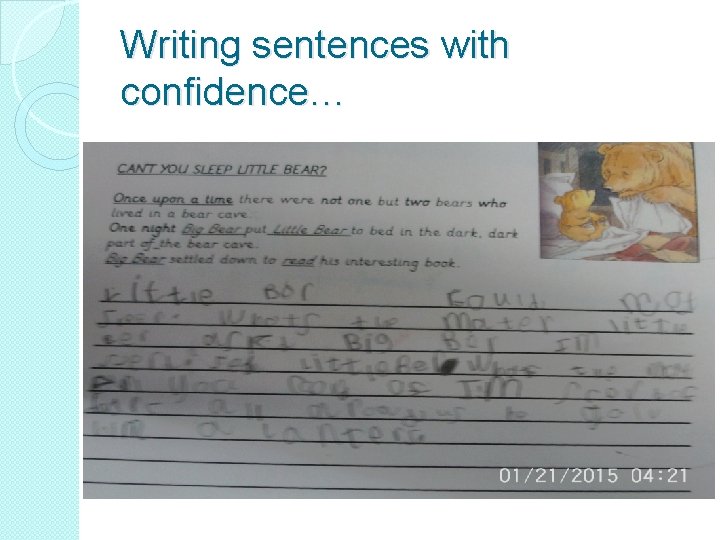
Writing sentences with confidence…
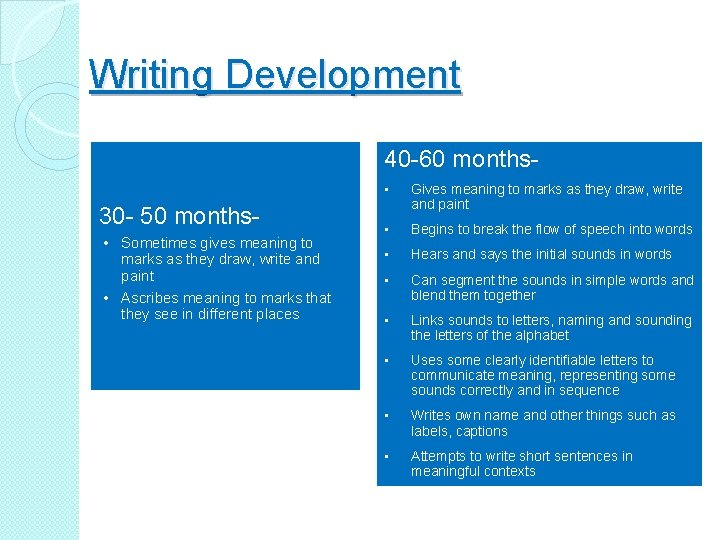
Writing Development 40 -60 months 30 - 50 months • Sometimes gives meaning to marks as they draw, write and paint • Ascribes meaning to marks that they see in different places • Gives meaning to marks as they draw, write and paint • Begins to break the flow of speech into words • Hears and says the initial sounds in words • Can segment the sounds in simple words and blend them together • Links sounds to letters, naming and sounding the letters of the alphabet • Uses some clearly identifiable letters to communicate meaning, representing some sounds correctly and in sequence • Writes own name and other things such as labels, captions • Attempts to write short sentences in meaningful contexts
At the end of Reception: Children use their phonic knowledge to write words in ways which match their spoken sounds. They also write some irregular common words. They write simple sentences which can be read by themselves and others. Some words are spelt correctly and others are phonetically plausible.
Strategies to support early writing in school � Letter formation sayings/ Jolly Phonics songs � Being able to ‘hold’ a sentence in your head. � Think it, say it, write it, check it. � Visual support (finger spacers/ sound mats) � Providing children with interesting stimulus to motivate and encourage writing and early markmaking. � Variety of pencils and mark-making tools of various thicknesses to help children to develop a comfortable pencil grip. � Writing opportunities based around own interests
Supporting your child in class… �Child-led writing �Guided writing �Interventions and strategies to support development of gross and fine motor skills. �Daily phonics sessions �Handwriting
Helping your child to begin to write at home � � � Mark-making with meaning – can your child talk about the marks that they make? Swapping hands & pencil grip – show your child how a pencil should be held & gently encourage this…every child will be ready for this in their own time. Do not force children to hold their pencil in a certain way. Orally blend and segment lots of words at home Support children in recognising and writing their own names. Make books with children of activities they have been doing, using photographs of them as illustrations. Encourage children to use their phonics when writing. Talk to children about the letters that represent the sounds they hear at the beginning of their own names and other familiar words. Demonstrate how to segment the sounds(phonemes) in simple words and how the sounds are represented by letters (graphemes). • Support and scaffold individual children’s writing as opportunities arise. Build up their confidence! Have fun paper and pens to write with at home linked to your child’s interests.
You could also work with your child to: � Write party � Encourage invitations. children to write thank you letters after birthdays and Christmas. � Write postcards when on holiday. � Write menu for a family meal or party. � Email a family member or friend. � Make a scrap book with labels and captions – maybe after a holiday or special event. � Write short stories involving the adventures of their favourite toys. � Write an information leaflet about something they find interesting eg. dinosaurs, sports etc. � Invent and write rules for the house, bedroom etc. and put on a poster � Draw, label and explain their own inventions.
Any questions?