
WRITING IN RESPONSE TO TEXT ACROSS THE CURRICULUM

- Slides: 55
WRITING IN RESPONSE TO TEXT ACROSS THE CURRICULUM Timothy Shanahan University of Illinois at Chicago www. shanahanonliteracy. com
WRITING ACROSS THE CURRICULUM • Growing interest in writing in content areas • Using writing to help teaching science, social studies, math, and literature
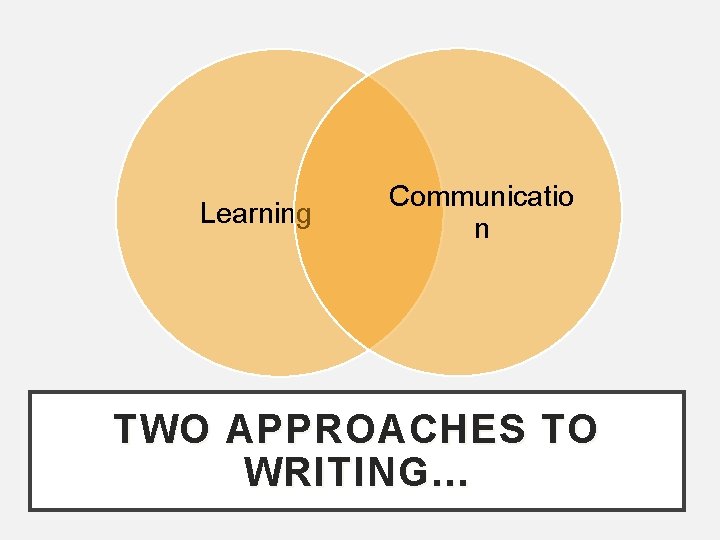
Learning Communicatio n TWO APPROACHES TO WRITING. . .
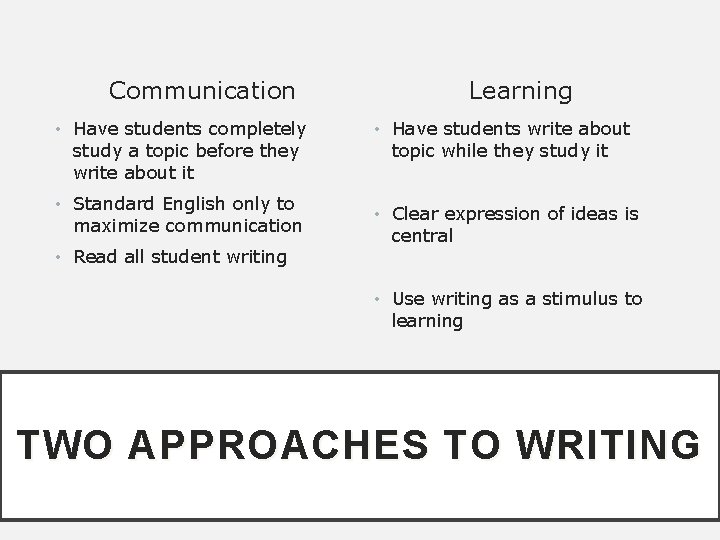
Communication • Have students completely study a topic before they write about it • Standard English only to maximize communication • Read all student writing Learning • Have students write about topic while they study it • Clear expression of ideas is central • Use writing as a stimulus to learning TWO APPROACHES TO WRITING
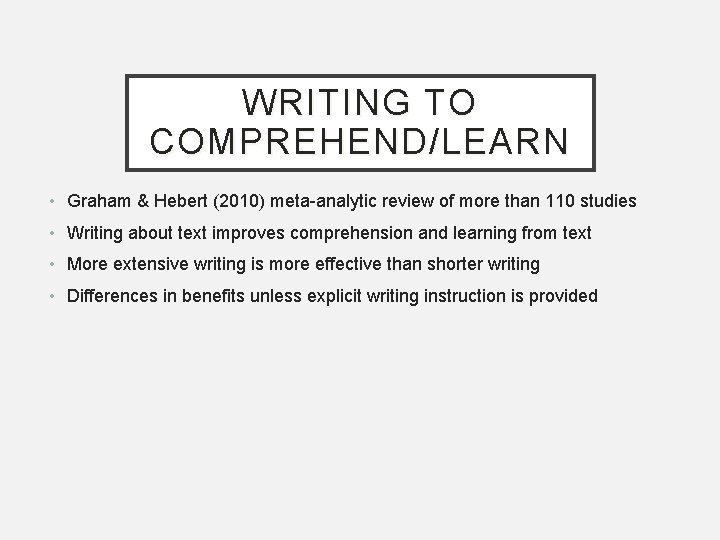
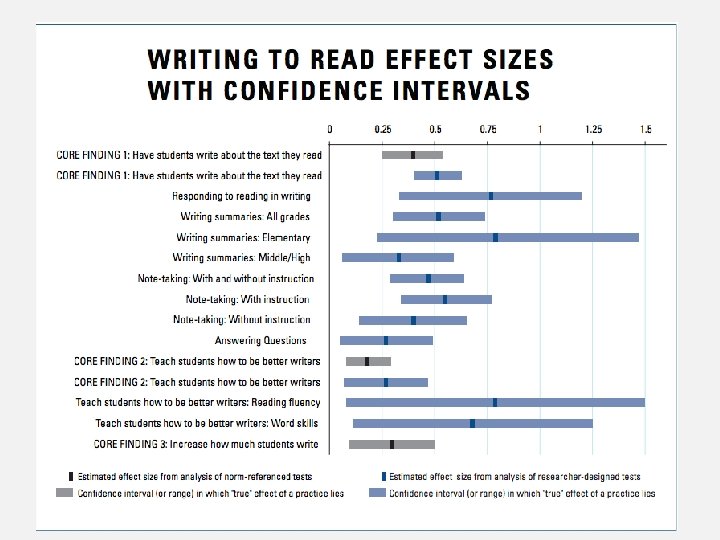
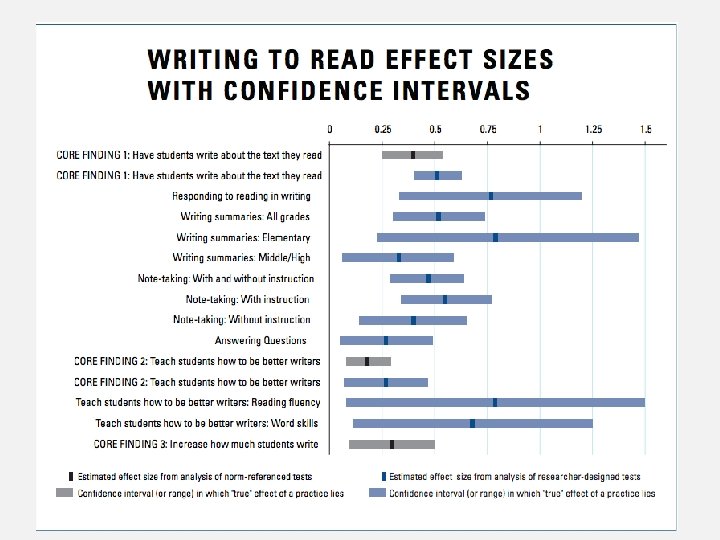
WRITING TO COMPREHEND/LEARN • Graham & Hebert (2010) meta-analytic review of more than 110 studies • Writing about text improves comprehension and learning from text • More extensive writing is more effective than shorter writing • Differences in benefits unless explicit writing instruction is provided
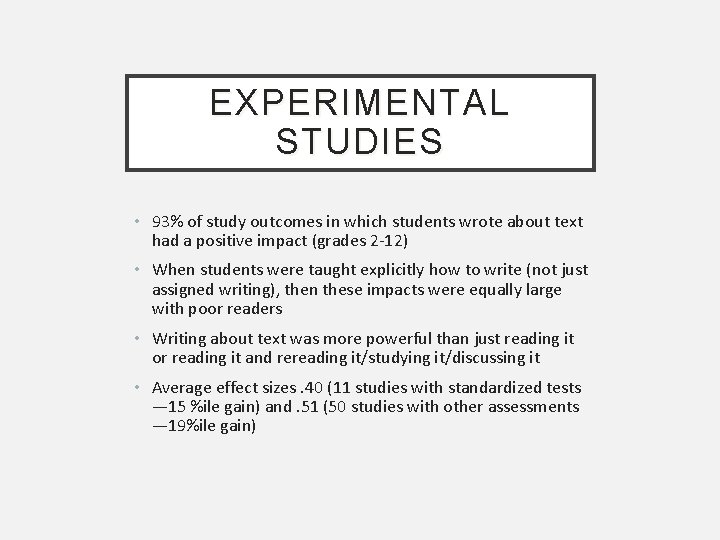
EXPERIMENTAL STUDIES • 93% of study outcomes in which students wrote about text had a positive impact (grades 2 -12) • When students were taught explicitly how to write (not just assigned writing), then these impacts were equally large with poor readers • Writing about text was more powerful than just reading it or reading it and rereading it/studying it/discussing it • Average effect sizes. 40 (11 studies with standardized tests — 15 %ile gain) and. 51 (50 studies with other assessments — 19%ile gain)
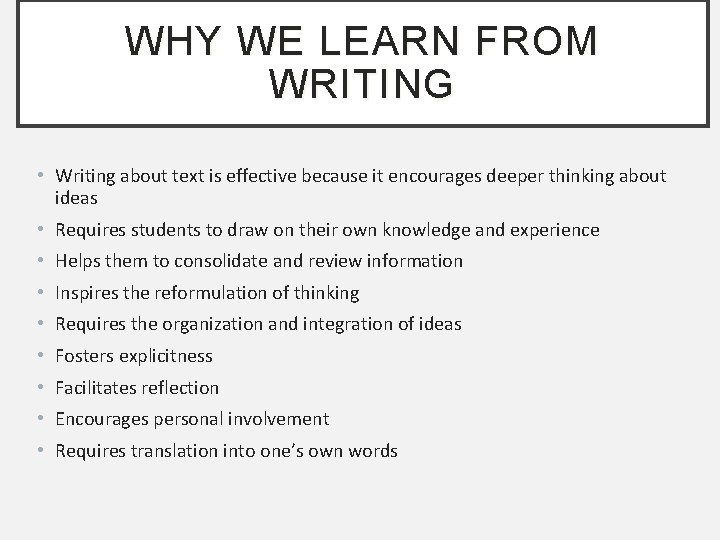
WHY WE LEARN FROM WRITING • Writing about text is effective because it encourages deeper thinking about ideas • Requires students to draw on their own knowledge and experience • Helps them to consolidate and review information • Inspires the reformulation of thinking • Requires the organization and integration of ideas • Fosters explicitness • Facilitates reflection • Encourages personal involvement • Requires translation into one’s own words
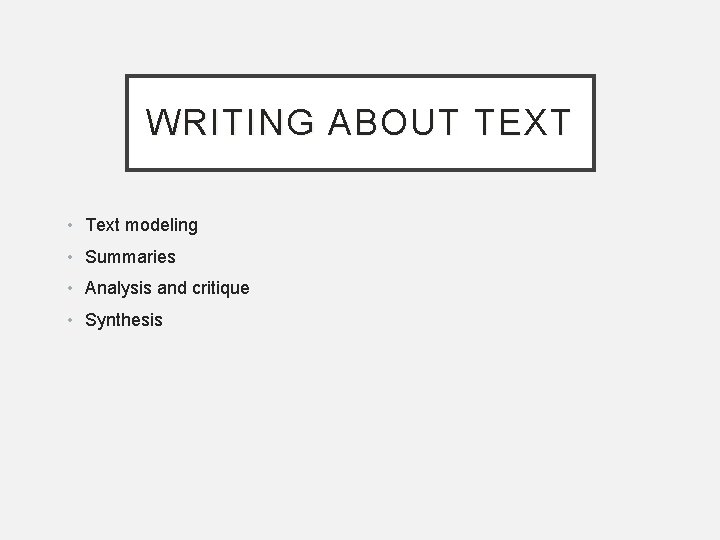
WRITING ABOUT TEXT • Text modeling • Summaries • Analysis and critique • Synthesis
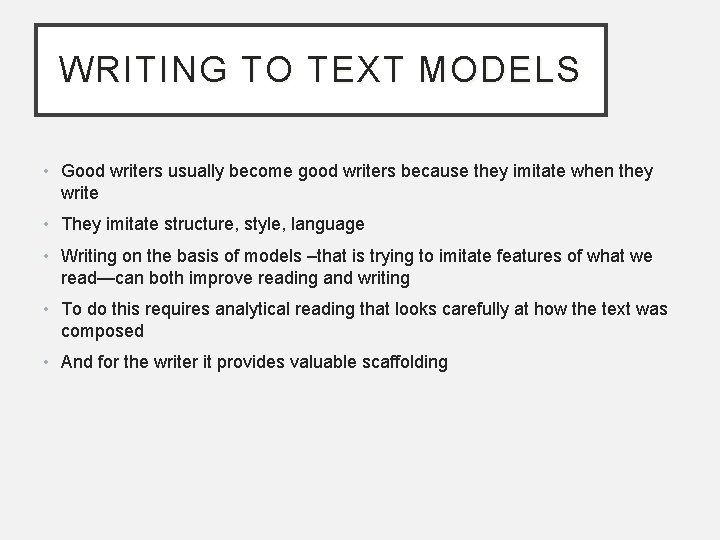
WRITING TO TEXT MODELS • Good writers usually become good writers because they imitate when they write • They imitate structure, style, language • Writing on the basis of models –that is trying to imitate features of what we read—can both improve reading and writing • To do this requires analytical reading that looks carefully at how the text was composed • And for the writer it provides valuable scaffolding
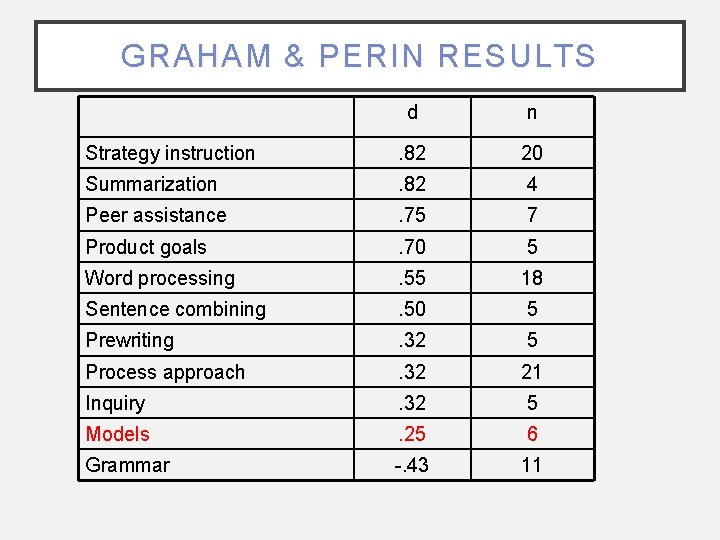
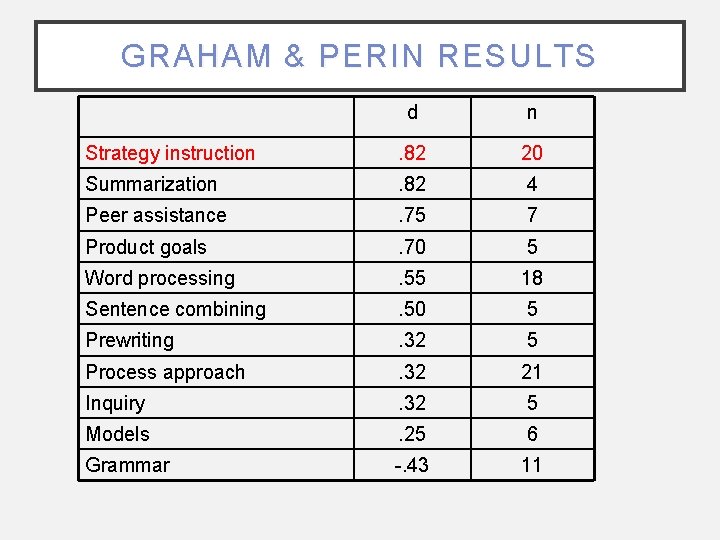
GRAHAM & PERIN RESULTS d n Strategy instruction . 82 20 Summarization . 82 4 Peer assistance . 75 7 Product goals . 70 5 Word processing . 55 18 Sentence combining . 50 5 Prewriting . 32 5 Process approach . 32 21 Inquiry . 32 5 Models . 25 6 Grammar -. 43 11
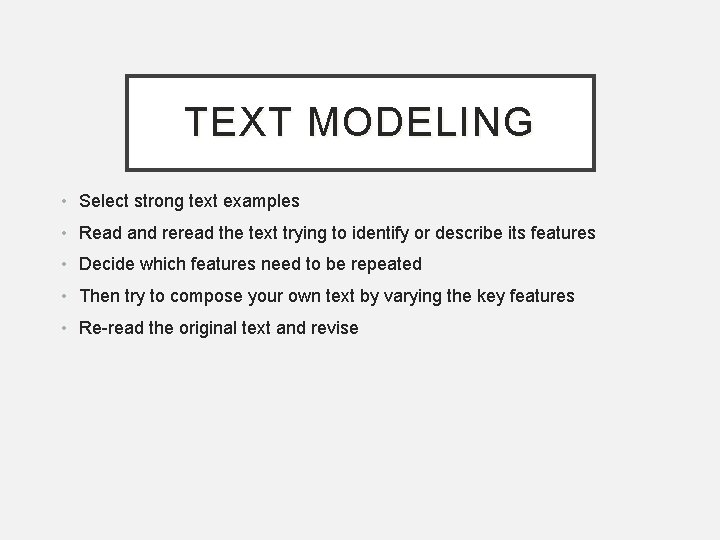
TEXT MODELING • Select strong text examples • Read and reread the text trying to identify or describe its features • Decide which features need to be repeated • Then try to compose your own text by varying the key features • Re-read the original text and revise
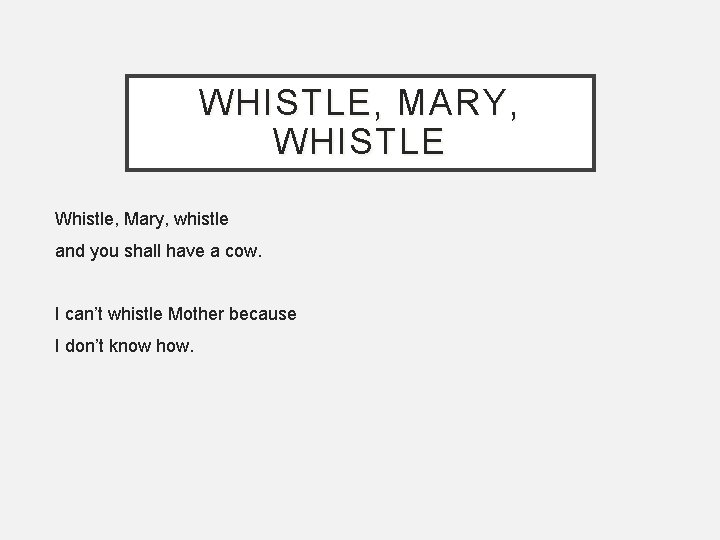
WHISTLE, MARY, WHISTLE Whistle, Mary, whistle and you shall have a cow. I can’t whistle Mother because I don’t know how.
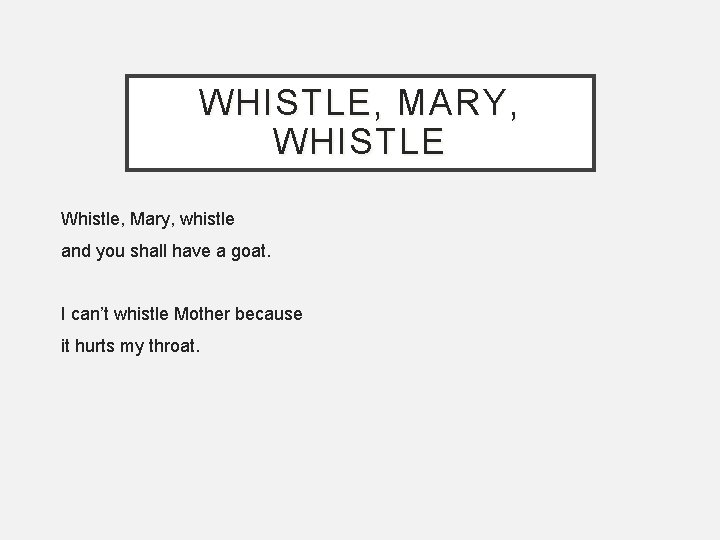
WHISTLE, MARY, WHISTLE Whistle, Mary, whistle and you shall have a goat. I can’t whistle Mother because it hurts my throat.
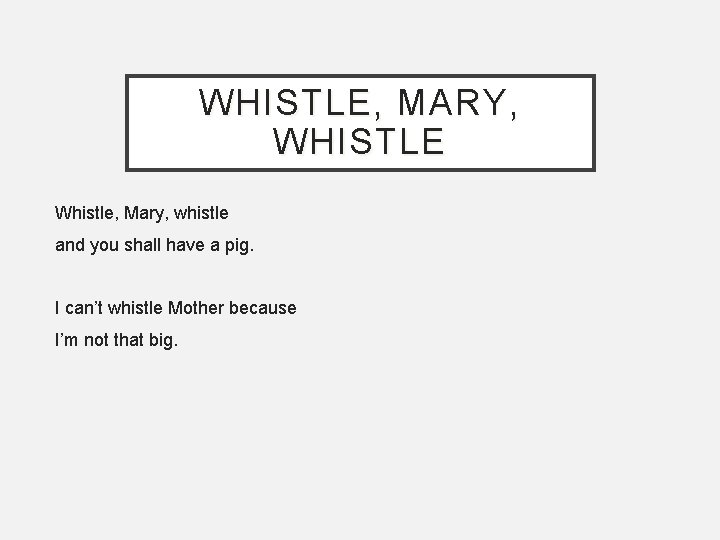
WHISTLE, MARY, WHISTLE Whistle, Mary, whistle and you shall have a pig. I can’t whistle Mother because I’m not that big.
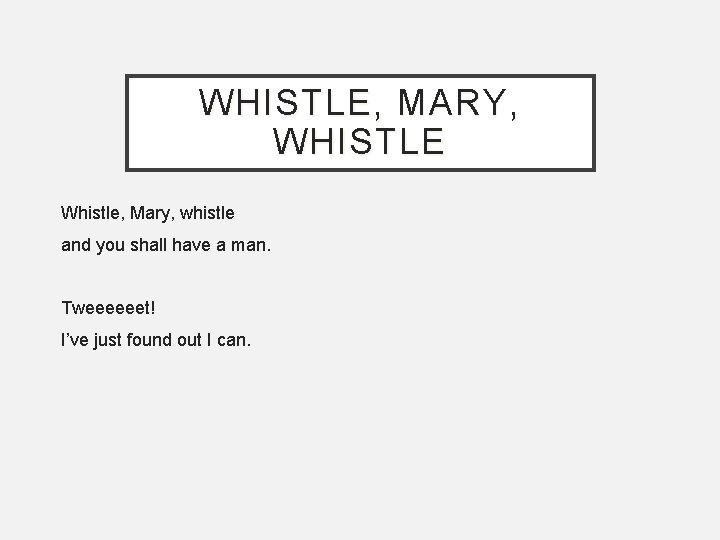
WHISTLE, MARY, WHISTLE Whistle, Mary, whistle and you shall have a man. Tweeeeeet! I’ve just found out I can.
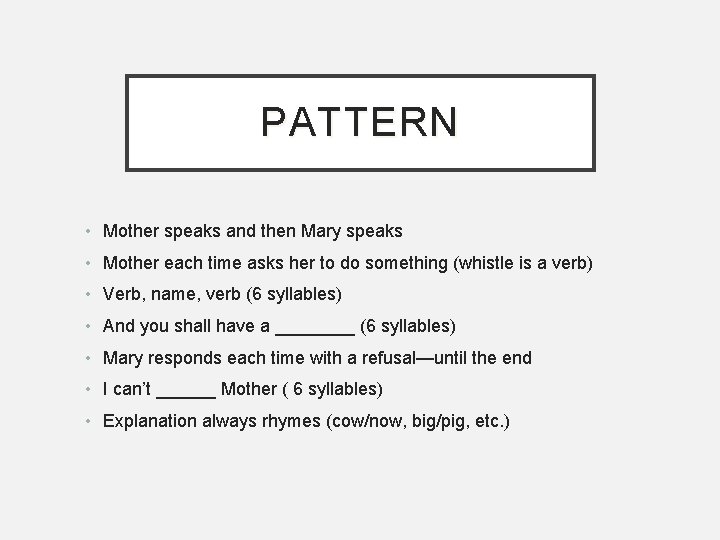
PATTERN • Mother speaks and then Mary speaks • Mother each time asks her to do something (whistle is a verb) • Verb, name, verb (6 syllables) • And you shall have a ____ (6 syllables) • Mary responds each time with a refusal—until the end • I can’t ______ Mother ( 6 syllables) • Explanation always rhymes (cow/now, big/pig, etc. )
SUMMARIZATION • Writing about text is effective because it encourages students to think about what the author wrote (more effective with elementary than secondary) • Requires students to identify the key ideas and details and to think about how those ideas are organized • More explicit consideration of the text than if the reader were only reading
GRAHAM & PERIN RESULTS d n Strategy instruction . 82 20 Summarization . 82 4 Peer assistance . 75 7 Product goals . 70 5 Word processing . 55 18 Sentence combining . 50 5 Prewriting . 32 5 Process approach . 32 21 Inquiry . 32 5 Models . 25 6 Grammar -. 43 11
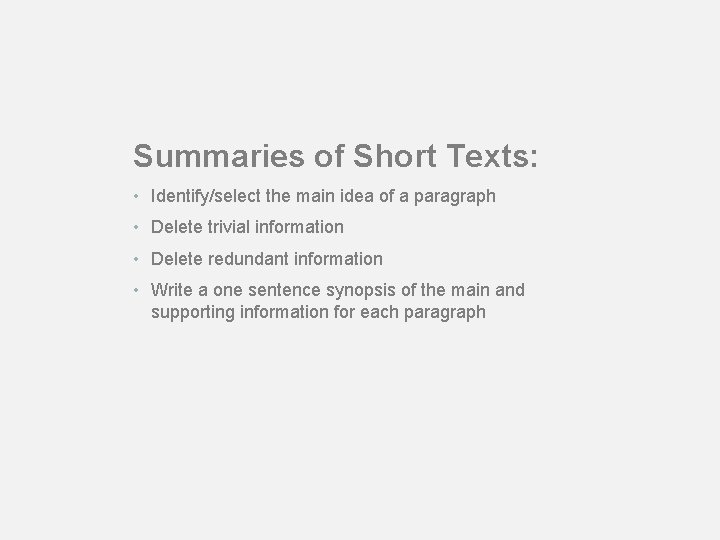
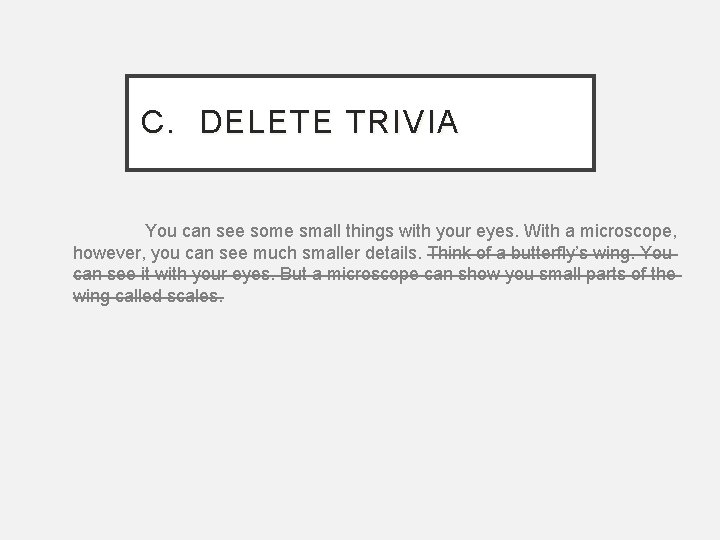
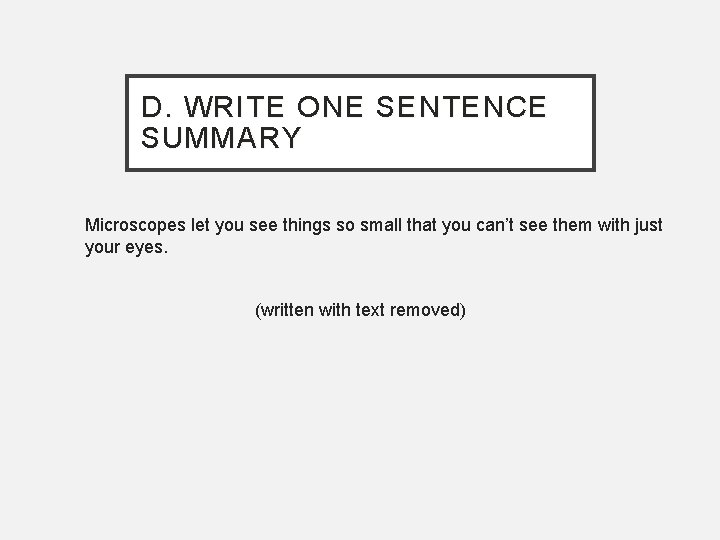
Summaries of Short Texts: • Identify/select the main idea of a paragraph • Delete trivial information • Delete redundant information • Write a one sentence synopsis of the main and supporting information for each paragraph
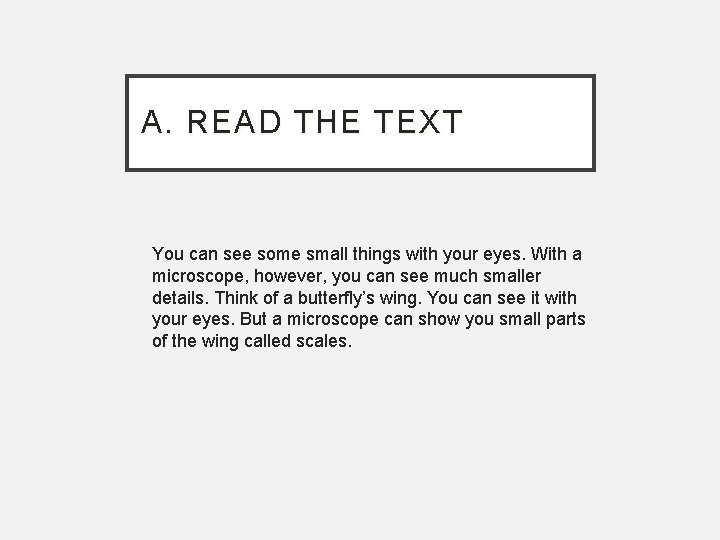
A. READ THE TEXT You can see some small things with your eyes. With a microscope, however, you can see much smaller details. Think of a butterfly’s wing. You can see it with your eyes. But a microscope can show you small parts of the wing called scales.
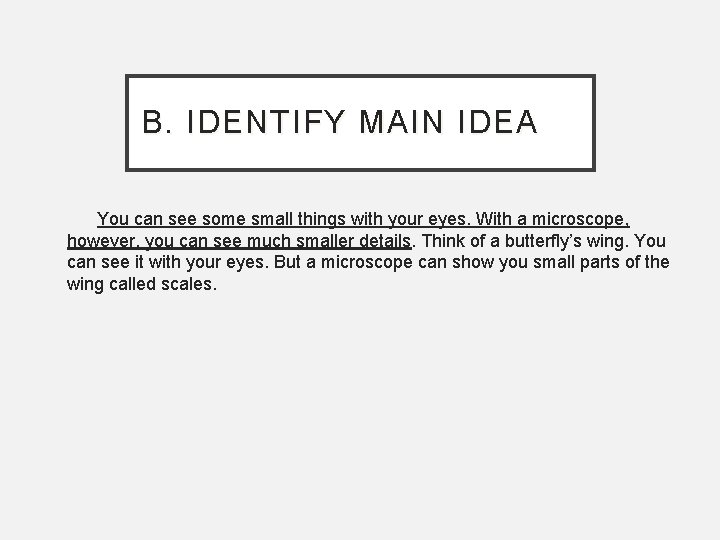
B. IDENTIFY MAIN IDEA You can see some small things with your eyes. With a microscope, however, you can see much smaller details. Think of a butterfly’s wing. You can see it with your eyes. But a microscope can show you small parts of the wing called scales.
C. DELETE TRIVIA You can see some small things with your eyes. With a microscope, however, you can see much smaller details. Think of a butterfly’s wing. You can see it with your eyes. But a microscope can show you small parts of the wing called scales.
D. WRITE ONE SENTENCE SUMMARY Microscopes let you see things so small that you can’t see them with just your eyes. (written with text removed)
Summaries of Longer Texts: Identify/select the main idea of a text Create a skeleton outline using the subheadings from the text Identify 2 -3 important ideas for each subheading Convert the outline into a summary
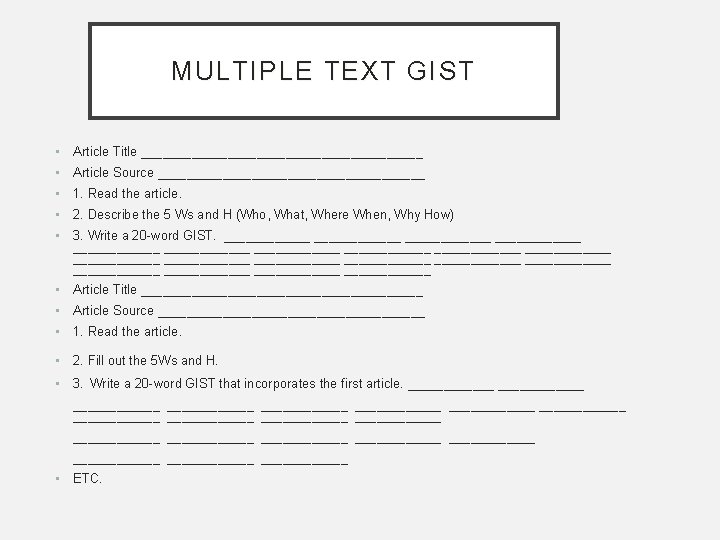
GIST • 1. Read text (section) • 2. Identify 5 Ws and H • 3. Write 20 word summary __________ __________ __________ __________ __________ _____
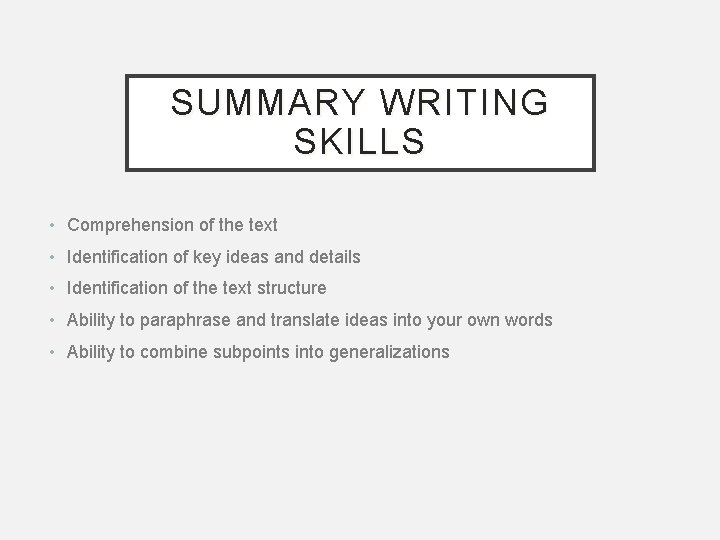
SUMMARY WRITING SKILLS • Comprehension of the text • Identification of key ideas and details • Identification of the text structure • Ability to paraphrase and translate ideas into your own words • Ability to combine subpoints into generalizations
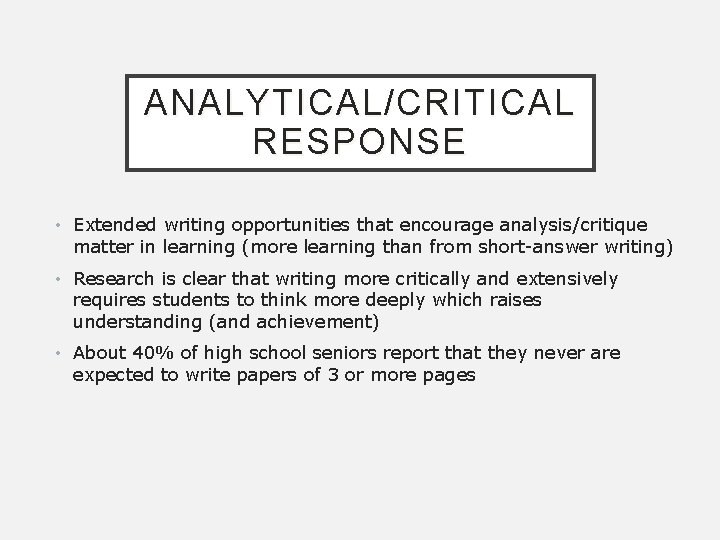
ANALYTICAL/CRITICAL RESPONSE • Extended writing opportunities that encourage analysis/critique matter in learning (more learning than from short-answer writing) • Research is clear that writing more critically and extensively requires students to think more deeply which raises understanding (and achievement) • About 40% of high school seniors report that they never are expected to write papers of 3 or more pages
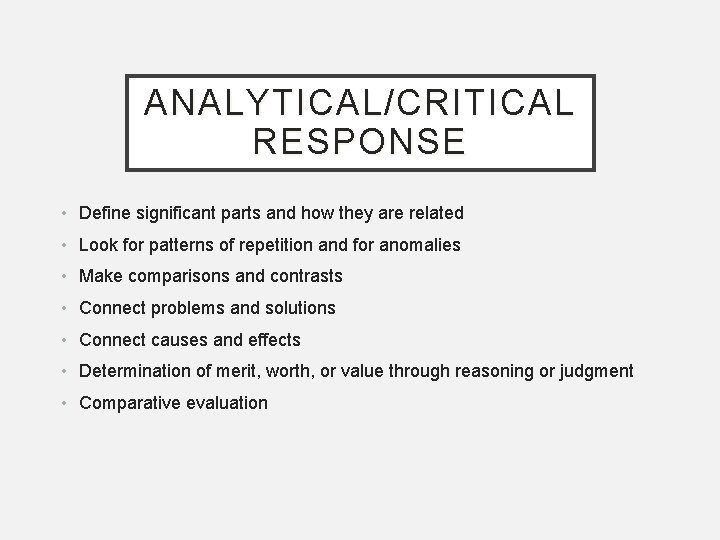
ANALYTICAL/CRITICAL RESPONSE • Define significant parts and how they are related • Look for patterns of repetition and for anomalies • Make comparisons and contrasts • Connect problems and solutions • Connect causes and effects • Determination of merit, worth, or value through reasoning or judgment • Comparative evaluation
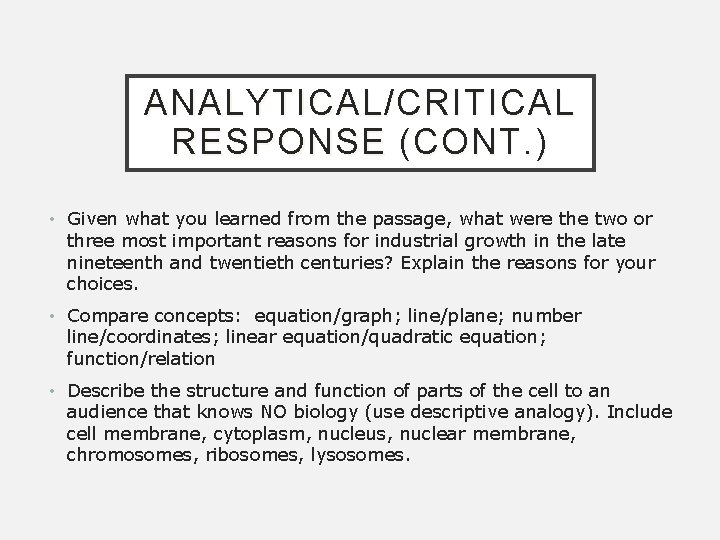
ANALYTICAL/CRITICAL RESPONSE (CONT. ) • Given what you learned from the passage, what were the two or three most important reasons for industrial growth in the late nineteenth and twentieth centuries? Explain the reasons for your choices. • Compare concepts: equation/graph; line/plane; number line/coordinates; linear equation/quadratic equation; function/relation • Describe the structure and function of parts of the cell to an audience that knows NO biology (use descriptive analogy). Include cell membrane, cytoplasm, nucleus, nuclear membrane, chromosomes, ribosomes, lysosomes.
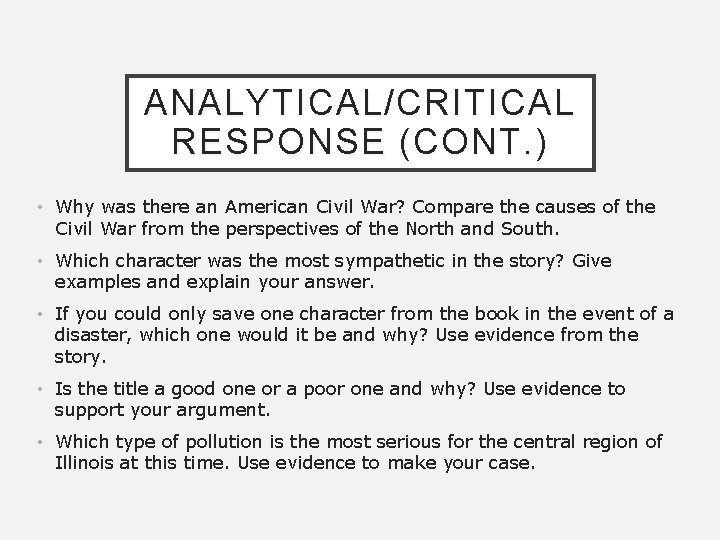
ANALYTICAL/CRITICAL RESPONSE (CONT. ) • Why was there an American Civil War? Compare the causes of the Civil War from the perspectives of the North and South. • Which character was the most sympathetic in the story? Give examples and explain your answer. • If you could only save one character from the book in the event of a disaster, which one would it be and why? Use evidence from the story. • Is the title a good one or a poor one and why? Use evidence to support your argument. • Which type of pollution is the most serious for the central region of Illinois at this time. Use evidence to make your case.
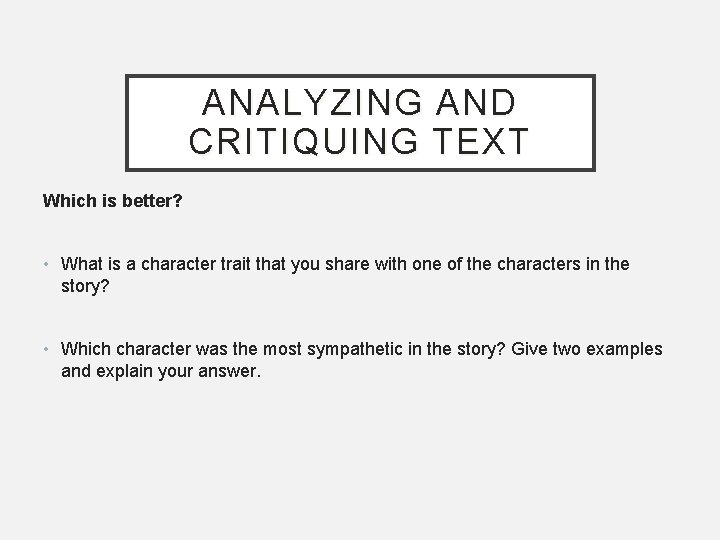
ANALYZING AND CRITIQUING TEXT Which is better? • What is a character trait that you share with one of the characters in the story? • Which character was the most sympathetic in the story? Give two examples and explain your answer.
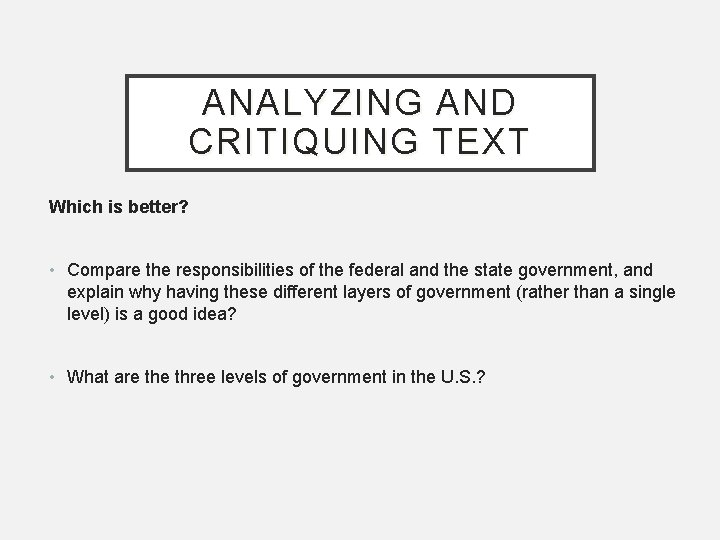
ANALYZING AND CRITIQUING TEXT Which is better? • Compare the responsibilities of the federal and the state government, and explain why having these different layers of government (rather than a single level) is a good idea? • What are three levels of government in the U. S. ?
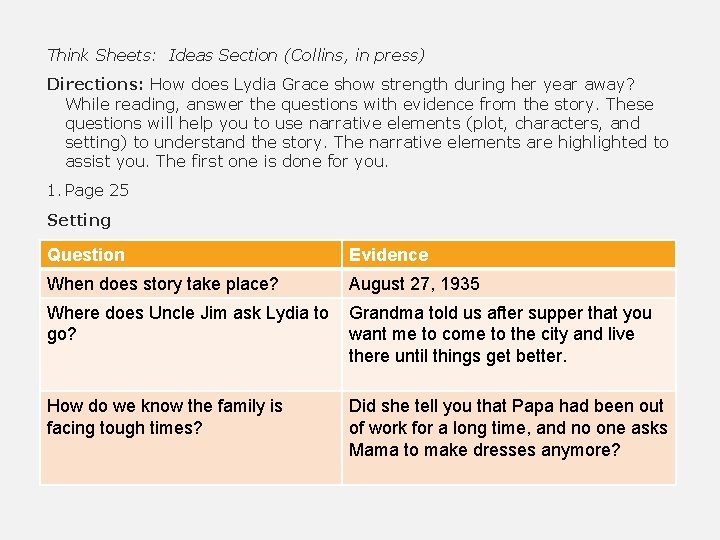
Think Sheets: Ideas Section (Collins, in press) Directions: How does Lydia Grace show strength during her year away? While reading, answer the questions with evidence from the story. These questions will help you to use narrative elements (plot, characters, and setting) to understand the story. The narrative elements are highlighted to assist you. The first one is done for you. 1. Page 25 Setting Question Evidence When does story take place? August 27, 1935 Where does Uncle Jim ask Lydia to Grandma told us after supper that you go? want me to come to the city and live there until things get better. How do we know the family is facing tough times? Did she tell you that Papa had been out of work for a long time, and no one asks Mama to make dresses anymore?
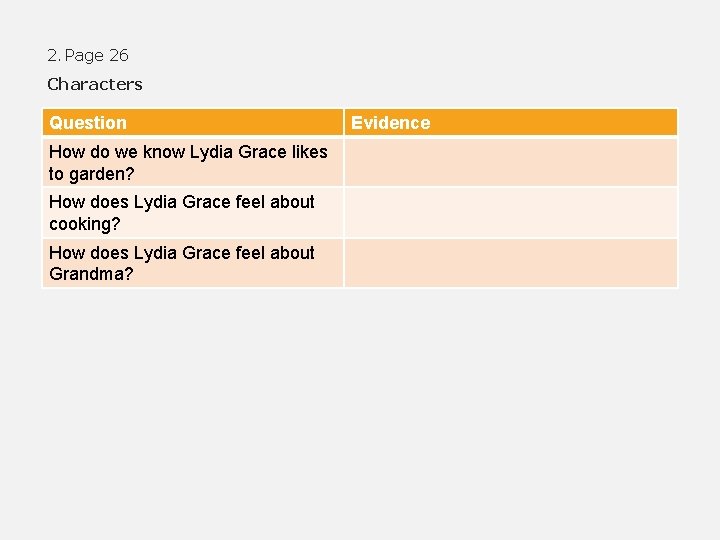
2. Page 26 Characters Question How do we know Lydia Grace likes to garden? How does Lydia Grace feel about cooking? How does Lydia Grace feel about Grandma? Evidence
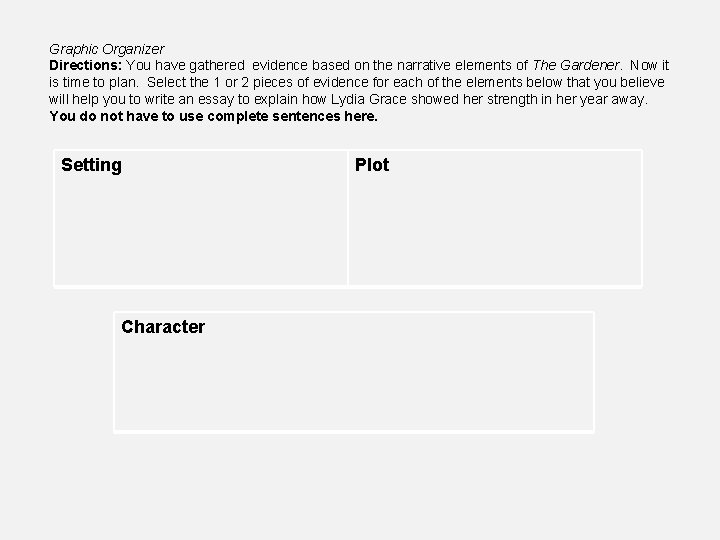
Graphic Organizer Directions: You have gathered evidence based on the narrative elements of The Gardener. Now it is time to plan. Select the 1 or 2 pieces of evidence for each of the elements below that you believe will help you to write an essay to explain how Lydia Grace showed her strength in her year away. You do not have to use complete sentences here. Setting Character Plot
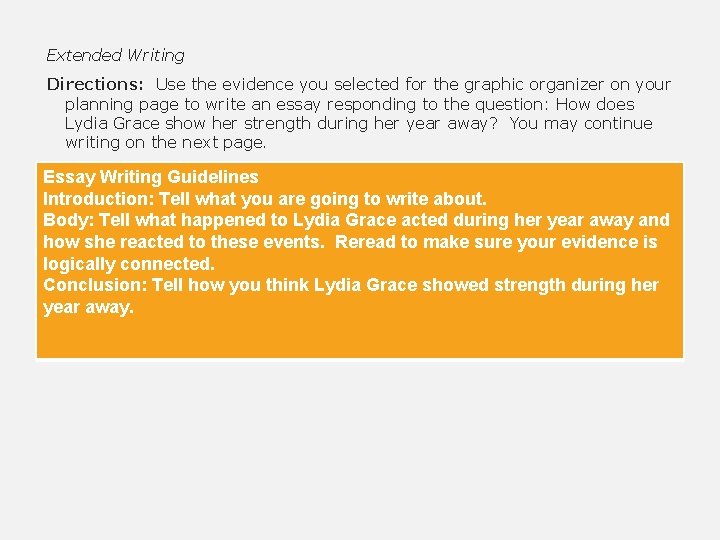
Extended Writing Directions: Use the evidence you selected for the graphic organizer on your planning page to write an essay responding to the question: How does Lydia Grace show her strength during her year away? You may continue writing on the next page. Essay Writing Guidelines Introduction: Tell what you are going to write about. Body: Tell what happened to Lydia Grace acted during her year away and how she reacted to these events. Reread to make sure your evidence is logically connected. Conclusion: Tell how you think Lydia Grace showed strength during her year away.
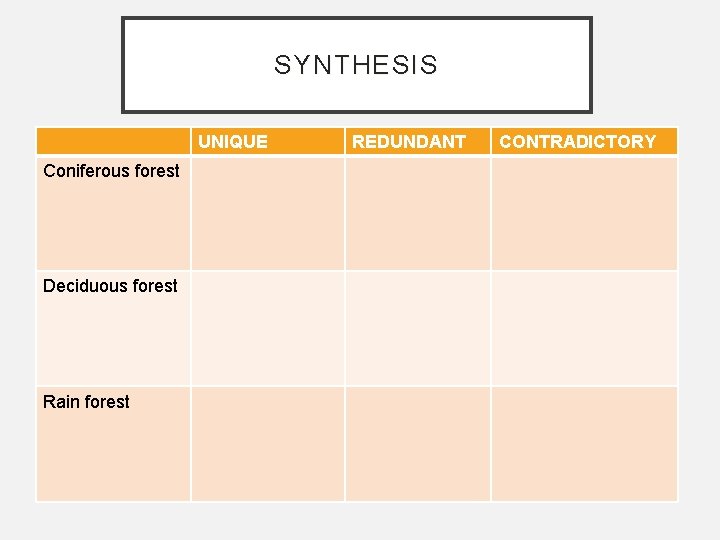
SYNTHESIS • Synthesis involves combining information from multiple sources, evaluating information, resolving conflicting information • Writing ones own text, but relying on evidence from multiple sources (research writing, report writing, writing from sources, etc. )
SYNTHESIS OF TEXTS (CONT. ) • Research skills of identifying relevant and appropriate sources of information • Critical reading and analysis skills to determine the value and soundness of sources • Ability to adequately summarize information and paraphrase information from sources (avoiding plagiarism) • Ability to recognize uniqueness and redundancy of information across texts (and to reveal or resolve contradiction) • Synthesis requires explicit use of evidence and citation or crediting of sources
SYNTHESIS OF TEXTS (CONT. ) • All of these skills are challenging and all of them require specific explicit teaching over a long period of time in order to master • Critical reading and analysis skills to determine the value and soundness of sources • Ability to adequately summarize information and paraphrase information from sources (avoiding plagiarism) • Ability to recognize uniqueness and redundancy of information across texts (and to reveal or resolve contradiction) • Synthesis requires explicit use of evidence and citation or crediting of sources
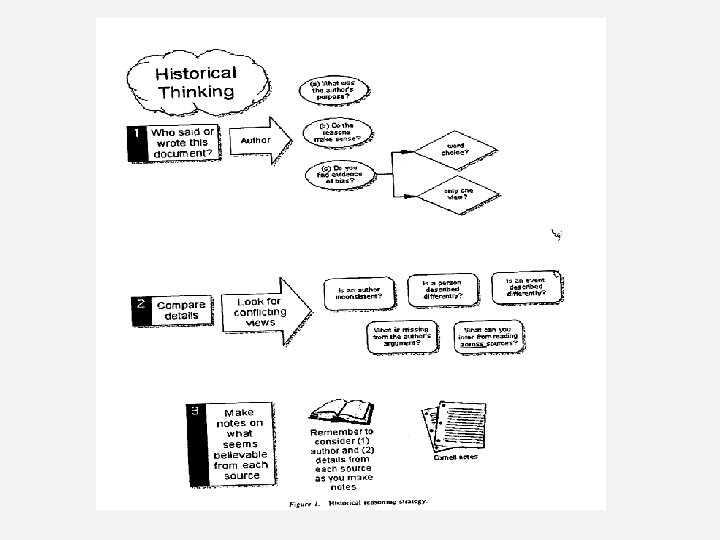
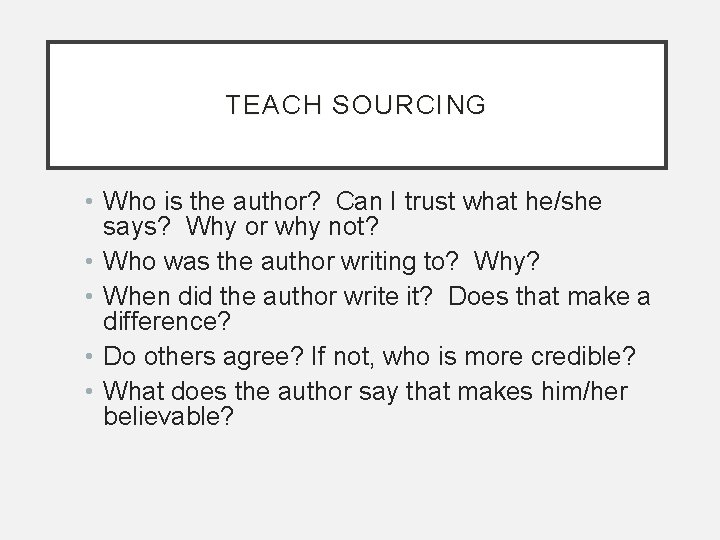
TEACH SOURCING • Who is the author? Can I trust what he/she says? Why or why not? • Who was the author writing to? Why? • When did the author write it? Does that make a difference? • Do others agree? If not, who is more credible? • What does the author say that makes him/her believable?
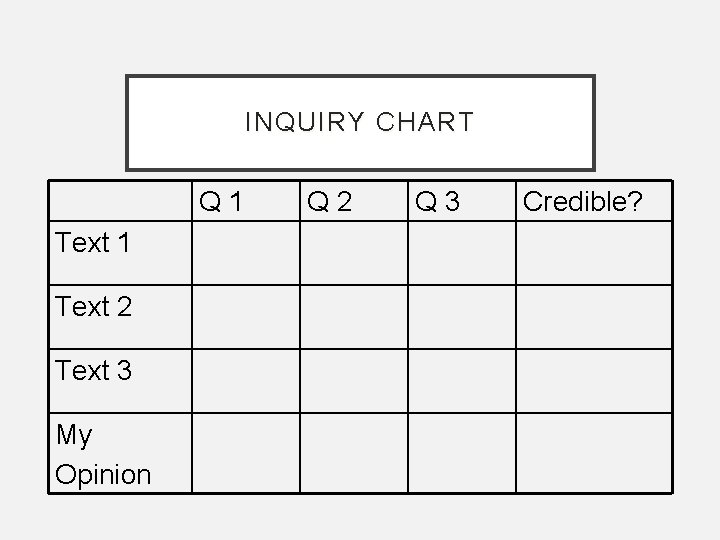
INQUIRY CHART Q 1 Text 2 Text 3 My Opinion Q 2 Q 3 Credible?
SYNTHESIS UNIQUE Coniferous forest Deciduous forest Rain forest REDUNDANT CONTRADICTORY
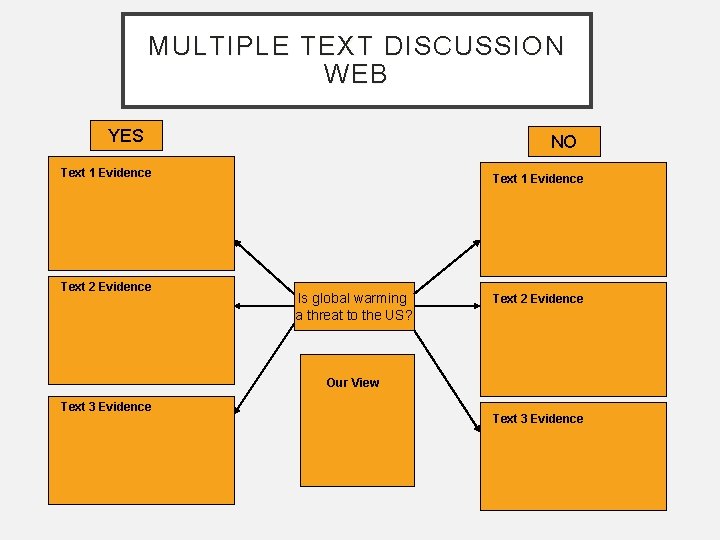
MULTIPLE TEXT DISCUSSION WEB YES NO Text 1 Evidence Text 2 Evidence Text 1 Evidence Is global warming a threat to the US? Text 2 Evidence Our View Text 3 Evidence
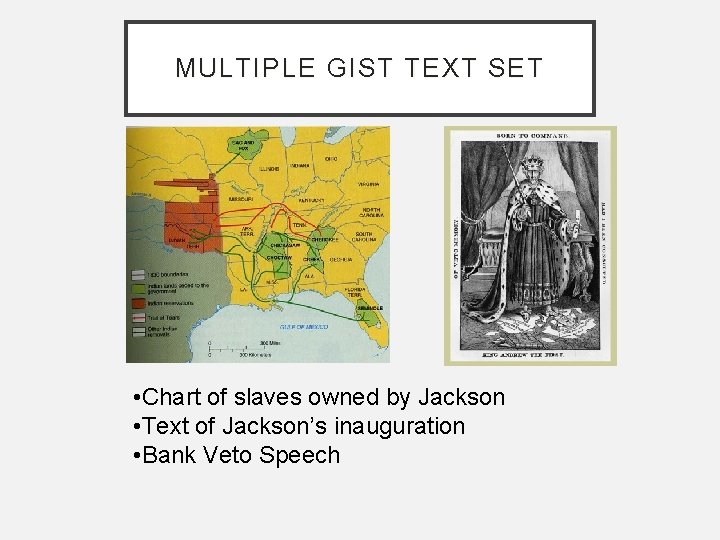
MULTIPLE GIST TEXT SET • Chart of slaves owned by Jackson • Text of Jackson’s inauguration • Bank Veto Speech
MULTIPLE TEXT GIST • Article Title ____________________ • Article Source ___________________ • 1. Read the article. • 2. Describe the 5 Ws and H (Who, What, Where When, Why How) • 3. Write a 20 -word GIST. ____________ ____________ ____________ ____________ ____________ • Article Title ____________________ • Article Source ___________________ • 1. Read the article. • 2. Fill out the 5 Ws and H. • 3. Write a 20 -word GIST that incorporates the first article. ____________ ____________ ____________ ____________ ____________ • ETC.
CONCLUSIONS • Writing will need to be more closely integrated with reading comprehension instruction • The amount of writing about what students read will need to increase • Greater emphasis on summarization, writing to models, critical analysis, and synthesis of information than in the past • Greater attention to precision, accuracy, clarity, and use of evidence
RESEARCH SOURCES Collins, J. L. , & Gunning, T. (Eds. ), Building struggling students' higher level literacy. Newark, DE: International Reading Association. De La Paz, S. (2005). Effects of historical reasoning instruction and writing strategy mastery in culturally and academically diverse middle school classrooms. Journal of Educational Psychology, 97, 139 -156. Graham, S. , & Hebert, M. (2010). Writing to read: Evidence of how writing can improve reading. Washington, DC: Alliance for Excellent Education. Graham, S. , & Perin, D. (2007). A meta-analysis of writing instruction for adolescent students. Journal of Educational Psychology, 99, 445– 476) Jetton, T. , & Shanahan, C. (Eds. ). (2012). Adolescent literacy in the academic disciplines: General principles and practical strategies. New York: Guilford. Shanahan, T. (2004). Overcoming the dominance of communication: Writing to think and learn. In T. L. Jetton & J. A. Dole (Eds. ), Adolescent literacy research and practice. New York: Guilford Press. Shanahan, T. (2008). Relations among oral language, reading, and writing development. In C. A. Mac. Arthur, S. Graham, & J. Fitzgerald (Eds. ), Handbook of Writing Research (pp. 171186). New York: Guilford Press. Spatt, B. (2010). Writing from sources (8 th ed. ). Boston: Bedford/St. Martins. Tierney, R. J. , & Shanahan, T. (1991). Research on the reading-writing relationship: Interactions, transactions, and outcomes. In R. Barr, M. L. Kamil, P. Mosenthal, P. D. Pearson (Eds. ), Handbook of Reading Research (pp. 246 -280). New York: Longman.