
Writing in America The Puritans 1620 1728 or
- Slides: 25
Writing in America The Puritans, 1620 -1728 (or thereabouts)
What We’ll Cover A quick review of the periods of American Lit What is Puritanism Characteristics of Puritan writings • A few well-known Puritan authors • • •
Periods in American Literature • Pre-19 th century • • – Pre-settlement (before 1620) Native American literature – Puritanism (1620 s – 1728) – Enlightenment, also known as The Age of Reason (second half of the 18 th century) Romanticism (1820 s-1861) Realism (1860 s-1920 s) Modernism (1914 -1945) Post-World War II (1945 - )
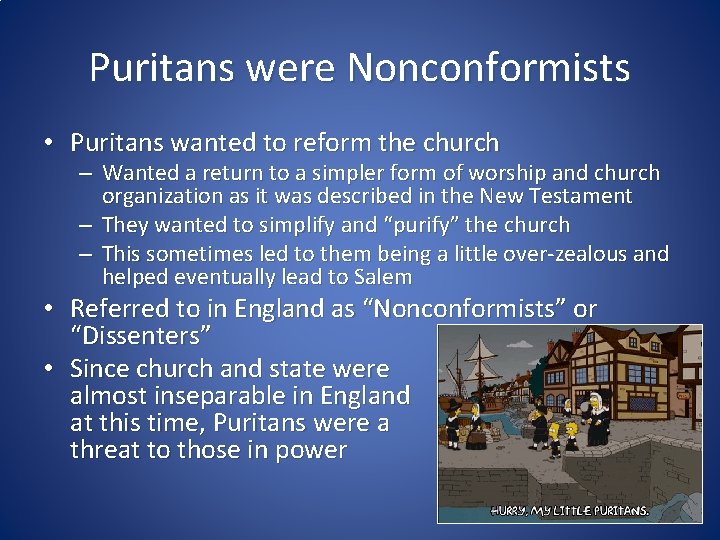
Puritans were Nonconformists • Puritans wanted to reform the church – Wanted a return to a simpler form of worship and church organization as it was described in the New Testament – They wanted to simplify and “purify” the church – This sometimes led to them being a little over-zealous and helped eventually lead to Salem • Referred to in England as “Nonconformists” or “Dissenters” • Since church and state were almost inseparable in England at this time, Puritans were a threat to those in power
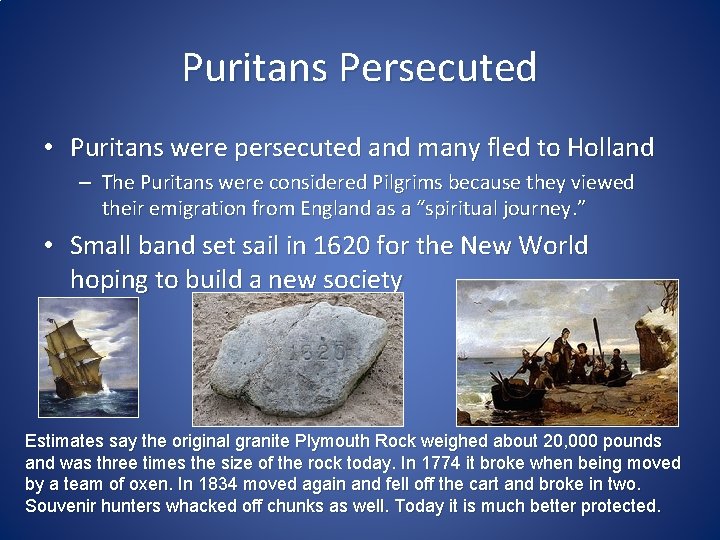
Puritans Persecuted • Puritans were persecuted and many fled to Holland – The Puritans were considered Pilgrims because they viewed their emigration from England as a “spiritual journey. ” • Small band set sail in 1620 for the New World hoping to build a new society Estimates say the original granite Plymouth Rock weighed about 20, 000 pounds and was three times the size of the rock today. In 1774 it broke when being moved by a team of oxen. In 1834 moved again and fell off the cart and broke in two. Souvenir hunters whacked off chunks as well. Today it is much better protected.
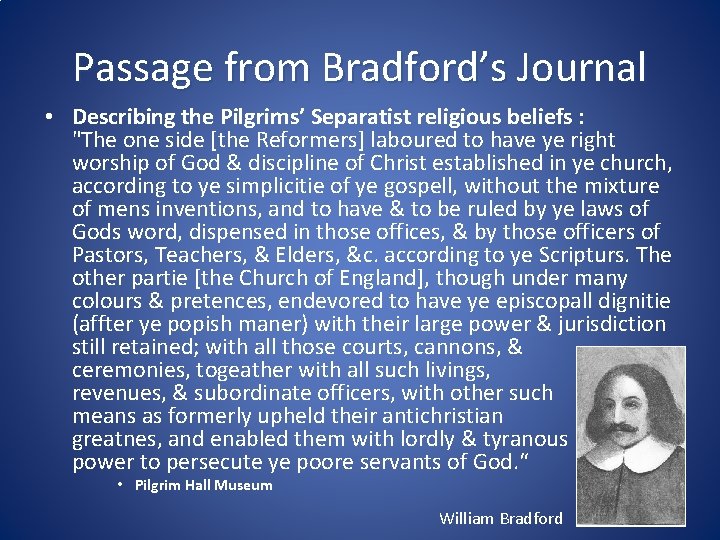
Passage from Bradford’s Journal • Describing the Pilgrims’ Separatist religious beliefs : "The one side [the Reformers] laboured to have ye right worship of God & discipline of Christ established in ye church, according to ye simplicitie of ye gospell, without the mixture of mens inventions, and to have & to be ruled by ye laws of Gods word, dispensed in those offices, & by those officers of Pastors, Teachers, & Elders, &c. according to ye Scripturs. The other partie [the Church of England], though under many colours & pretences, endevored to have ye episcopall dignitie (affter ye popish maner) with their large power & jurisdiction still retained; with all those courts, cannons, & ceremonies, togeather with all such livings, revenues, & subordinate officers, with other such means as formerly upheld their antichristian greatnes, and enabled them with lordly & tyranous power to persecute ye poore servants of God. “ • Pilgrim Hall Museum William Bradford
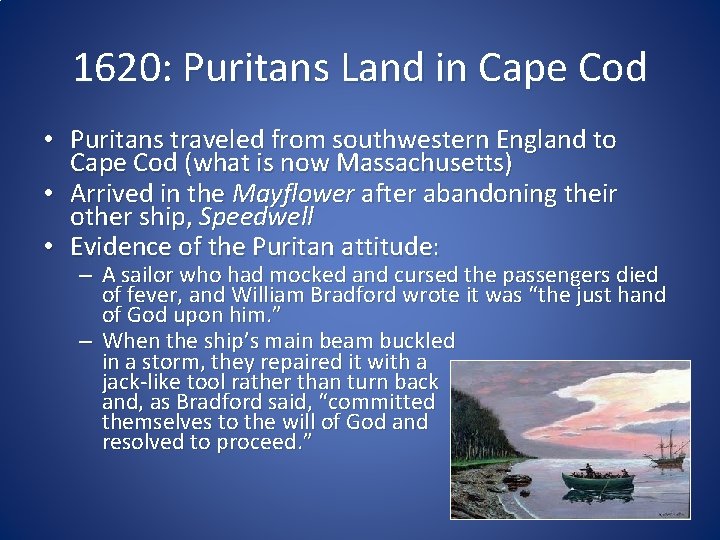
1620: Puritans Land in Cape Cod • Puritans traveled from southwestern England to Cape Cod (what is now Massachusetts) • Arrived in the Mayflower after abandoning their other ship, Speedwell • Evidence of the Puritan attitude: – A sailor who had mocked and cursed the passengers died of fever, and William Bradford wrote it was “the just hand of God upon him. ” – When the ship’s main beam buckled in a storm, they repaired it with a jack-like tool rather than turn back and, as Bradford said, “committed themselves to the will of God and resolved to proceed. ”
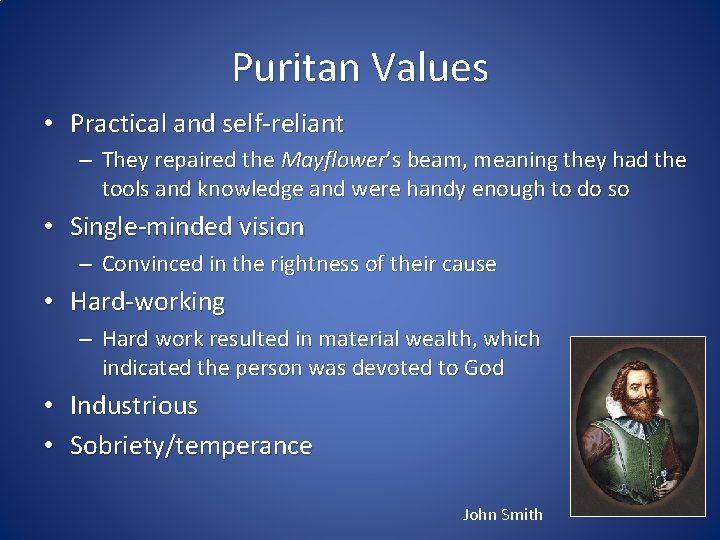
Puritan Values • Practical and self-reliant – They repaired the Mayflower’s beam, meaning they had the tools and knowledge and were handy enough to do so • Single-minded vision – Convinced in the rightness of their cause • Hard-working – Hard work resulted in material wealth, which indicated the person was devoted to God • Industrious • Sobriety/temperance John Smith
Puritans’ Fate Was in God’s Hands • Convinced of the rightness of their purpose • Because they didn’t know God’s thoughts, they assumed God already knew their fate – Most of humanity “damned” by the sin of Adam and Eve – The unknown helped them lead pious lives: How did you know if you were one of the damned or one of the saved? • But if you were bad, then for sure you were cooked! • The Puritans were considered Pilgrims because they viewed their emigration from England as a “spiritual journey. ”
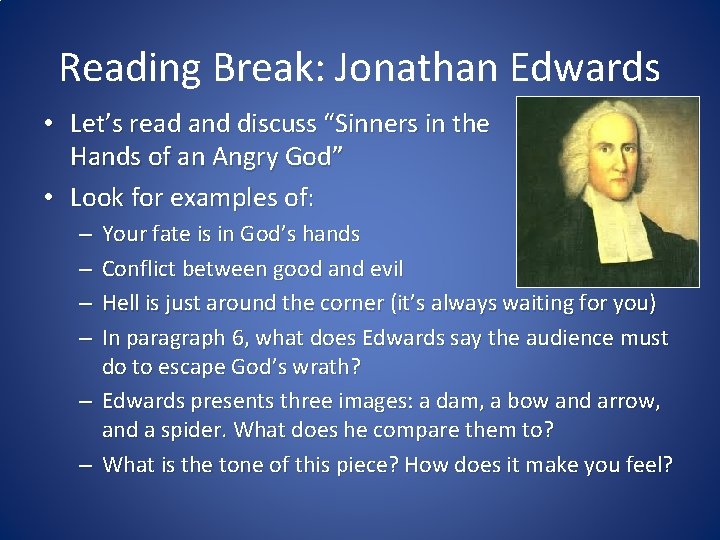
Reading Break: Jonathan Edwards • Let’s read and discuss “Sinners in the Hands of an Angry God” • Look for examples of: Your fate is in God’s hands Conflict between good and evil Hell is just around the corner (it’s always waiting for you) In paragraph 6, what does Edwards say the audience must do to escape God’s wrath? – Edwards presents three images: a dam, a bow and arrow, and a spider. What does he compare them to? – What is the tone of this piece? How does it make you feel? – –
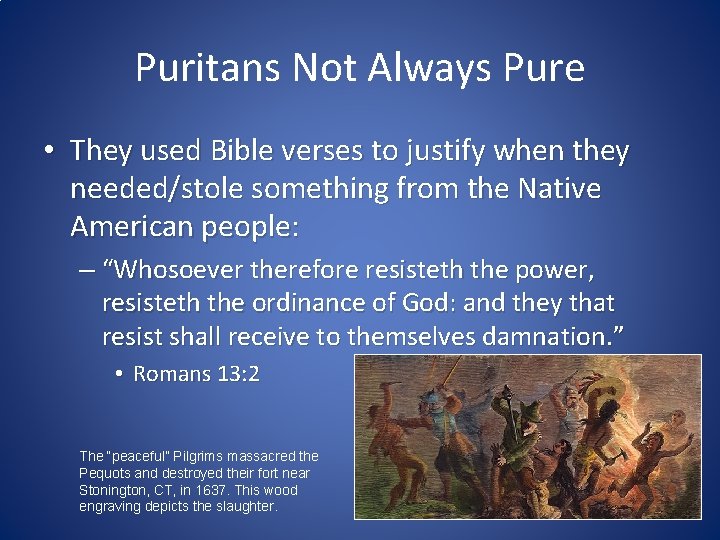
Puritans Not Always Pure • They used Bible verses to justify when they needed/stole something from the Native American people: – “Whosoever therefore resisteth the power, resisteth the ordinance of God: and they that resist shall receive to themselves damnation. ” • Romans 13: 2 The “peaceful” Pilgrims massacred the Pequots and destroyed their fort near Stonington, CT, in 1637. This wood engraving depicts the slaughter.
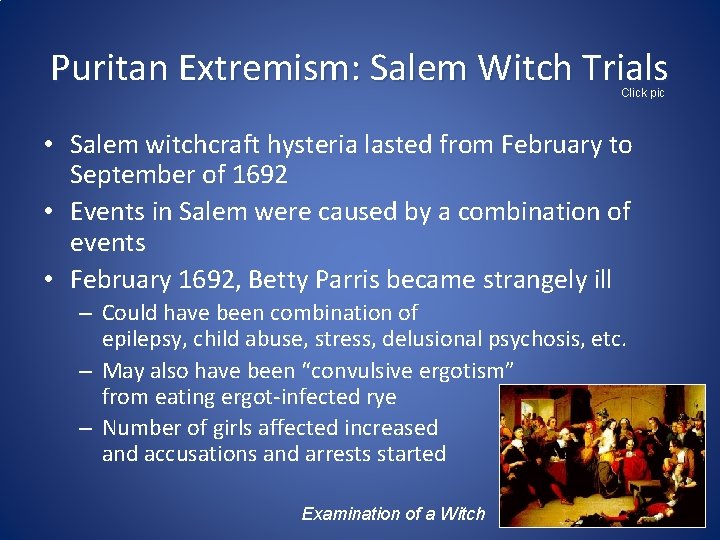
Puritan Extremism: Salem Witch Trials Click pic • Salem witchcraft hysteria lasted from February to September of 1692 • Events in Salem were caused by a combination of events • February 1692, Betty Parris became strangely ill – Could have been combination of epilepsy, child abuse, stress, delusional psychosis, etc. – May also have been “convulsive ergotism” from eating ergot-infected rye – Number of girls affected increased and accusations and arrests started Examination of a Witch
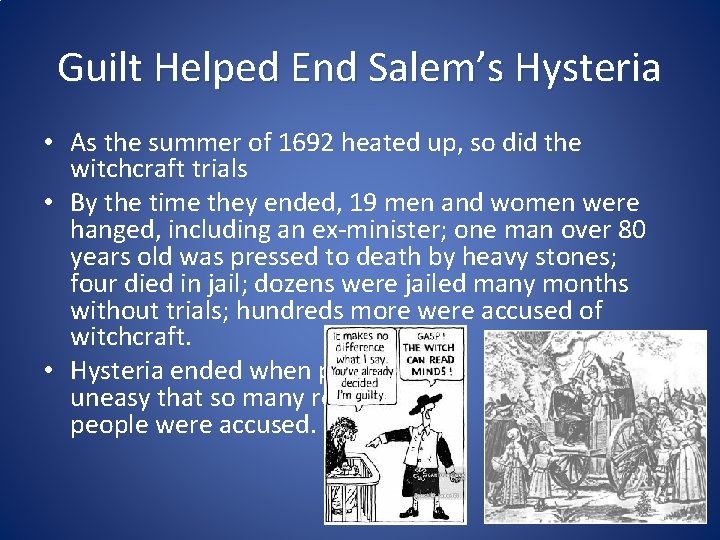
Guilt Helped End Salem’s Hysteria • As the summer of 1692 heated up, so did the witchcraft trials • By the time they ended, 19 men and women were hanged, including an ex-minister; one man over 80 years old was pressed to death by heavy stones; four died in jail; dozens were jailed many months without trials; hundreds more were accused of witchcraft. • Hysteria ended when people grew uneasy that so many reputable people were accused.
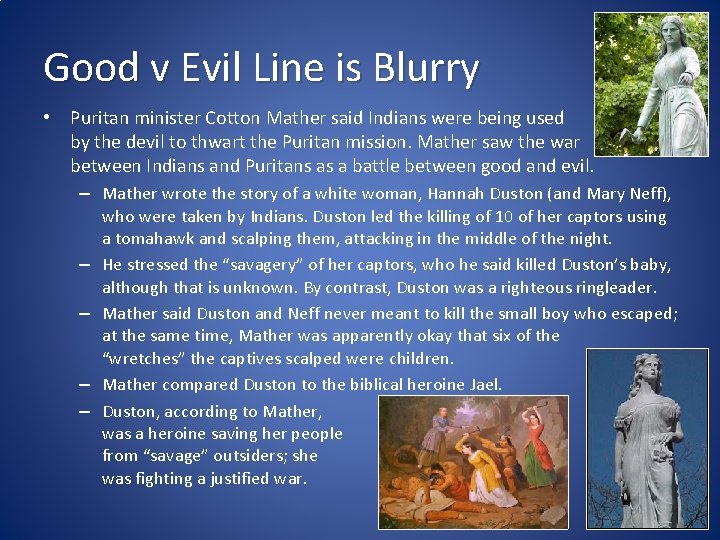
Good v Evil Line is Blurry • Puritan minister Cotton Mather said Indians were being used by the devil to thwart the Puritan mission. Mather saw the war between Indians and Puritans as a battle between good and evil. – Mather wrote the story of a white woman, Hannah Duston (and Mary Neff), who were taken by Indians. Duston led the killing of 10 of her captors using a tomahawk and scalping them, attacking in the middle of the night. – He stressed the “savagery” of her captors, who he said killed Duston’s baby, although that is unknown. By contrast, Duston was a righteous ringleader. – Mather said Duston and Neff never meant to kill the small boy who escaped; at the same time, Mather was apparently okay that six of the “wretches” the captives scalped were children. – Mather compared Duston to the biblical heroine Jael. – Duston, according to Mather, was a heroine saving her people from “savage” outsiders; she was fighting a justified war.
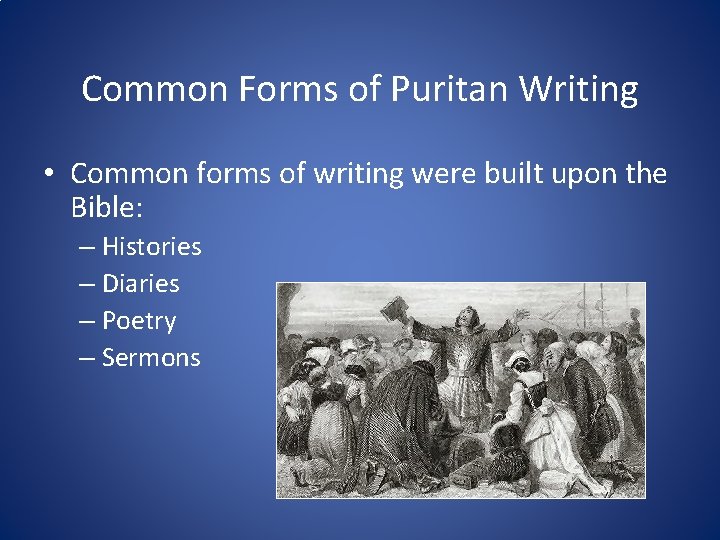
Common Forms of Puritan Writing • Common forms of writing were built upon the Bible: – Histories – Diaries – Poetry – Sermons
Example: Of Plymouth Plantation by William Bradford • In the fore part of this year, the Pequots fell openly upon the English at Connecticut, in the lower parts of the river, and slew sundry of them as they were at work in the fields, both men and women, to the great terror of the rest, and went away in great pride and triumph, with many high threats. They also assaulted a fort at the river’s mouth, though strong and well defended; and though they did ‘not there prevail, yet it struck them with much fear and astonishment to see their bold attempts in the face of danger. Which made them in all places to stand upon their ground and to prepare for resistance, and earnestly to solicit their friends and confederates in the Bay of Massachusetts to send them speedy aid, for they looked for more forcible assaults. Mr. Vane, being the Governor, writ from their General Court to them here to join with them in this war. William Bradford
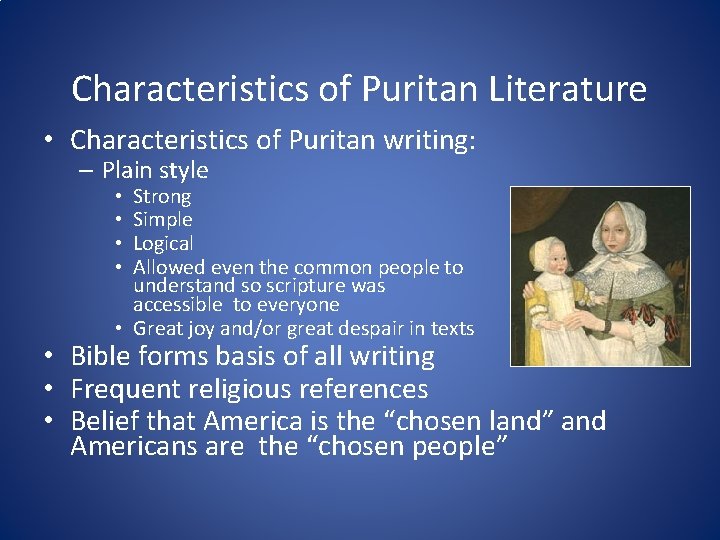
Characteristics of Puritan Literature • Characteristics of Puritan writing: – Plain style Strong Simple Logical Allowed even the common people to understand so scripture was accessible to everyone • Great joy and/or great despair in texts • • • Bible forms basis of all writing • Frequent religious references • Belief that America is the “chosen land” and Americans are the “chosen people”
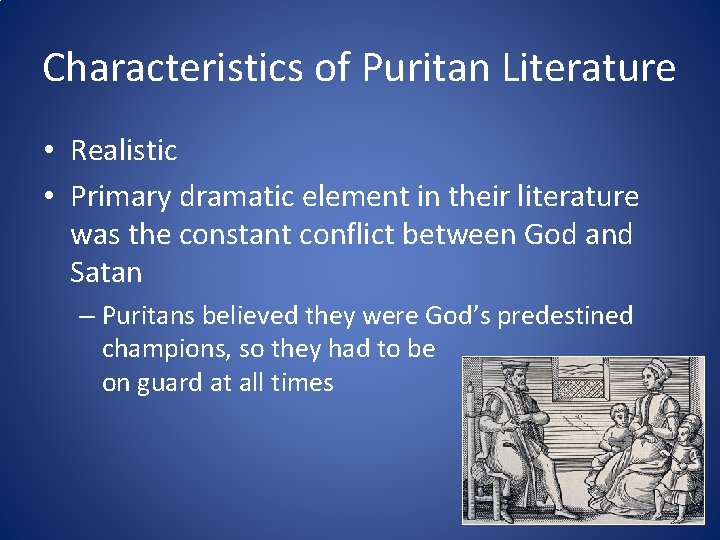
Characteristics of Puritan Literature • Realistic • Primary dramatic element in their literature was the constant conflict between God and Satan – Puritans believed they were God’s predestined champions, so they had to be on guard at all times
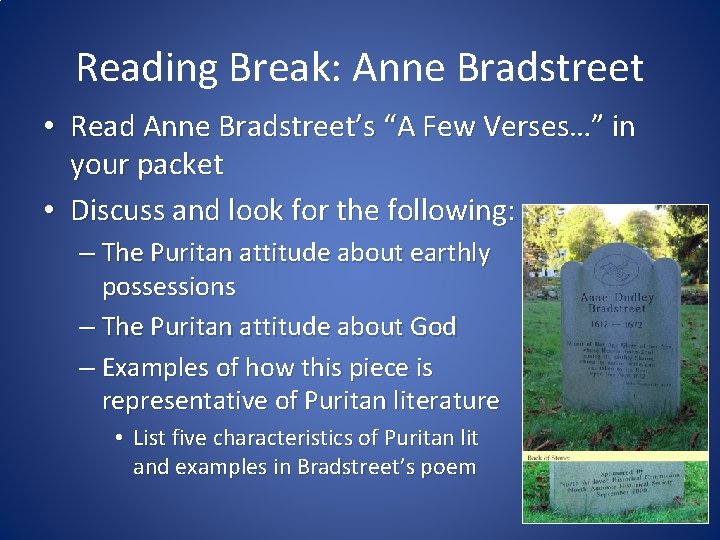
Reading Break: Anne Bradstreet • Read Anne Bradstreet’s “A Few Verses…” in your packet • Discuss and look for the following: – The Puritan attitude about earthly possessions – The Puritan attitude about God – Examples of how this piece is representative of Puritan literature • List five characteristics of Puritan lit and examples in Bradstreet’s poem
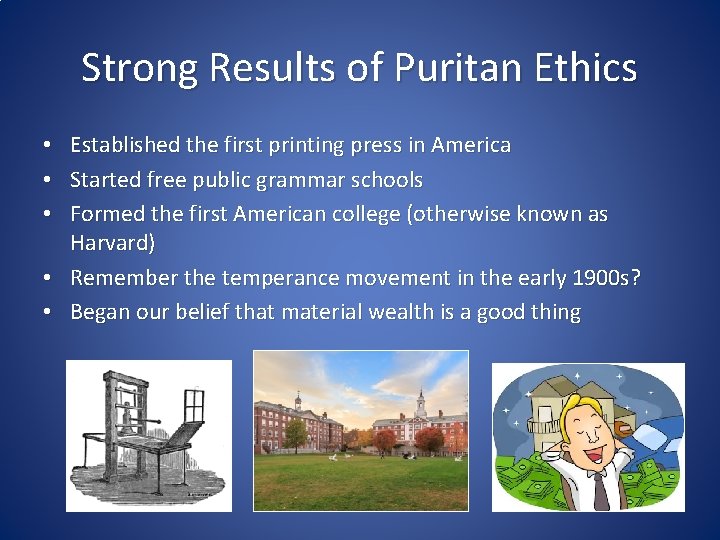
Strong Results of Puritan Ethics • Established the first printing press in America • Started free public grammar schools • Formed the first American college (otherwise known as Harvard) • Remember the temperance movement in the early 1900 s? • Began our belief that material wealth is a good thing
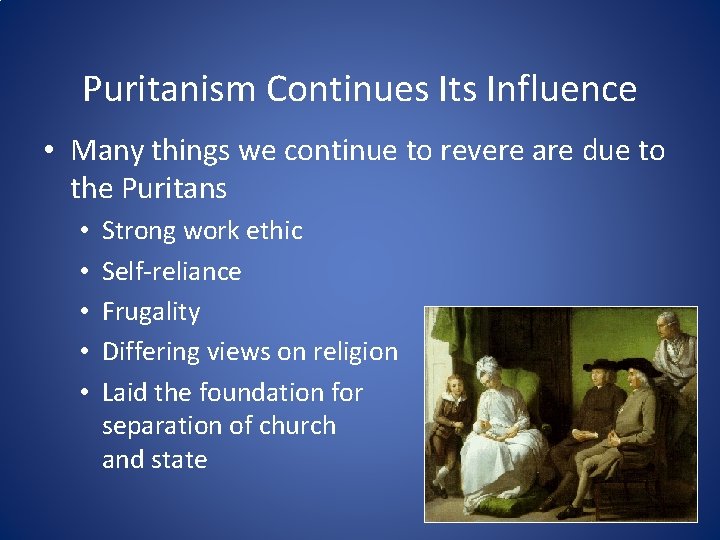
Puritanism Continues Its Influence • Many things we continue to revere are due to the Puritans • • • Strong work ethic Self-reliance Frugality Differing views on religion Laid the foundation for separation of church and state
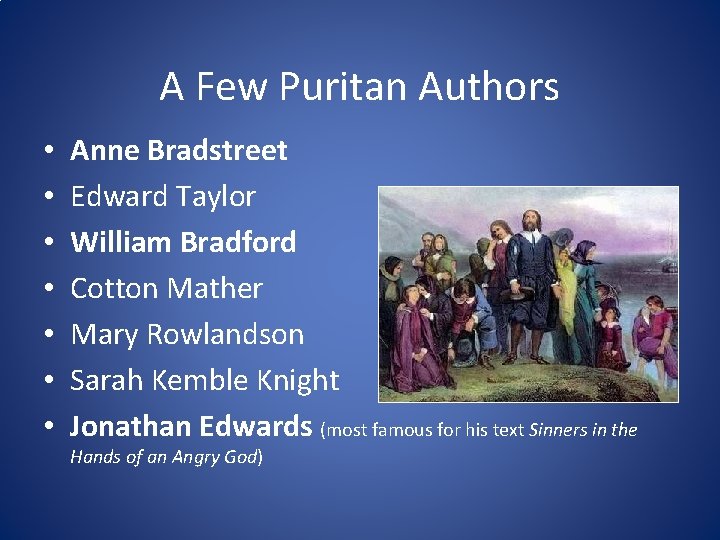
A Few Puritan Authors • • Anne Bradstreet Edward Taylor William Bradford Cotton Mather Mary Rowlandson Sarah Kemble Knight Jonathan Edwards (most famous for his text Sinners in the Hands of an Angry God)
To Review… Puritans were persecuted in England Believed in the rightness of their mission Bible forms basis of their literature Wrote in a plain, strong style to enable common people to understand • Frequent references to religion • Influence still felt today • •
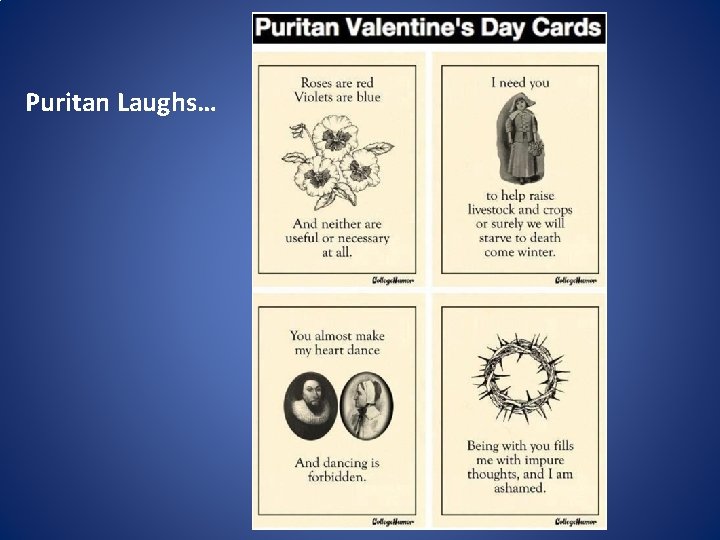
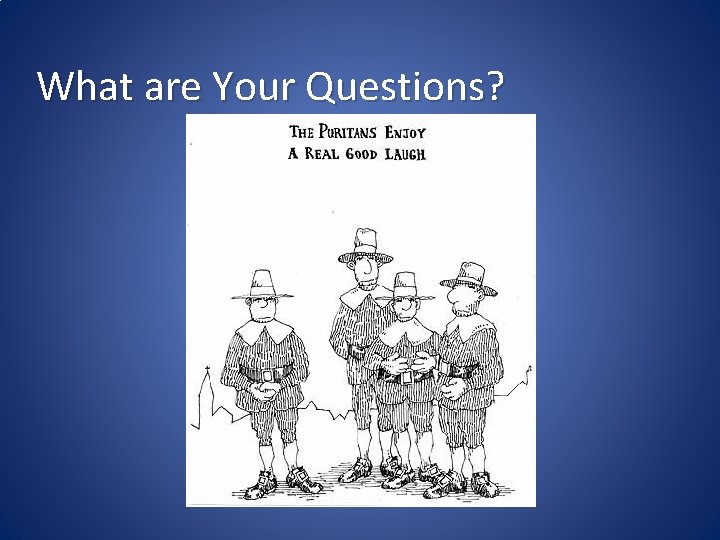
Puritan Laughs…
What are Your Questions?