
Writing Goals and Objectives Benjamin Bloom and his
Writing Goals and Objectives
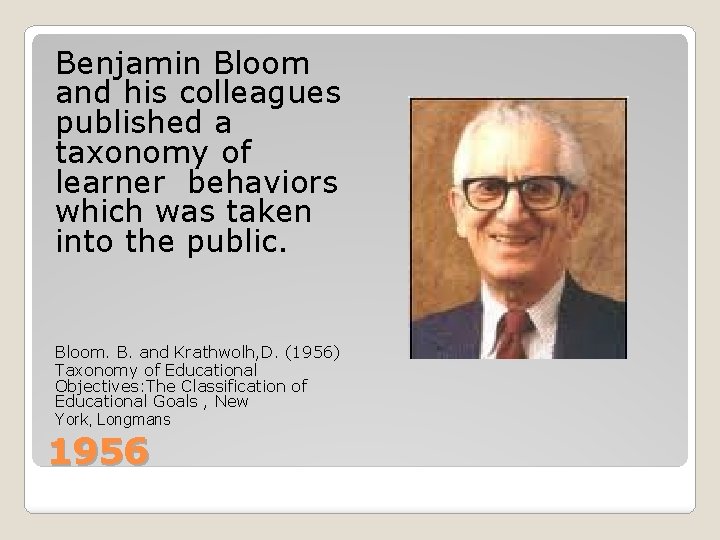
Benjamin Bloom and his colleagues published a taxonomy of learner behaviors which was taken into the public. Bloom. B. and Krathwolh, D. (1956) Taxonomy of Educational Objectives: The Classification of Educational Goals , New York, Longmans 1956

GOALS � Broad OBJECTIVES statements � General intentions � Intangible � Generally measure � Specific � Precise � Tangible hard to � Measurable The Difference Between Goals and Objectives
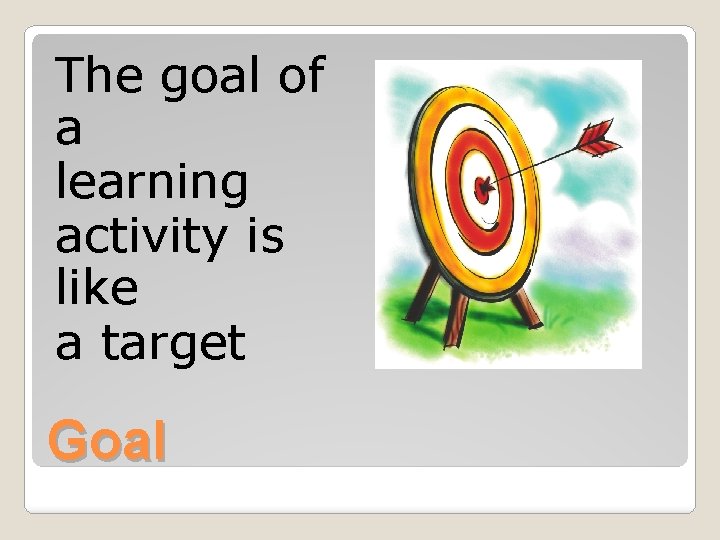
The goal of a learning activity is like a target Goal
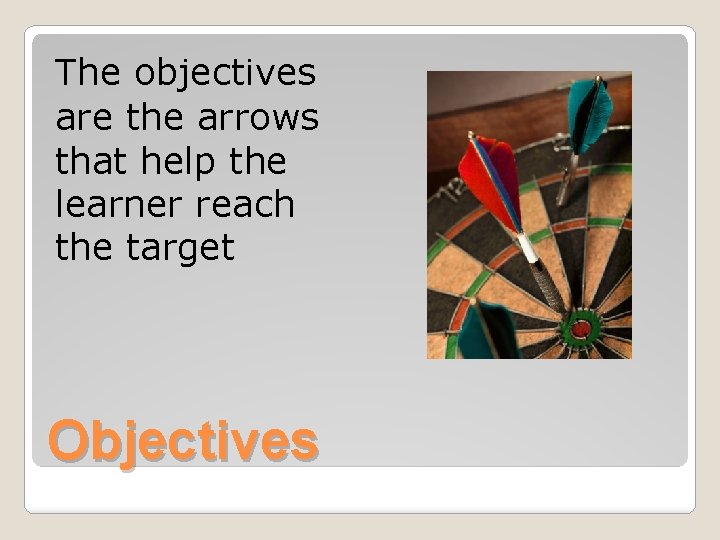
The objectives are the arrows that help the learner reach the target Objectives
� Why are learning objectives important? � provide students with a clear purpose to focus their learning efforts � direct for the teacher choice of instructional activities � guide for the teacher assessment strategies � Guide for the teacher relative to the design of instruction � Guide for the teacher for evaluation/test design � Guide for the learner relative to learning focus � Guide for the learner relative to self assessment � Statements of objectives tell others what we value
�Makes teaching more directed and organized. �Forces teacher to think carefully about what is important �Helps students make decisions regarding prioritizing �Provides feedback to learners as objectives
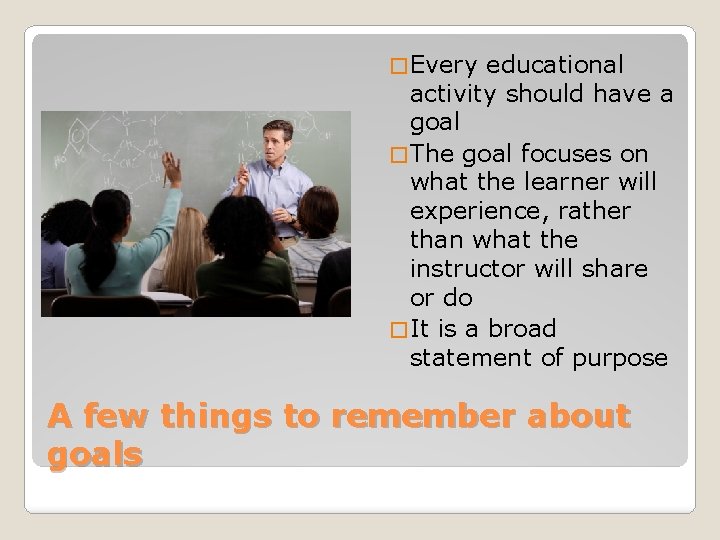
� Every educational activity should have a goal � The goal focuses on what the learner will experience, rather than what the instructor will share or do � It is a broad statement of purpose A few things to remember about goals
ALWAYS BEGIN WITH THE END RESULT IN MIND! Be SMART The Components of an Objective
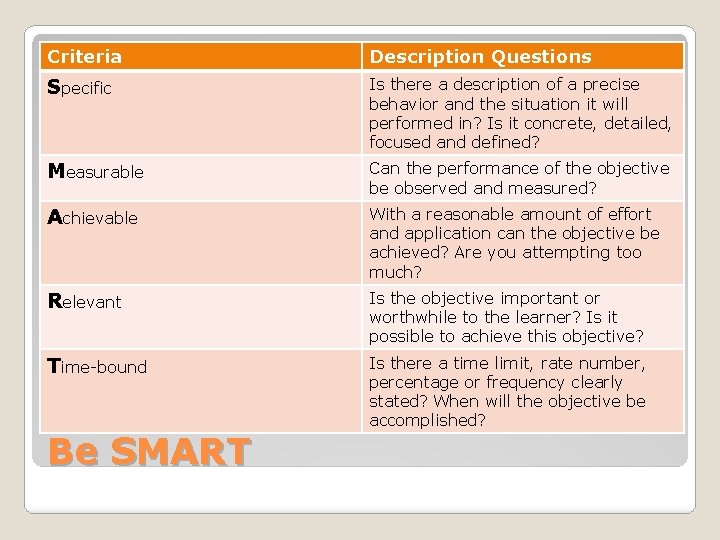
Criteria Description Questions Specific Is there a description of a precise behavior and the situation it will performed in? Is it concrete, detailed, focused and defined? Measurable Can the performance of the objective be observed and measured? Achievable With a reasonable amount of effort and application can the objective be achieved? Are you attempting too much? Relevant Is the objective important or worthwhile to the learner? Is it possible to achieve this objective? Time-bound Is there a time limit, rate number, percentage or frequency clearly stated? When will the objective be accomplished? Be SMART
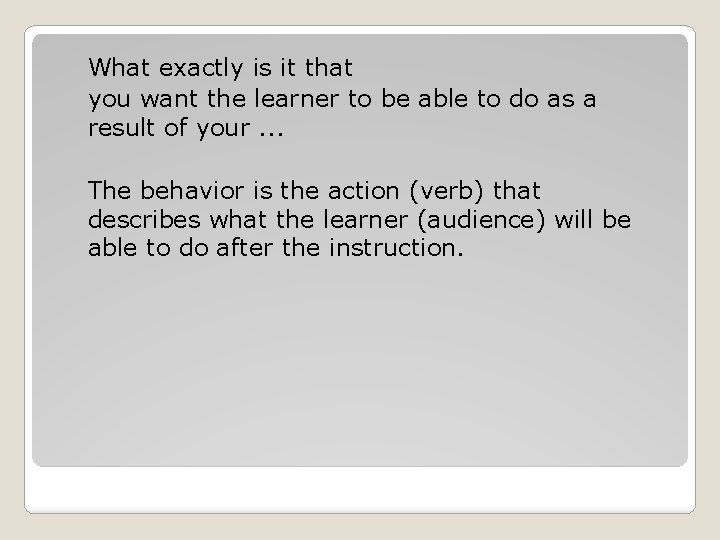
What exactly is it that you want the learner to be able to do as a result of your. . . The behavior is the action (verb) that describes what the learner (audience) will be able to do after the instruction.
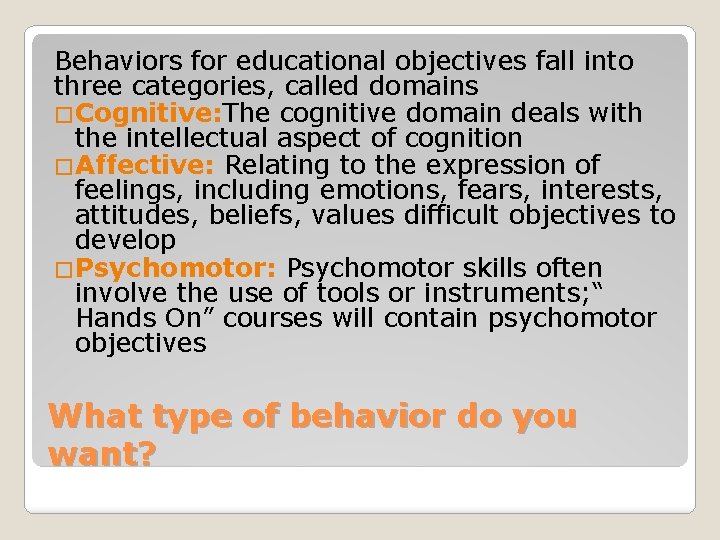
Behaviors for educational objectives fall into three categories, called domains �Cognitive: The cognitive domain deals with the intellectual aspect of cognition �Affective: Relating to the expression of feelings, including emotions, fears, interests, attitudes, beliefs, values difficult objectives to develop �Psychomotor: Psychomotor skills often involve the use of tools or instruments; “ Hands On” courses will contain psychomotor objectives What type of behavior do you want?
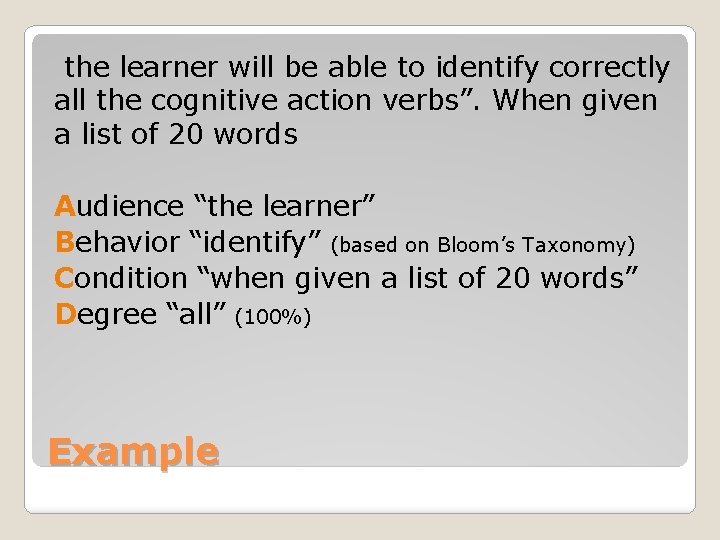
the learner will be able to identify correctly all the cognitive action verbs”. When given a list of 20 words Audience “the learner” Behavior “identify” (based on Bloom’s Taxonomy) Condition “when given a list of 20 words” Degree “all” (100%) Example
�Blooms Taxonomy of Educational Objectives �Classification of Blooms taxonomy � 1. Cognitive domain- Knowledge field � 2. Affective domain- feeling field � 3. Psychomotor domain-doing field �
�Instructional Objectives in Cognitive Domain �Knowledge �Acquisition of knowledge is the lowest level in the cognitive domain. It includes the ability of students to recall and remember the information learned in the classrooms. Recall and recognition are the specification of this instructional objectiv
�An example at this level: �The student defines the cell……. �The student should mention the text of Archimedes' rule……. � the student name the parts of an atom……
�Comprehension �It is the second level of cognitive domain. It is the meaningful recall and recognition of the learned content. Here the learner could understand explain what he learned in the classroom as his own language. Identifying relations, classification of objects, explanations, comparisons, translation etc
�Examples at this level: � - That the student gives examples of. . . not mentioned in the textbook. � The student should reformulate the Charles Law in his own style…………
�Application �In third level the learners are able to apply or use the knowledge which is acquired and comprehended during the first two levels. It is the ability to apply the acquired knowledge trough instruction in real life situations. Establishing new relationship, formulating hypothesis, predictions are the some specification of this level.
� The student solves a problem using Ohm's Law…………………
�Analysis is the meaningful breakdown of the materials into its various components and to identify the interrelationship between the elements and find out how they are organized and related. Specification of this level includes the analysis of elements, analysis of relationship, analysis of organizational principles.
�That the student compare between. . and. . – �the student chooses the relevant data to solve a problem. That the student identifies the similarities between. . and. . � - The student reads the following essay and states the writer's remote goal (reading between the lines)
�Synthesis is the mental ability of the learner to integrate the acquired, comprehended, applied analyzed knowledge in to a comprehensive whole. It involves the ability to give a new shape or structure to statements or procedures
�That the student proposes a plan to conduct an experiment that proves that air has weight. � The student should design an electronic circuit for the purpose of. . � - The student arrives at a new relationship that connects. . and
�Evaluation �This is the highest level of cognitive domain. Students could evaluate an object, person, a theory or a principle if only he is par with all other lower hierarchy in the cognitive domain. It is the ability to judge a value of a material, aspects, methods, principles , theory, philosophy and so forth for a given purposes. At this level s/he could perform personal viewpoint about the information s/he synthesized.
�That the student discusses the following phrase: Mathematics is the language of science. He who is not fluent in it does not know science � student gives an opinion "on human cloning. " ……… �The student criticizes theory.
- Slides: 26