
Writing for Print By Heather Di Pietro with
Writing for Print By Heather Di. Pietro with some revisions by Mrs. Bomeisl
Characteristics of News Writing • Unifying theme • Central idea – Expressed early in the story which sets the tone and direction – Also known as the “lead”.
• Transitions: relationship between various pieces of information • Connections: words that help unify the writing. Examples: and, but, this, now, even, therefore, meanwhile • Hooks: Words or phrases that are repeated throughout an article to give sense of unity • Pronouns: best transitional devices for writing about people
• Associations: Repeated ideas using different words to refer to them. • Chronology: word or phrase that refers to a time. Most are not written in chronological order, but reference to time of events. • Enumeration: Numbering within writing ties the writing together.
• Attribution: telling the reader where info comes from. Establishes news, support and credibility. • Verbs of attribution: Said, explain, relate, declare, reveal, verifies, assent, etc. – More objective: illustrates, indicates, mentions, addresses, states, suggests, cites, writes… – Use with care: exclaims, insinuates, retorts, mumbles, whines… • For a more detailed list of verbs for attribution, see the handout on bomedia. pbworks. com.
Developing a Feature Story • Needs a “Catchy” title to catch the reader’s attention. • Needs a “Grabber” paragraph to grab the interest of the reader. • Needs information that is factual, but not boring. • Needs a “wrap-up” paragraph that brings the article to a nice close.
Inverted Pyramid • Most important information first and so on… • The lead is the focal point of the basic story. Second Paragraph expands on lead with additional information. Body provides info; supp. Evidence, context, quotes, and other descriptions.
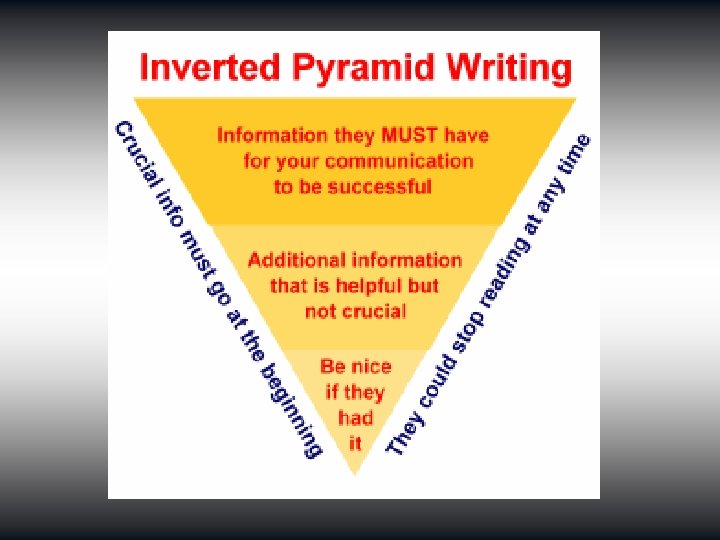
– Important info first lets the reader decide if they’re interested. – Organizes info in a way that the reader can be efficient. – Get information as fast as possible and stop reading when they’re satisfied with the story. • Works best written chronologically – Technical • Editors must decide how to fit stories on a page. – When a story is too large for the space the editor will cut out a portion of the article, but make sure that facts are not lost.
Developing a story • Important info first – Lead • answers all the questions the reader might have – Story ends when all the questions have been answered
Quotations • Direct – Uses speakers words with quotation marks. – 3 elements to importance • Who said it • What has been said • The fact it was said • Indirect Quote – Sometimes a few words that were used by the speaker, but usually a paraphrase. No quotation marks are used.
Editing and Rewriting • Copy editing • Making changes to improve copy, but does not rewrite report. • Rewriting editing • Is rewriting large proportions of the text or reword to change order of story ideas.
• First thing writers check are spelling, grammar and style mistakes. – Verbs • Use action verbs instead of leading verbs for they will catch the reader’s attention. – Wordiness • Using too many words to express an idea. – Answering all the questions • Reader will have questions, be sure to answer them.
• Internal consistency • Time sequence should be stated • Tone and structure should be looked at as well.
Writing featured Stories • Opinion based with a central theme and summary, but done in a slower pace. • Four structures – Anecdotal Features – Suspended Interest – Profiles – Question and Answer
Anecdotal Features- starts with story followed by facts, then quotations and woven throughout the story. Profiles- is a story on a single person, goes though the events in the person’s life usually starting with birth and ending with present. • Question and Answer- starts with story that has answers to the questions raised.
Suspended Interest Features- used for producing a special event with a short story and a punch line. Consists of multiple paragraphs that raise questions for the reader to think about. All questions are answered at the end of the story in an unexpected way.
Characteristics of a feature story • More relaxed than a news story • Easier to read • More entertaining
Parts of a Feature Story • Lead – Few sentences or paragraph long – Hook – the reader must discover some benefit to reading the story.
• Engine (also called fat, snapper or the “why” paragraph) – Gives the reader what they wanted from the lead – Sets stage for the rest of story
• Body – Answers all questions from lead – Substance of article and should be what the reader has been led to expect • Ending – Put story in perspective – Answer lingering questions – Make final point to story’s subject – The feature writer should not allow a story to go on too long, stop writing when there is nothing of substance to say.
Tips – Don’t over use adjectives and adverbs, makes the writing dull-will not produce lively writing. – Describe five senses, not just how things look. – Telling the 5 W’s and H • (Who, What, When, Where, Why, How)
- Slides: 22