
WRITING FEEDBACK RHETORICAL ANALYSIS ESSAY INTRODUCTORY PARAGRAPH STRUCTURE
WRITING FEEDBACK RHETORICAL ANALYSIS ESSAY
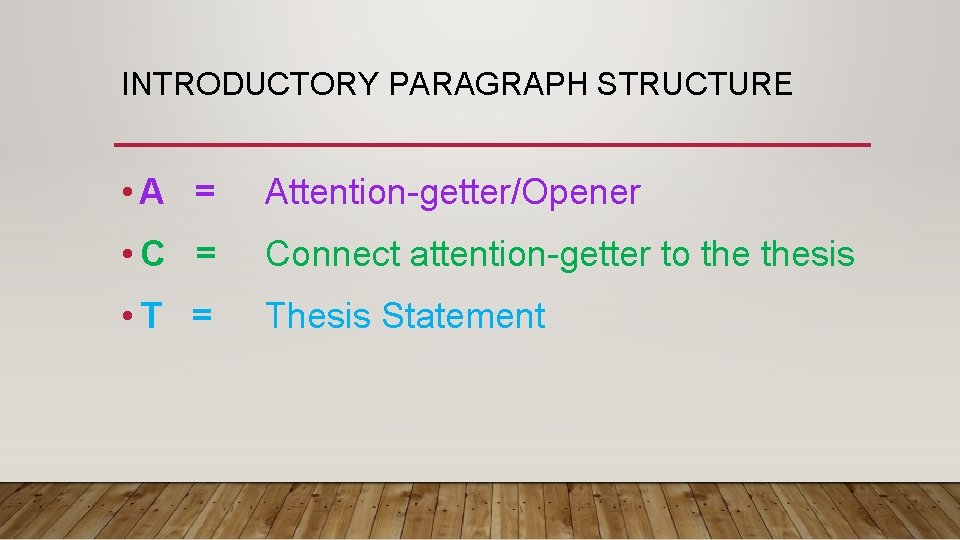
INTRODUCTORY PARAGRAPH STRUCTURE • A = Attention-getter/Opener • C = Connect attention-getter to thesis • T = Thesis Statement
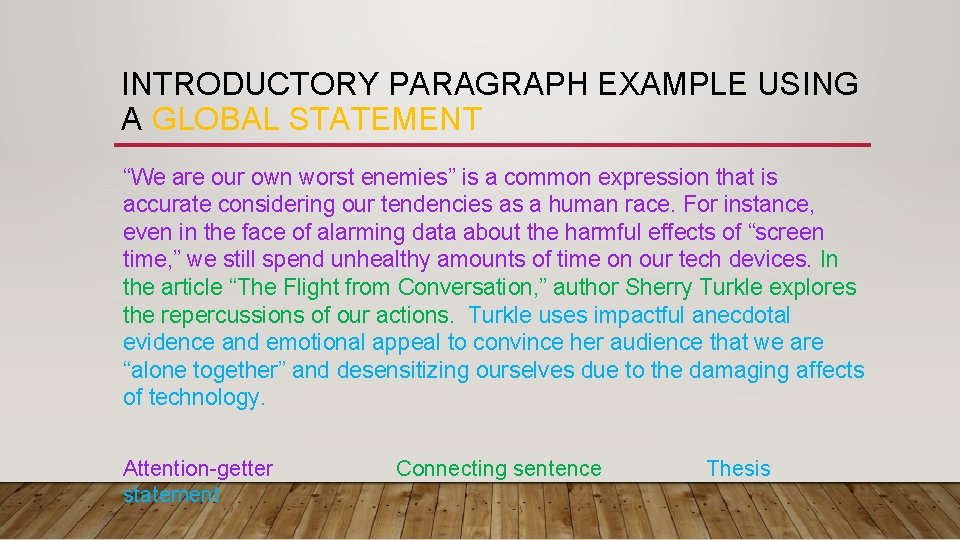
INTRODUCTORY PARAGRAPH EXAMPLE USING A GLOBAL STATEMENT “We are our own worst enemies” is a common expression that is accurate considering our tendencies as a human race. For instance, even in the face of alarming data about the harmful effects of “screen time, ” we still spend unhealthy amounts of time on our tech devices. In the article “The Flight from Conversation, ” author Sherry Turkle explores the repercussions of our actions. Turkle uses impactful anecdotal evidence and emotional appeal to convince her audience that we are “alone together” and desensitizing ourselves due to the damaging affects of technology. Attention-getter statement Connecting sentence Thesis
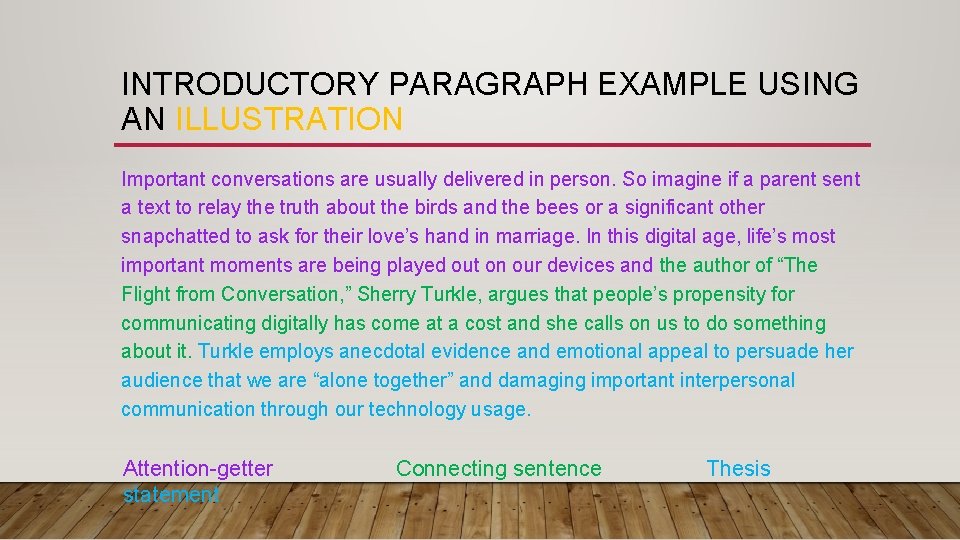
INTRODUCTORY PARAGRAPH EXAMPLE USING AN ILLUSTRATION Important conversations are usually delivered in person. So imagine if a parent sent a text to relay the truth about the birds and the bees or a significant other snapchatted to ask for their love’s hand in marriage. In this digital age, life’s most important moments are being played out on our devices and the author of “The Flight from Conversation, ” Sherry Turkle, argues that people’s propensity for communicating digitally has come at a cost and she calls on us to do something about it. Turkle employs anecdotal evidence and emotional appeal to persuade her audience that we are “alone together” and damaging important interpersonal communication through our technology usage. Attention-getter statement Connecting sentence Thesis
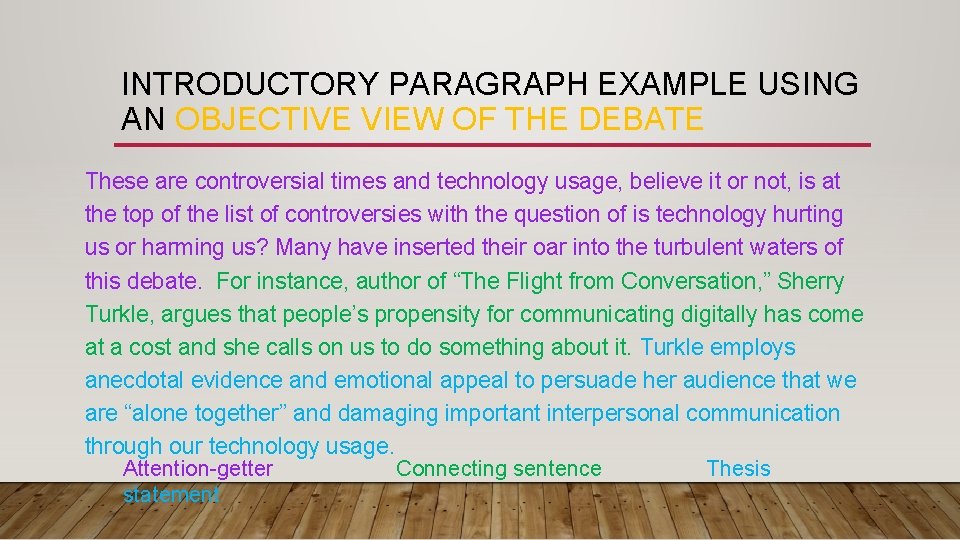
INTRODUCTORY PARAGRAPH EXAMPLE USING AN OBJECTIVE VIEW OF THE DEBATE These are controversial times and technology usage, believe it or not, is at the top of the list of controversies with the question of is technology hurting us or harming us? Many have inserted their oar into the turbulent waters of this debate. For instance, author of “The Flight from Conversation, ” Sherry Turkle, argues that people’s propensity for communicating digitally has come at a cost and she calls on us to do something about it. Turkle employs anecdotal evidence and emotional appeal to persuade her audience that we are “alone together” and damaging important interpersonal communication through our technology usage. Attention-getter Connecting sentence Thesis statement
TOPIC SENTENCES • First off, Goleman’s use of personal anecdotes accurately supports his claim that technology comes at a cost: the loss of human interaction. • Secondly, after Goleman sets the foundation of his claim through personal anecdotes, he uses scientific data to reinforce the structure of his argument. • Lastly, Goleman smartly employs scare tactics to emotionally move the audience to believe that our technology usage is harmful.
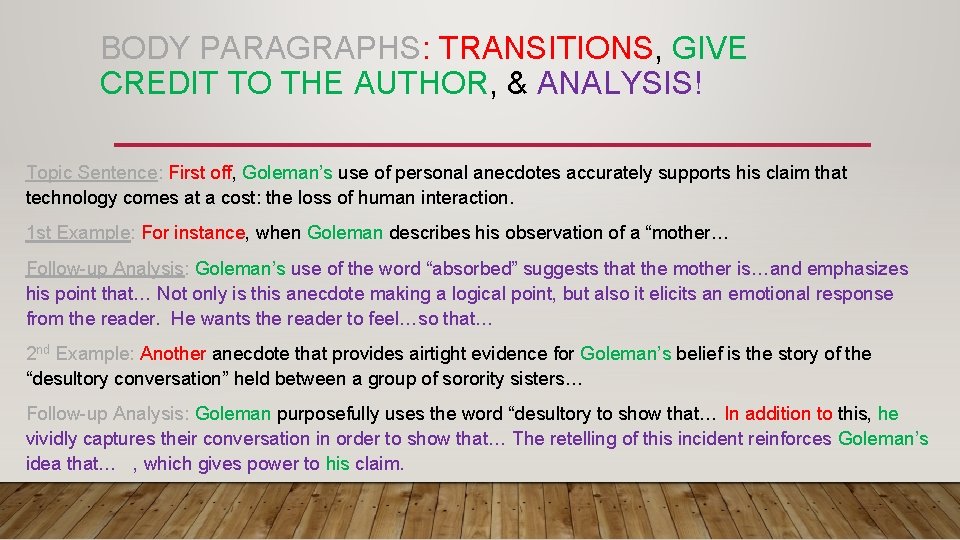
BODY PARAGRAPHS: TRANSITIONS, GIVE CREDIT TO THE AUTHOR, & ANALYSIS! Topic Sentence: First off, Goleman’s use of personal anecdotes accurately supports his claim that technology comes at a cost: the loss of human interaction. 1 st Example: For instance, when Goleman describes his observation of a “mother… Follow-up Analysis: Goleman’s use of the word “absorbed” suggests that the mother is…and emphasizes his point that… Not only is this anecdote making a logical point, but also it elicits an emotional response from the reader. He wants the reader to feel…so that… 2 nd Example: Another anecdote that provides airtight evidence for Goleman’s belief is the story of the “desultory conversation” held between a group of sorority sisters… Follow-up Analysis: Goleman purposefully uses the word “desultory to show that… In addition to this, he vividly captures their conversation in order to show that… The retelling of this incident reinforces Goleman’s idea that… , which gives power to his claim.
RAISE MAJOR POINTS BEFORE CONCLUDING SENTENCE • All of these anecdotes combined provide a solid body of evidence for Goleman’s claim that technology is “disrupting” our human connections. He is keenly appealing to the reader’s sense of logic to convince us. In light of this evidence, the reader views Goleman as a expert; consequently, the reader reflects on his or her own habits and losses due to technology, which is exactly Goleman’s purpose. Goleman makes huge gains through his use of anecdotes to effectively build his argument and persuade his audience.
- Slides: 8