
Writing Expectations and how to read my comments

- Slides: 48
Writing Expectations (and how to read my comments)
A sentence, a clause, and a phrase, OH MY! Sentence: A group of words that makes complete sense, contains a main verb, and begins with a capital letter. Clause: A group of words that contains a verb, but may not be a complete idea. Phrase: The smallest meaningful group of words. Anything other than a sentence will be labeled as “inc” meaning incomplete.
Consistency is key! Form the possessive singular of nouns by adding ‘s no matter what the final consonant. Possessive: showing possession or ownership. Michael’s Jennifer’s Chris’s (not Chris’)
More things that require consistency: Tense: when writing you must maintain the same tense throughout the paper. This will be marked “tense switch” Spelling of names must also remain consistent. Don’t start calling William “Bill” halfway through the paper and then switch back and forth. Anything like this might simply be circled with “? ? ? ” somewhere next to it. Write out numbers that require less than three syllables to say! Ex: Forty seven… 531.
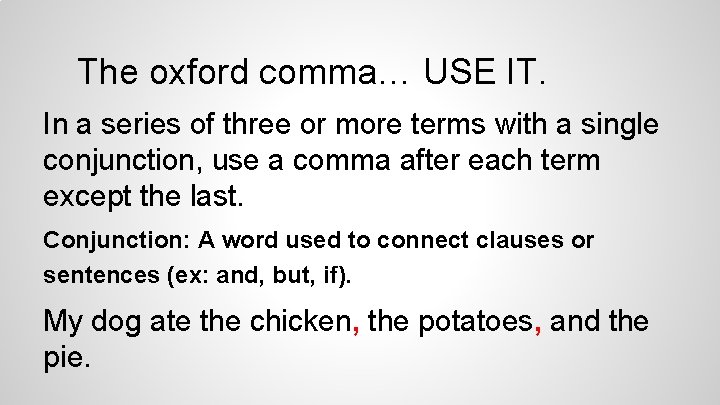
The oxford comma… USE IT. In a series of three or more terms with a single conjunction, use a comma after each term except the last. Conjunction: A word used to connect clauses or sentences (ex: and, but, if). My dog ate the chicken, the potatoes, and the pie.
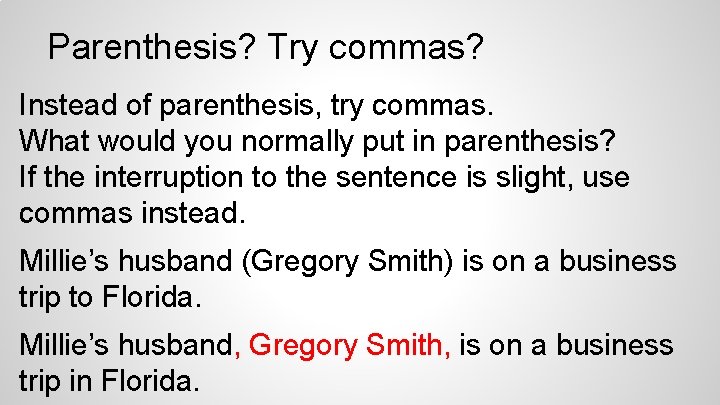
Parenthesis? Try commas? Instead of parenthesis, try commas. What would you normally put in parenthesis? If the interruption to the sentence is slight, use commas instead. Millie’s husband (Gregory Smith) is on a business trip to Florida. Millie’s husband, Gregory Smith, is on a business trip in Florida.
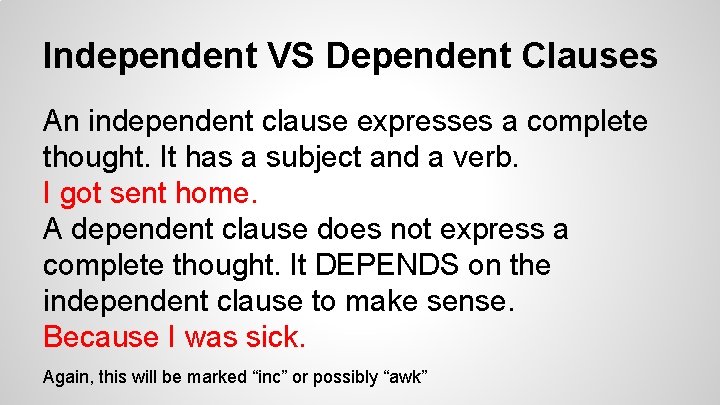
Independent VS Dependent Clauses An independent clause expresses a complete thought. It has a subject and a verb. I got sent home. A dependent clause does not express a complete thought. It DEPENDS on the independent clause to make sense. Because I was sick. Again, this will be marked “inc” or possibly “awk”
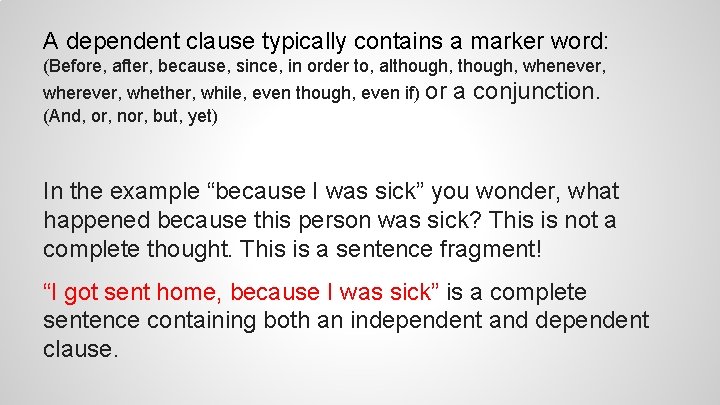
A dependent clause typically contains a marker word: (Before, after, because, since, in order to, although, whenever, wherever, whether, while, even though, even if) or (And, or, nor, but, yet) a conjunction. In the example “because I was sick” you wonder, what happened because this person was sick? This is not a complete thought. This is a sentence fragment! “I got sent home, because I was sick” is a complete sentence containing both an independent and dependent clause.
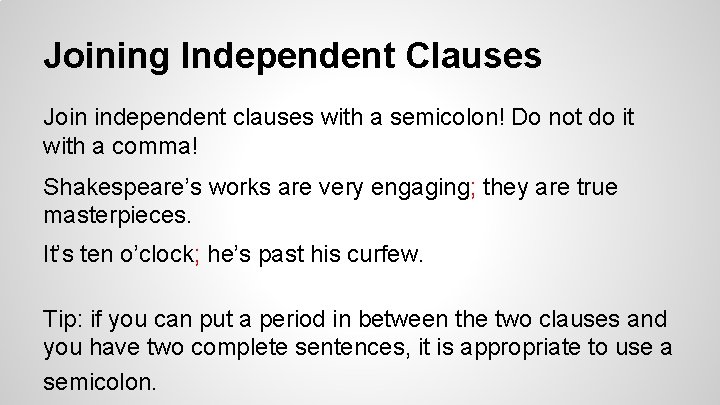
Joining Independent Clauses Join independent clauses with a semicolon! Do not do it with a comma! Shakespeare’s works are very engaging; they are true masterpieces. It’s ten o’clock; he’s past his curfew. Tip: if you can put a period in between the two clauses and you have two complete sentences, it is appropriate to use a semicolon.
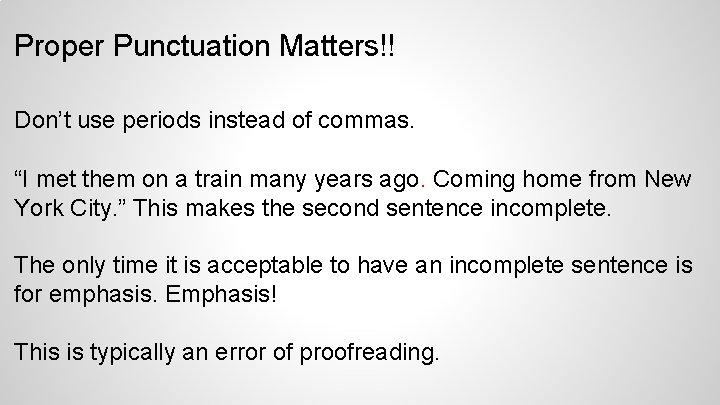
Proper Punctuation Matters!! Don’t use periods instead of commas. “I met them on a train many years ago. Coming home from New York City. ” This makes the second sentence incomplete. The only time it is acceptable to have an incomplete sentence is for emphasis. Emphasis! This is typically an error of proofreading.
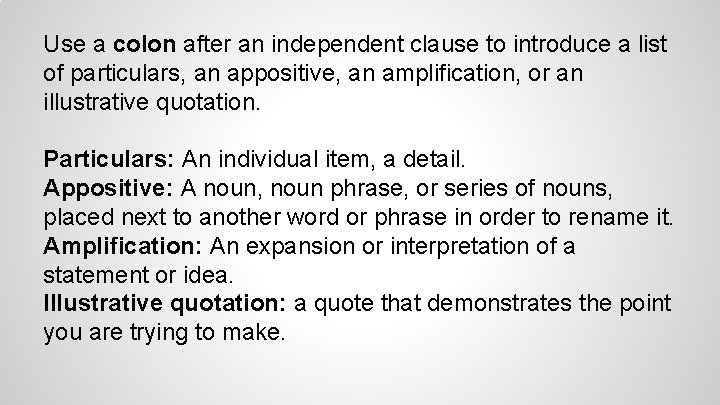
Use a colon after an independent clause to introduce a list of particulars, an appositive, an amplification, or an illustrative quotation. Particulars: An individual item, a detail. Appositive: A noun, noun phrase, or series of nouns, placed next to another word or phrase in order to rename it. Amplification: An expansion or interpretation of a statement or idea. Illustrative quotation: a quote that demonstrates the point you are trying to make.
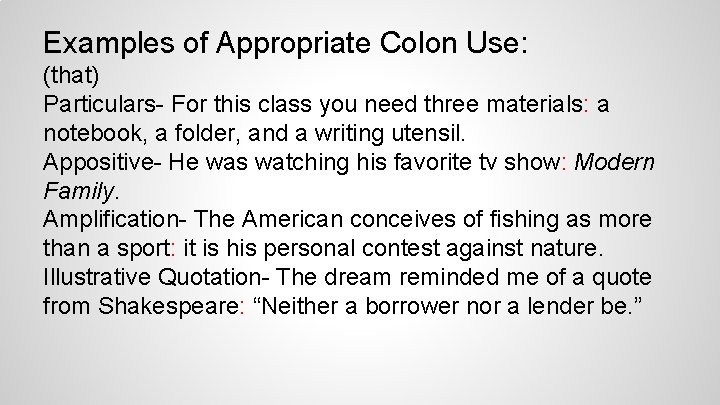
Examples of Appropriate Colon Use: (that) Particulars- For this class you need three materials: a notebook, a folder, and a writing utensil. Appositive- He was watching his favorite tv show: Modern Family. Amplification- The American conceives of fishing as more than a sport: it is his personal contest against nature. Illustrative Quotation- The dream reminded me of a quote from Shakespeare: “Neither a borrower nor a lender be. ”
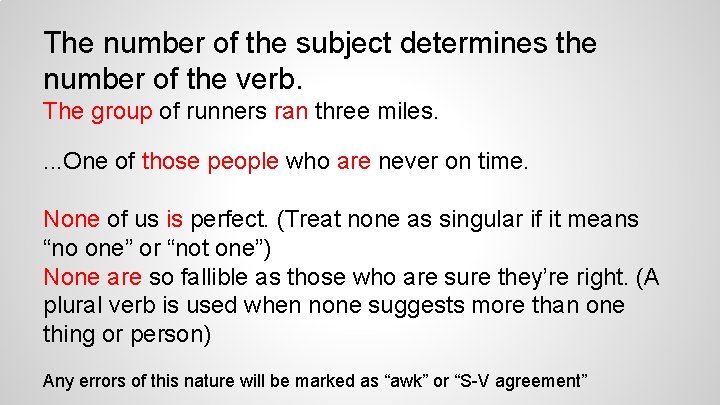
The number of the subject determines the number of the verb. The group of runners ran three miles. . One of those people who are never on time. None of us is perfect. (Treat none as singular if it means “no one” or “not one”) None are so fallible as those who are sure they’re right. (A plural verb is used when none suggests more than one thing or person) Any errors of this nature will be marked as “awk” or “S-V agreement”
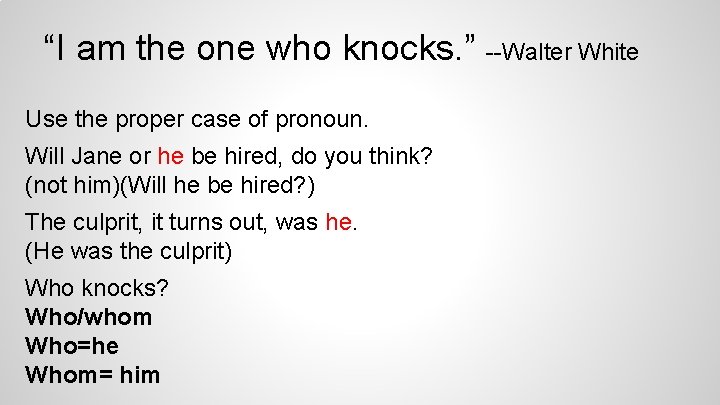
“I am the one who knocks. ” --Walter White Use the proper case of pronoun. Will Jane or he be hired, do you think? (not him)(Will he be hired? ) The culprit, it turns out, was he. (He was the culprit) Who knocks? Who/whom Who=he Whom= him
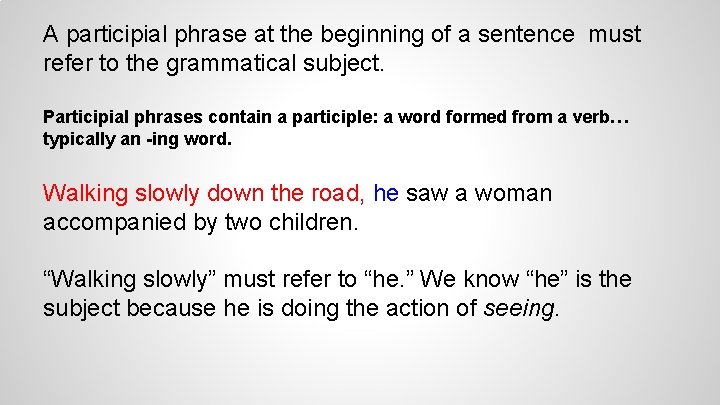
A participial phrase at the beginning of a sentence must refer to the grammatical subject. Participial phrases contain a participle: a word formed from a verb… typically an -ing word. Walking slowly down the road, he saw a woman accompanied by two children. “Walking slowly” must refer to “he. ” We know “he” is the subject because he is doing the action of seeing.
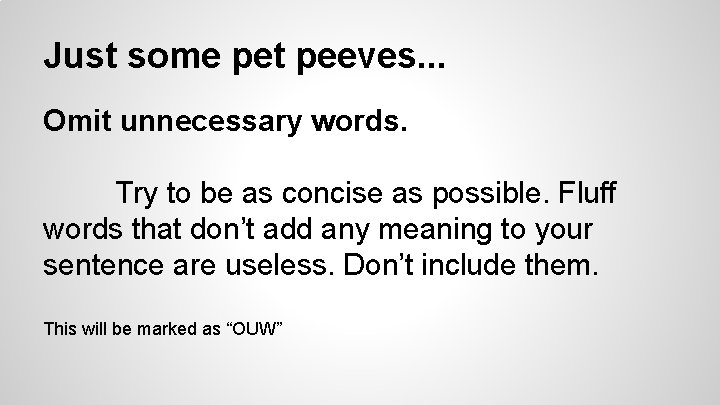
Just some pet peeves. . . Omit unnecessary words. Try to be as concise as possible. Fluff words that don’t add any meaning to your sentence are useless. Don’t include them. This will be marked as “OUW”
Don’t address the reader. Write “one can see” or “the reader sees” NOT “you can see”
Introduction and Conclusion: ● Intro: Tell me what you’re going to show me. ● Body: Show me. ● Conclusion: Tell me what you’ve shown me. For the conclusion- don’t simply restate your paper. Summarize it in a NEW and INTERESTING way!
MLA Format! ● Modern Language Association ● Most commonly used among the liberal arts and humanities. ● As of 2012: 7 th Edition
What it’s used for: ● Formatting ● Layout ● Citations
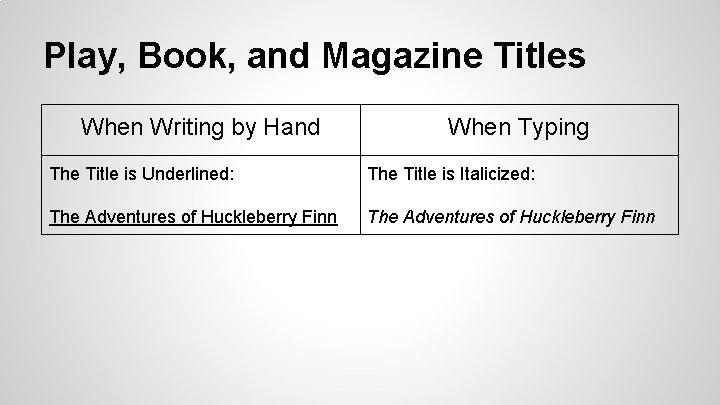
Play, Book, and Magazine Titles When Writing by Hand When Typing The Title is Underlined: The Title is Italicized: The Adventures of Huckleberry Finn
Play, Book, and Magazine Titles When Writing by Hand When Typing The Title is Underlined: The Title is Italicized: The Adventures of Huckleberry Finn
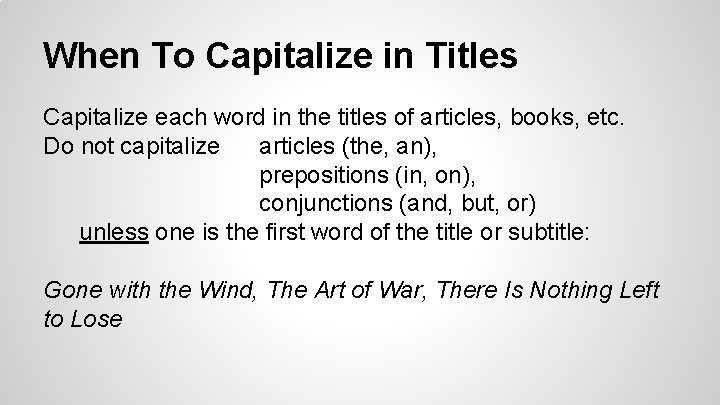
When To Capitalize in Titles Capitalize each word in the titles of articles, books, etc. Do not capitalize articles (the, an), prepositions (in, on), conjunctions (and, but, or) unless one is the first word of the title or subtitle: Gone with the Wind, The Art of War, There Is Nothing Left to Lose
When Typing Papers: Double space! Use either Times New Roman, Cambria, or Arial. Use 12 point font! Have a header and heading. Use indentations.
The Header and Heading The header appears in the top right corner of every page except the first! It contains your last name and the page number- nothing else. The heading appears in the top left corner of the first page only. For this class your header will be as follows: Your name Ms. Trippe Your block period The date
Indentations At the beginning of each paragraph, indent one half inch. Just press the tab key once!! After each paragraph there should be only one blank line. Press the enter key one if you are in doublespace settings!
Title Your Paper! For this class, every paper you turn in MUST have a title! Make it creative, yet topic appropriate. The title should appear on the first page, one line under your heading. DO NOT KILL ANY MORE TREES THAN YOU HAVE TO BY MAKING A TITLE PAGE!!!!!!!
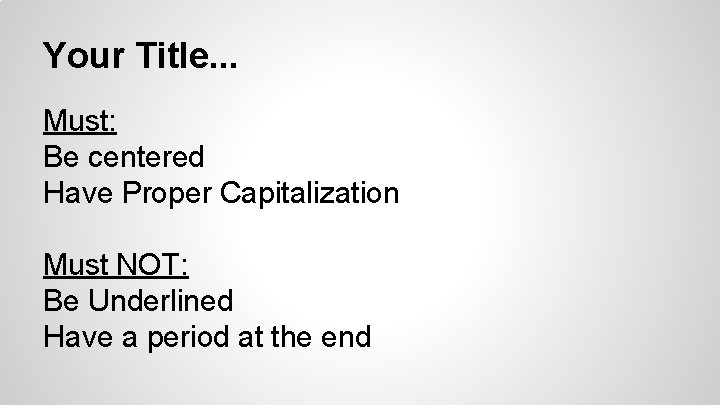
Your Title. . . Must: Be centered Have Proper Capitalization Must NOT: Be Underlined Have a period at the end
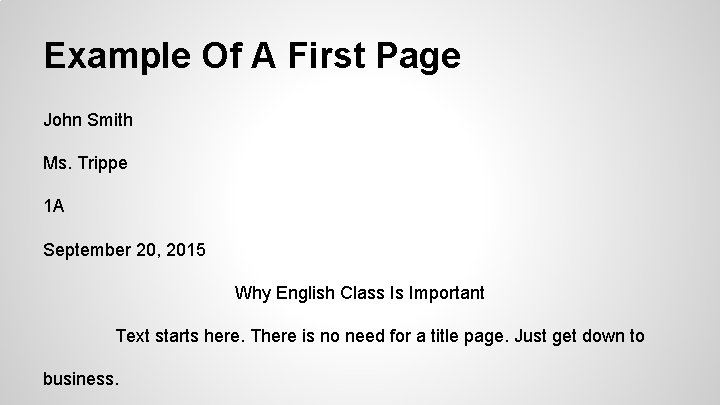
Example Of A First Page John Smith Ms. Trippe 1 A September 20, 2015 Why English Class Is Important Text starts here. There is no need for a title page. Just get down to business.
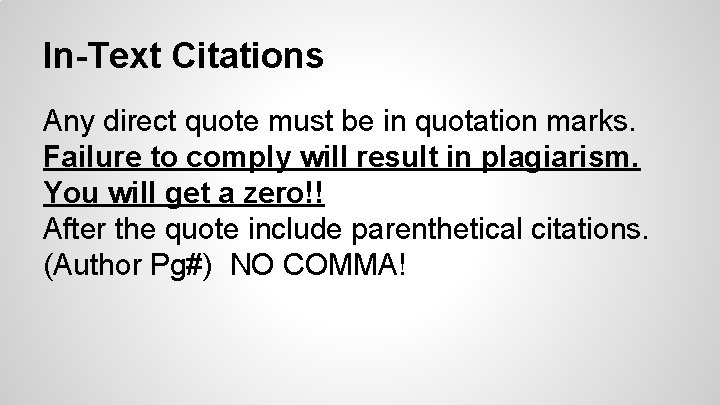
In-Text Citations Any direct quote must be in quotation marks. Failure to comply will result in plagiarism. You will get a zero!! After the quote include parenthetical citations. (Author Pg#) NO COMMA!
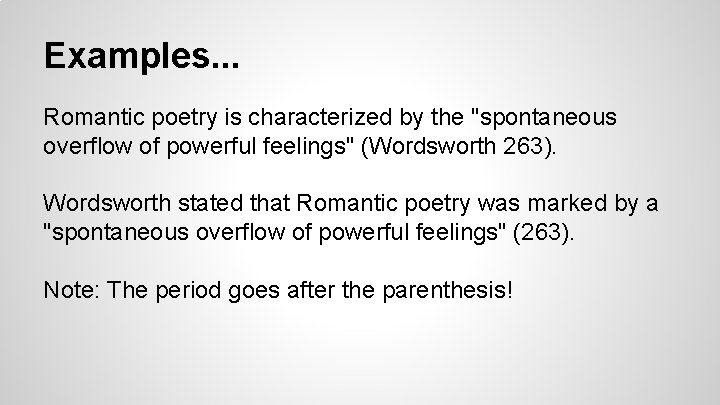
Examples. . . Romantic poetry is characterized by the "spontaneous overflow of powerful feelings" (Wordsworth 263). Wordsworth stated that Romantic poetry was marked by a "spontaneous overflow of powerful feelings" (263). Note: The period goes after the parenthesis!
WARNING!! You should never just have a quote! It should be introduced and integrated into your own sentence! Let’s go back and look at how it’s done!
Quotations LONGER than four lines Place quotations in a free-standing block of text and omit quotation marks. Start the quotation on a new line, with the entire quote indented one inch from the left margin; maintain doublespacing. Only indent the first line of the quotation by an additional quarter inch if you are citing multiple paragraphs. Your parenthetical citation should come after the closing punctuation mark. They entirely refused to have it in bed with them, or even in their room, and I had no more sense, so, I put it on the landing of the stairs, hoping it would be gone on the morrow. By chance, or else attracted by hearing his voice, it crept to Mr. Earnshaw's door, and there he found it on quitting his chamber. Inquiries were made as to how it got there; I was obliged to confess, and in recompense for my cowardice and inhumanity was sent out of the house. (Bronte 78)
In text citations also come after. . . Paraphrasing!! If you didn’t think of it yourself you cannot take credit for it (yes, even if the wording is yours)! Ex: Wordsworth extensively explored the role of emotion in the creative process (263).
The Author is Unknown. . In the parenthesis, put a shortened version of the title. Treat the shortened version of your title as you would treat the whole thing. Either italicize it or put it in quotation marks. For example: (“The Dangers of Global Warming” 7)
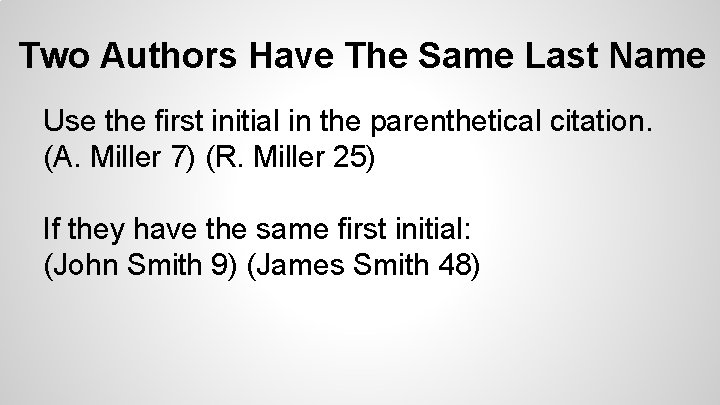
Two Authors Have The Same Last Name Use the first initial in the parenthetical citation. (A. Miller 7) (R. Miller 25) If they have the same first initial: (John Smith 9) (James Smith 48)
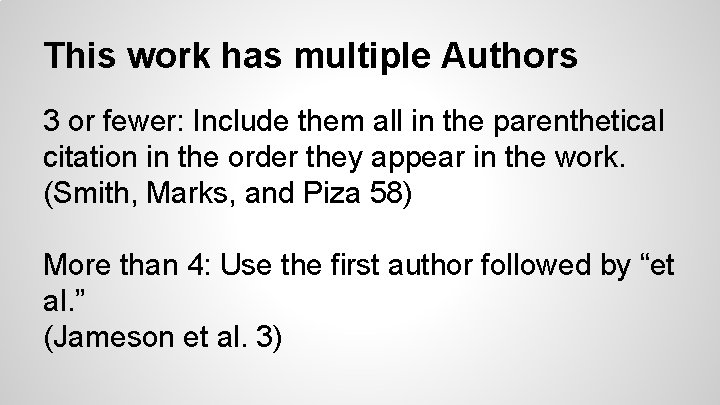
This work has multiple Authors 3 or fewer: Include them all in the parenthetical citation in the order they appear in the work. (Smith, Marks, and Piza 58) More than 4: Use the first author followed by “et al. ” (Jameson et al. 3)
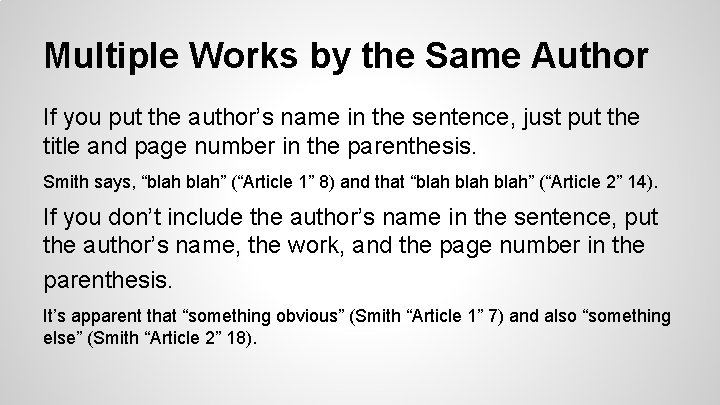
Multiple Works by the Same Author If you put the author’s name in the sentence, just put the title and page number in the parenthesis. Smith says, “blah” (“Article 1” 8) and that “blah” (“Article 2” 14). If you don’t include the author’s name in the sentence, put the author’s name, the work, and the page number in the parenthesis. It’s apparent that “something obvious” (Smith “Article 1” 7) and also “something else” (Smith “Article 2” 18).
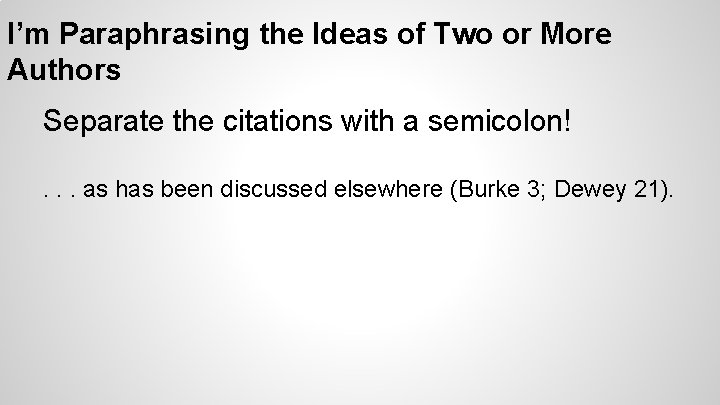
I’m Paraphrasing the Ideas of Two or More Authors Separate the citations with a semicolon!. . . as has been discussed elsewhere (Burke 3; Dewey 21).
Quote-ception If your quote has a quote in it: Forrest says, “My momma always said, ‘life was like a box of chocolates. You never know what you’re gonna get. ’” Introduce the quote as you normally would. The quote within the quote gets apostrophes instead of quotation marks.
Changing the quotation If you add a word or words in a quotation, you should put brackets around the words to indicate that they are not part of the original text. Jan Harold Brunvand, in an essay on urban legends, states, "some individuals [who retell urban legends] make a point of learning every rumor or tale" (78). If you omit a word or words from a quotation, you should indicate the deleted word or words by using ellipsis marks, which are three periods (. . . ) preceded and followed by a space. For example: In an essay on urban legends, Jan Harold Brunvand notes that "some individuals make a point of learning every recent rumor or tale. . . and in a short time a lively exchange of details occurs" (78).
When a Citation Isn’t Needed: OWL says to use your common sense and ethics! I say better safe than sorry!! If even for a second you find yourself asking “does this need a citation? ” JUST PUT IT!!
Works Cited Page The works cited page is completely double spaced. The title of the page is Works Cited This is the same as the title on the first page: it is centered with no punctuation.
Format: Each citation is put on the page in alphabetical order according to the FIRST WORD OF THE CITATION (9/10 times the first word of the citation is the author’s last name)!
For Each Work You Use. . . You should document: ● The author(s) full name(s) ● The title of the work (if it is an article you need the article title and the magazine/newspaper title) ● The year it was published ● The publishing company ● The publishing location ● How and the date you obtained the work (book/web)
Where to put that info: An online citation generator such as: ● easybib. com ● citationmachine. net
Where I got my info: https: //owl. english. purdue. edu/owl/resource/74 7/01/