
Writing effective analysis of argument James Pinnuck Program













- Slides: 71
Writing effective analysis of argument
James Pinnuck
Program overview • What is involved in the analysis or argument task • Key strategies to successfully complete the analysis of argument task
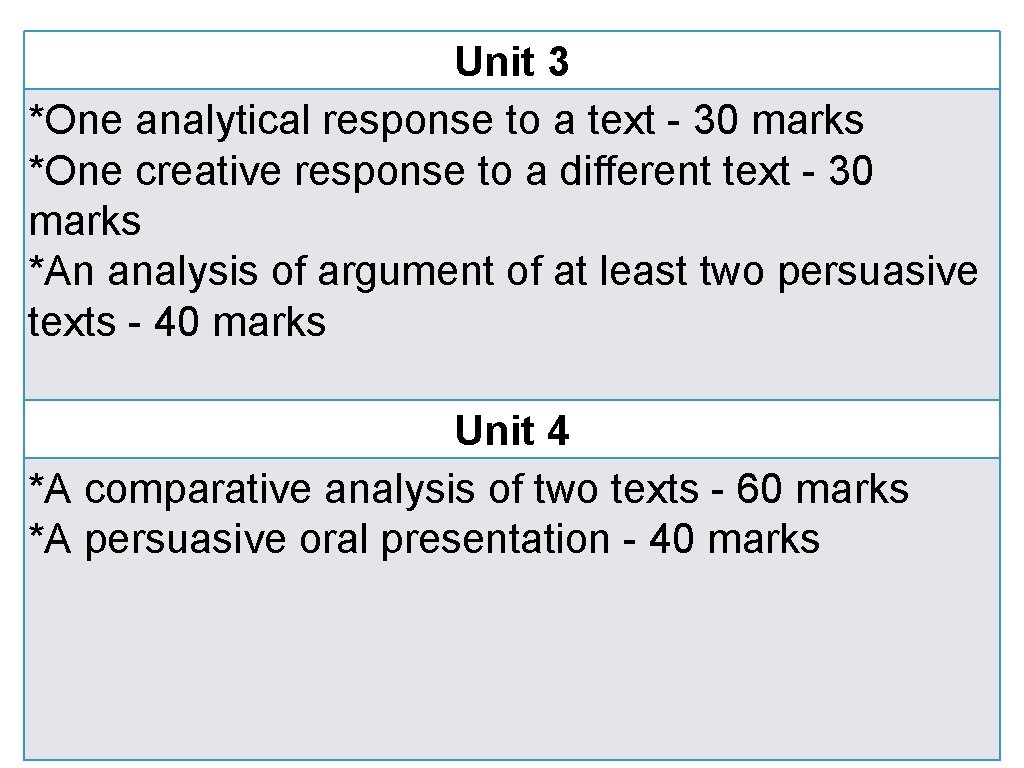
Unit 3 *One analytical response to a text - 30 marks *One creative response to a different text - 30 marks *An analysis of argument of at least two persuasive texts - 40 marks Unit 4 *A comparative analysis of two texts - 60 marks *A persuasive oral presentation - 40 marks
Unit 3 task
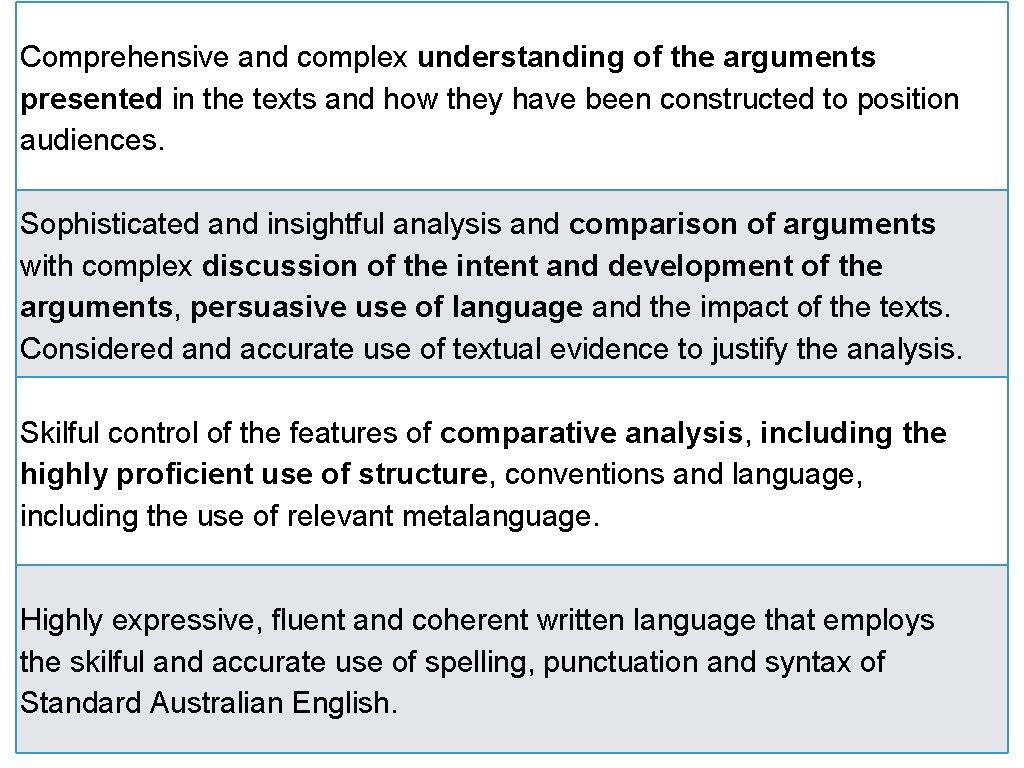
Comprehensive and complex understanding of the arguments presented in the texts and how they have been constructed to position audiences. Sophisticated and insightful analysis and comparison of arguments with complex discussion of the intent and development of the arguments, persuasive use of language and the impact of the texts. Considered and accurate use of textual evidence to justify the analysis. Skilful control of the features of comparative analysis, including the highly proficient use of structure, conventions and language, including the use of relevant metalanguage. Highly expressive, fluent and coherent written language that employs the skilful and accurate use of spelling, punctuation and syntax of Standard Australian English.
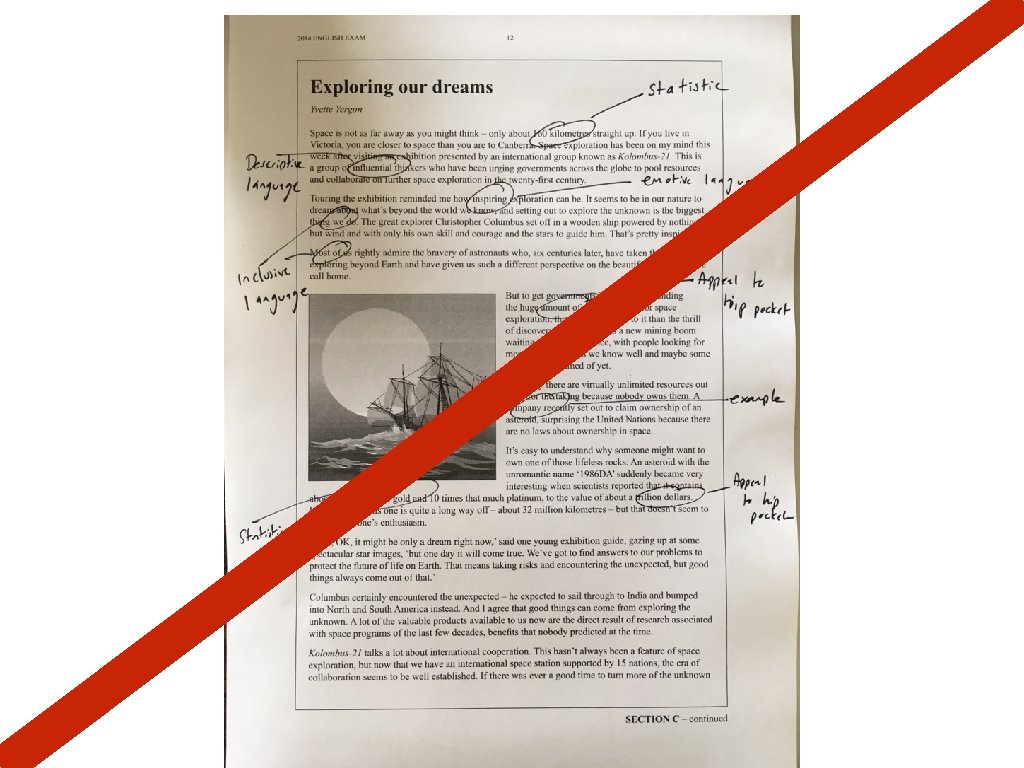
The task is not to list persuasive techniques
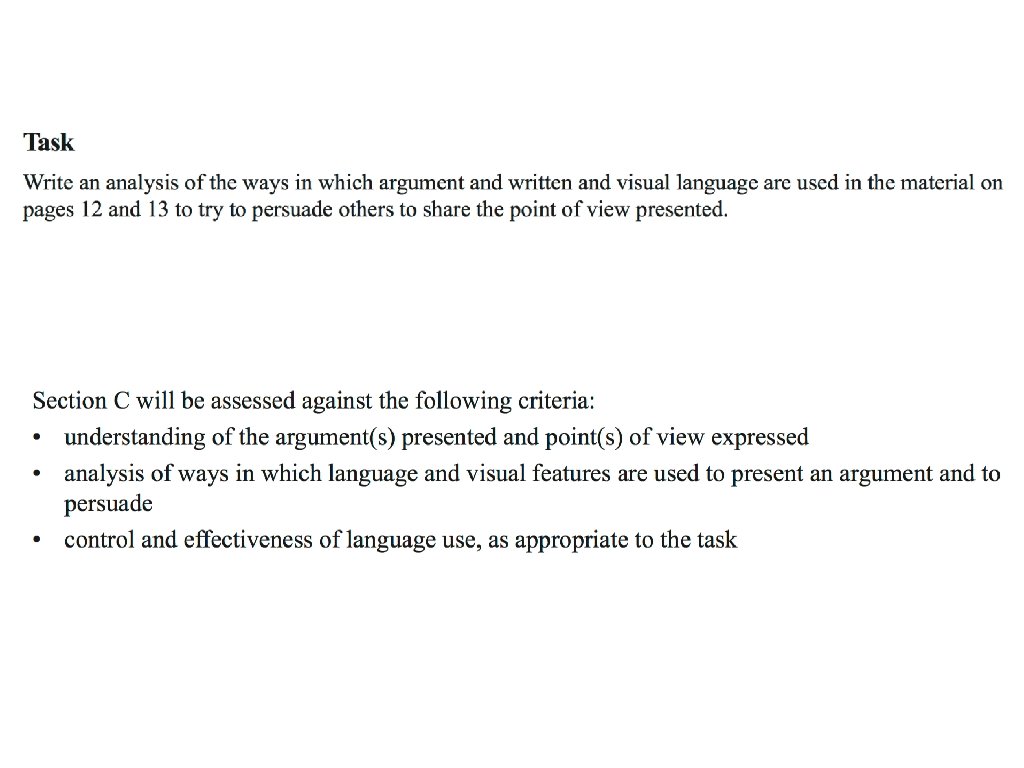
The exam task
Key strategies for completing the task
• Identify: • Contention • Intention • Arguments • Sections and their purpose of the piece • Analytically discuss: • How language and visuals within each section are used to support the overall intention
1# Identify the contention
Read through the pieces and circle one sentence which best summarises the contention
2# Identify the intention
• How does the author want the audience to feel about what she is saying? How does she want them to act in response to what she is saying?
She wants the audience to agree
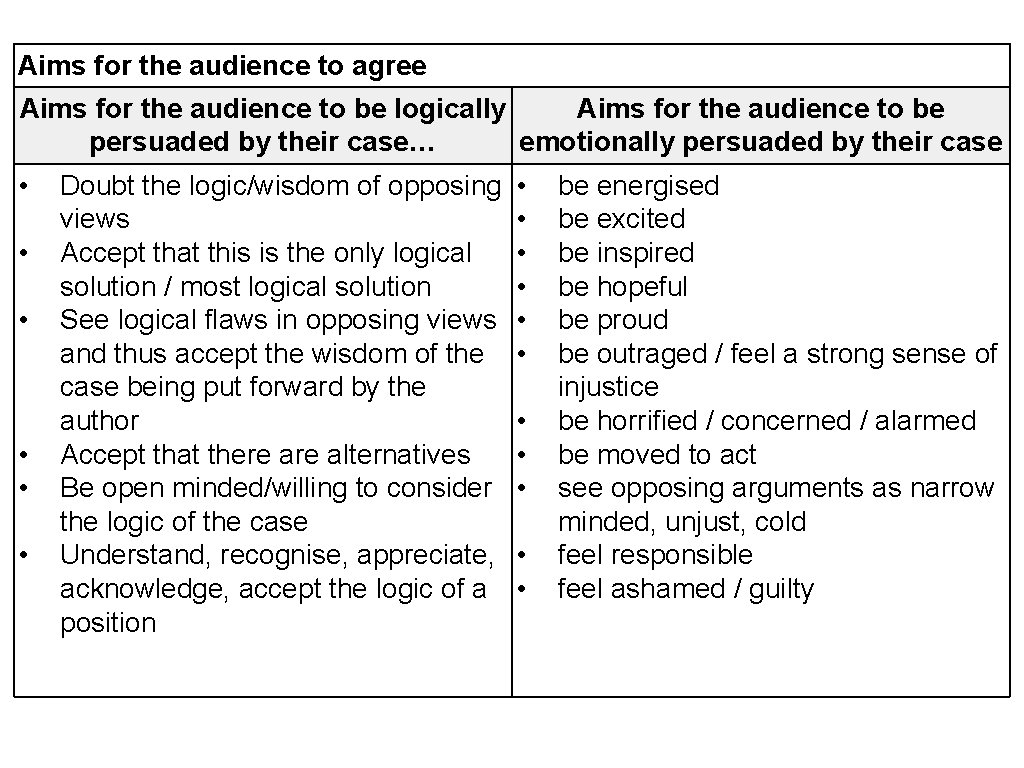
Aims for the audience to agree Aims for the audience to be logically Aims for the audience to be persuaded by their case… emotionally persuaded by their case • • • Doubt the logic/wisdom of opposing views Accept that this is the only logical solution / most logical solution See logical flaws in opposing views and thus accept the wisdom of the case being put forward by the author Accept that there alternatives Be open minded/willing to consider the logic of the case Understand, recognise, appreciate, acknowledge, accept the logic of a position • • • be energised be excited be inspired be hopeful be proud be outraged / feel a strong sense of injustice be horrified / concerned / alarmed be moved to act see opposing arguments as narrow minded, unjust, cold feel responsible feel ashamed / guilty
3# Understand nature of argument
Positive / Negative
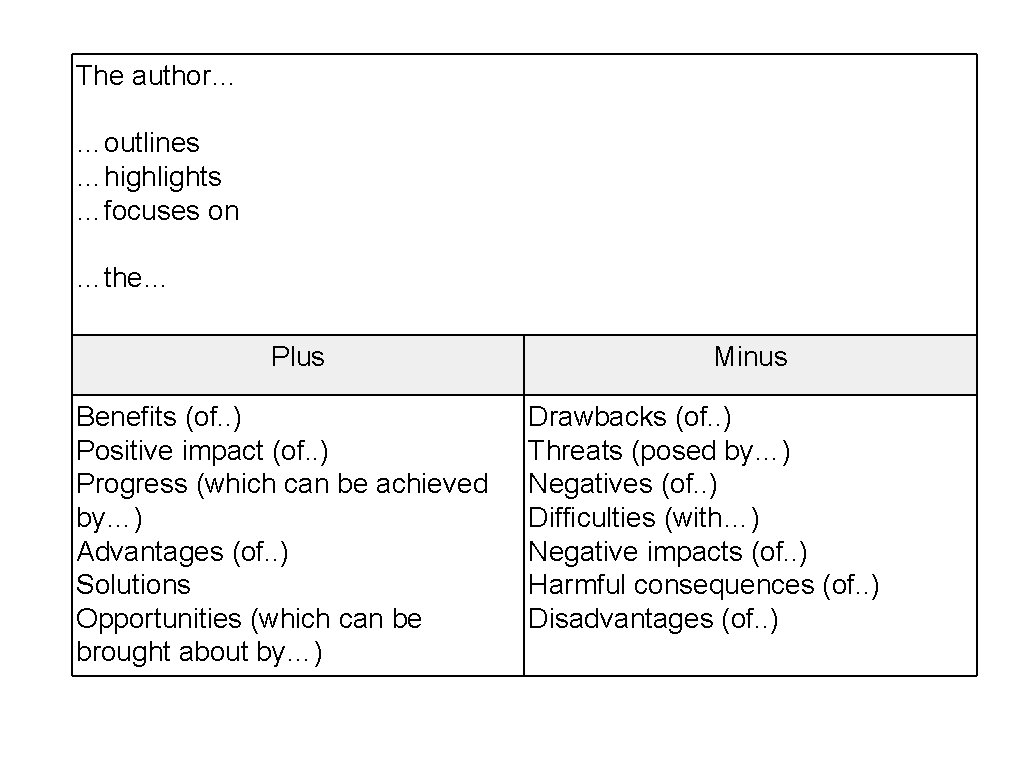
The author… …outlines …highlights …focuses on …the… Plus Benefits (of. . ) Positive impact (of. . ) Progress (which can be achieved by…) Advantages (of. . ) Solutions Opportunities (which can be brought about by…) Minus Drawbacks (of. . ) Threats (posed by…) Negatives (of. . ) Difficulties (with…) Negative impacts (of. . ) Harmful consequences (of. . ) Disadvantages (of. . )
What types of positive and negatives?
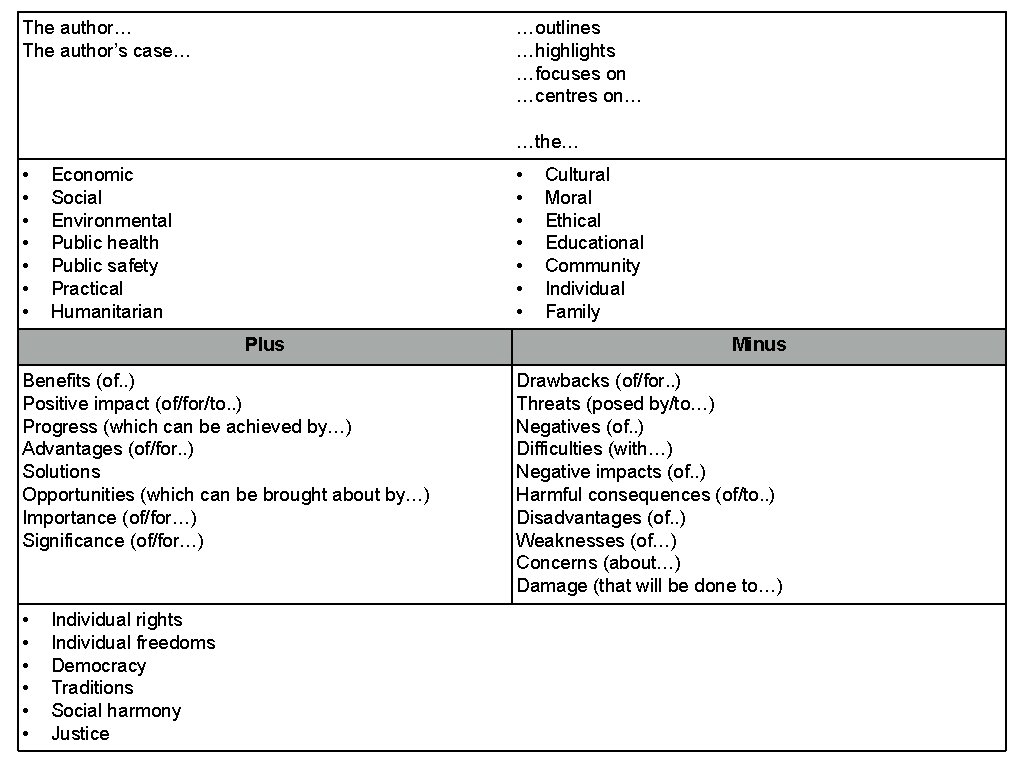
The author… The author’s case… …outlines …highlights …focuses on …centres on… …the… • • • • Economic Social Environmental Public health Public safety Practical Humanitarian Plus Benefits (of. . ) Positive impact (of/for/to. . ) Progress (which can be achieved by…) Advantages (of/for. . ) Solutions Opportunities (which can be brought about by…) Importance (of/for…) Significance (of/for…) • • • Individual rights Individual freedoms Democracy Traditions Social harmony Justice Cultural Moral Ethical Educational Community Individual Family Minus Drawbacks (of/for. . ) Threats (posed by/to…) Negatives (of. . ) Difficulties (with…) Negative impacts (of. . ) Harmful consequences (of/to. . ) Disadvantages (of. . ) Weaknesses (of…) Concerns (about…) Damage (that will be done to…)
Your now have most of the elements of an introduction
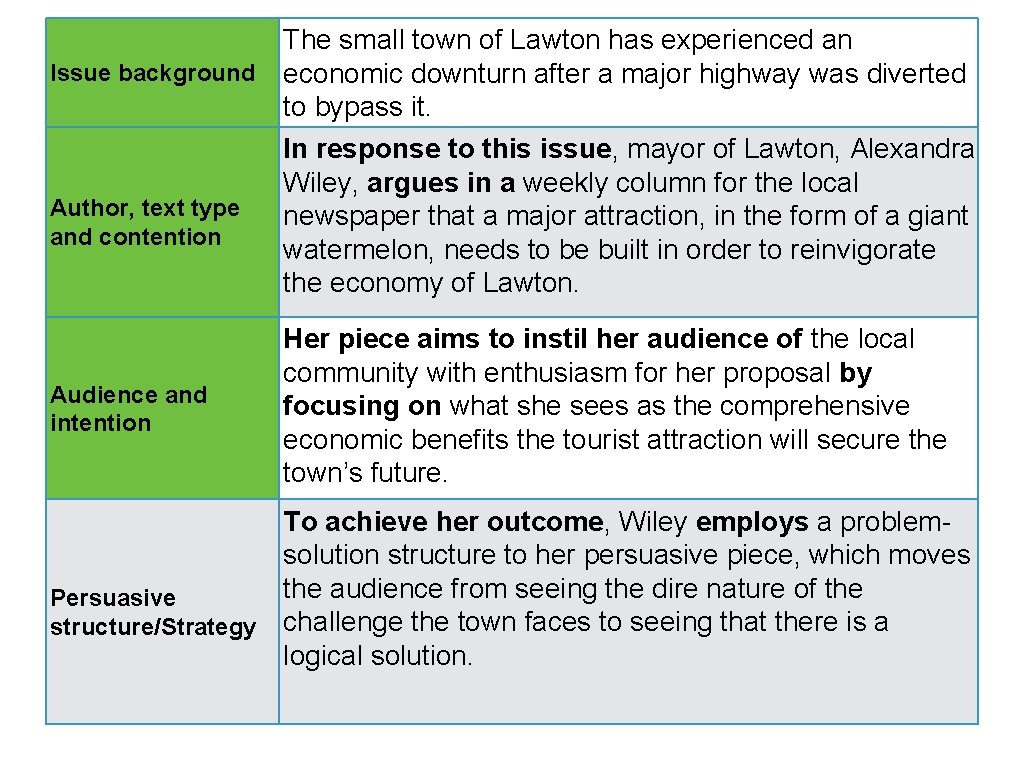
Issue background Author, text type and contention Audience and intention The small town of Lawton has experienced an economic downturn after a major highway was diverted to bypass it. In response to this issue, mayor of Lawton, Alexandra Wiley, argues in a weekly column for the local newspaper that a major attraction, in the form of a giant watermelon, needs to be built in order to reinvigorate the economy of Lawton. Her piece aims to instil her audience of the local community with enthusiasm for her proposal by focusing on what she sees as the comprehensive economic benefits the tourist attraction will secure the town’s future. To achieve her outcome, Wiley employs a problemsolution structure to her persuasive piece, which moves the audience from seeing the dire nature of the Persuasive structure/Strategy challenge the town faces to seeing that there is a logical solution.
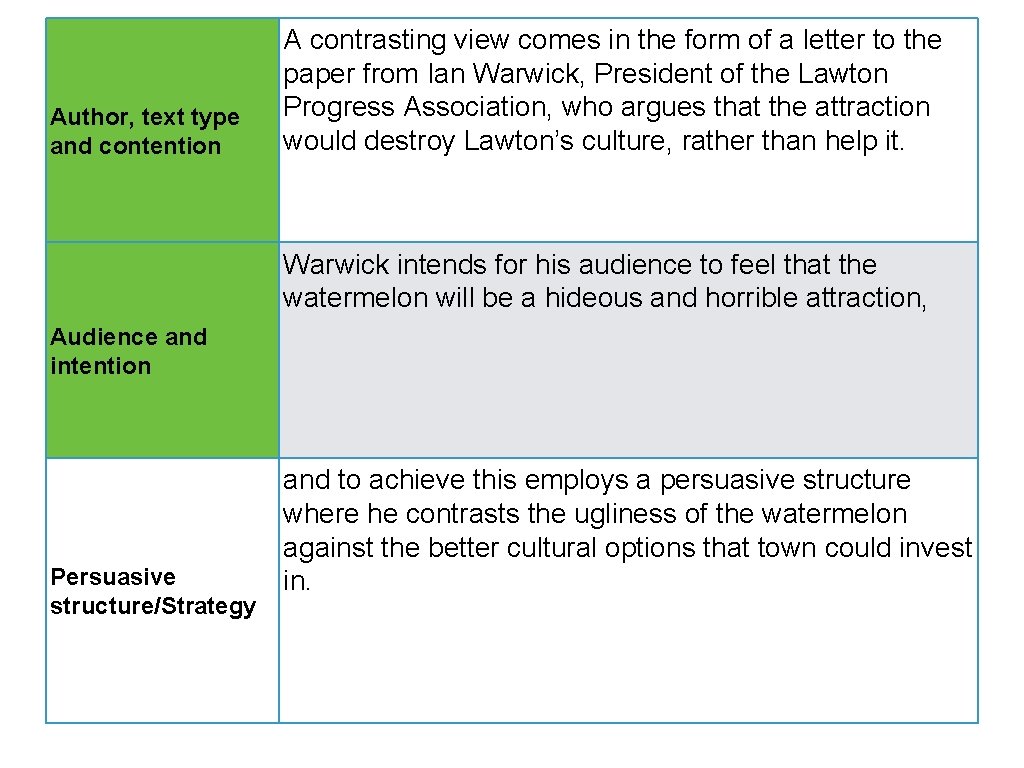
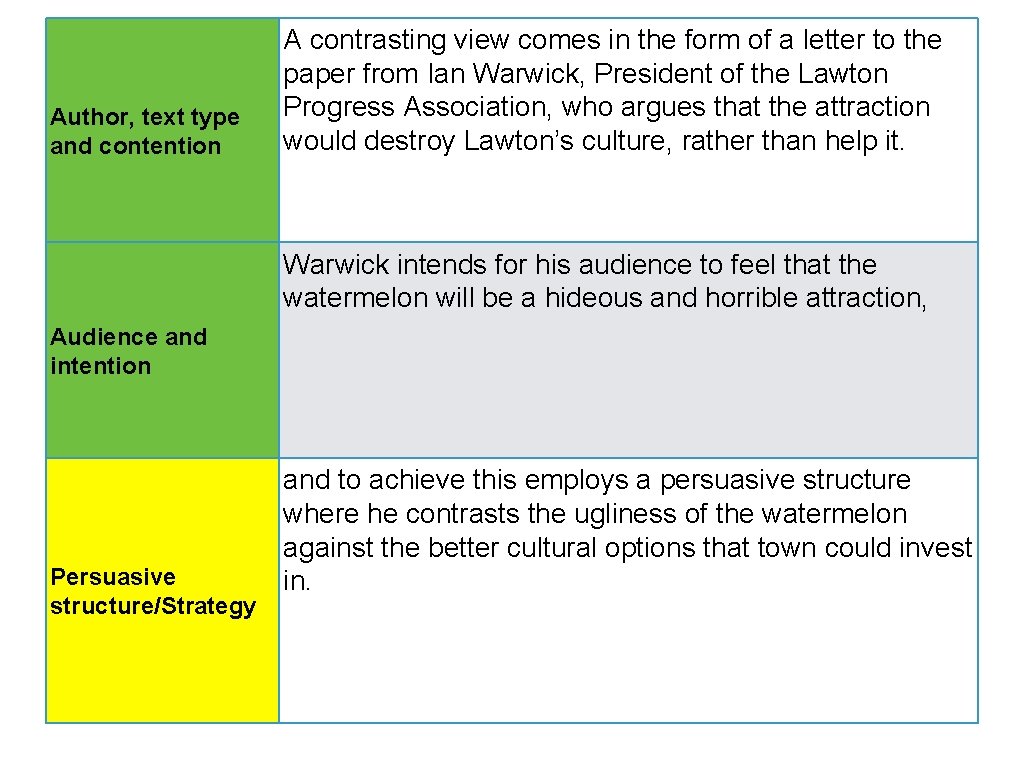
Author, text type and contention A contrasting view comes in the form of a letter to the paper from Ian Warwick, President of the Lawton Progress Association, who argues that the attraction would destroy Lawton’s culture, rather than help it. Warwick intends for his audience to feel that the watermelon will be a hideous and horrible attraction, Audience and intention Persuasive structure/Strategy and to achieve this employs a persuasive structure where he contrasts the ugliness of the watermelon against the better cultural options that town could invest in.
4# Identify how the structure of a piece supports its argument or arguments
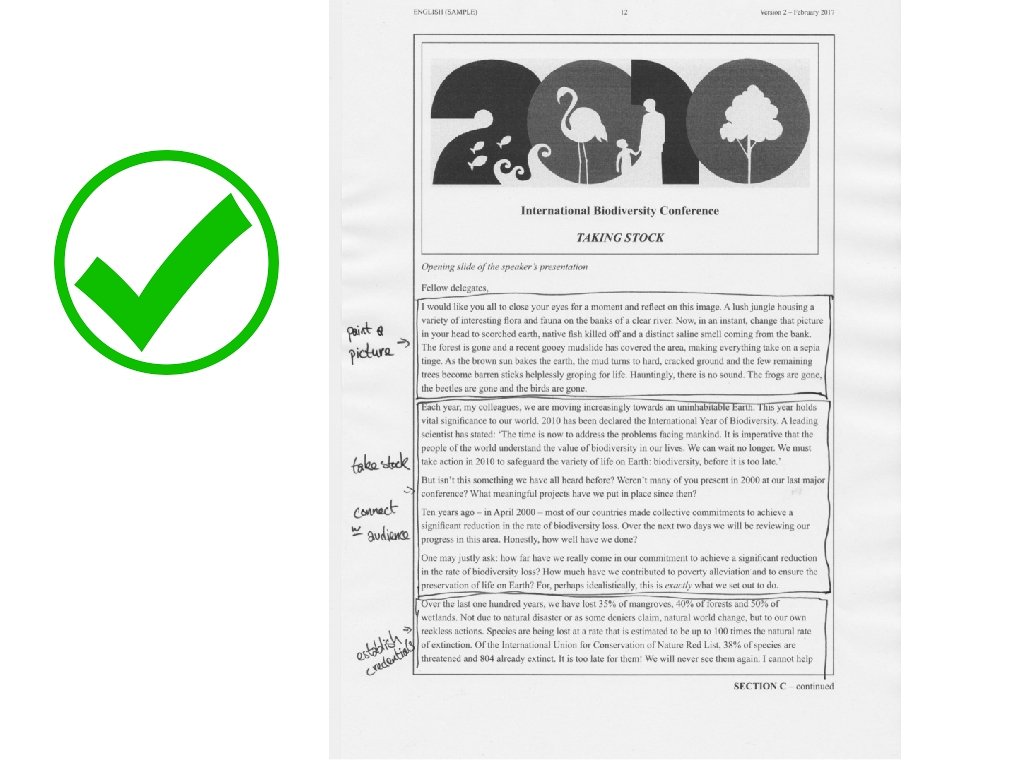
Split the piece into parts
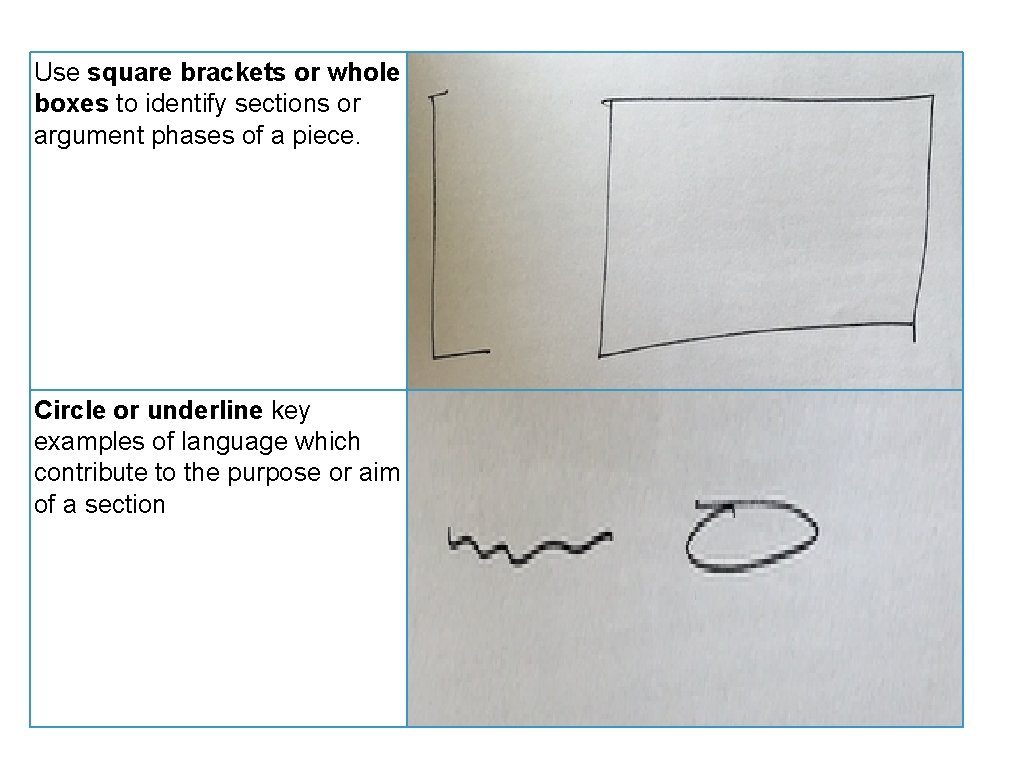
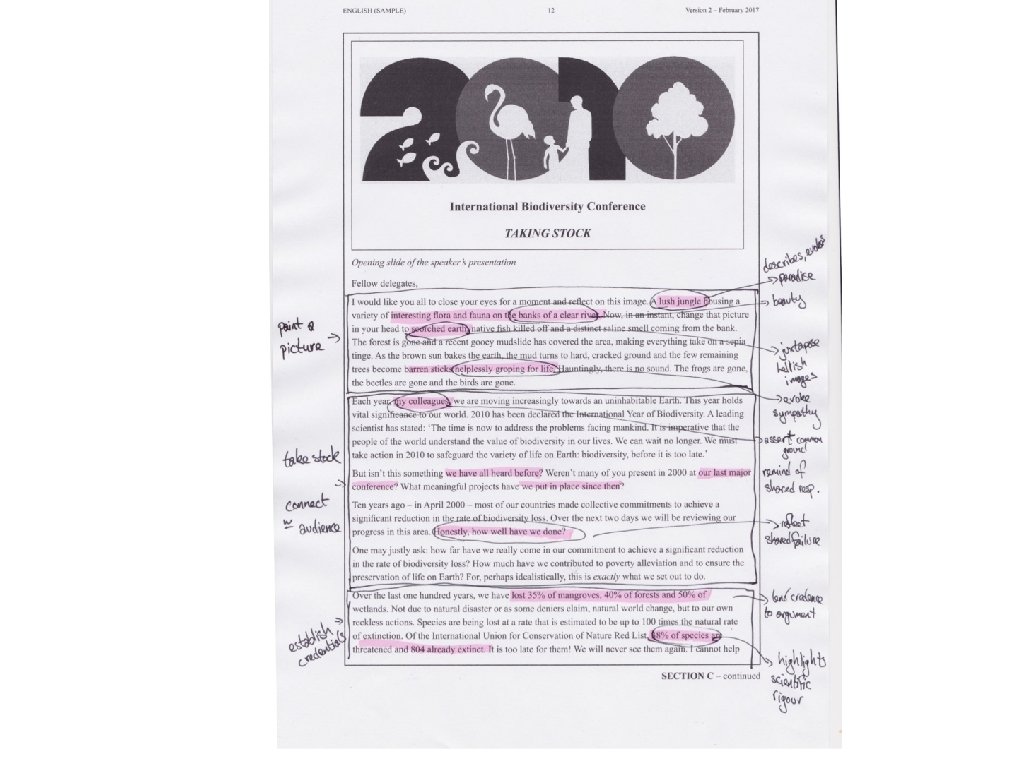
Use square brackets or whole boxes to identify sections or argument phases of a piece. Circle or underline key examples of language which contribute to the purpose or aim of a section
What is the purpose or aim of each section?
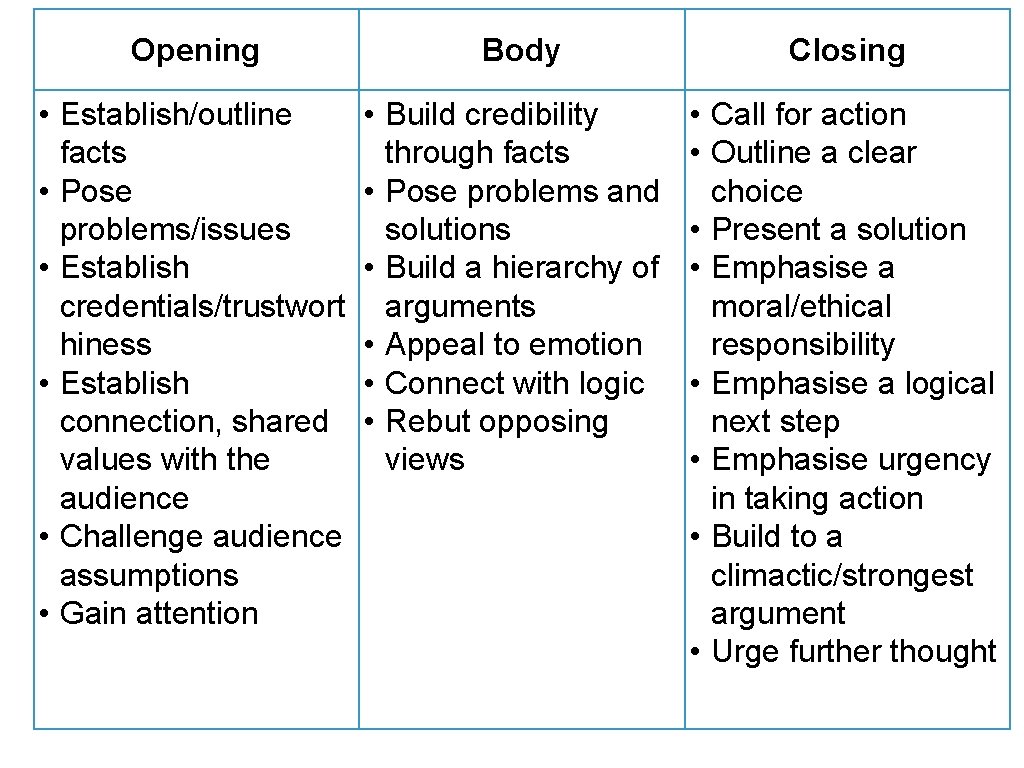
Opening • Establish/outline facts • Pose problems/issues • Establish credentials/trustwort hiness • Establish connection, shared values with the audience • Challenge audience assumptions • Gain attention Body • Build credibility through facts • Pose problems and solutions • Build a hierarchy of arguments • Appeal to emotion • Connect with logic • Rebut opposing views Closing • Call for action • Outline a clear choice • Present a solution • Emphasise a moral/ethical responsibility • Emphasise a logical next step • Emphasise urgency in taking action • Build to a climactic/strongest argument • Urge further thought
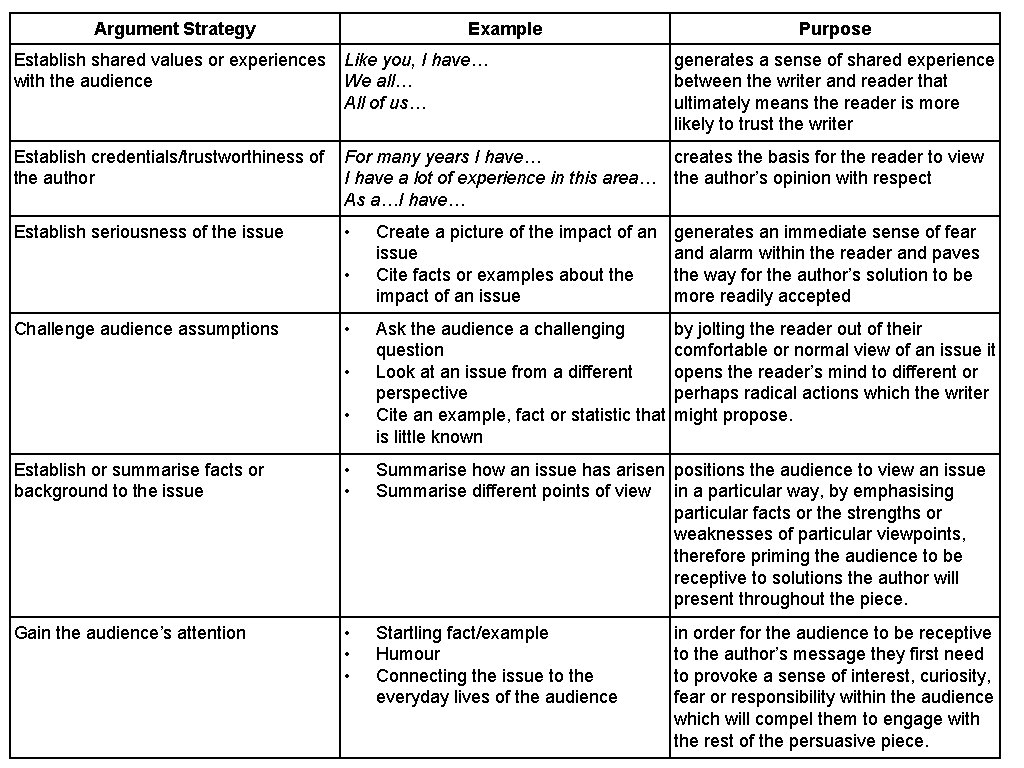
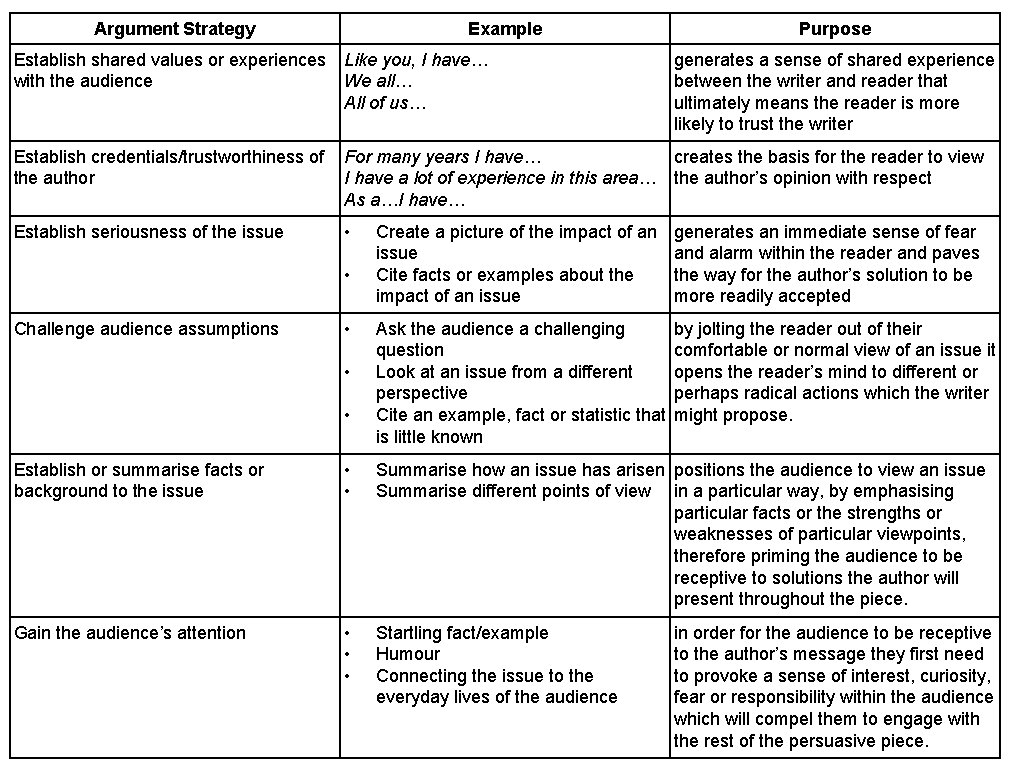
Argument Strategy Example Purpose Establish shared values or experiences Like you, I have… with the audience We all… All of us… generates a sense of shared experience between the writer and reader that ultimately means the reader is more likely to trust the writer Establish credentials/trustworthiness of the author For many years I have… I have a lot of experience in this area… As a…I have… creates the basis for the reader to view the author’s opinion with respect Establish seriousness of the issue • Create a picture of the impact of an issue Cite facts or examples about the impact of an issue generates an immediate sense of fear and alarm within the reader and paves the way for the author’s solution to be more readily accepted Ask the audience a challenging question Look at an issue from a different perspective Cite an example, fact or statistic that is little known by jolting the reader out of their comfortable or normal view of an issue it opens the reader’s mind to different or perhaps radical actions which the writer might propose. • Challenge audience assumptions • • • Establish or summarise facts or background to the issue • • Summarise how an issue has arisen positions the audience to view an issue Summarise different points of view in a particular way, by emphasising particular facts or the strengths or weaknesses of particular viewpoints, therefore priming the audience to be receptive to solutions the author will present throughout the piece. Gain the audience’s attention • • • Startling fact/example Humour Connecting the issue to the everyday lives of the audience in order for the audience to be receptive to the author’s message they first need to provoke a sense of interest, curiosity, fear or responsibility within the audience which will compel them to engage with the rest of the persuasive piece.
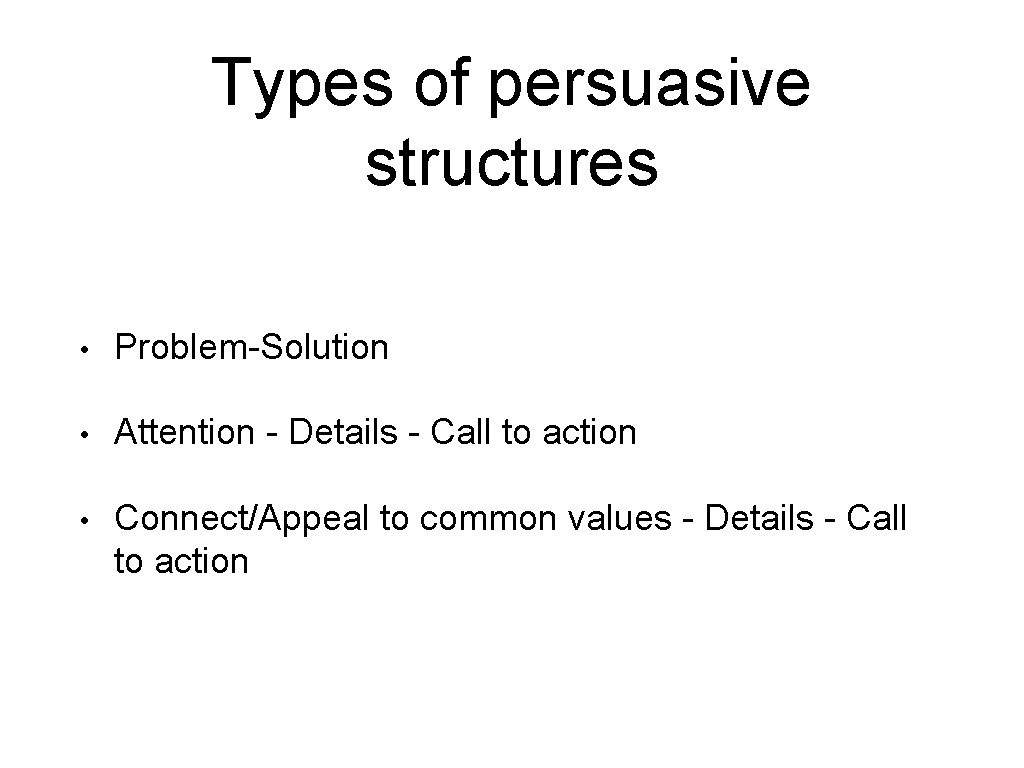
Types of persuasive structures • Problem-Solution • Attention - Details - Call to action • Connect/Appeal to common values - Details - Call to action
Your now have all of the elements of an introduction
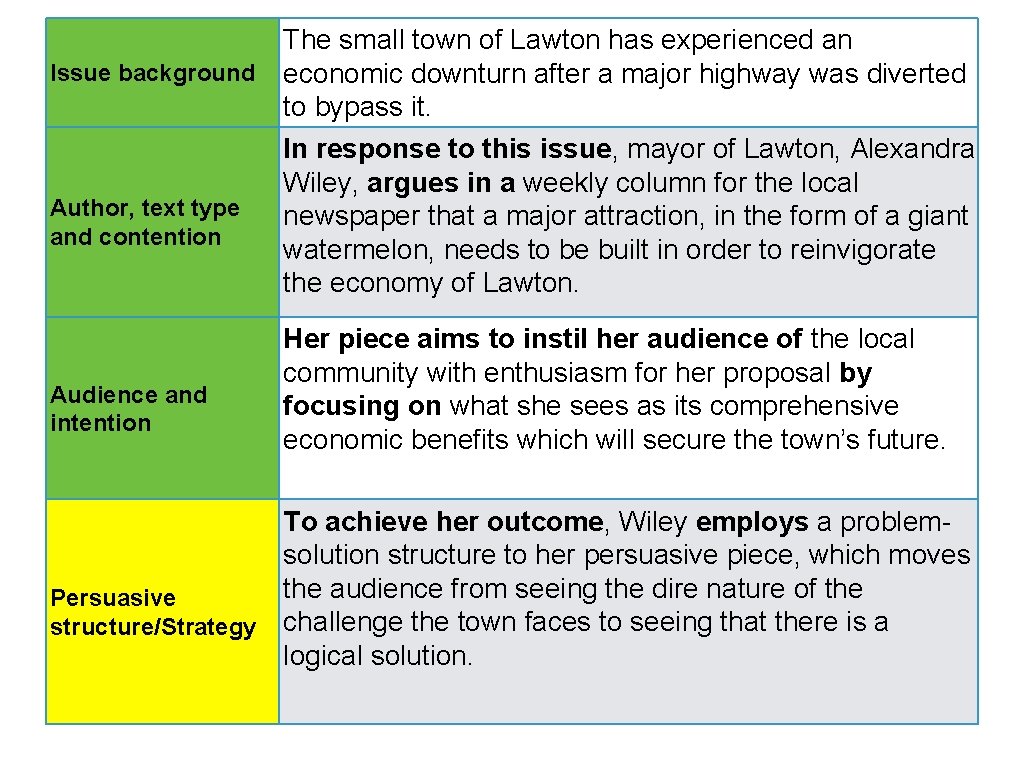
Issue background Author, text type and contention Audience and intention The small town of Lawton has experienced an economic downturn after a major highway was diverted to bypass it. In response to this issue, mayor of Lawton, Alexandra Wiley, argues in a weekly column for the local newspaper that a major attraction, in the form of a giant watermelon, needs to be built in order to reinvigorate the economy of Lawton. Her piece aims to instil her audience of the local community with enthusiasm for her proposal by focusing on what she sees as its comprehensive economic benefits which will secure the town’s future. To achieve her outcome, Wiley employs a problemsolution structure to her persuasive piece, which moves the audience from seeing the dire nature of the Persuasive structure/Strategy challenge the town faces to seeing that there is a logical solution.
Author, text type and contention A contrasting view comes in the form of a letter to the paper from Ian Warwick, President of the Lawton Progress Association, who argues that the attraction would destroy Lawton’s culture, rather than help it. Warwick intends for his audience to feel that the watermelon will be a hideous and horrible attraction, Audience and intention Persuasive structure/Strategy and to achieve this employs a persuasive structure where he contrasts the ugliness of the watermelon against the better cultural options that town could invest in.
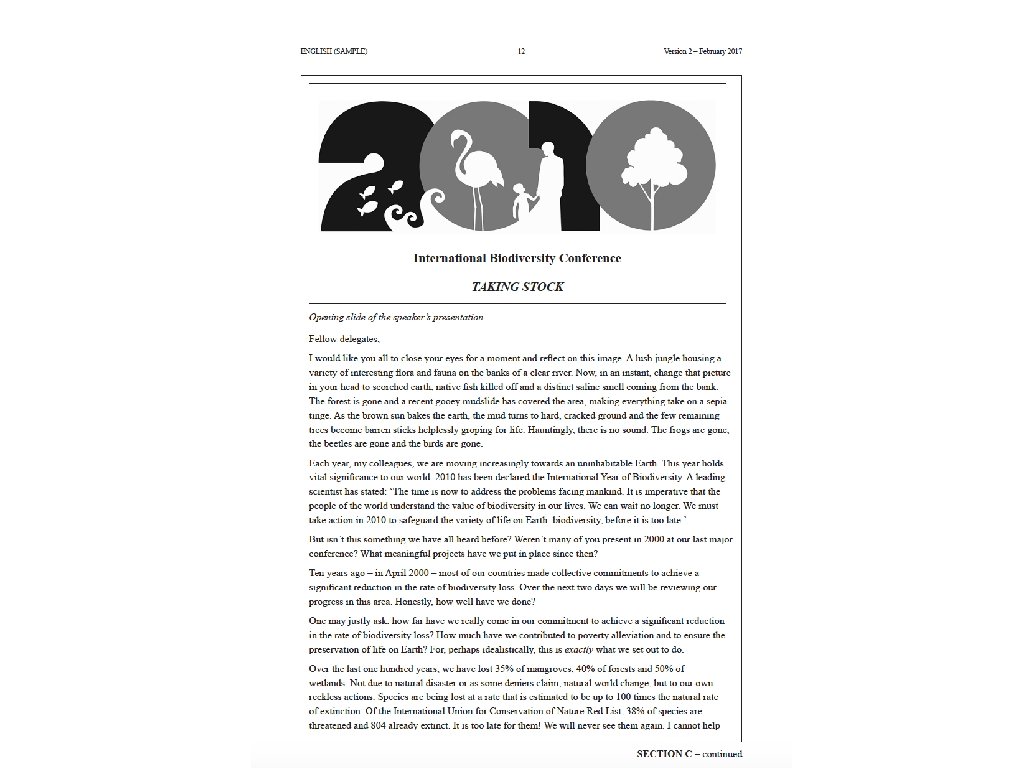
5# Identify the purpose of the visual
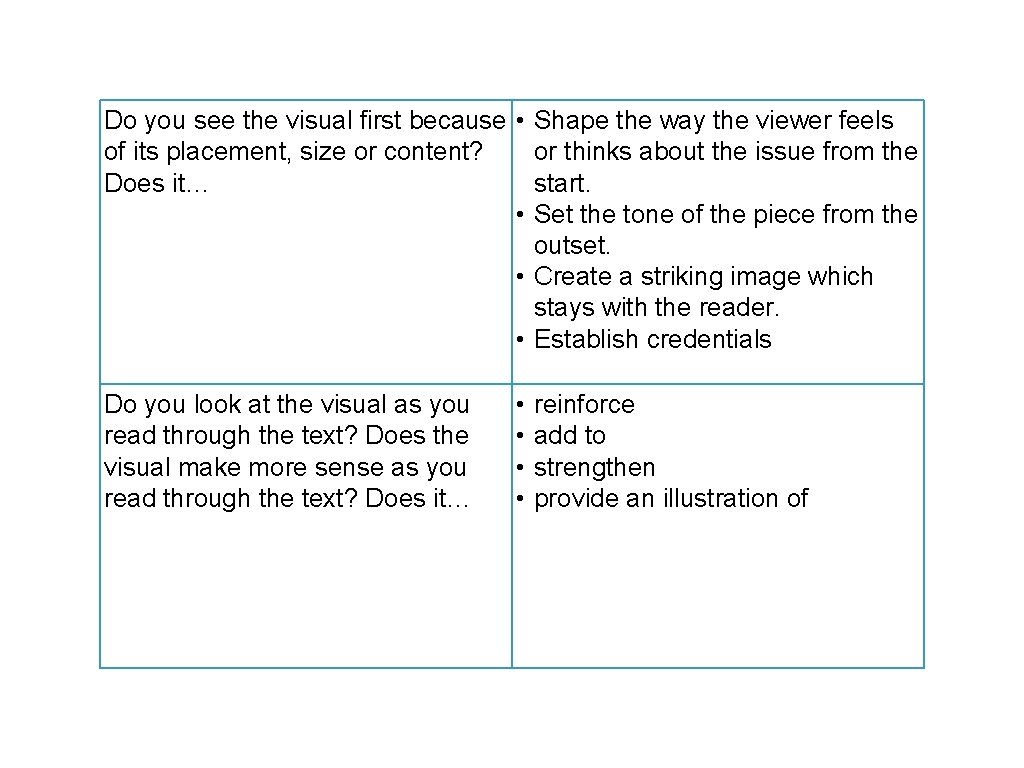
Do you see the visual first because • Shape the way the viewer feels of its placement, size or content? or thinks about the issue from the Does it… start. • Set the tone of the piece from the outset. • Create a striking image which stays with the reader. • Establish credentials Do you look at the visual as you read through the text? Does the visual make more sense as you read through the text? Does it… • • reinforce add to strengthen provide an illustration of
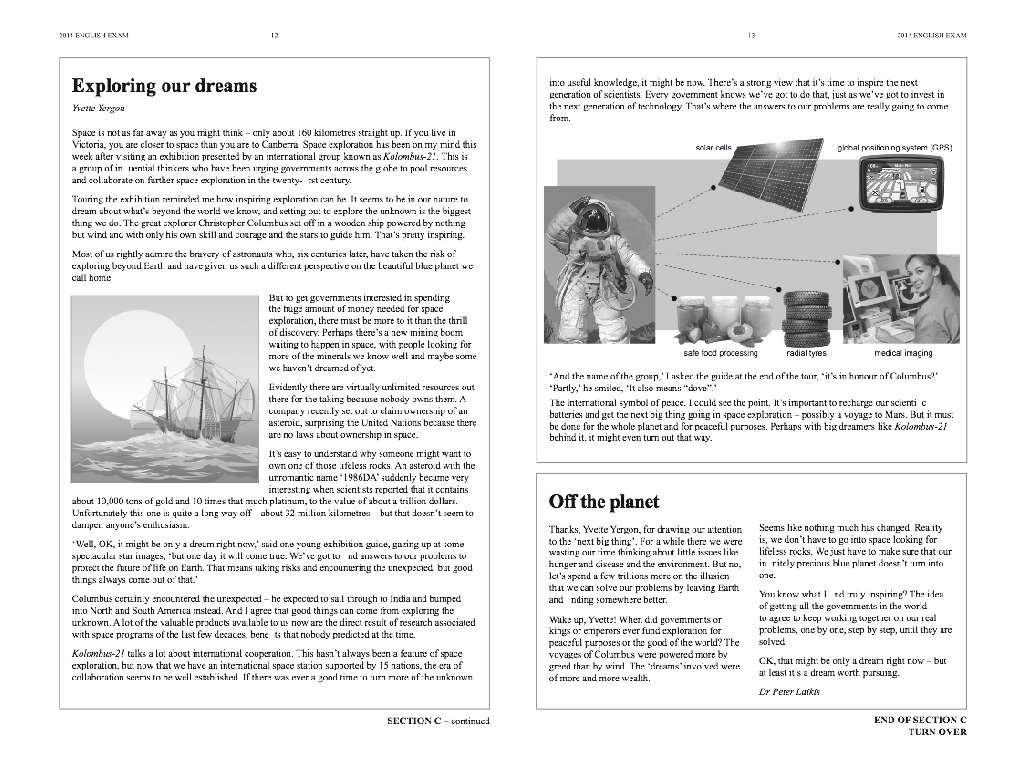
Circle the visual and… 1) Link to a part of the text 2) Annotate how it creates a first impression
You now have a structure for your analysis of argument
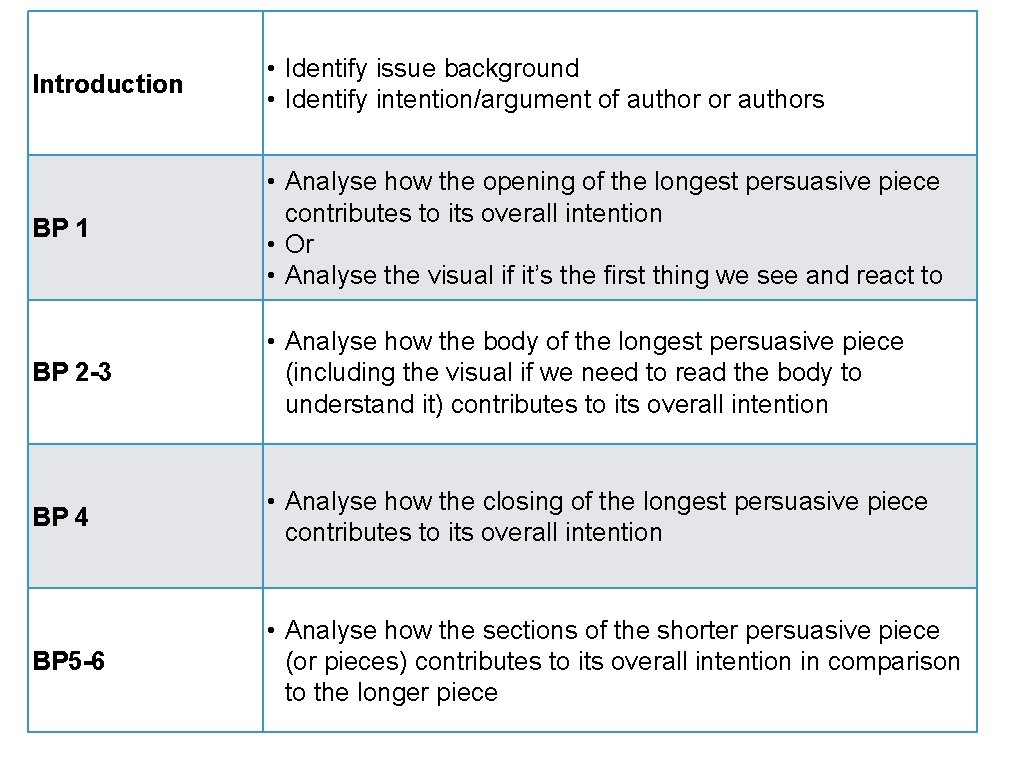
Introduction • Identify issue background • Identify intention/argument of author or authors BP 1 • Analyse how the opening of the longest persuasive piece contributes to its overall intention • Or • Analyse the visual if it’s the first thing we see and react to BP 2 -3 • Analyse how the body of the longest persuasive piece (including the visual if we need to read the body to understand it) contributes to its overall intention BP 4 • Analyse how the closing of the longest persuasive piece contributes to its overall intention BP 5 -6 • Analyse how the sections of the shorter persuasive piece (or pieces) contributes to its overall intention in comparison to the longer piece
6# Analyse how an argument and supporting strategies are used in each section to achieve the overall intention of a piece
What not to do
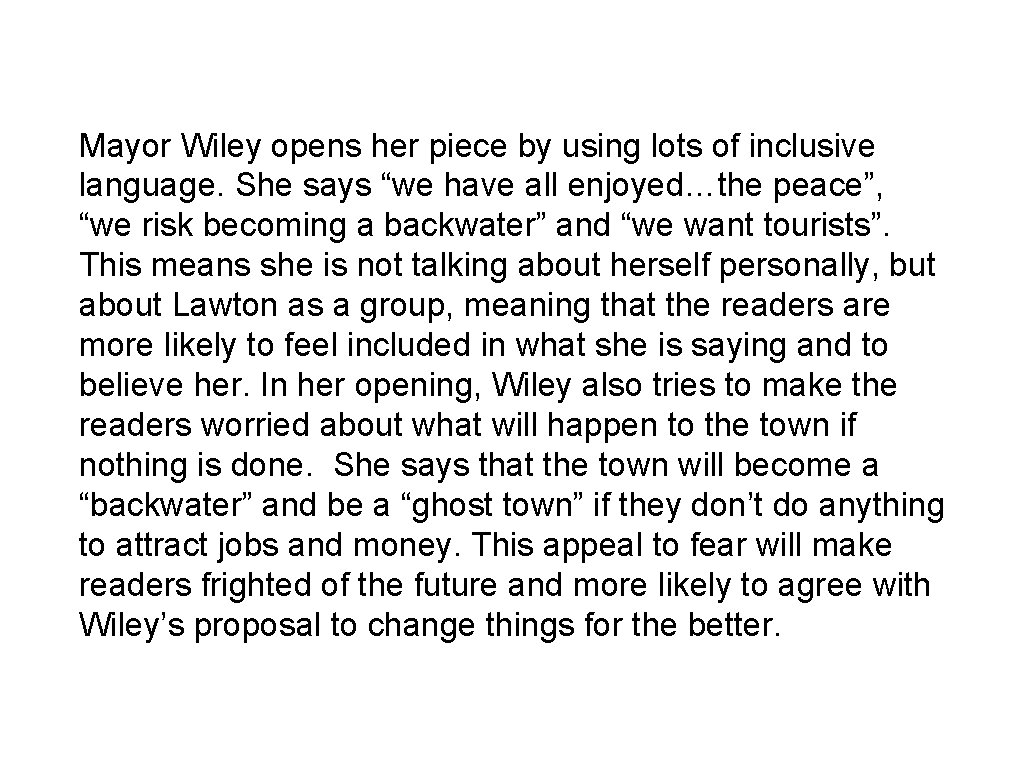
Mayor Wiley opens her piece by using lots of inclusive language. She says “we have all enjoyed…the peace”, “we risk becoming a backwater” and “we want tourists”. This means she is not talking about herself personally, but about Lawton as a group, meaning that the readers are more likely to feel included in what she is saying and to believe her. In her opening, Wiley also tries to make the readers worried about what will happen to the town if nothing is done. She says that the town will become a “backwater” and be a “ghost town” if they don’t do anything to attract jobs and money. This appeal to fear will make readers frighted of the future and more likely to agree with Wiley’s proposal to change things for the better.
Mayor Wiley opens her piece by using lots of inclusive language. She says “we have all enjoyed…the peace”, “we risk becoming a backwater” and “we want tourists”. This means she is not talking about herself personally, but about Lawton as a group, meaning that the readers are more likely to feel included in what she is saying and to believe her. In her opening, Wiley also tries to make the readers worried about what will happen to the town if nothing is done. She says that the town will become a “backwater” and be a “ghost town” if they don’t do anything to attract jobs and money. This appeal to fear will make readers frighted of the future and more likely to agree with Wiley’s proposal to change things for the better.
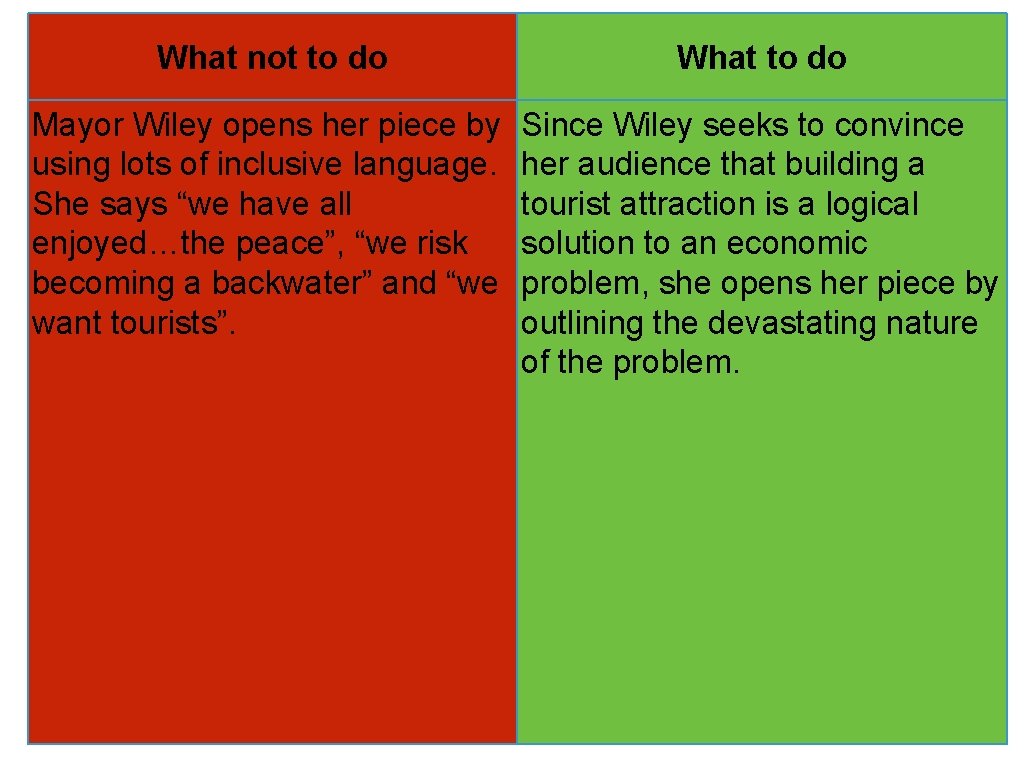
What not to do What to do Mayor Wiley opens her piece by using lots of inclusive language. She says “we have all enjoyed…the peace”, “we risk becoming a backwater” and “we want tourists”. Since Wiley seeks to convince her audience that building a tourist attraction is a logical solution to an economic problem, she opens her piece by outlining the devastating nature of the problem.
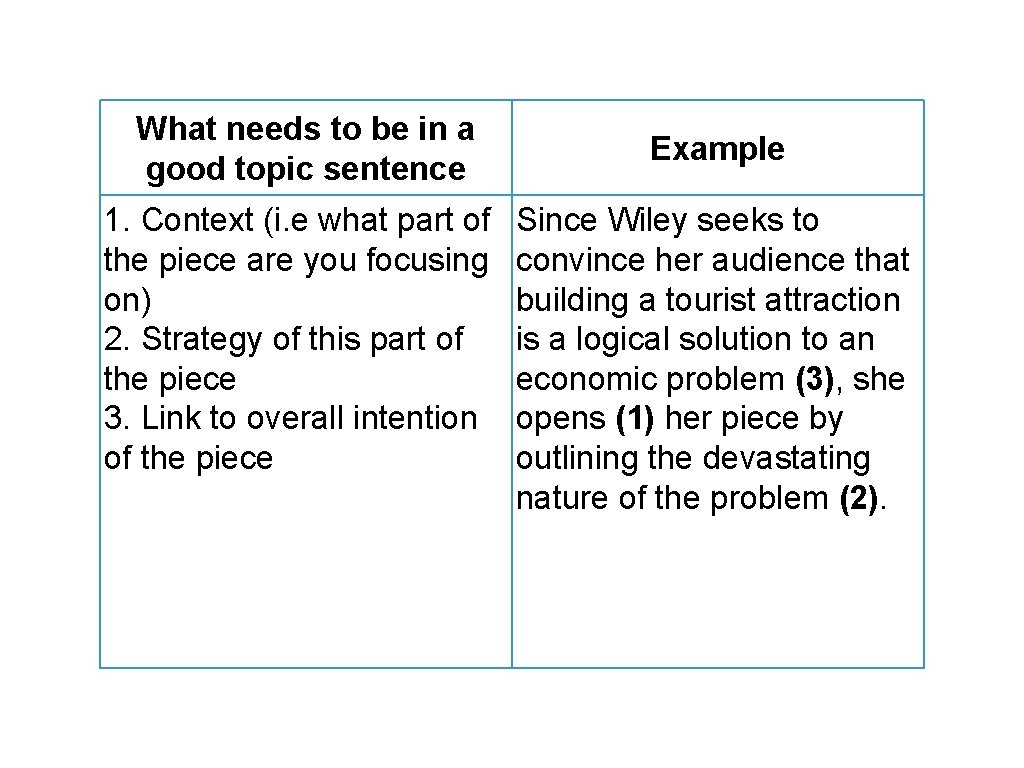
What needs to be in a good topic sentence 1. Context (i. e what part of the piece are you focusing on) 2. Strategy of this part of the piece 3. Link to overall intention of the piece Example Since Wiley seeks to convince her audience that building a tourist attraction is a logical solution to an economic problem (3), she opens (1) her piece by outlining the devastating nature of the problem (2).
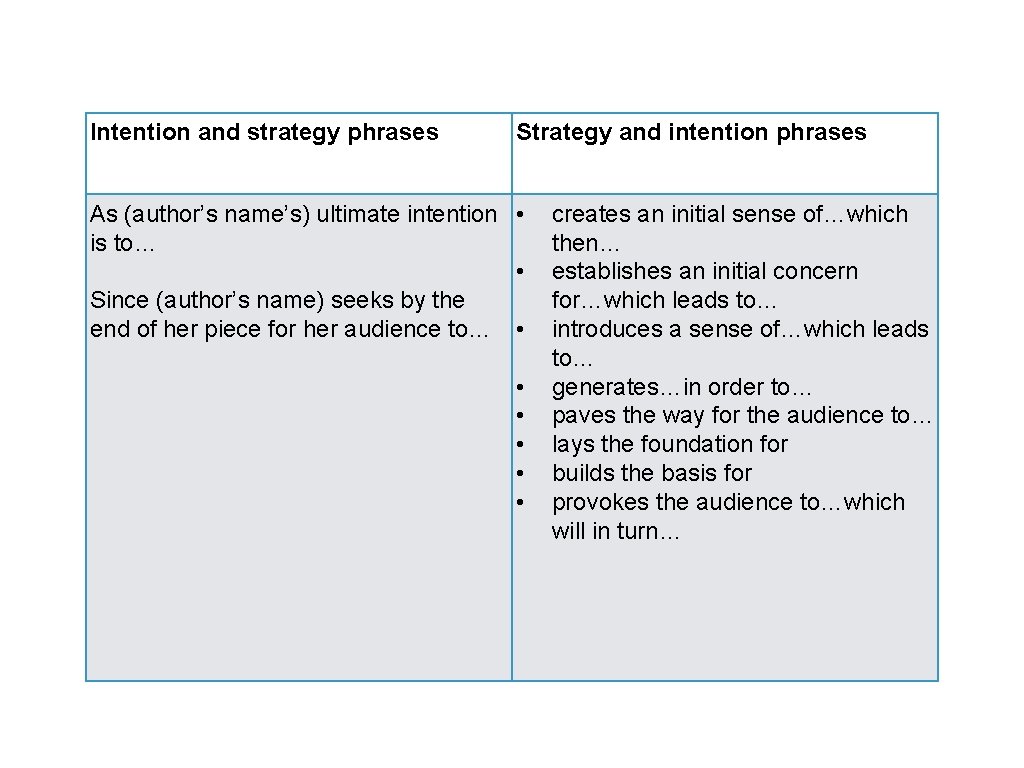
Intention and strategy phrases Strategy and intention phrases As (author’s name’s) ultimate intention • is to… • Since (author’s name) seeks by the end of her piece for her audience to… • • • creates an initial sense of…which then… establishes an initial concern for…which leads to… introduces a sense of…which leads to… generates…in order to… paves the way for the audience to… lays the foundation for builds the basis for provokes the audience to…which will in turn…
Argument Strategy Example Purpose Establish shared values or experiences Like you, I have… with the audience We all… All of us… generates a sense of shared experience between the writer and reader that ultimately means the reader is more likely to trust the writer Establish credentials/trustworthiness of the author For many years I have… I have a lot of experience in this area… As a…I have… creates the basis for the reader to view the author’s opinion with respect Establish seriousness of the issue • Create a picture of the impact of an issue Cite facts or examples about the impact of an issue generates an immediate sense of fear and alarm within the reader and paves the way for the author’s solution to be more readily accepted Ask the audience a challenging question Look at an issue from a different perspective Cite an example, fact or statistic that is little known by jolting the reader out of their comfortable or normal view of an issue it opens the reader’s mind to different or perhaps radical actions which the writer might propose. • Challenge audience assumptions • • • Establish or summarise facts or background to the issue • • Summarise how an issue has arisen positions the audience to view an issue Summarise different points of view in a particular way, by emphasising particular facts or the strengths or weaknesses of particular viewpoints, therefore priming the audience to be receptive to solutions the author will present throughout the piece. Gain the audience’s attention • • • Startling fact/example Humour Connecting the issue to the everyday lives of the audience in order for the audience to be receptive to the author’s message they first need to provoke a sense of interest, curiosity, fear or responsibility within the audience which will compel them to engage with the rest of the persuasive piece.
Your turn
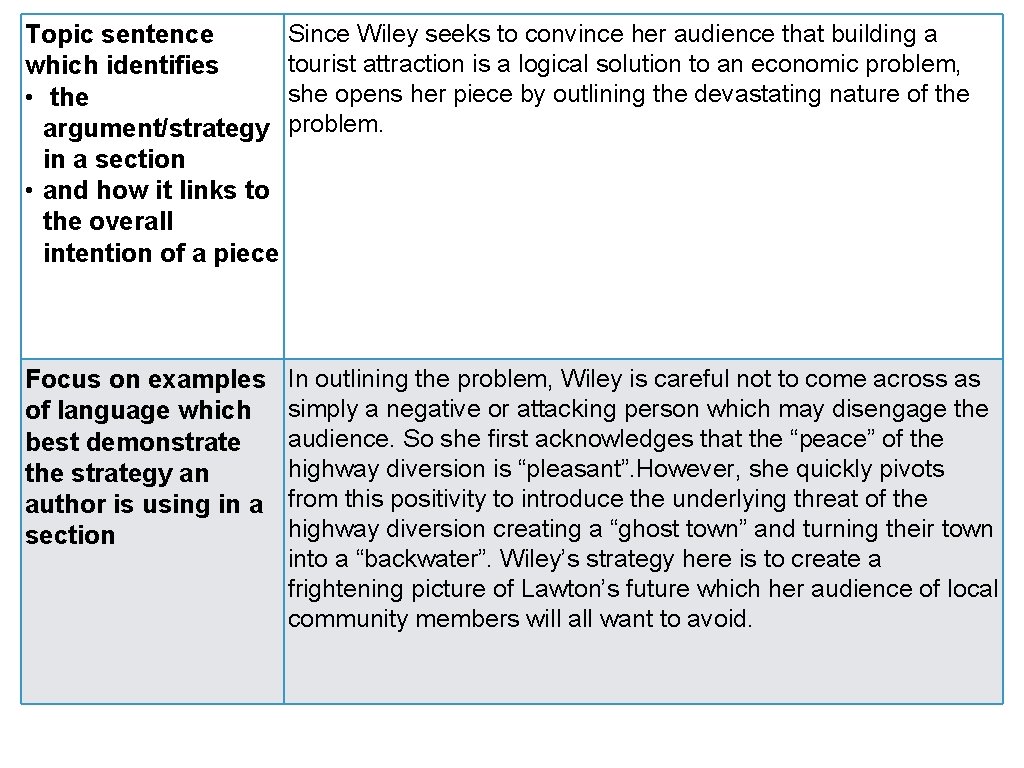
Topic sentence which identifies • the argument/strategy in a section • and how it links to the overall intention of a piece Since Wiley seeks to convince her audience that building a tourist attraction is a logical solution to an economic problem, she opens her piece by outlining the devastating nature of the problem. Focus on examples of language which best demonstrate the strategy an author is using in a section In outlining the problem, Wiley is careful not to come across as simply a negative or attacking person which may disengage the audience. So she first acknowledges that the “peace” of the highway diversion is “pleasant”. However, she quickly pivots from this positivity to introduce the underlying threat of the highway diversion creating a “ghost town” and turning their town into a “backwater”. Wiley’s strategy here is to create a frightening picture of Lawton’s future which her audience of local community members will all want to avoid.
Identify examples of language
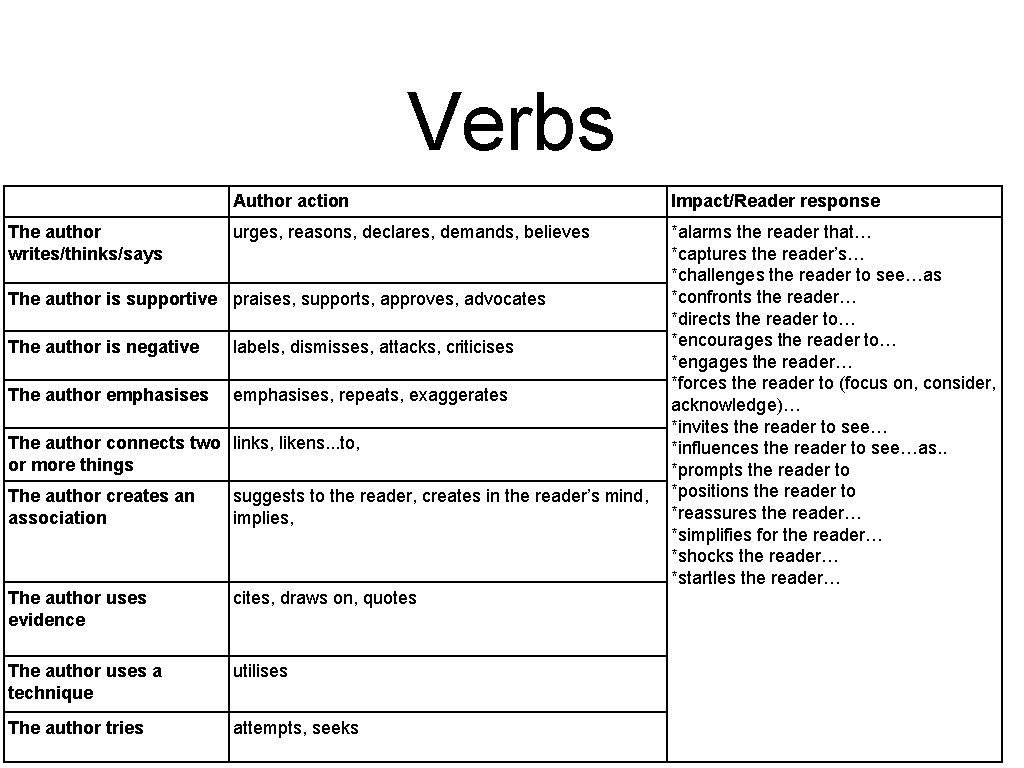
Verbs The author writes/thinks/says Author action Impact/Reader response urges, reasons, declares, demands, believes *alarms the reader that… *captures the reader’s… *challenges the reader to see…as *confronts the reader… *directs the reader to… *encourages the reader to… *engages the reader… *forces the reader to (focus on, consider, acknowledge)… *invites the reader to see… *influences the reader to see…as. . *prompts the reader to *positions the reader to *reassures the reader… *simplifies for the reader… *shocks the reader… *startles the reader… The author is supportive praises, supports, approves, advocates The author is negative labels, dismisses, attacks, criticises The author emphasises, repeats, exaggerates The author connects two links, likens. . . to, or more things The author creates an association suggests to the reader, creates in the reader’s mind, implies, The author uses evidence cites, draws on, quotes The author uses a technique utilises The author tries attempts, seeks
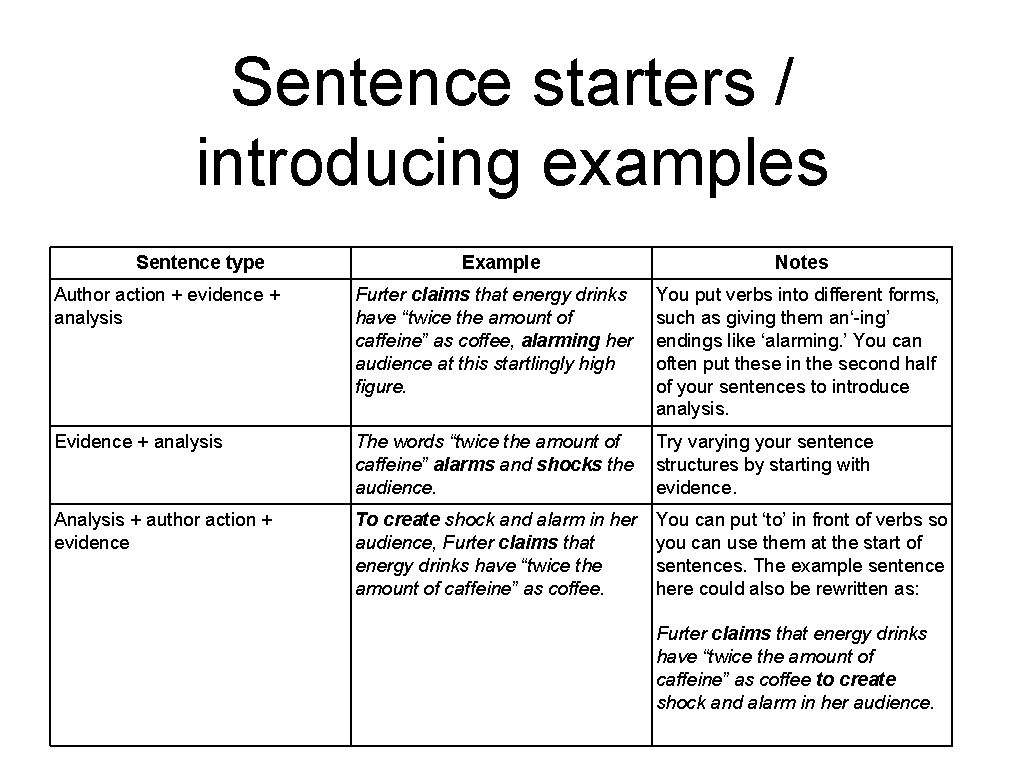
Sentence starters / introducing examples Sentence type Example Notes Author action + evidence + analysis Furter claims that energy drinks have “twice the amount of caffeine” as coffee, alarming her audience at this startlingly high figure. You put verbs into different forms, such as giving them an‘-ing’ endings like ‘alarming. ’ You can often put these in the second half of your sentences to introduce analysis. Evidence + analysis The words “twice the amount of caffeine” alarms and shocks the audience. Try varying your sentence structures by starting with evidence. Analysis + author action + evidence To create shock and alarm in her audience, Furter claims that energy drinks have “twice the amount of caffeine” as coffee. You can put ‘to’ in front of verbs so you can use them at the start of sentences. The example sentence here could also be rewritten as: Furter claims that energy drinks have “twice the amount of caffeine” as coffee to create shock and alarm in her audience.
How do arguments build on each other?
• Having outlined the nature of the threat to Lawton in her opening, Wiley proceeds in her body to provide a solution. This solution is presented by Wiley at the start of her body as the “answer”, an authoritative word which is designed to instil confidence within her readers and lead them to ultimately trust her plan for the giant watermelon is the right thing for the town.
• Building upon (his/her) initial strategy to…, in the body of their…(author name)… • Having… • established… • created for the reader… • argued…. • dismissed…. • introduced • outlined • established • made clear… • positioned the reader to see… • …the author seeks in the body of their piece to… • …the author turns their attention in the middle of their piece to… • …the author builds on this in their body by…
Compare pieces
Comprehensive and complex understanding of the arguments presented in the texts and how they have been constructed to position audiences. Sophisticated and insightful analysis and comparison of arguments with complex discussion of the intent and development of the arguments, persuasive use of language and the impact of the texts. Considered and accurate use of textual evidence to justify the analysis. Skilful control of the features of comparative analysis, including the highly proficient use of structure, conventions and language, including the use of relevant metalanguage. Highly expressive, fluent and coherent written language that employs the skilful and accurate use of spelling, punctuation and syntax of Standard Australian English.
More than just one transition phrase
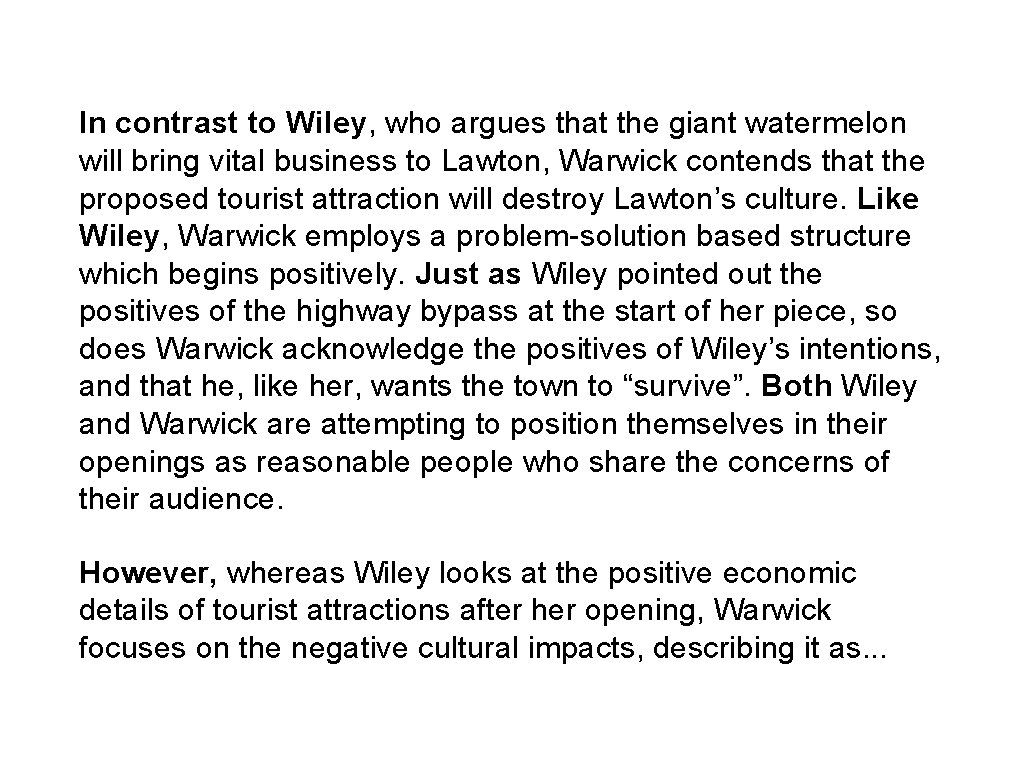
In contrast to Wiley, who argues that the giant watermelon will bring vital business to Lawton, Warwick contends that the proposed tourist attraction will destroy Lawton’s culture. Like Wiley, Warwick employs a problem-solution based structure which begins positively. Just as Wiley pointed out the positives of the highway bypass at the start of her piece, so does Warwick acknowledge the positives of Wiley’s intentions, and that he, like her, wants the town to “survive”. Both Wiley and Warwick are attempting to position themselves in their openings as reasonable people who share the concerns of their audience. However, whereas Wiley looks at the positive economic details of tourist attractions after her opening, Warwick focuses on the negative cultural impacts, describing it as. . .
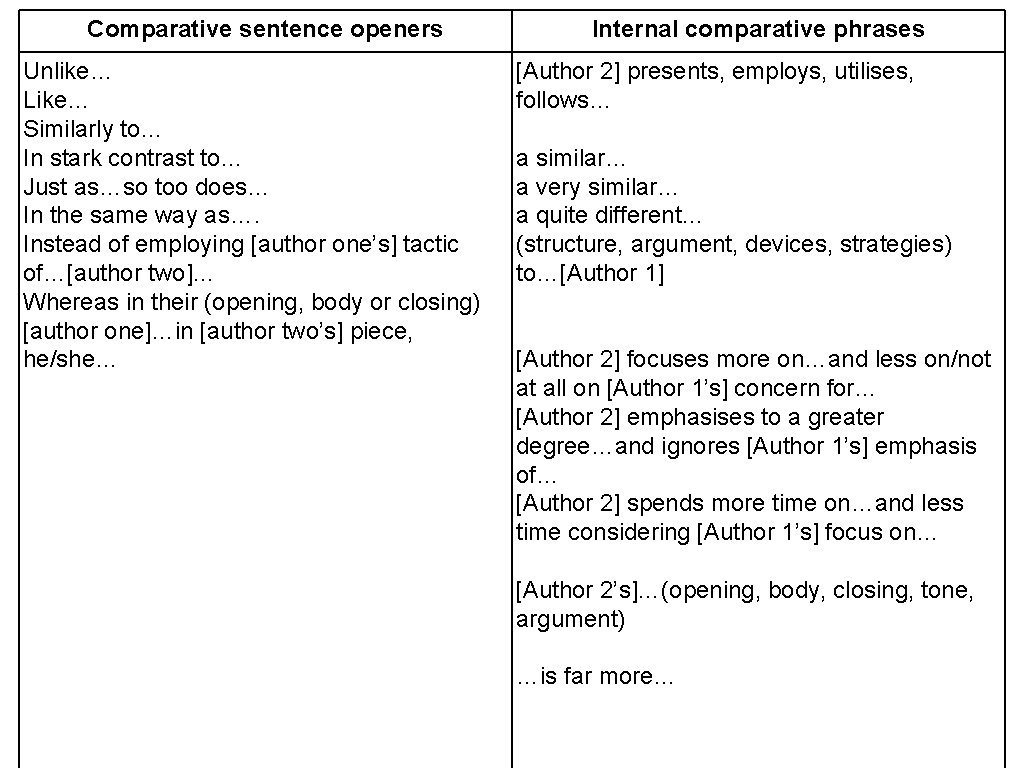
Comparative sentence openers Unlike… Like… Similarly to… In stark contrast to… Just as…so too does… In the same way as…. Instead of employing [author one’s] tactic of…[author two]… Whereas in their (opening, body or closing) [author one]…in [author two’s] piece, he/she… Internal comparative phrases [Author 2] presents, employs, utilises, follows… a similar… a very similar… a quite different… (structure, argument, devices, strategies) to…[Author 1] [Author 2] focuses more on…and less on/not at all on [Author 1’s] concern for… [Author 2] emphasises to a greater degree…and ignores [Author 1’s] emphasis of… [Author 2] spends more time on…and less time considering [Author 1’s] focus on… [Author 2’s]…(opening, body, closing, tone, argument) …is far more…
Thank you