
Writing Criterion Referenced Assessment Criteria and Standards writing


- Slides: 18
Writing Criterion Referenced Assessment Criteria and Standards writing criterion referenced assessment criteria and standards Deb Murdoch, QLT Assessment
Learning objectives for this session: • Identify assessable components of the task ready to develop criteria in line with AQF requirements • Define and develop clear criteria • Develop differentiating levels of performance standards
Defining clear criteria While a task description shares what students will submit, criteria are about what you will value when you assess what they submit. Criteria should align to the learning outcomes of the subject.
Aligning your outcome, task and criteria Check the alignment between the learning outcomes, the task requirements and the criteria. 4 steps to criteria and standards: 1. Analyse what the learning outcome is assessing 2. Analyse whether the learning task is actually assessing those elements 3. Check whether the criteria include those elements or write criteria that do 4. Write differentiated standards that at a minimum meet a PS level
Step 1: Analyse the learning outcome • What action does the student have to take? What is the verb in the learning outcome? E. g. analyse, create, describe, identify. What’s the level of thinking you are expecting from the student? • What is the content area, concept, theory, knowledge that is being assessed? • What is the context of the assessment? Or how is the task being assessed? What should the content area relate to?
Step 1: examples • develop and reflect on their emerging identity as student engineers, and how this will change as they move into placement in industry • identify strengths and opportunities for improvement in a team environment ;
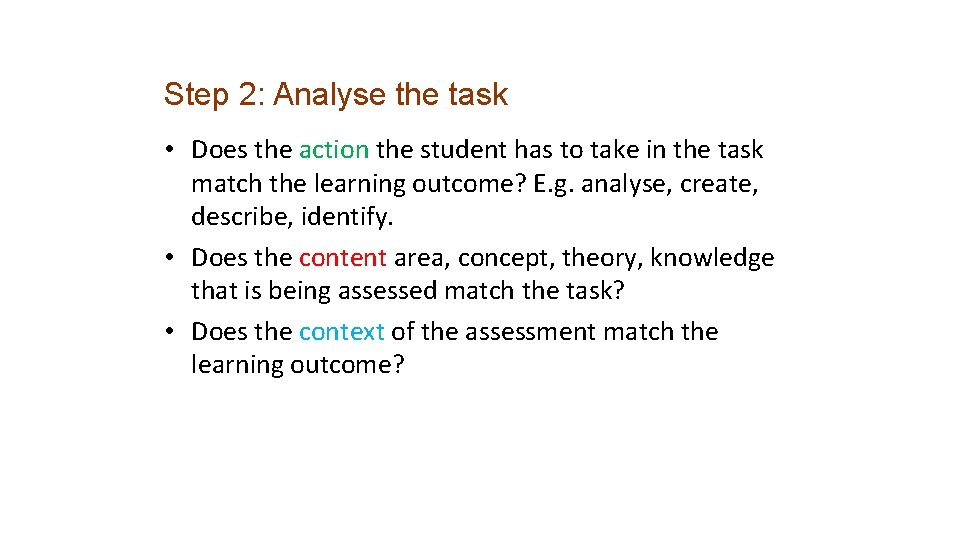
Step 2: Analyse the task • Does the action the student has to take in the task match the learning outcome? E. g. analyse, create, describe, identify. • Does the content area, concept, theory, knowledge that is being assessed match the task? • Does the context of the assessment match the learning outcome?
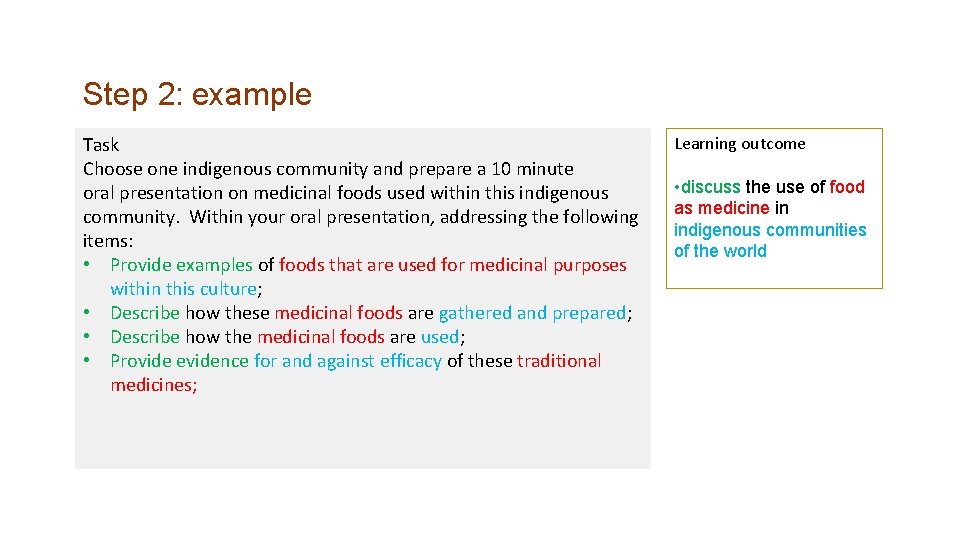
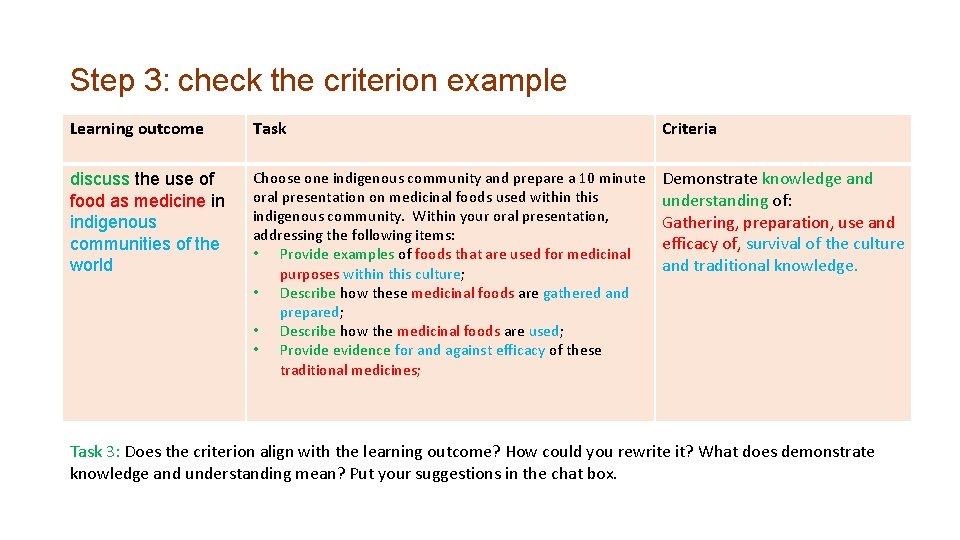
Step 2: example Task Choose one indigenous community and prepare a 10 minute oral presentation on medicinal foods used within this indigenous community. Within your oral presentation, addressing the following items: • Provide examples of foods that are used for medicinal purposes within this culture; • Describe how these medicinal foods are gathered and prepared; • Describe how the medicinal foods are used; • Provide evidence for and against efficacy of these traditional medicines; Learning outcome • discuss the use of food as medicine in indigenous communities of the world
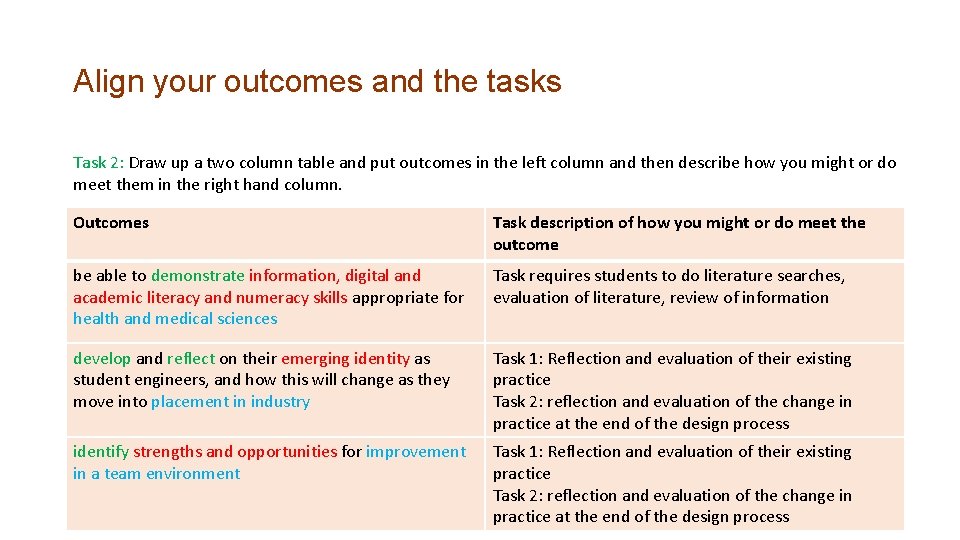
Align your outcomes and the tasks Task 2: Draw up a two column table and put outcomes in the left column and then describe how you might or do meet them in the right hand column. Outcomes Task description of how you might or do meet the outcome be able to demonstrate information, digital and academic literacy and numeracy skills appropriate for health and medical sciences Task requires students to do literature searches, evaluation of literature, review of information develop and reflect on their emerging identity as student engineers, and how this will change as they move into placement in industry Task 1: Reflection and evaluation of their existing practice Task 2: reflection and evaluation of the change in practice at the end of the design process identify strengths and opportunities for improvement in a team environment Task 1: Reflection and evaluation of their existing practice Task 2: reflection and evaluation of the change in practice at the end of the design process
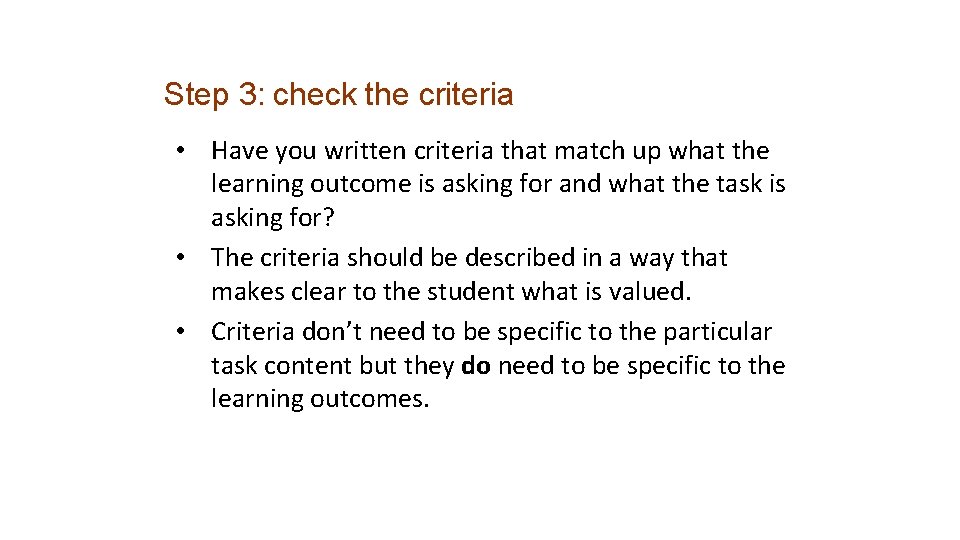
Step 3: check the criteria • Have you written criteria that match up what the learning outcome is asking for and what the task is asking for? The • The criteria should be described in a way that makes clear to the student what is valued. • Criteria don’t need to be specific to the particular task content but they do need to be specific to the learning outcomes.
Step 3: check the criterion example Learning outcome Task Criteria discuss the use of food as medicine in indigenous communities of the world Choose one indigenous community and prepare a 10 minute oral presentation on medicinal foods used within this indigenous community. Within your oral presentation, addressing the following items: • Provide examples of foods that are used for medicinal purposes within this culture; • Describe how these medicinal foods are gathered and prepared; • Describe how the medicinal foods are used; • Provide evidence for and against efficacy of these traditional medicines; Demonstrate knowledge and understanding of: Gathering, preparation, use and efficacy of, survival of the culture and traditional knowledge. Task 3: Does the criterion align with the learning outcome? How could you rewrite it? What does demonstrate knowledge and understanding mean? Put your suggestions in the chat box.
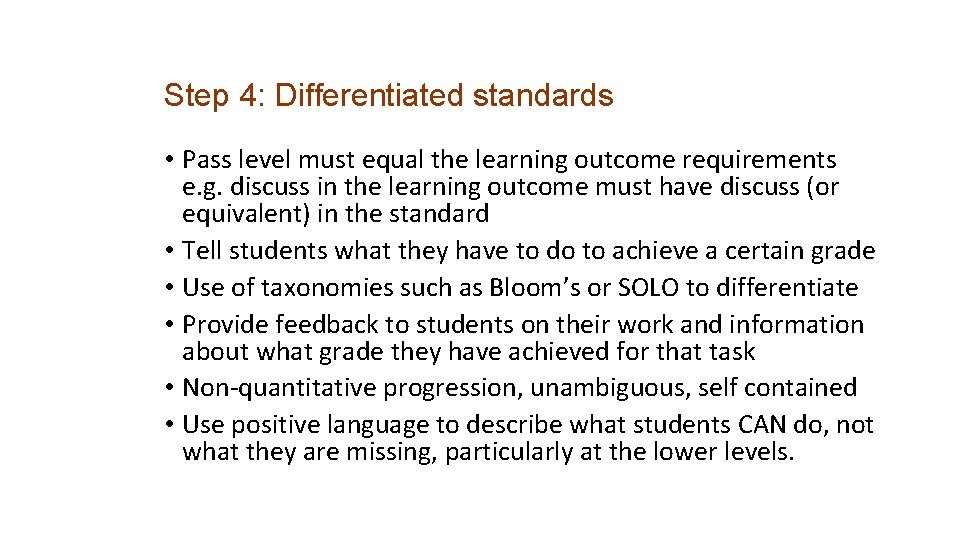
Step 4: Differentiated standards • Pass level must equal the learning outcome requirements e. g. discuss in the learning outcome must have discuss (or equivalent) in the standard • Tell students what they have to do to achieve a certain grade • Use of taxonomies such as Bloom’s or SOLO to differentiate • Provide feedback to students on their work and information about what grade they have achieved for that task • Non-quantitative progression, unambiguous, self contained • Use positive language to describe what students CAN do, not what they are missing, particularly at the lower levels.
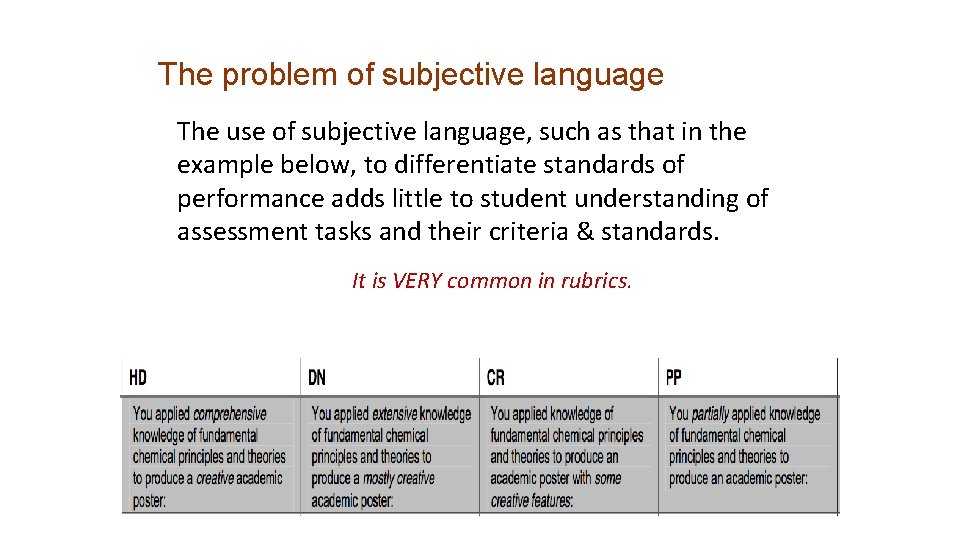
The problem of subjective language The use of subjective language, such as that in the example below, to differentiate standards of performance adds little to student understanding of assessment tasks and their criteria & standards. It is VERY common in rubrics.
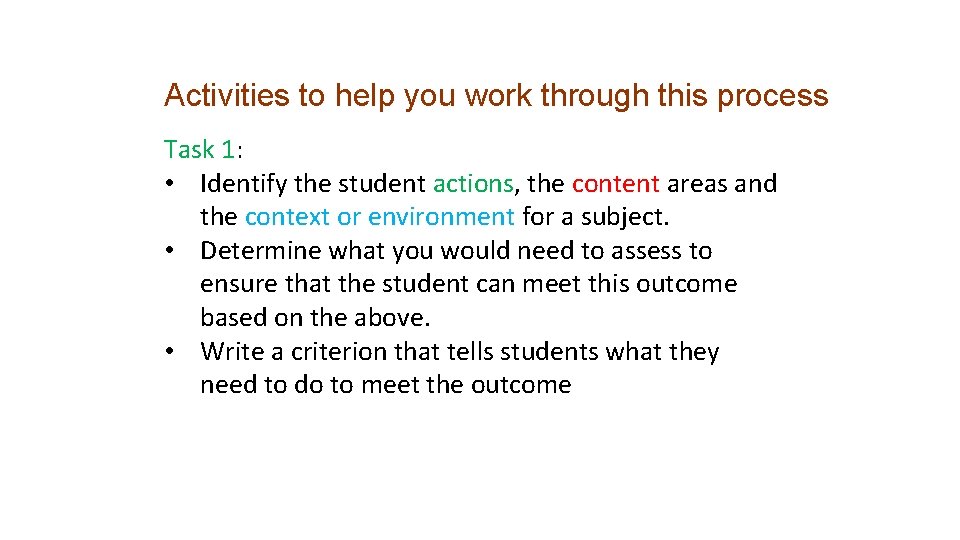
Activities to help you work through this process Task 1: • Identify the student actions, the content areas and the context or environment for a subject. • Determine what you would need to assess to ensure that the student can meet this outcome based on the above. • Write a criterion that tells students what they need to do to meet the outcome
Activities to help you work through this process Task 2: • Write a PASS standard that tells students what standard they need to do to meet to achieve the criterion • NOTE: ensure that the student actions also meet the standard of the related subject learning outcome
Activities to help you work through this process Task 3: • Write a HD standard that tells students what standard they need to meet to achieve the criterion
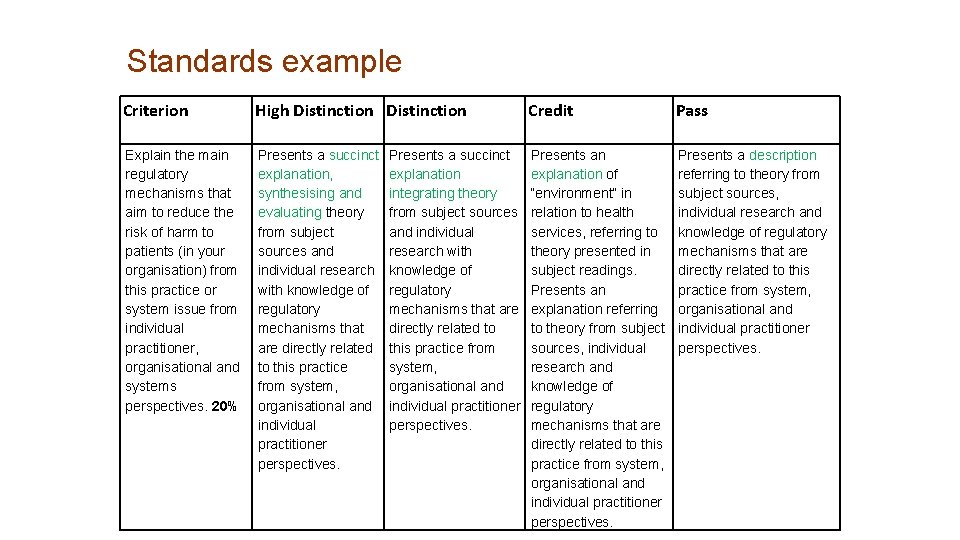
Standards example Criterion High Distinction Credit Pass Explain the main regulatory mechanisms that aim to reduce the risk of harm to patients (in your organisation) from this practice or system issue from individual practitioner, organisational and systems perspectives. 20% Presents a succinct explanation, synthesising and evaluating theory from subject sources and individual research with knowledge of regulatory mechanisms that are directly related to this practice from system, organisational and individual practitioner perspectives. Presents an explanation of “environment” in relation to health services, referring to theory presented in subject readings. Presents an explanation referring to theory from subject sources, individual research and knowledge of regulatory mechanisms that are directly related to this practice from system, organisational and individual practitioner perspectives. Presents a description referring to theory from subject sources, individual research and knowledge of regulatory mechanisms that are directly related to this practice from system, organisational and individual practitioner perspectives. Presents a succinct explanation integrating theory from subject sources and individual research with knowledge of regulatory mechanisms that are directly related to this practice from system, organisational and individual practitioner perspectives.
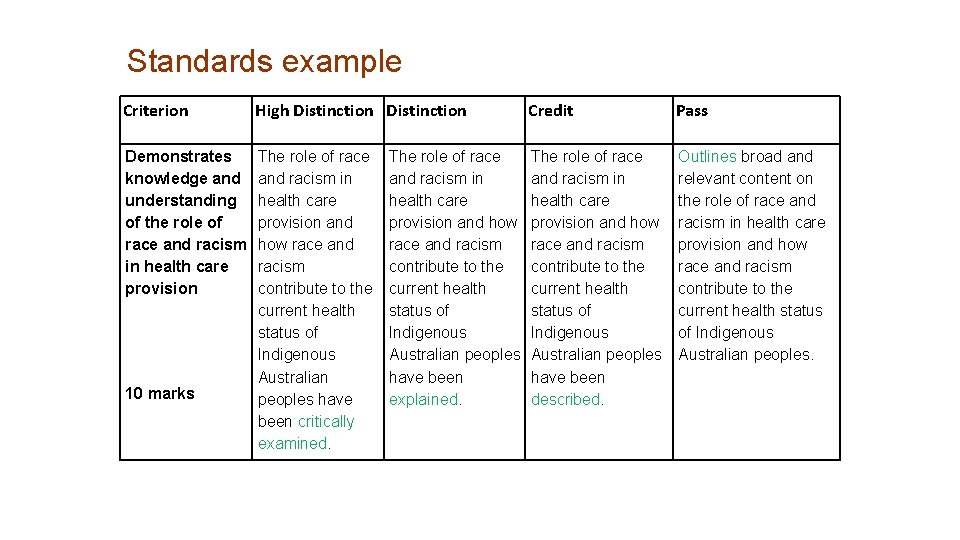
Standards example Criterion High Distinction Credit Pass Demonstrates knowledge and understanding of the role of race and racism in health care provision The role of race and racism in health care provision and how race and racism contribute to the current health status of Indigenous Australian peoples have been critically examined. The role of race and racism in health care provision and how race and racism contribute to the current health status of Indigenous Australian peoples have been described. Outlines broad and relevant content on the role of race and racism in health care provision and how race and racism contribute to the current health status of Indigenous Australian peoples. 10 marks The role of race and racism in health care provision and how race and racism contribute to the current health status of Indigenous Australian peoples have been explained.