
Writing Conclusions How to effectively wrap up your
- Slides: 5
Writing Conclusions How to effectively wrap up your ideas…
Conclusions are important This is your last chance to persuade the reader to your point of view n Final impression—if you leave with a weak conclusion, your readers will remember n Needs to convey a sense of closure n BUT it should not close off the discussion of the topic n
Add Closure…Without ending the conversation n Link back to beginning to create closure n n Add an additional quote from the text you are writing about or from another source that drives home your point For instance: n n n Restate your thesis (in new words) Reference your hook in some way You might conclude an essay on James Joyce's short story collection, Dubliners, with information about Joyce's own complex feelings towards Dublin, his home. OR you might end with a biographer's statement about Joyce's attitude toward Dublin, which could illuminate his characters' responses to the city. However, make sure you get the last word!
Other options for closure… n Put your discussion in another context n n Are we still striving for the same things today? Consider the implications of your argument —what can people learn from what you have to say?
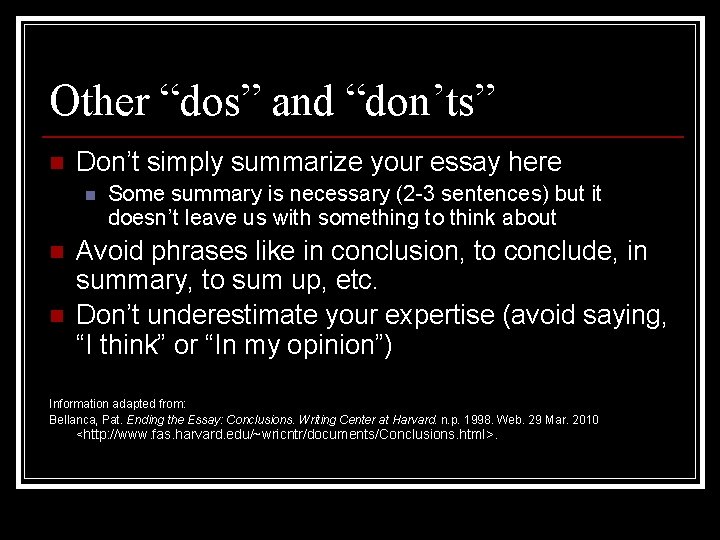
Other “dos” and “don’ts” n Don’t simply summarize your essay here n n n Some summary is necessary (2 -3 sentences) but it doesn’t leave us with something to think about Avoid phrases like in conclusion, to conclude, in summary, to sum up, etc. Don’t underestimate your expertise (avoid saying, “I think” or “In my opinion”) Information adapted from: Bellanca, Pat. Ending the Essay: Conclusions. Writing Center at Harvard. n. p. 1998. Web. 29 Mar. 2010 <http: //www. fas. harvard. edu/~wricntr/documents/Conclusions. html>.