
Writing Collection Development Policies and Responding to Challenges

- Slides: 43
Writing Collection Development Policies and Responding to Challenges to Materials to Stave Off Lawsuits Infopeople Webcast Tuesday July 11, 2006 12: 00 noon to 1: 00 p. m Mary Minow, J. D. , A. M. L. S. Library. Law. com consult@librarylaw. com
Technical Housekeeping Don’t wait • Today’s webcast: for Q&A to – presentation: 50 minutes submit – Q&A: final 10 minutes questions • Submit your questions via ‘Chat’ during webcast so presenter gets them in time • Fill out evaluation during Q&A Webcast Archives: http: //infopeople. org/training/webcasts/archived. php
Using Chat • Chat Box is located at the bottom, lower left corner (below the video of the presenter) • To send a message, select ALL from the dropdown • Type message in box to right of ALL and press Enter. Use Chat to send questions to the presenter and to get help with technical difficulties. Send messages to ALL.
Legal Disclaimer • Legal information • Not legal advice!
AGENDA 1. Legal Lens: Who Decides What’s in Library’s Collection? 2. Elements of Collection Development Policies 3. Responding to Challenges
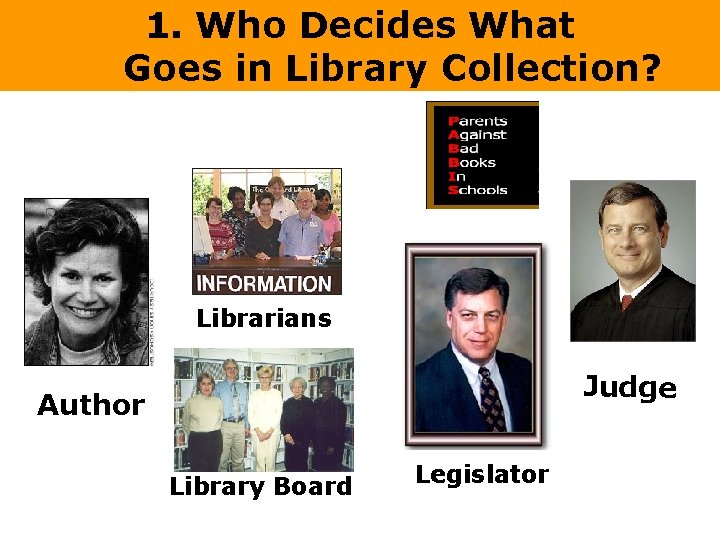
1. Who Decides What Goes in Library Collection? Librarians Judge Author Library Board Legislator
Selection v. Removal Librarian doesn’t buy book No judicial review
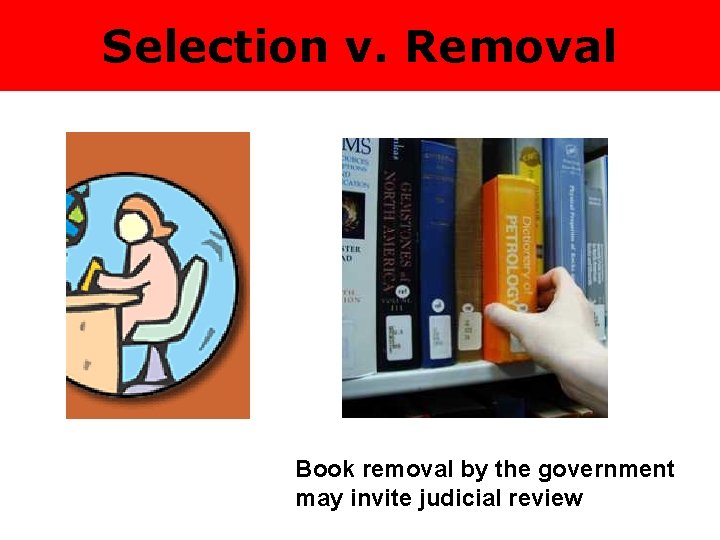
Selection v. Removal Book removal by the government may invite judicial review
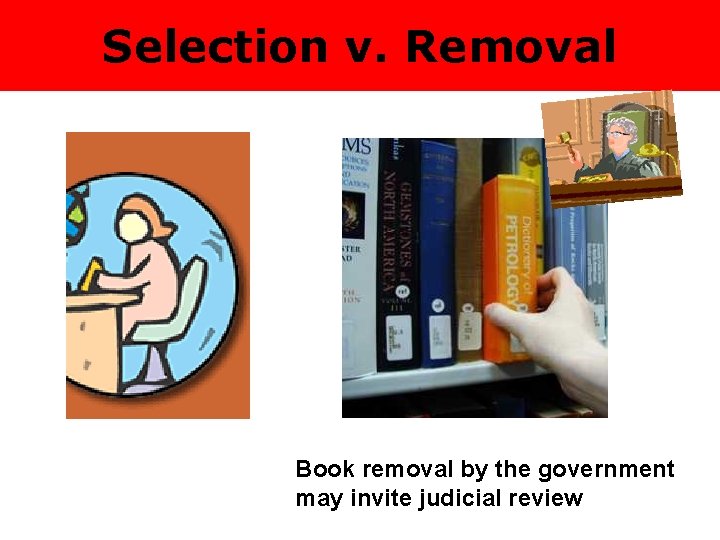
Selection v. Removal Book removal by the government may invite judicial review
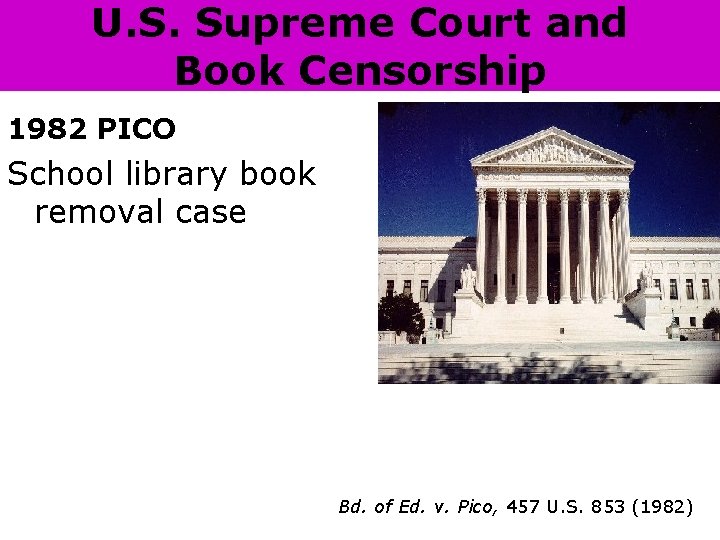
U. S. Supreme Court and Book Censorship 1982 PICO School library book removal case Bd. of Ed. v. Pico, 457 U. S. 853 (1982)
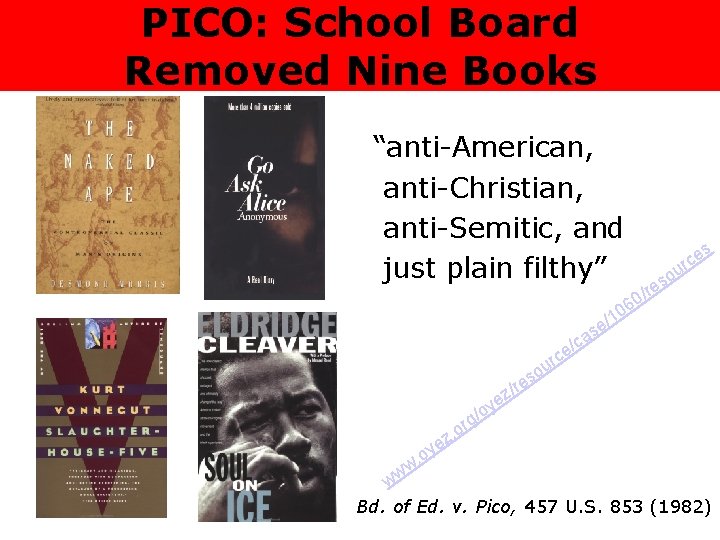
PICO: School Board Removed Nine Books “anti-American, anti-Christian, anti-Semitic, and just plain filthy” s ce r ou s e r 0/ 06 1 / se a c / e c ur o s e r z/ e y o g/ r o. z e y o. w ww Bd. of Ed. v. Pico, 457 U. S. 853 (1982)
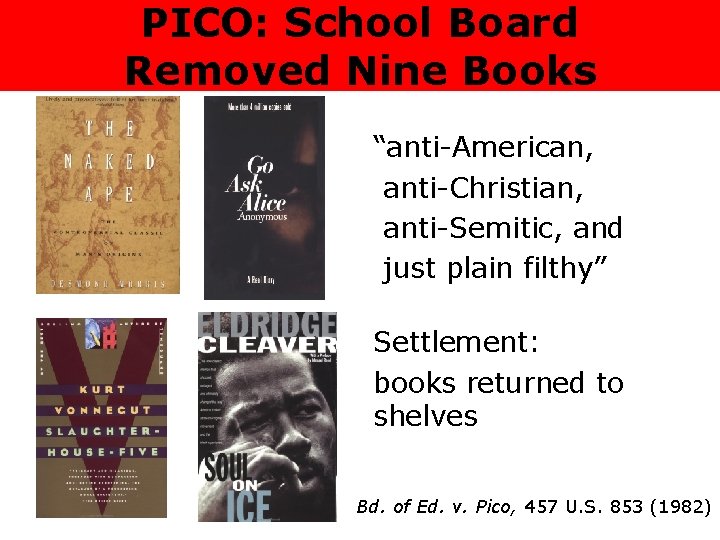
PICO: School Board Removed Nine Books “anti-American, anti-Christian, anti-Semitic, and just plain filthy” Settlement: books returned to shelves Bd. of Ed. v. Pico, 457 U. S. 853 (1982)
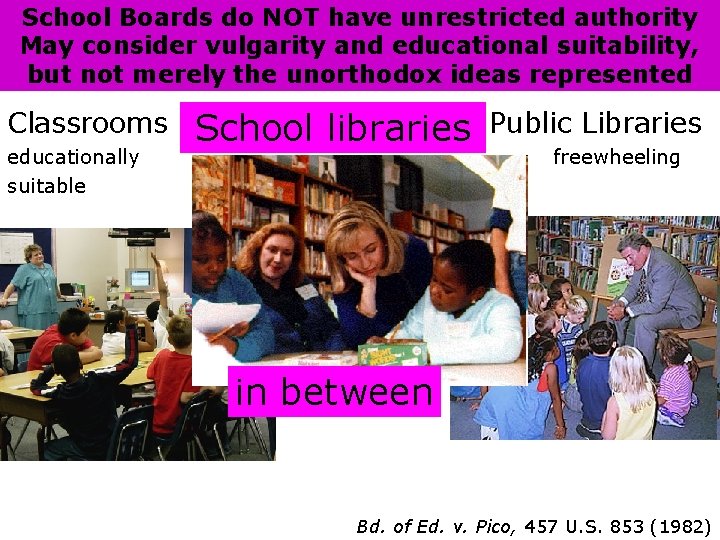
School Boards do NOT have unrestricted authority May consider vulgarity and educational suitability, but not merely the unorthodox ideas represented Classrooms educationally suitable School Libraries School libraries Public Libraries freewheeling in between Bd. of Ed. v. Pico, 457 U. S. 853 (1982)
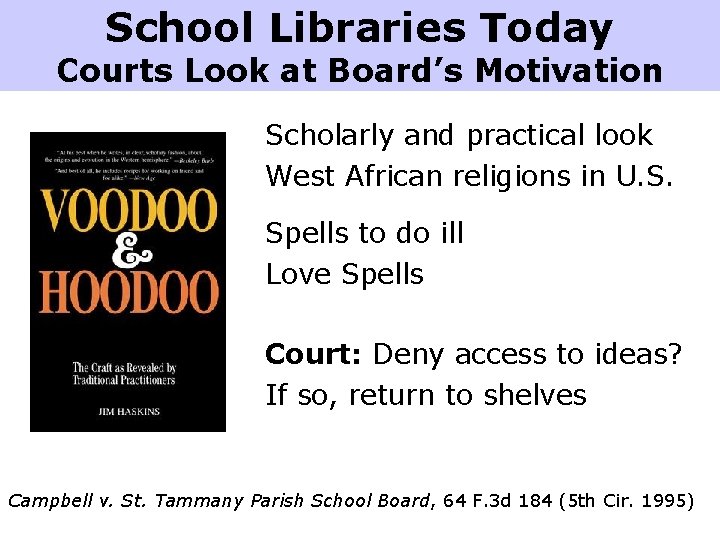
School Libraries Today Courts Look at Board’s Motivation Scholarly and practical look West African religions in U. S. Spells to do ill Love Spells Court: Deny access to ideas? If so, return to shelves Campbell v. St. Tammany Parish School Board, 64 F. 3 d 184 (5 th Cir. 1995)
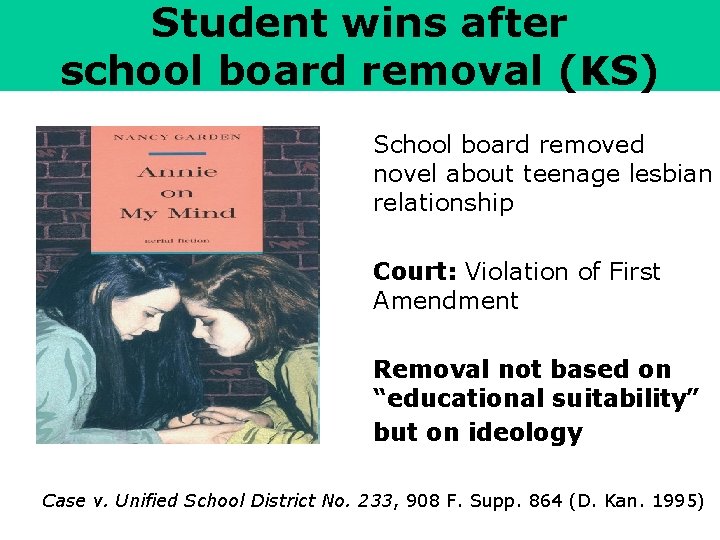
Student wins after school board removal (KS) School board removed novel about teenage lesbian relationship Court: Violation of First Amendment Removal not based on “educational suitability” but on ideology Case v. Unified School District No. 233, 908 F. Supp. 864 (D. Kan. 1995)
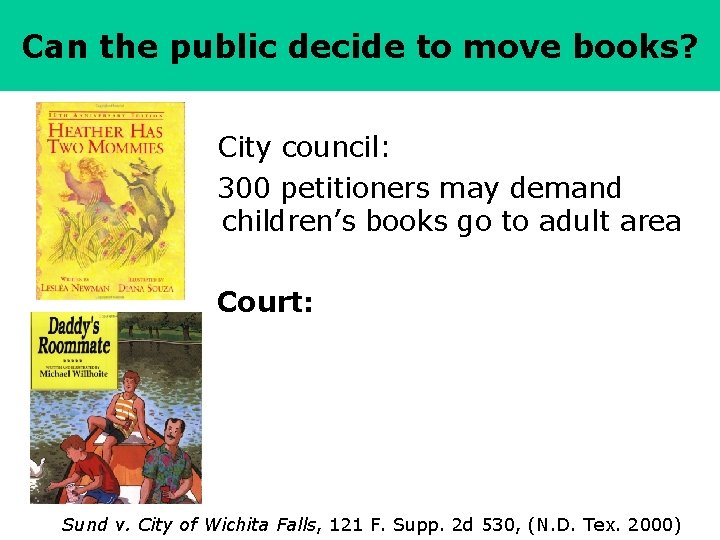
Can the public decide to move books? City council: 300 petitioners may demand children’s books go to adult area Court: Sund v. City of Wichita Falls, 121 F. Supp. 2 d 530, (N. D. Tex. 2000)
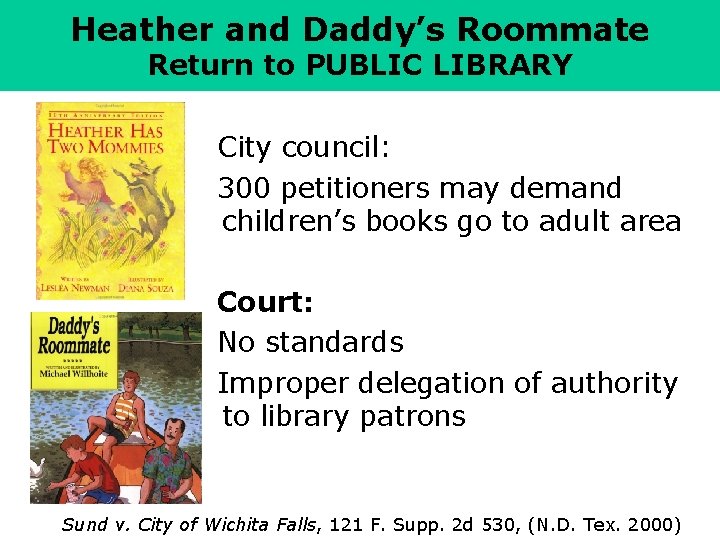
Heather and Daddy’s Roommate Return to PUBLIC LIBRARY City council: 300 petitioners may demand children’s books go to adult area Court: No standards Improper delegation of authority to library patrons Sund v. City of Wichita Falls, 121 F. Supp. 2 d 530, (N. D. Tex. 2000)
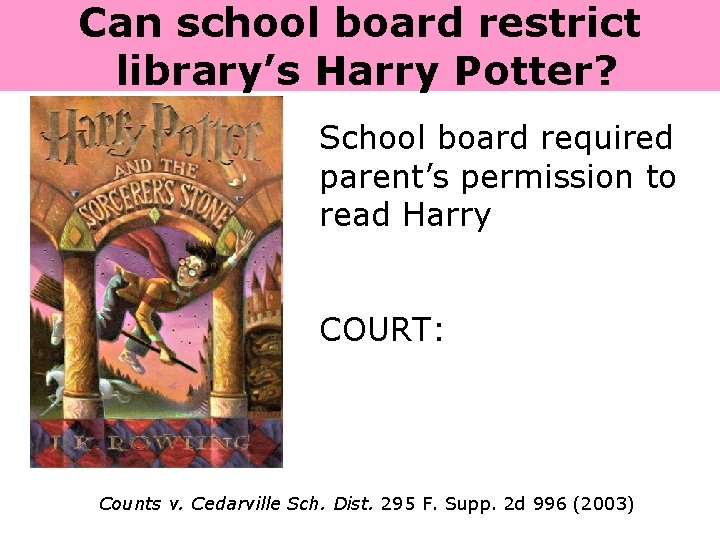
Can school board restrict library’s Harry Potter? School board required parent’s permission to read Harry COURT: Counts v. Cedarville Sch. Dist. 295 F. Supp. 2 d 996 (2003)
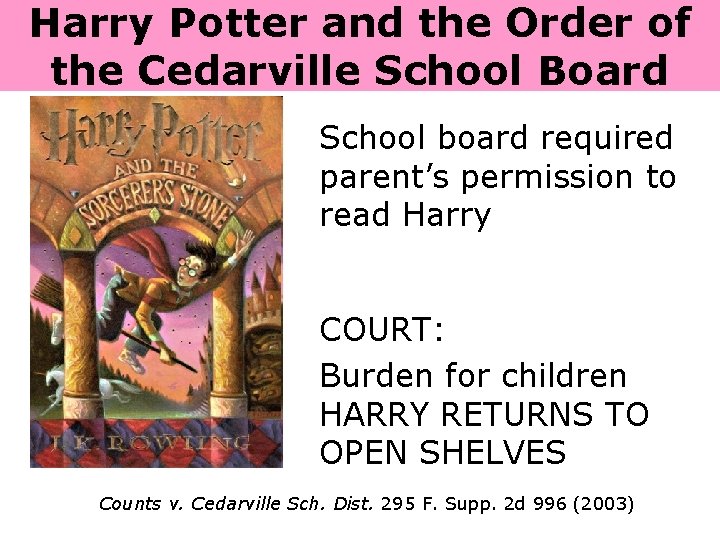
Harry Potter and the Order of the Cedarville School Board School board required parent’s permission to read Harry COURT: Burden for children HARRY RETURNS TO OPEN SHELVES Counts v. Cedarville Sch. Dist. 295 F. Supp. 2 d 996 (2003)
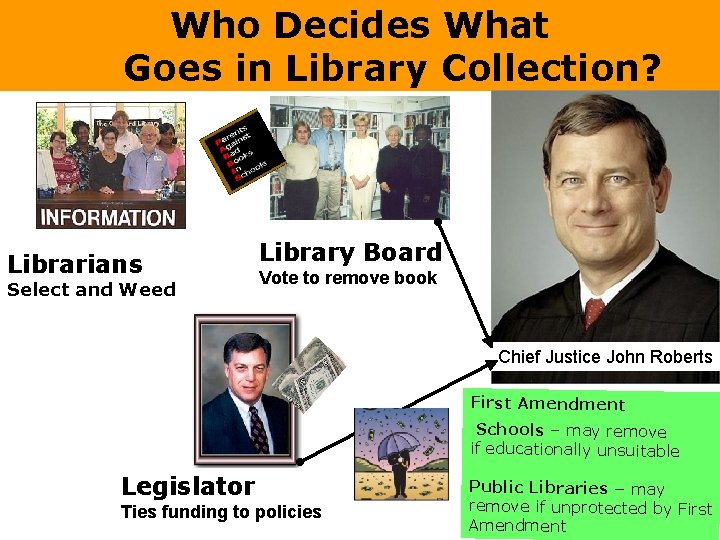
Who Decides What Goes in Library Collection? Librarians Select and Weed Library Board Vote to remove book Chief Justice John Roberts First Amendment Schools – may remove if educationally unsuitable Legislator Ties funding to policies Public Libraries – may remove if unprotected by First Amendment
Okay to Restrict • Child Pornography • Obscenity • Harmful to Minors for more detail see definitions at www. llrx. com/features/updatecipa. htm
2. Collection Development Policies • Adopted by library’s governing body • Reviewed within last 5 yrs by lawyer • Look at samples • Adopt your own, reflect community
Preamble Mission of library Philosophy based on mission and community Library Bill of Rights … Based on Candace Morgan, “Challenges to Library Resources, ” Law for Librarians, April 4 -6, 2006 Chicago, IL
www. ala. org/ala/oif/statementspols/statementsif/librarybillrights. htm
Selection Objectives Example: The Library collection will be selected and maintained to enable each person to find the library materials and information that she or he wants according to her or his own free choice. No material will be excluded because of the race, nationality, religion, gender, sexual orientation, political or social view of either the author or of the material. Selection of materials by the Library does not mean endorsement of the contents or the views expressed in those materials.
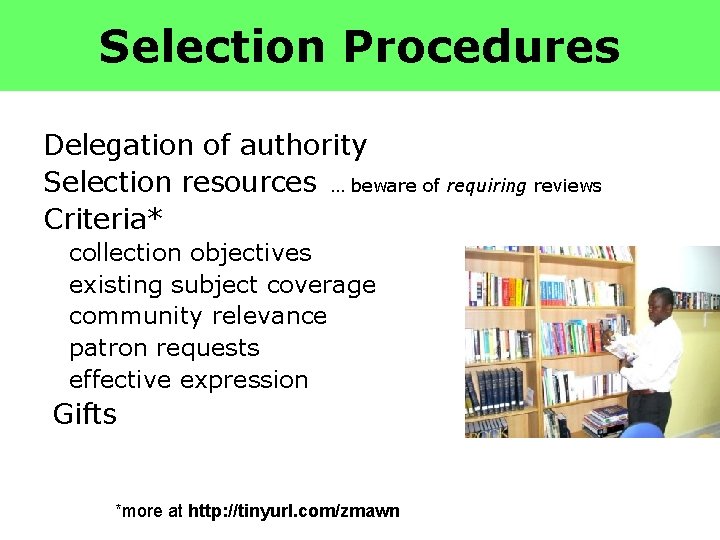
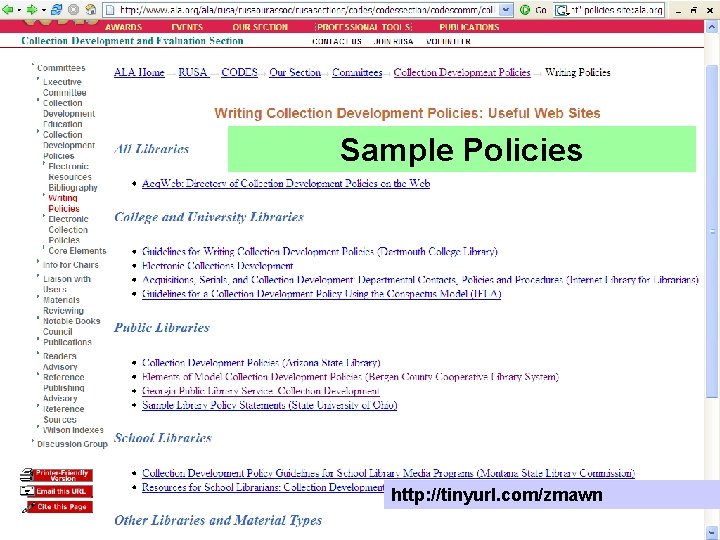
Selection Procedures Delegation of authority Selection resources … beware of requiring reviews Criteria* collection objectives existing subject coverage community relevance patron requests effective expression Gifts *more at http: //tinyurl. com/zmawn
Controversial Materials Statement Example: Individual items, which in and of themselves may be controversial or offensive to some patrons or staff, may be selected if their inclusion will contribute to the range of viewpoints in the collection as a whole and the effectiveness of the library’s ability to serve its community.
Access Statement Example Full, confidential, and unrestricted access to information is essential in order for patrons to exercise their constitutional rights. The Library does not stand in loco parentis. Parents and guardians, not the Library, have the responsibility to guide and direct the reading, listening and viewing choices of their own minor children. The Library collection will be organized, marked and maintained in a nonjudgmental, objective manner to help people find the materials they want. Materials will not be restricted, sequestered, altered or labeled by the Library because of controversy about the author of the subject matter.
Requests for Reconsideration of Materials Patrons may submit written form Reviewed by [Library Director/designee] or committee [name members: e. g. director/librarian/board/patron] reads item in entirety, reviews, evaluates wrt library mission, collection development policy [Director/designee] respond in writing [30 days] important says may appeal to [Board] Director informs [Board] During review process, item continues to be available
Sample Policies http: //tinyurl. com/zmawn
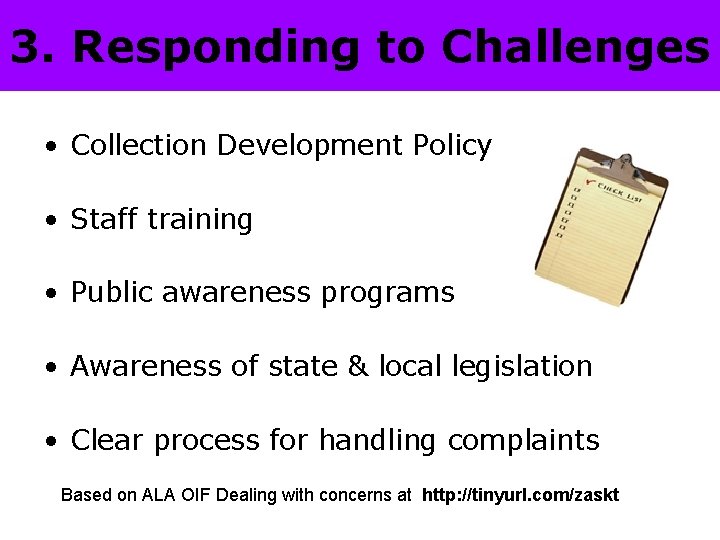
3. Responding to Challenges • Collection Development Policy • Staff training • Public awareness programs • Awareness of state & local legislation • Clear process for handling complaints Based on ALA OIF Dealing with concerns at http: //tinyurl. com/zaskt
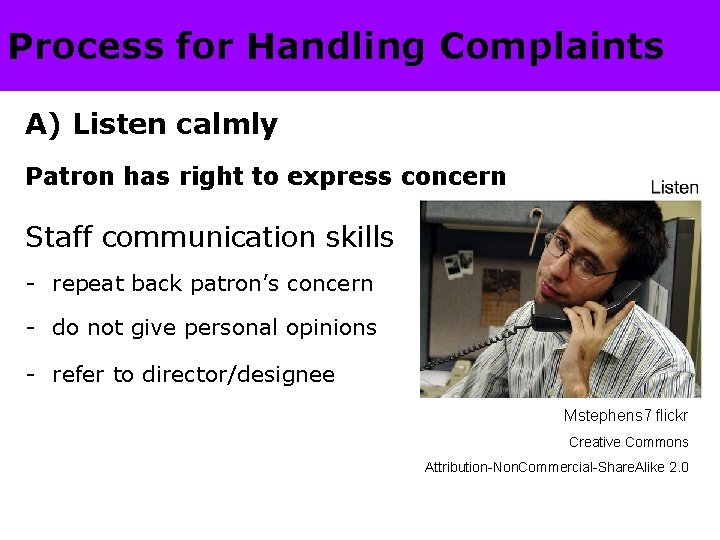
Process for Handling Complaints A) Listen calmly Patron has right to express concern Staff communication skills - repeat back patron’s concern - do not give personal opinions - refer to director/designee Mstephens 7 flickr Creative Commons Attribution-Non. Commercial-Share. Alike 2. 0
If patron wants to pursue complaint… B) Explain your library’s policy & procedures Some libraries: Here is form to describe your concern [Library director/designee] will respond within [30 days] Other libraries: Frontline staff discuss further Show library’s collection development policy [and Library Bill of Rights] Library has other materials on subject Solicit suggestions for purchase
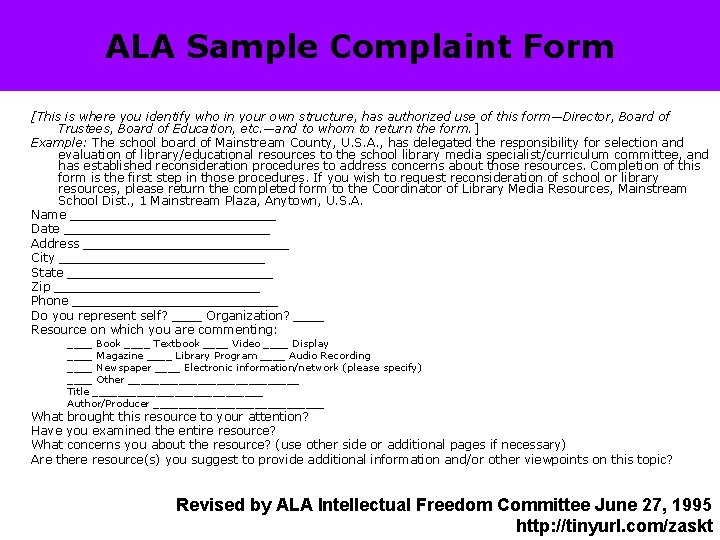
ALA Sample Complaint Form [This is where you identify who in your own structure, has authorized use of this form—Director, Board of Trustees, Board of Education, etc. —and to whom to return the form. ] Example: The school board of Mainstream County, U. S. A. , has delegated the responsibility for selection and evaluation of library/educational resources to the school library media specialist/curriculum committee, and has established reconsideration procedures to address concerns about those resources. Completion of this form is the first step in those procedures. If you wish to request reconsideration of school or library resources, please return the completed form to the Coordinator of Library Media Resources, Mainstream School Dist. , 1 Mainstream Plaza, Anytown, U. S. A. Name ______________ Date ______________ Address ______________ City ______________ State ______________ Zip ______________ Phone ______________ Do you represent self? ____ Organization? ____ Resource on which you are commenting: ____ Book ____ Textbook ____ Video ____ Display ____ Magazine ____ Library Program ____ Audio Recording ____ Newspaper ____ Electronic information/network (please specify) ____ Other ______________ Title ______________ Author/Producer ______________ What brought this resource to your attention? Have you examined the entire resource? What concerns you about the resource? (use other side or additional pages if necessary) Are there resource(s) you suggest to provide additional information and/or other viewpoints on this topic? Revised by ALA Intellectual Freedom Committee June 27, 1995 http: //tinyurl. com/zaskt
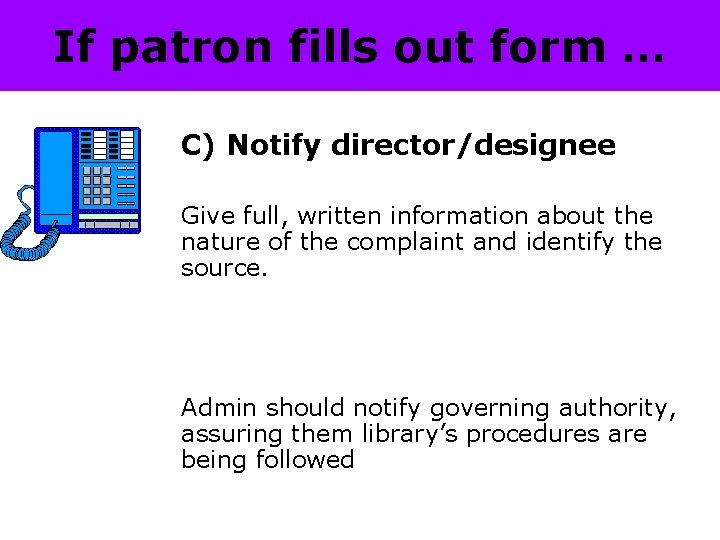
If patron fills out form … C) Notify director/designee Give full, written information about the nature of the complaint and identify the source. Admin should notify governing authority, assuring them library’s procedures are being followed
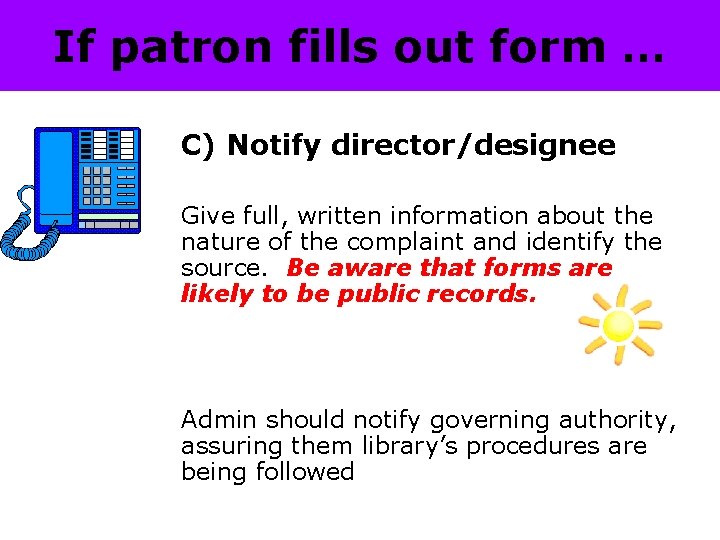
If patron fills out form … C) Notify director/designee Give full, written information about the nature of the complaint and identify the source. Be aware that forms are likely to be public records. Admin should notify governing authority, assuring them library’s procedures are being followed
If library needs more help … D) Contact library associations California Library Association 916 -447 -8541 717 20 th Street, Suite 200 Sacramento CA 95814 info@cla-net. org also ask for CLA Intellectual Freedom Committee chair American Library Association 800 -545 -2433 Office for Intellectual Freedom ext. 4223 50 E. Huron oif@ala. org Chicago, IL 60611
www. ala. org/ala/oif/challengesupport/reporting/challengedatabaseform. html
Gather allies E) Seek support of local media and civic organizations Designate one spokesperson Key message 25 words or less Media tips at http: //www. ala. org/ala/oif/challengesupport/dealing/coping. pdf
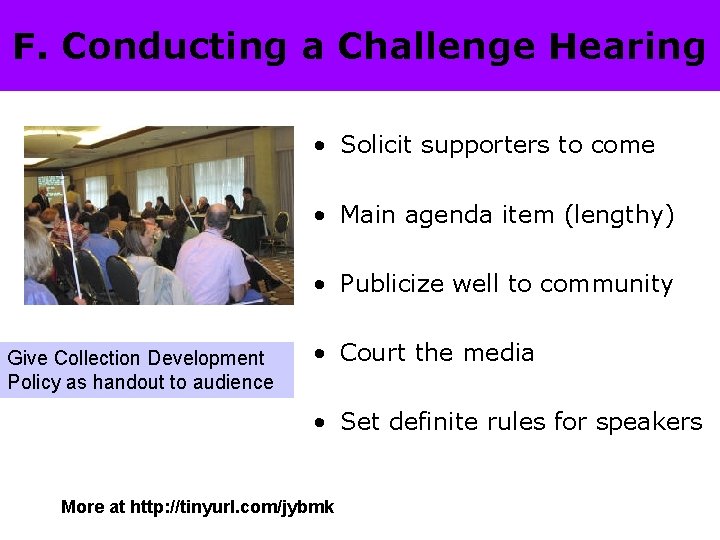
F. Conducting a Challenge Hearing • Solicit supporters to come • Main agenda item (lengthy) • Publicize well to community Give Collection Development Policy as handout to audience • Court the media • Set definite rules for speakers More at http: //tinyurl. com/jybmk
More Resources American Library Association, Intellectual Freedom Manual (7 th ed. 2006) American Library Association, Office for Intellectual Freedom http: //www. ala. org/ala/oif/intellectual. htm Nicolle Steffen and Martin Garnar, Intellectual Freedom Issues in Colorado Libraries: Concerns, Challenges, Resources, and Opinions (April 2004) http: //www. lrs. org/documents/closer_look/IFchallenge. pdf
Summary 1. Legal Lens: Who Decides What’s in Library’s Collection? 2. Elements of Collection Development Policies 3. Responding to Challenges
Internet, CIPA, and Sexual Harassment Infopeople Webcast Thursday Sept. 7, 2006 12: 00 noon to 1: 00 p. m e m Co k c a b ! w no Mary Minow, J. D. , A. M. L. S. Library. Law. com consult@librarylaw. com