
Writing Chemical Equations SECTION 3 2 Objectives At
Writing Chemical Equations SECTION 3. 2
Objectives �At the end of this lesson, you will be able to: �Translate chemical word equations into formula equations �Balance simple chemical equations

Chemical Equations �Chemical equations represent the process of a chemical reaction �To write one, must know the reactants and products �Need to know if a chemical change has occurred Use our evidence of chemical changes- what are they? �Takes everything we have learned so far and puts it into a condensed equation i. e. compound names and formulas, states, ionic vs. molecular etc
Writing Word Equations �A plus sign (+) groups the reactants together It does not matter which order the reactants are written in �An arrow ( ) separates the reactants from the products and is read “produces” �A plus sign (+) also joins the products

Word Equations �Taken from descriptions of a chemical reaction Ex. Solid magnesium metal reacts with aqueous hydrochloric acid to produce aqueous magnesium chloride and hydrogen gas Evidence of a chemical change: gas, heat is given off �How do we write this as a chemical equation? Using words? magnesium + hydrochloric acid magnesium chloride + hydrogen gas
Word Equations �Another example: aluminium foil reacts with blue copper II sulphate solution and produced solid copper and colourless (grey? ) aluminium sulphate solution �As a word equation:
To Do: �Writing Formula Equations from Word Equations

Objectives �At the end of this lesson, you will be able to: �Translate chemical word equations into formula equations �Balance simple chemical equations
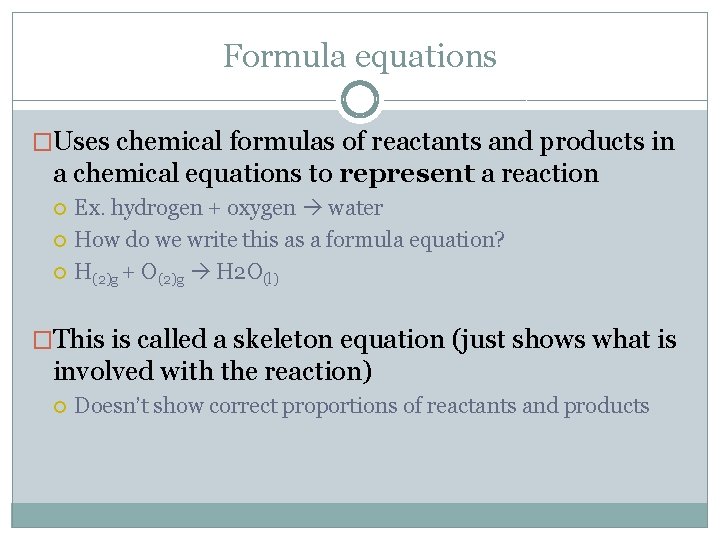
Formula equations �Uses chemical formulas of reactants and products in a chemical equations to represent a reaction Ex. hydrogen + oxygen water How do we write this as a formula equation? H(2)g + O(2)g H 2 O(l) �This is called a skeleton equation (just shows what is involved with the reaction) Doesn’t show correct proportions of reactants and products
Formula Equations - example �Aluminium and copper II sulphate example: � Aluminium (s) + copper II sulphate (aq) copper (s) + aluminium sulphate (aq) � As a formula equation:
Balancing Equations �We know what the correct proportions are through: Law of Conservation of Mass �Developed by Antoine Lavoisier �Total mass of the reactants equals the total mass of the products �Using this, we can deduce that: ** total # of atoms present before a reaction equals the total # of atoms after a reaction
Balancing Equations �Let’s look at this example: �Water decomposes (with electrical energy) to produce oxygen gas and hydrogen gas �As a formula equation: �Does this equation follow the conservation of mass? Why or why not?
Balancing Equations �To get the number of atoms to stay the same, before and after the equation, more than one of a molecule may be involved in the reaction �The number of molecules is represented by a number in front of the formula called the coefficient
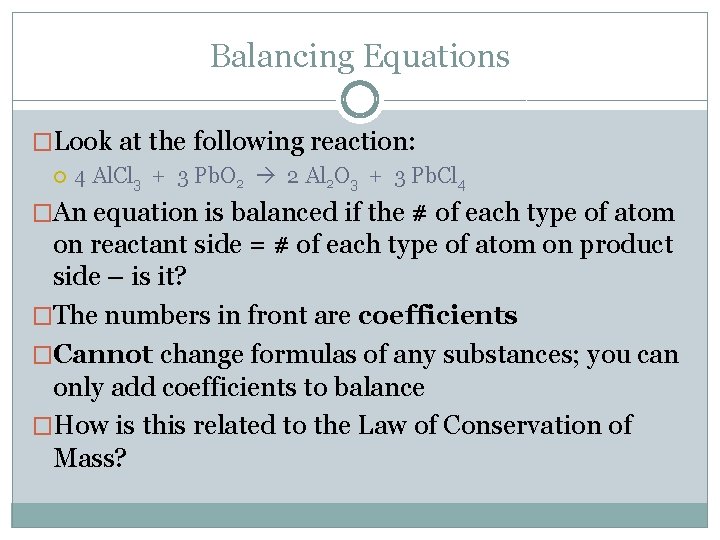
Balancing Equations �Look at the following reaction: 4 Al. Cl 3 + 3 Pb. O 2 2 Al 2 O 3 + 3 Pb. Cl 4 �An equation is balanced if the # of each type of atom on reactant side = # of each type of atom on product side – is it? �The numbers in front are coefficients �Cannot change formulas of any substances; you can only add coefficients to balance �How is this related to the Law of Conservation of Mass?
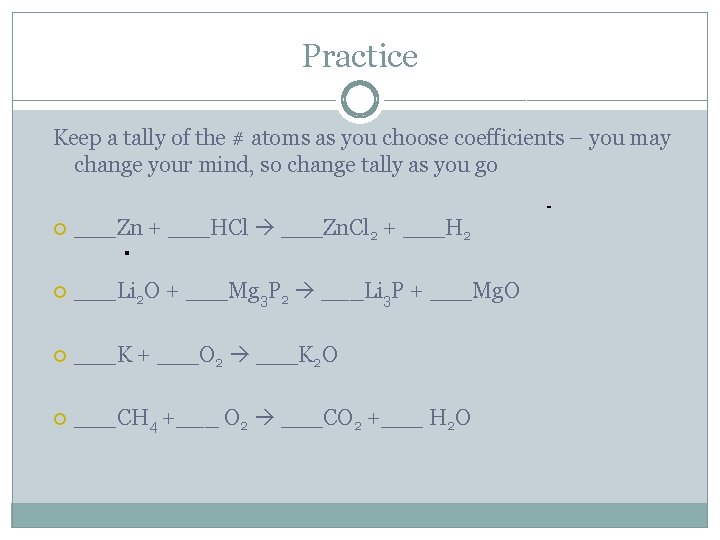
Practice Keep a tally of the # atoms as you choose coefficients – you may change your mind, so change tally as you go ___Zn + ___HCl ___Zn. Cl 2 + ___H 2 ___Li 2 O + ___Mg 3 P 2 ___Li 3 P + ___Mg. O ___K + ___O 2 ___K 2 O ___CH 4 +___ O 2 ___CO 2 +___ H 2 O

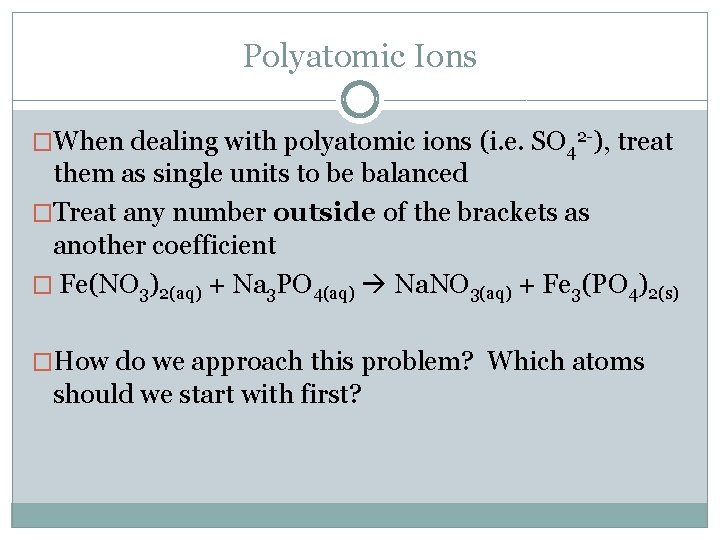
Polyatomic Ions �When dealing with polyatomic ions (i. e. SO 42 -), treat them as single units to be balanced �Treat any number outside of the brackets as another coefficient � Fe(NO 3)2(aq) + Na 3 PO 4(aq) Na. NO 3(aq) + Fe 3(PO 4)2(s) �How do we approach this problem? Which atoms should we start with first?
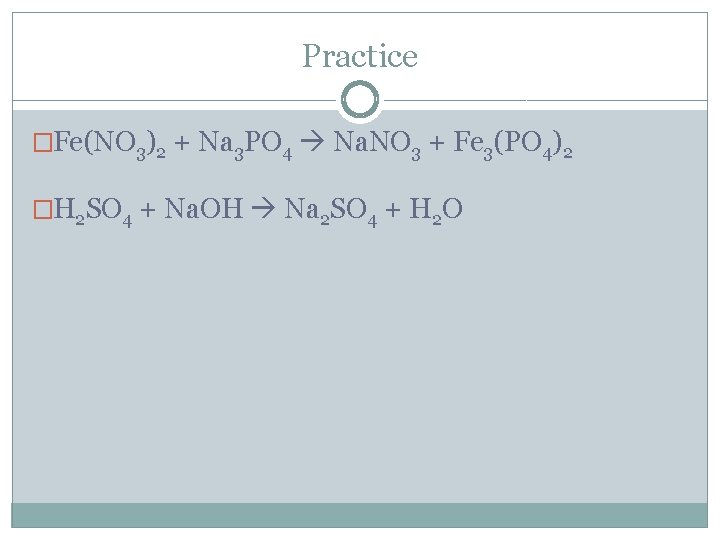
Practice �Fe(NO 3)2 + Na 3 PO 4 Na. NO 3 + Fe 3(PO 4)2 �H 2 SO 4 + Na. OH Na 2 SO 4 + H 2 O
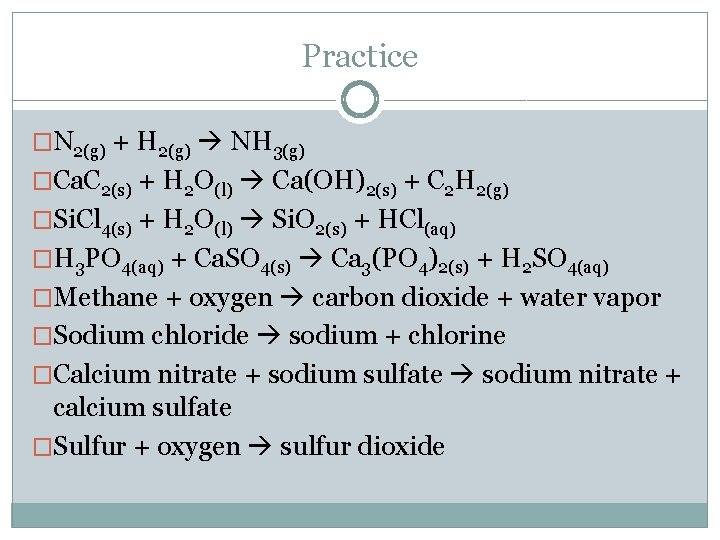
Practice �N 2(g) + H 2(g) NH 3(g) �Ca. C 2(s) + H 2 O(l) Ca(OH)2(s) + C 2 H 2(g) �Si. Cl 4(s) + H 2 O(l) Si. O 2(s) + HCl(aq) �H 3 PO 4(aq) + Ca. SO 4(s) Ca 3(PO 4)2(s) + H 2 SO 4(aq) �Methane + oxygen carbon dioxide + water vapor �Sodium chloride sodium + chlorine �Calcium nitrate + sodium sulfate sodium nitrate + calcium sulfate �Sulfur + oxygen sulfur dioxide
Practice Try the following for more practice: �P. 90 # 7 -9 �Chem Workbook: “Balancing Formula Equations 1” “Balancing Formula Equations 2”
- Slides: 21