
Writing Center Staffing Recruitment and Training Models Dr




- Slides: 37
Writing Center Staffing, Recruitment, and Training Models Dr. Genie Giaimo January 20, 2017
Setting-up a Writing Center Staffing Model Recruitment Model Training Model
Writing Center Staffing Models
Writing Center Staffing Models Undergraduate only Graduate only Undergraduate and Graduate Tutors Faculty only Faculty and Adjunct Staff tutors Combination of some/all of the above
Writing Center Staff Recruitment
Staff Recruitment Required course Local Graduate Programs Non-required course Local-Area Institutions Prior experience Offering faculty fellowship to professors working in WC. Departmental fellowship support Faculty recommendation Recruitment through Clubs or sports Recruitment of professional Open call for consultants/tutors (i. e. Instructors) through University hiring system.
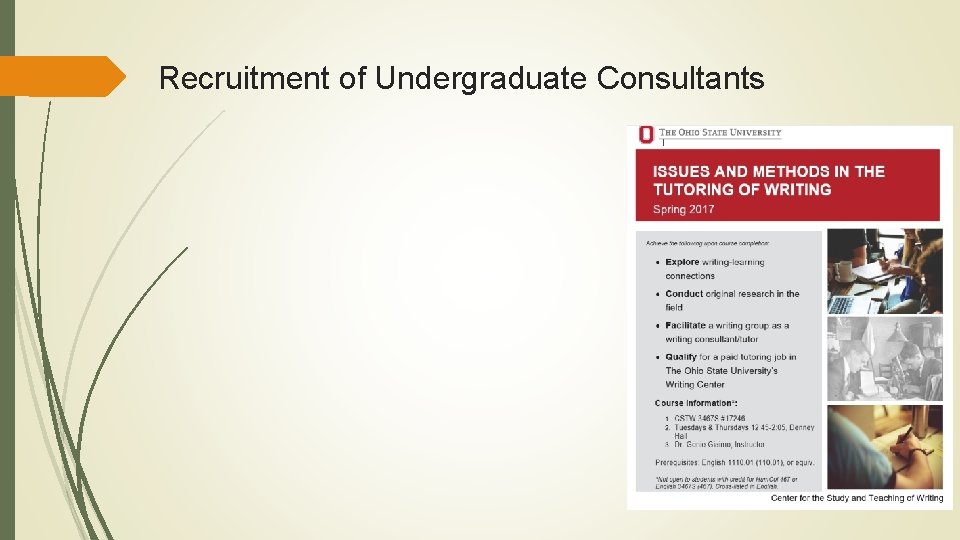
Recruitment of Undergraduate Consultants
Recruitment of Graduate Consultants Through the graduate student writing center theory and research pro-seminar. Through recruiting graduate students with prior writing center experience. Through offering a semester-long bi-weekly non-credit analogue to the writing center theory and research proseminar.
General Writing Center Training Models
General Training Models Course-based
General Training Models Course-based Professional Development Opportunities
General Training Models Course-based Professional Development Opportunities Pre-semester workshops
General Training Models Course-based Professional Development Opportunities Pre-semester workshops In-semester workshops
General Training Models Course-based Professional Development Opportunities Pre-semester workshops In-semester workshops Mentorship groups
General Training Models Course-based Professional Development Opportunities Pre-semester workshops In-semester workshops Mentorship groups Discussion groups
General Training Models Course-based Professional Development Opportunities Pre-semester workshops In-semester workshops Mentorship groups Discussion groups All-staff meetings
Specific Writing Center Training Models
College Reading and Learning Association (CRLA) International Tutor Training Program Certification (ITTPC) Standardized training program Out-of-step with a writing center course Broken into three levels of competency Institutional certification, fee-based Institution's training program requires CRLA approval and periodic evaluation
Discussion of CRLA/ITTPC Training Program Please review handout. Discuss particular benchmarks of Levels I, II, and III training.
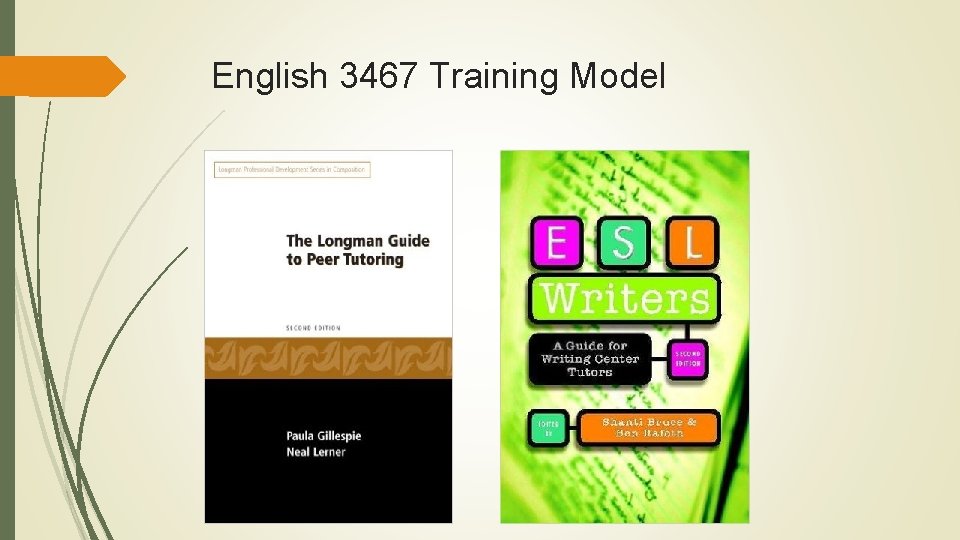
English 3467 Training Model
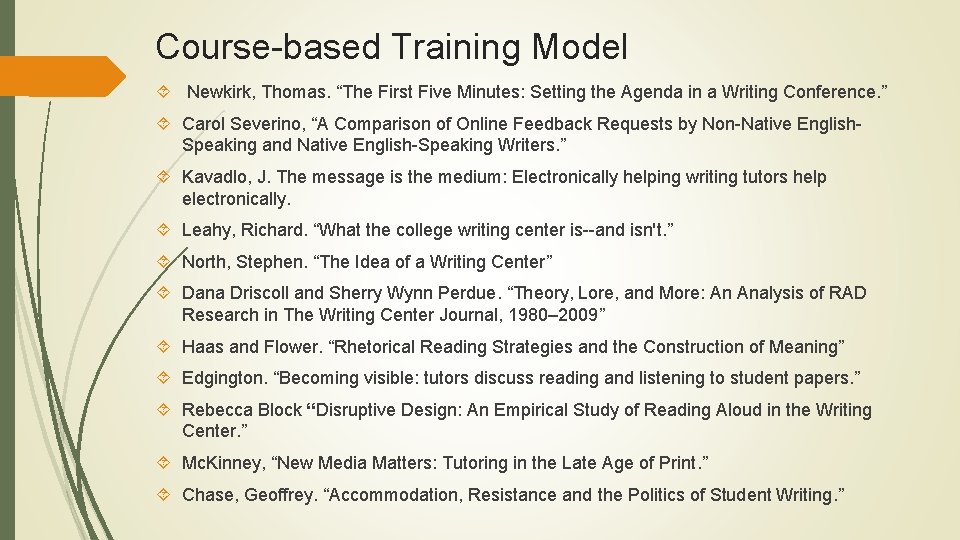
Course-based Training Model Newkirk, Thomas. “The First Five Minutes: Setting the Agenda in a Writing Conference. ” Carol Severino, “A Comparison of Online Feedback Requests by Non-Native English. Speaking and Native English-Speaking Writers. ” Kavadlo, J. The message is the medium: Electronically helping writing tutors help electronically. Leahy, Richard. “What the college writing center is--and isn't. ” North, Stephen. “The Idea of a Writing Center” Dana Driscoll and Sherry Wynn Perdue. “Theory, Lore, and More: An Analysis of RAD Research in The Writing Center Journal, 1980– 2009” Haas and Flower. “Rhetorical Reading Strategies and the Construction of Meaning” Edgington. “Becoming visible: tutors discuss reading and listening to student papers. ” Rebecca Block “Disruptive Design: An Empirical Study of Reading Aloud in the Writing Center. ” Mc. Kinney, “New Media Matters: Tutoring in the Late Age of Print. ” Chase, Geoffrey. “Accommodation, Resistance and the Politics of Student Writing. ”
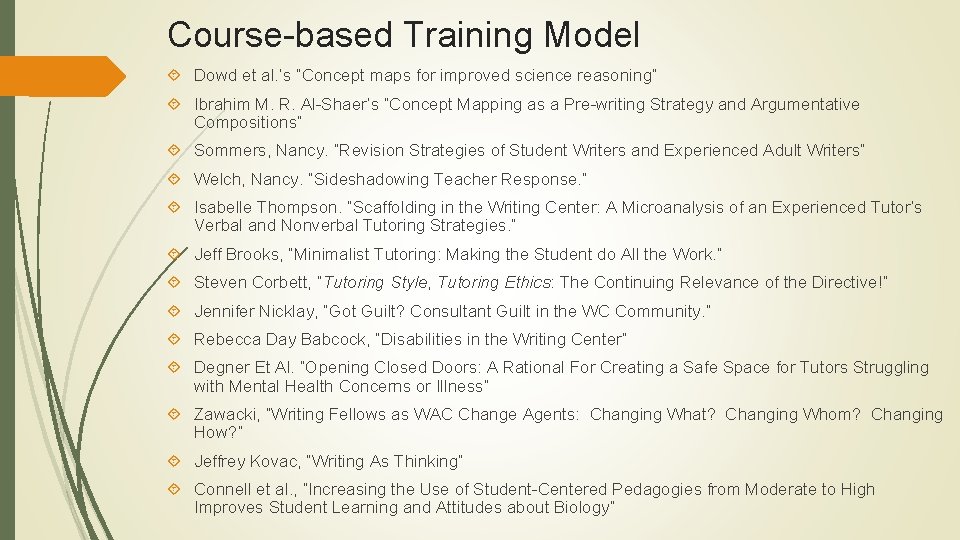
Course-based Training Model Dowd et al. ’s “Concept maps for improved science reasoning” Ibrahim M. R. Al-Shaer’s “Concept Mapping as a Pre-writing Strategy and Argumentative Compositions” Sommers, Nancy. “Revision Strategies of Student Writers and Experienced Adult Writers” Welch, Nancy. “Sideshadowing Teacher Response. ” Isabelle Thompson. “Scaffolding in the Writing Center: A Microanalysis of an Experienced Tutor’s Verbal and Nonverbal Tutoring Strategies. ” Jeff Brooks, “Minimalist Tutoring: Making the Student do All the Work. ” Steven Corbett, “Tutoring Style, Tutoring Ethics: The Continuing Relevance of the Directive!” Jennifer Nicklay, “Got Guilt? Consultant Guilt in the WC Community. ” Rebecca Day Babcock, “Disabilities in the Writing Center” Degner Et Al. “Opening Closed Doors: A Rational For Creating a Safe Space for Tutors Struggling with Mental Health Concerns or Illness” Zawacki, “Writing Fellows as WAC Change Agents: Changing What? Changing Whom? Changing How? ” Jeffrey Kovac, “Writing As Thinking” Connell et al. , “Increasing the Use of Student-Centered Pedagogies from Moderate to High Improves Student Learning and Attitudes about Biology”
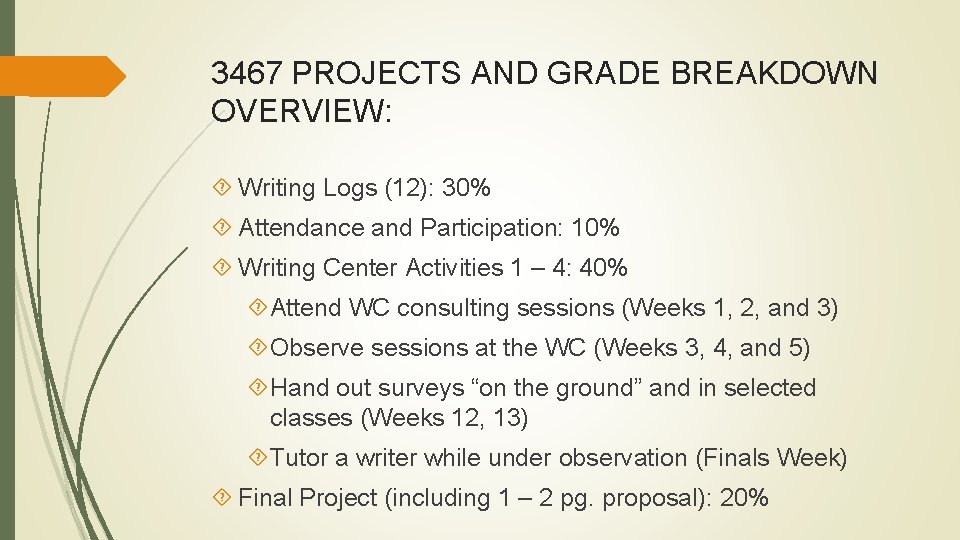
3467 PROJECTS AND GRADE BREAKDOWN OVERVIEW: Writing Logs (12): 30% Attendance and Participation: 10% Writing Center Activities 1 – 4: 40% Attend WC consulting sessions (Weeks 1, 2, and 3) Observe sessions at the WC (Weeks 3, 4, and 5) Hand out surveys “on the ground” and in selected classes (Weeks 12, 13) Tutor a writer while under observation (Finals Week) Final Project (including 1 – 2 pg. proposal): 20%
Discussion of Course-Based 3467 Training Program Please review syllabus. Discuss differences between CRLA training and coursebased training.
Non-Course OSU Writing Center Training Initiatives
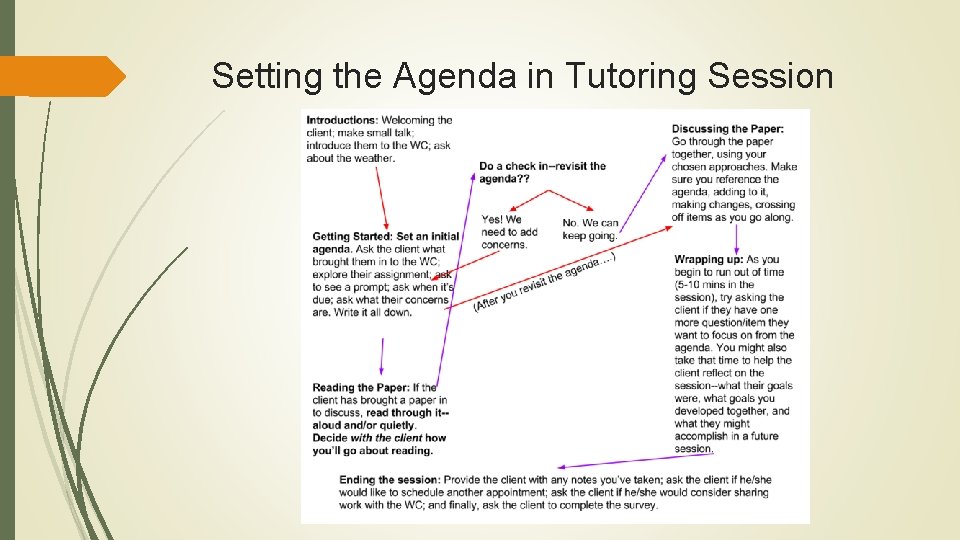
OSU Writing Center Training Initiatives Summer 2016 Fall 2016 3 -day Intensive Training Monthly Meetings § Agenda Setting § Working with Multilanguage Learners § Multimodal Assignments § Consultant Wellness § Writing Group Facilitation § Online Tutoring § Directive and Non-Directive Tutoring Methods REACH Suicide Prevention Threshold Concepts and Transfer of Writing Knowledge English 1110 Assignment Training
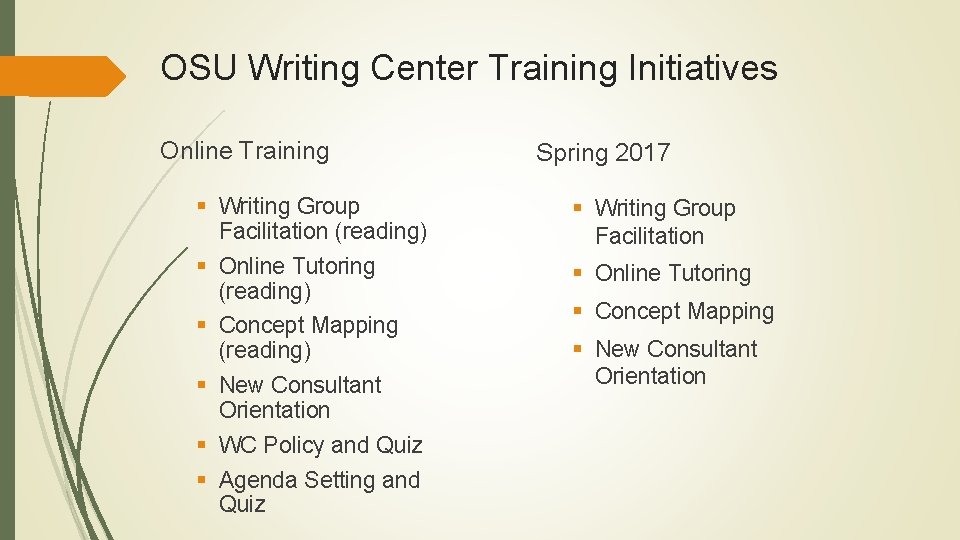
OSU Writing Center Training Initiatives Online Training § Writing Group Facilitation (reading) § Online Tutoring (reading) § Concept Mapping (reading) § New Consultant Orientation § WC Policy and Quiz § Agenda Setting and Quiz Spring 2017 § Writing Group Facilitation § Online Tutoring § Concept Mapping § New Consultant Orientation
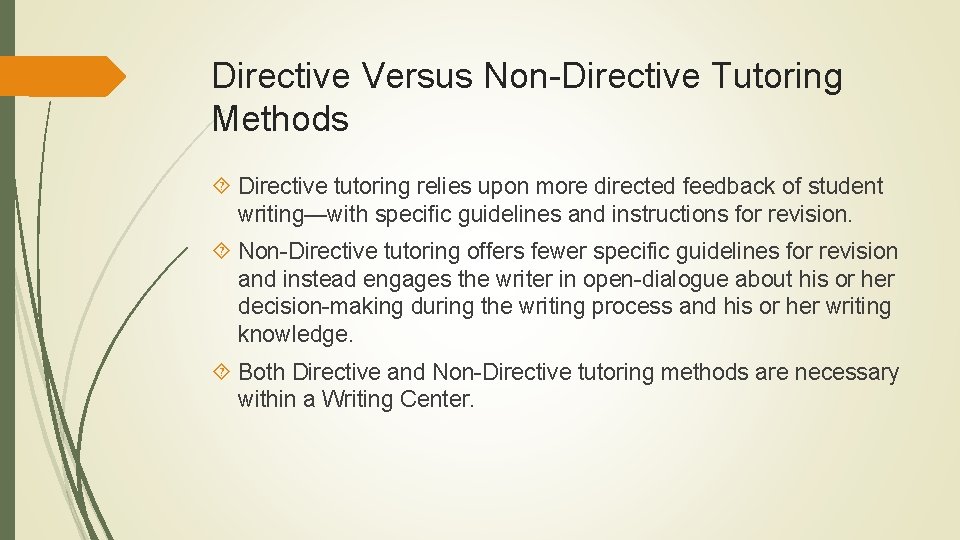
Directive Versus Non-Directive Tutoring Methods Directive tutoring relies upon more directed feedback of student writing—with specific guidelines and instructions for revision. Non-Directive tutoring offers fewer specific guidelines for revision and instead engages the writer in open-dialogue about his or her decision-making during the writing process and his or her writing knowledge. Both Directive and Non-Directive tutoring methods are necessary within a Writing Center.
Setting the Agenda in Tutoring Session
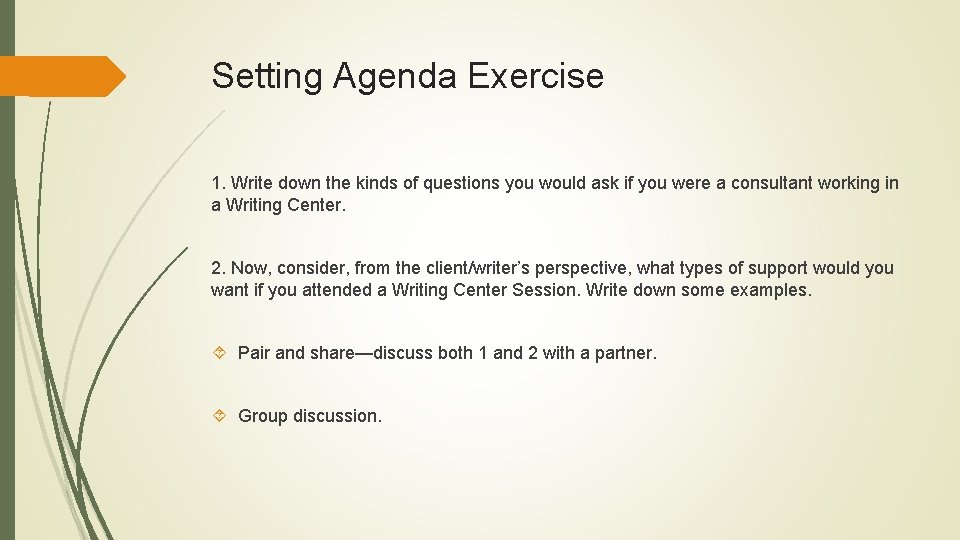
Setting Agenda Exercise 1. Write down the kinds of questions you would ask if you were a consultant working in a Writing Center. 2. Now, consider, from the client/writer’s perspective, what types of support would you want if you attended a Writing Center Session. Write down some examples. Pair and share—discuss both 1 and 2 with a partner. Group discussion.
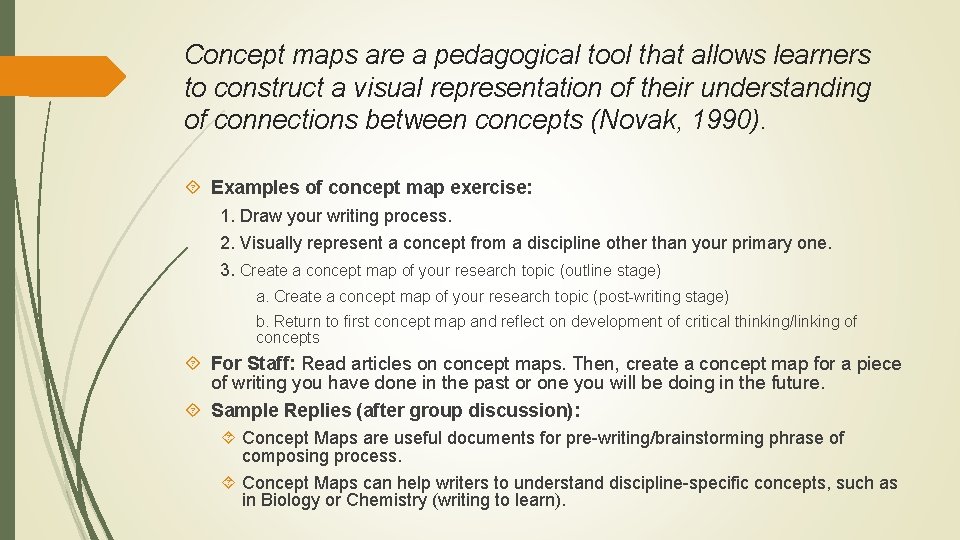
Concept maps are a pedagogical tool that allows learners to construct a visual representation of their understanding of connections between concepts (Novak, 1990). Examples of concept map exercise: 1. Draw your writing process. 2. Visually represent a concept from a discipline other than your primary one. 3. Create a concept map of your research topic (outline stage) a. Create a concept map of your research topic (post-writing stage) b. Return to first concept map and reflect on development of critical thinking/linking of concepts For Staff: Read articles on concept maps. Then, create a concept map for a piece of writing you have done in the past or one you will be doing in the future. Sample Replies (after group discussion): Concept Maps are useful documents for pre-writing/brainstorming phrase of composing process. Concept Maps can help writers to understand discipline-specific concepts, such as in Biology or Chemistry (writing to learn).
Writing Center Resources
Academic Resources Writing Lab Newsletter Praxis: A Writing Center Journal International Writing Centers Association
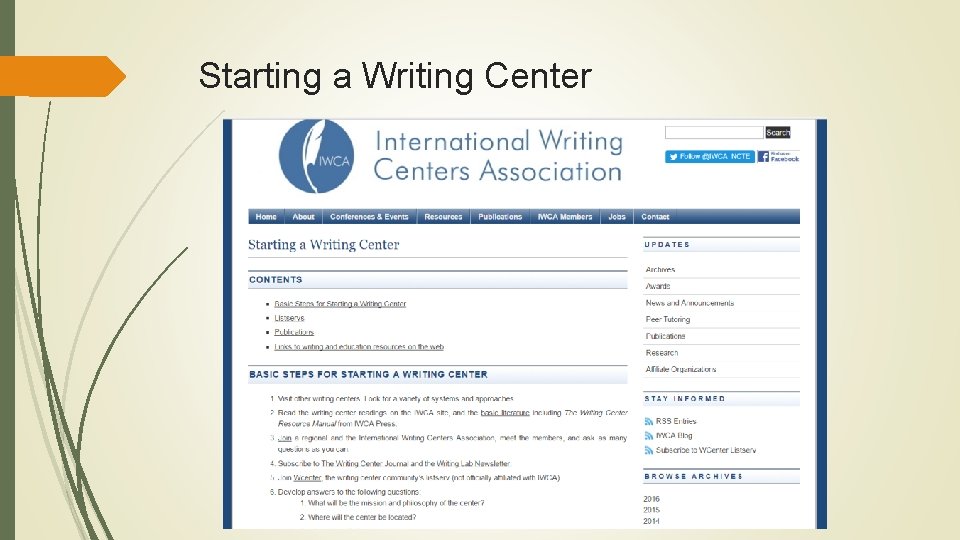
Starting a Writing Center
Writing Center Careers
Writing Center Career Opportunities Writing Center Director Foreign and Second Language Writing Coordinator Faculty Institution Data Analytics English Instructor, abroad Academic Learning Specialist Teaching and Learning Center (TLC/CTL) Employee Tutoring/Writing Center Coordinator
Discussion