
Writing Body Paragraphs Readiness is all William Shakespeare
Writing Body Paragraphs “Readiness is all. " (William Shakespeare) 1
This can be tricky for some because. . . This is where you actually have to use reason and logic. In other words, if you don’t think before writing, you will more than likely repeat yourself, go off topic, or not write enough. (Errors which more than likely will cause you to fail. ) 2
Before you write a body paragraph, you need to make sure. . . • That you have adequate and specific examples. (Article, Graph, Chart, etc…) or • A short story (Novel, Play, Etc…) to back up or illustrate your thinking. and • That your ideas are in the right T. E. X. A. S. order. 3
This is the format for the body paragraph which should include about 6 to 9 sentences and be of about 100 words in length. T – stands for Topic. Here you state what you’ll be talking about in the paragraph. It only needs to be one line, just enough to specify what you're talking about. E - stands for Explain. Here you will elaborate on your Topic, giving the reader more information about what it is. One line will do here, but two is more beneficial for your mark. X - stands for Example. This is where your paragraph comes to the crunch. You will have to use a real example. If you’re Responding to Literature, you'll need a real quote. If you're doing a formal writing essay you'll be able to get away with a looser interpretation of the word 'real'. You will be judged on the content of your quote and how you use it to back up your argument. A - stands for Analysis. Here you discuss how your example backs up your argument. Two lines is a good bet here, the more you show much you understand your example the better. Feel free to start it off with, 'This shows how. . . " or "Here we see. . . " You shouldn't get marked down particularly, but you'll get marked up for a more original link. S - stands for Summary. This often means repeating your Topic statement with more affirmative grammar. Rearranging the words never hurt either. 4
This is the format for the body paragraph which should include about 6 to 9 sentences and be of about 100 words in length. T – stands for Topic. Here you state what you’ll be talking about in the paragraph. It only needs to be one line, just enough to specify what you're talking about. 5
This is the format for the body paragraph which should include about 6 to 9 sentences and be of about 100 words in length. E - stands for Explain. Here you will elaborate on your Topic, giving the reader more information about what it is. One line will do here, but two is more beneficial for your mark. 6
This is the format for the body paragraph which should include about 6 to 9 sentences and be of about 100 words in length. X - stands for Example. This is where your paragraph comes to the crunch. You will have to use a real example. If you’re Responding to Literature, you'll need a real quote from an actual book. You can easily start a sentence with “This can be seen when ______ says…” If you're doing a formal writing essay you'll be able to get away with a looser interpretation of the word 'real'. You will be judged on the content of your quote and how you use it to back up your argument. 7
This is the format for the body paragraph which should include about 6 to 9 sentences and be of about 100 words in length. A - stands for Analysis. Here you discuss how your example backs up your argument. Two lines is a good bet here, the more you show much you understand your example the better. Feel free to start it off with, 'This shows how. . . " or "Here one can see. . . ". 8
This is the format for the body paragraph which should include about 6 to 9 sentences and be of about 100 words in length. S - stands for Summary. This often means repeating your Topic statement with more affirmative grammar. Rearranging the words never hurt either. 9
Before you begin to write, you must outline, brainstorm or pre-write. • Use the T. E. X. A. S. Graphic Organizer to arrange and plot out your ideas. If you ultimately move your sentence around that is okay, but use the organizer to rough draft. 10
Let’s say that the topic is, “Should the New Zealand Government invest money in roads ? ” We come up with three reasons a. Traffic Jams are causing unforeseen problems, b. The roads are in disrepair and need work, c. Cars are bad for the environment When you are thinking about what to write, you don’t want to use a lot of words. You just want to jot down ideas. Let’s work on reason a. 11
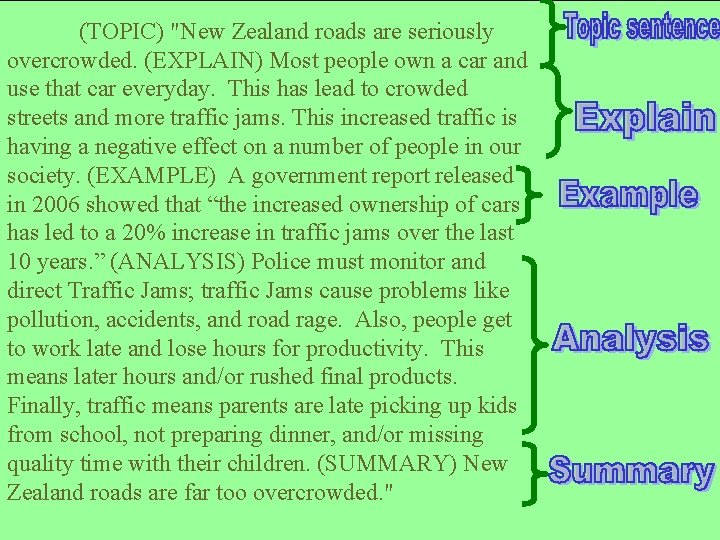
(TOPIC) "New Zealand roads are seriously overcrowded. (EXPLAIN) Most people own a car and use that car everyday. This has lead to crowded streets and more traffic jams. This increased traffic is having a negative effect on a number of people in our society. (EXAMPLE) A government report released in 2006 showed that “the increased ownership of cars has led to a 20% increase in traffic jams over the last 10 years. ” (ANALYSIS) Police must monitor and direct Traffic Jams; traffic Jams cause problems like pollution, accidents, and road rage. Also, people get to work late and lose hours for productivity. This means later hours and/or rushed final products. Finally, traffic means parents are late picking up kids from school, not preparing dinner, and/or missing quality time with their children. (SUMMARY) New Zealand roads are far too overcrowded. " Created by 12
- Slides: 12