
Writing Better MCQs Why Multiple Choice Questions Most
Writing Better MCQs
Why Multiple Choice Questions? • Most commonly used format in the College • Most commonly used format on licensing examinations • This session will NOT cover essays, fill-in-the-blank items, true/false, or any other question types

Strengths of MCQ • Can assessment achievement of learning from simple to complex • More reliable than True/False items • Scoring is easy, reliable, and objective • Can cover a lot of material Zimmaro (2004)
Limitations of MCQs • Time consuming to write good questions • Acceptable distractors are sometimes hard to find • Is not the best way to evaluate problem-solving • Sometimes there is more than one correct answer • May encourage guessing Zimmaro (2004)
Why Good Questions Matter • Strengths of MCQs are only valid if constructed well • Use in national licensure and credentialing examinations Example: BPS examinations • Well written items can assess more than recall of knowledge • MCQs become “tricky” when rewritten from the original best format

Parts of a MCQ • Stem – the text of the question • Options – the choices provided after the stem • Key – the CORRECT answer in the list of options • Distracters – the INCORRECT answers in the list of options
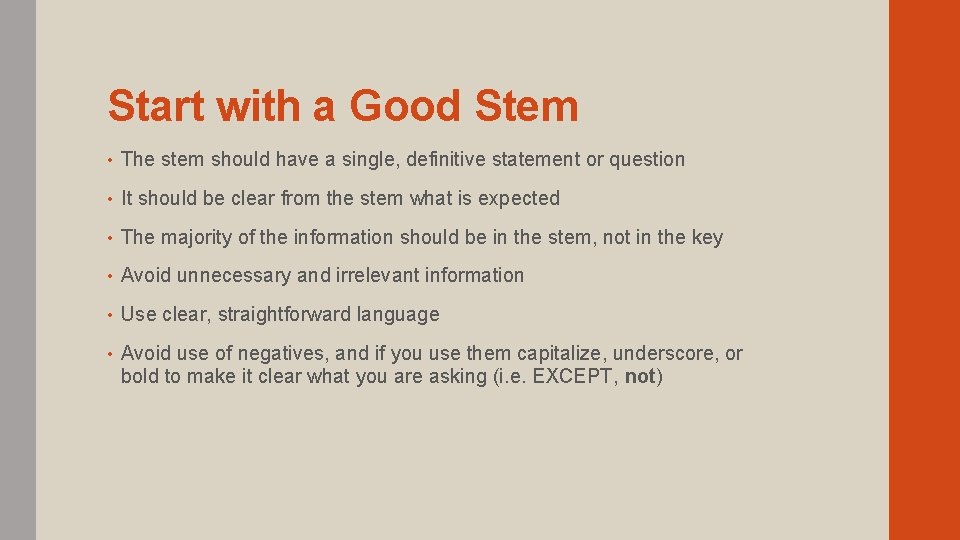
Start with a Good Stem • The stem should have a single, definitive statement or question • It should be clear from the stem what is expected • The majority of the information should be in the stem, not in the key • Avoid unnecessary and irrelevant information • Use clear, straightforward language • Avoid use of negatives, and if you use them capitalize, underscore, or bold to make it clear what you are asking (i. e. EXCEPT, not)
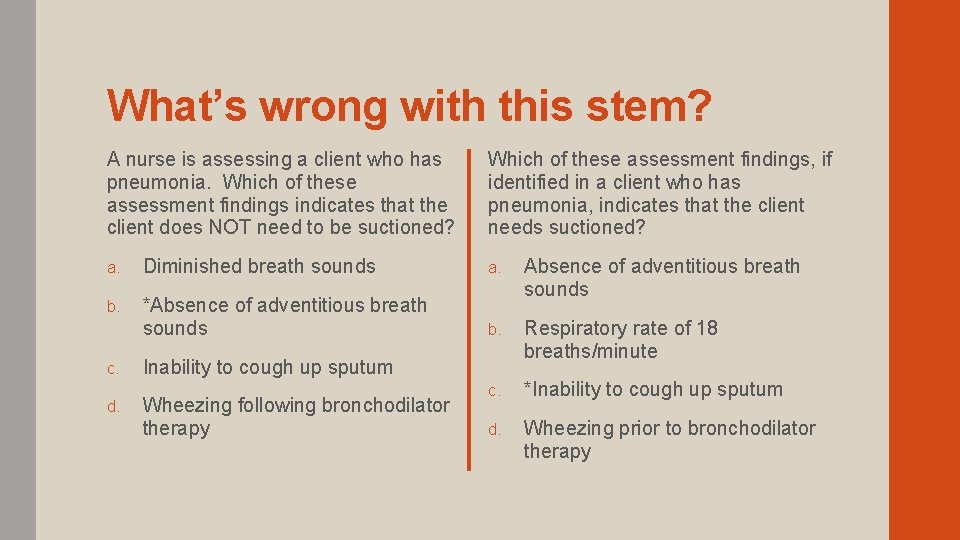
What’s wrong with this stem? A nurse is assessing a client who has pneumonia. Which of these assessment findings indicates that the client does NOT need to be suctioned? Which of these assessment findings, if identified in a client who has pneumonia, indicates that the client needs suctioned? a. Diminished breath sounds a. b. *Absence of adventitious breath sounds b. Respiratory rate of 18 breaths/minute c. *Inability to cough up sputum d. Wheezing prior to bronchodilator therapy c. d. Inability to cough up sputum Wheezing following bronchodilator therapy
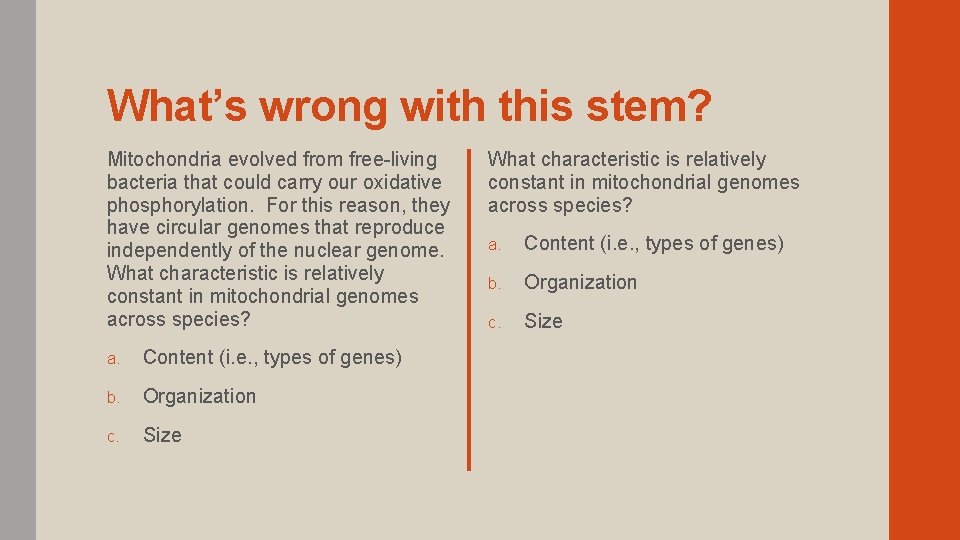
What’s wrong with this stem? Mitochondria evolved from free-living bacteria that could carry our oxidative phosphorylation. For this reason, they have circular genomes that reproduce independently of the nuclear genome. What characteristic is relatively constant in mitochondrial genomes across species? a. Content (i. e. , types of genes) b. Organization c. Size
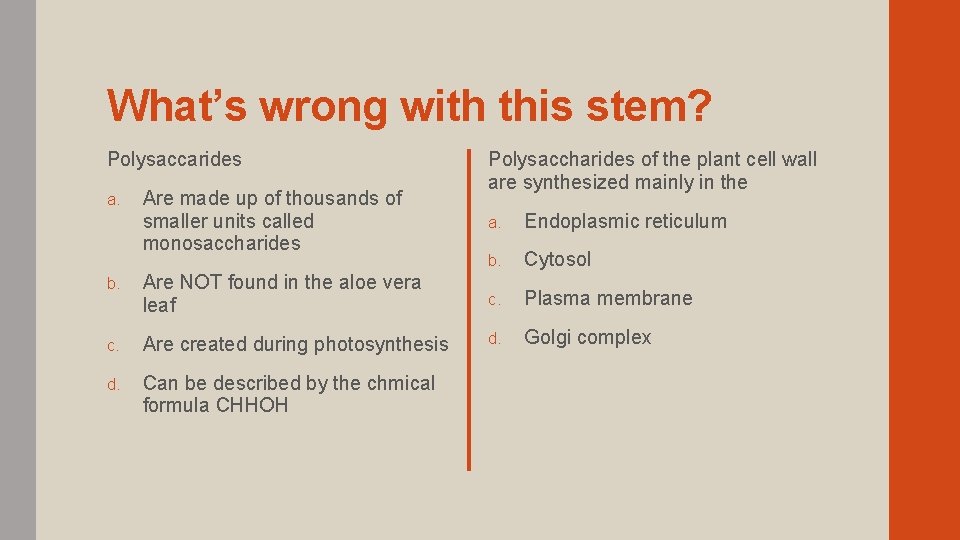
What’s wrong with this stem? Polysaccarides a. Are made up of thousands of smaller units called monosaccharides Polysaccharides of the plant cell wall are synthesized mainly in the a. Endoplasmic reticulum b. Cytosol b. Are NOT found in the aloe vera leaf c. Plasma membrane c. Are created during photosynthesis d. Golgi complex d. Can be described by the chmical formula CHHOH
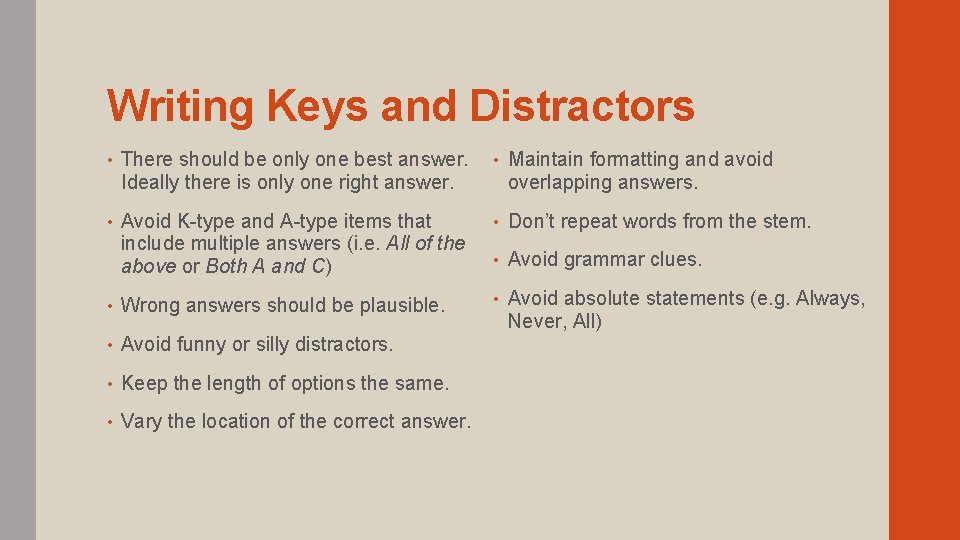
Writing Keys and Distractors • There should be only one best answer. Ideally there is only one right answer. • Maintain formatting and avoid overlapping answers. • Avoid K-type and A-type items that include multiple answers (i. e. All of the above or Both A and C) • Don’t repeat words from the stem. • Avoid grammar clues. • Wrong answers should be plausible. • Avoid absolute statements (e. g. Always, Never, All) • Avoid funny or silly distractors. • Keep the length of options the same. • Vary the location of the correct answer.
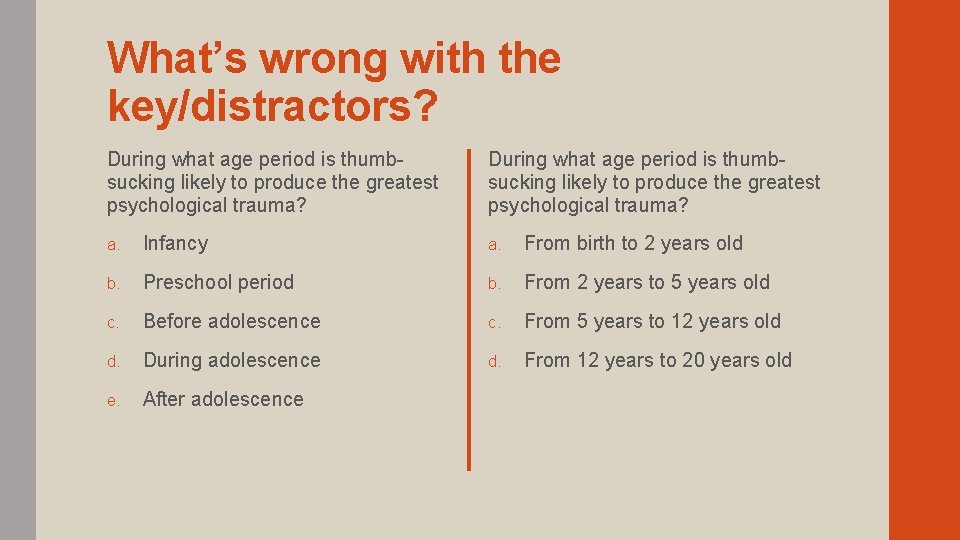
What’s wrong with the key/distractors? During what age period is thumbsucking likely to produce the greatest psychological trauma? a. Infancy a. From birth to 2 years old b. Preschool period b. From 2 years to 5 years old c. Before adolescence c. From 5 years to 12 years old d. During adolescence d. From 12 years to 20 years old e. After adolescence
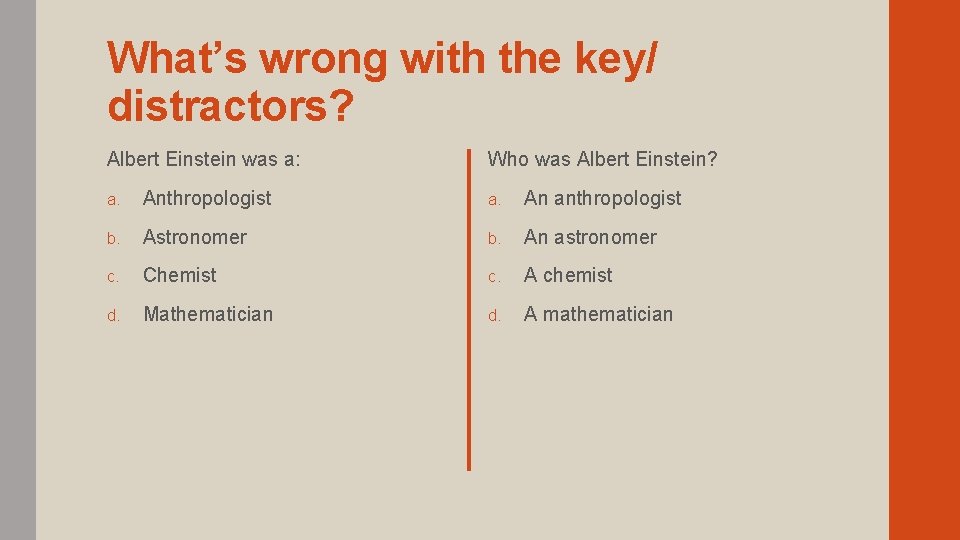
What’s wrong with the key/ distractors? Albert Einstein was a: Who was Albert Einstein? a. Anthropologist a. An anthropologist b. Astronomer b. An astronomer c. Chemist c. A chemist d. Mathematician d. A mathematician
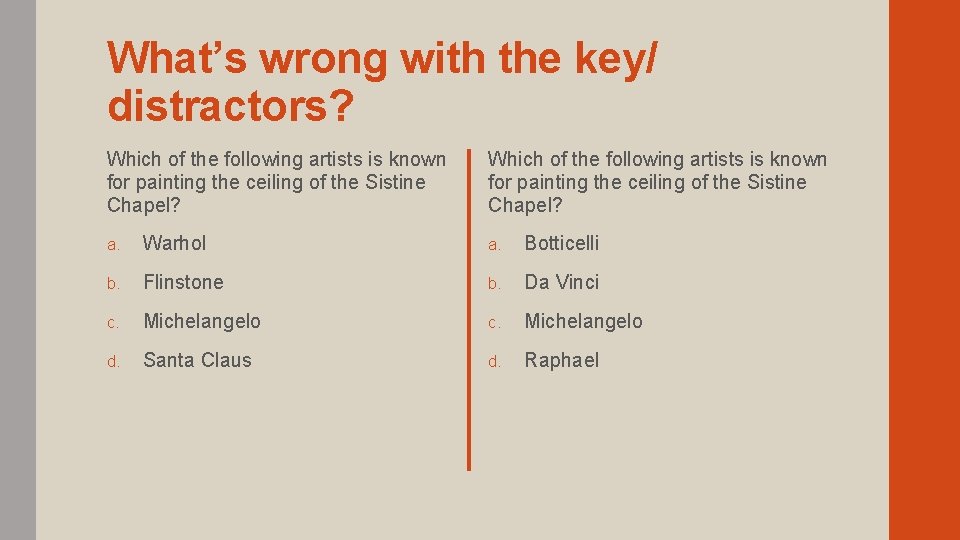
What’s wrong with the key/ distractors? Which of the following artists is known for painting the ceiling of the Sistine Chapel? a. Warhol a. Botticelli b. Flinstone b. Da Vinci c. Michelangelo d. Santa Claus d. Raphael
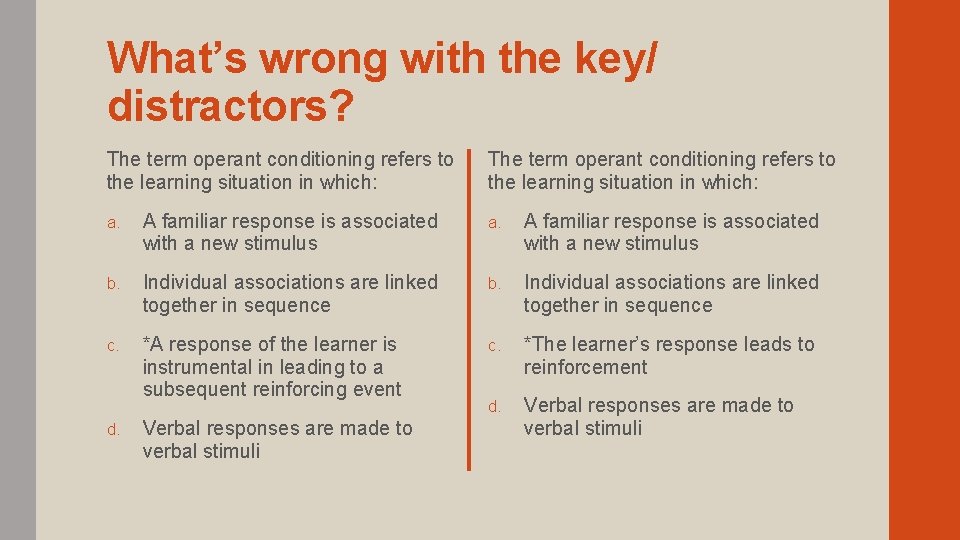
What’s wrong with the key/ distractors? The term operant conditioning refers to the learning situation in which: a. A familiar response is associated with a new stimulus b. Individual associations are linked together in sequence c. *A response of the learner is instrumental in leading to a subsequent reinforcing event c. *The learner’s response leads to reinforcement d. Verbal responses are made to verbal stimuli
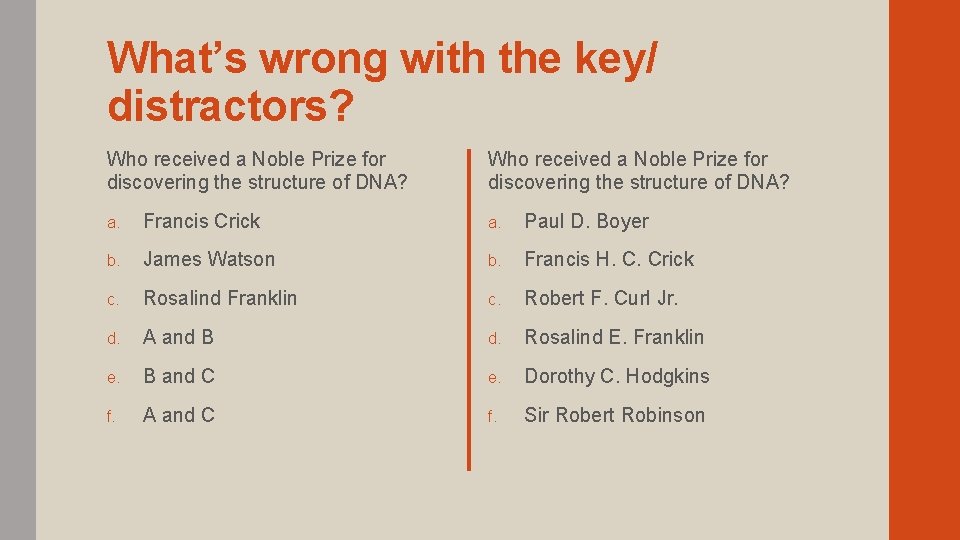
What’s wrong with the key/ distractors? Who received a Noble Prize for discovering the structure of DNA? a. Francis Crick a. Paul D. Boyer b. James Watson b. Francis H. C. Crick c. Rosalind Franklin c. Robert F. Curl Jr. d. A and B d. Rosalind E. Franklin e. B and C e. Dorothy C. Hodgkins f. A and C f. Sir Robert Robinson
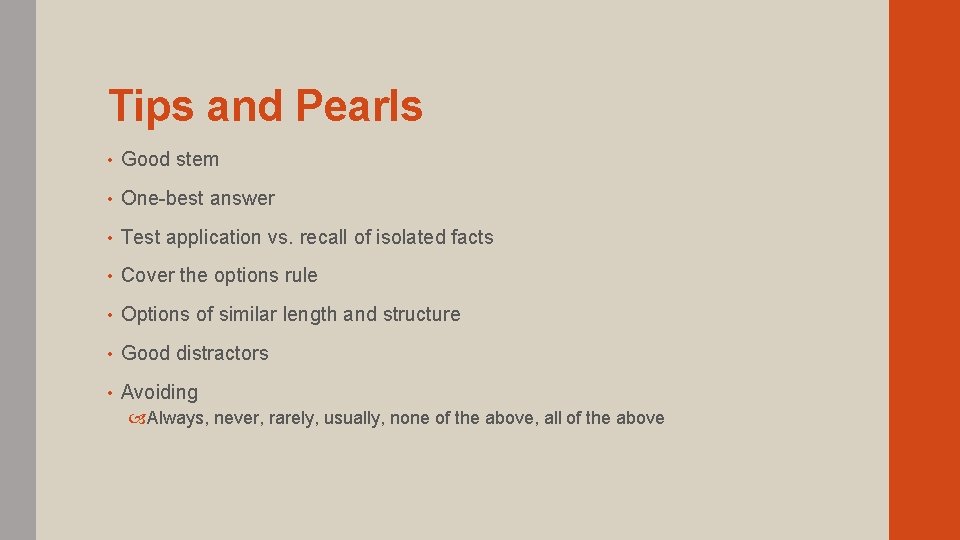
Tips and Pearls • Good stem • One-best answer • Test application vs. recall of isolated facts • Cover the options rule • Options of similar length and structure • Good distractors • Avoiding Always, never, rarely, usually, none of the above, all of the above

Time to Review Your Own Test
Resources • Constructing Written Test Questions for the Basic and Clinical Sciences (NBME) • Dos and Don’ts of Writing MCQs • Good, Better, best: Multiple Choice Exam Construction • Writing Good Multiple Choice Test Questions • Writing Multiple Choice Questions: An Introductory Tutorial (NBME)
- Slides: 19