
Writing Assessment Grids Writing Milestones 0 1 0


- Slides: 25
Writing Assessment Grids
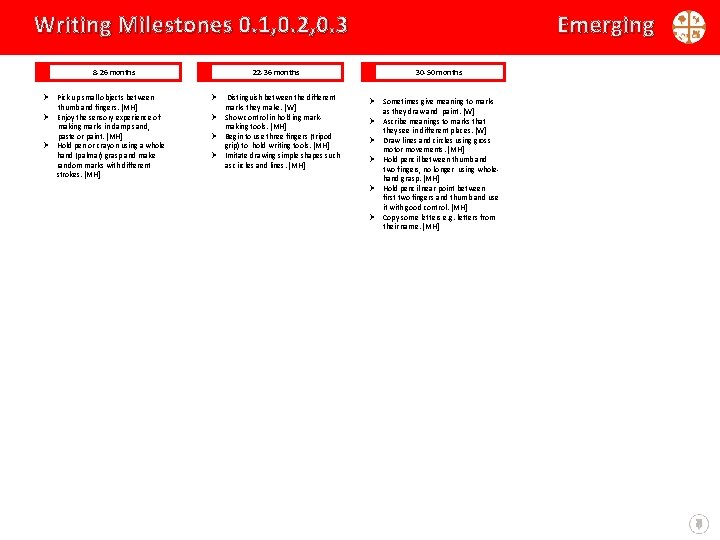
Writing Milestones 0. 1, 0. 2, 0. 3 8 -26 months Ø Pick up small objects between thumb and fingers. [MH] Ø Enjoy the sensory experience of making marks in damp sand, paste or paint. [MH] Ø Hold pen or crayon using a whole hand (palmar) grasp and make random marks with different strokes. [MH] 22 -36 months Ø Distinguish between the different marks they make. [W] Ø Show control in holding markmaking tools. [MH] Ø Begin to use three fingers (tripod grip) to hold writing tools. [MH] Ø Imitate drawing simple shapes such as circles and lines. [MH] Emerging 30 -50 months Ø Sometimes give meaning to marks as they draw and paint. [W] Ø Ascribe meanings to marks that they see in different places. [W] Ø Draw lines and circles using gross motor movements. [MH] Ø Hold pencil between thumb and two fingers, no longer using wholehand grasp. [MH] Ø Hold pencil near point between first two fingers and thumb and use it with good control. [MH] Ø Copy some letters e. g. letters from their name. [MH]
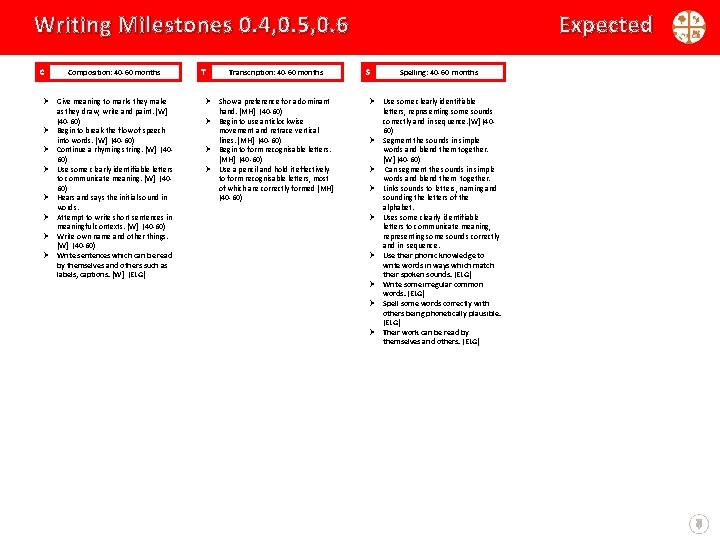
Writing Milestones 0. 4, 0. 5, 0. 6 C Composition: 40 -60 months Ø Give meaning to marks they make Ø Ø Ø Ø as they draw, write and paint. [W] (40 -60) Begin to break the flow of speech into words. [W] (40 -60) Continue a rhyming string. [W] (4060) Use some clearly identifiable letters to communicate meaning. [W] (4060) Hears and says the initial sound in words. Attempt to write short sentences in meaningful contexts. [W] (40 -60) Write own name and other things. [W] (40 -60) Write sentences which can be read by themselves and others such as labels, captions. [W] (ELG) T Transcription: 40 -60 months Ø Show a preference for a dominant hand. [MH] (40 -60) Ø Begin to use anticlockwise movement and retrace vertical lines. [MH] (40 -60) Ø Begin to form recognisable letters. [MH] (40 -60) Ø Use a pencil and hold it effectively to form recognisable letters, most of which are correctly formed [MH] (40 -60) Expected S Spelling: 40 -60 months Ø Use some clearly identifiable Ø Ø Ø Ø letters, representing some sounds correctly and in sequence. [W] (4060) Segment the sounds in simple words and blend them together. [W] (40 -60) Can segment the sounds in simple words and blend them together. Links sounds to letters, naming and sounding the letters of the alphabet. Uses some clearly identifiable letters to communicate meaning, representing some sounds correctly and in sequence. Use their phonic knowledge to write words in ways which match their spoken sounds. (ELG) Write some irregular common words. (ELG) Spell some words correctly with others being phonetically plausible. (ELG) Their work can be read by themselves and others. (ELG)
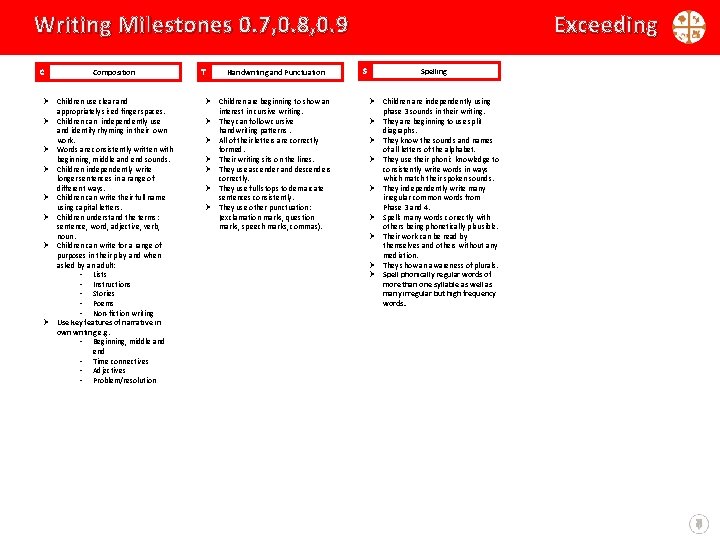
Writing Milestones 0. 7, 0. 8, 0. 9 C Composition T Handwriting and Punctuation Exceeding S Spelling Ø Children use clear and Ø Children are beginning to show an Ø Children are independently using Ø Ø Ø They are beginning to use split Ø Ø Ø appropriately sized finger spaces. Children can independently use and identify rhyming in their own work. Words are consistently written with beginning, middle and end sounds. Children independently write longer sentences in a range of different ways. Children can write their full name using capital letters. Children understand the terms: sentence, word, adjective, verb, noun. Children can write for a range of purposes in their play and when asked by an adult: • Lists • Instructions • Stories • Poems • Non-fiction writing Use key features of narrative in own writing e. g. • Beginning, middle and end • Time connectives • Adjectives • Problem/resolution Ø Ø Ø interest in cursive writing. They can follow cursive handwriting patterns. All of their letters are correctly formed. Their writing sits on the lines. They use ascender and descenders correctly. They use full stops to demarcate sentences consistently. They use other punctuation: (exclamation marks, question marks, speech marks, commas). phase 3 sounds in their writing. diagraphs. Ø They know the sounds and names of all letters of the alphabet. Ø They use their phonic knowledge to Ø Ø Ø consistently write words in ways which match their spoken sounds. They independently write many irregular common words from Phase 3 and 4. Spells many words correctly with others being phonetically plausible. Their work can be read by themselves and others without any mediation. They show an awareness of plurals. Spell phonically regular words of more than one syllable as well as many irregular but high frequency words.
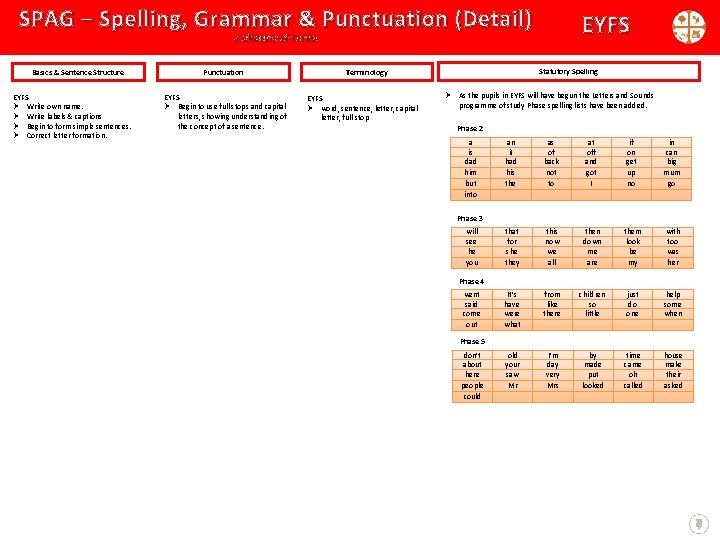
SPAG – Spelling, Grammar & Punctuation (Detail) EYFS + Glossary of Terms Basics & Sentence Structure EYFS Ø Write own name. Ø Write labels & captions Ø Begin to form simple sentences. Ø Correct letter formation. Punctuation EYFS Ø Begin to use full stops and capital letters, showing understanding of the concept of a sentence. Statutory Spelling Terminology EYFS Ø word, sentence, letter, capital letter, full stop Ø As the pupils in EYFS will have begun the Letters and Sounds programme of study Phase spelling lists have been added. Phase 2 a is dad him but into an it had his the as of back not to at off and got I if on get up no in can big mum go that for she they this now we all then down me are them look be my with too was her It’s have were what from like there children so little just do one help some when old your saw Mr I’m day very Mrs by made put looked time came oh called house make their asked Phase 3 will see he you Phase 4 went said come out Phase 5 don’t about here people could
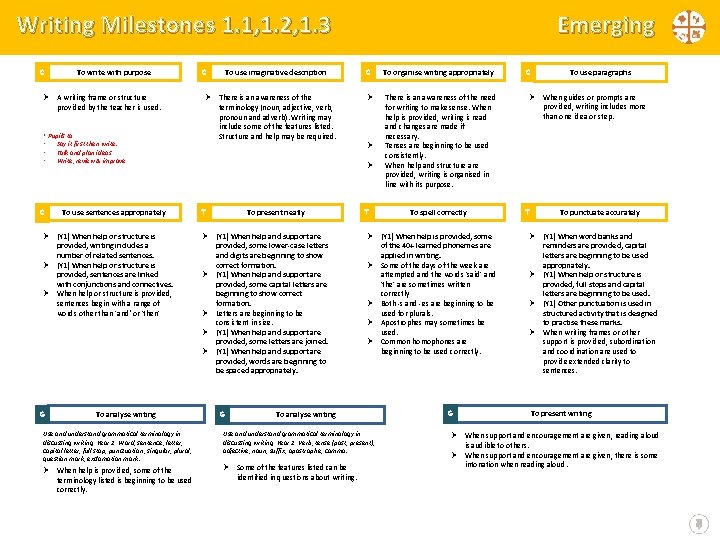
Writing Milestones 1. 1, 1. 2, 1. 3 C To write with purpose Ø A writing frame or structure provided by the teacher is used. C Ø There is an awareness of the terminology (noun, adjective, verb, pronoun and adverb). Writing may include some of the features listed. Structure and help may be required. * Pupils to: • Say it first then write. • Talk and plan ideas • Write, review & improve C To use sentences appropriately Ø (Y 1) When help or structure is provided, writing includes a number of related sentences. Ø (Y 1) When help or structure is provided, sentences are linked with conjunctions and connectives. Ø When help or structure is provided, sentences begin with a range of words other than 'and‘ or 'then' T Use and understand grammatical terminology in discussing writing: Year 1: Word, sentence, letter, capital letter, full stop, punctuation , singular, plural, question mark, exclamation mark. Ø When help is provided, some of the terminology listed is beginning to be used correctly. To present neatly Ø (Y 1) When help and support are Ø Ø Ø To analyse writing C To organise writing appropriately Ø There is an awareness of the need for writing to make sense. When help is provided, writing is read and changes are made if necessary. Tenses are beginning to be used consistently. When help and structure are provided, writing is organised in line with its purpose. Ø Ø Ø G To use imaginative description Emerging provided, some lower-case letters and digits are beginning to show correct formation. (Y 1) When help and support are provided, some capital letters are beginning to show correct formation. Letters are beginning to be consistent in size. (Y 1) When help and support are provided, some letters are joined. (Y 1) When help and support are provided, words are beginning to be spaced appropriately. G T Ø (Y 1) When help is provided, some Ø Ø To analyse writing Use and understand grammatical terminology in discussing writing: Year 2: Verb, tense (past, present), adjective, noun, suffix, apostrophe, comma. Ø Some of the features listed can be identified in questions about writing. To spell correctly of the 40+ learned phonemes are applied in writing. Some of the days of the week are attempted and the words 'said' and 'the' are sometimes written correctly Both -s and -es are beginning to be used for plurals. Apostrophes may sometimes be used. Common homophones are beginning to be used correctly. C To use paragraphs Ø When guides or prompts are provided, writing includes more than one idea or step. T To punctuate accurately Ø (Y 1) When word banks and reminders are provided, capital letters are beginning to be used appropriately. Ø (Y 1) When help or structure is provided, full stops and capital letters are beginning to be used. Ø (Y 1) Other punctuation is used in structured activity that is designed to practise these marks. Ø When writing frames or other support is provided, subordination and coordination are used to provide extended clarity to sentences. G To present writing Ø When support and encouragement are given, reading aloud is audible to others. Ø When support and encouragement are given, there is some intonation when reading aloud.
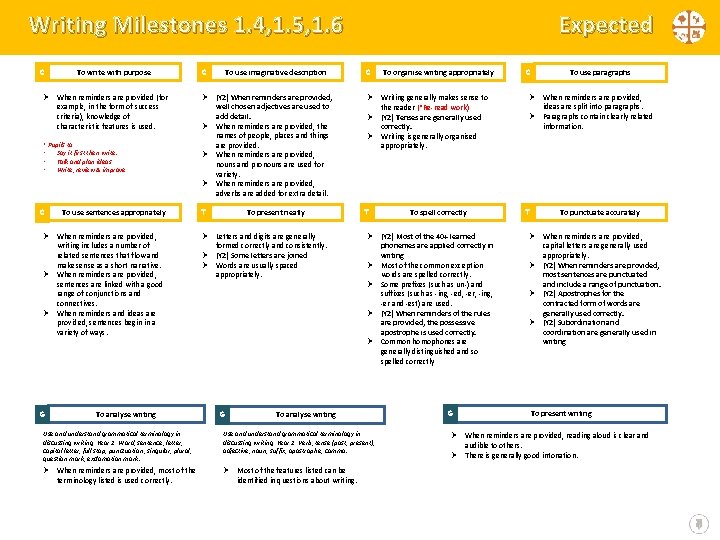
Writing Milestones 1. 4, 1. 5, 1. 6 C To write with purpose Ø When reminders are provided (for example, in the form of success criteria), knowledge of characteristic features is used. * Pupils to: • Say it first then write. • Talk and plan ideas • Write, review & improve C To use sentences appropriately Ø When reminders are provided, writing includes a number of related sentences that flow and make sense as a short narrative. Ø When reminders are provided, sentences are linked with a good range of conjunctions and connectives. Ø When reminders and ideas are provided, sentences begin in a variety of ways. G To analyse writing C To use imaginative description Ø (Y 2) When reminders are provided, well chosen adjectives are used to add detail. Ø When reminders are provided, the names of people, places and things are provided. Ø When reminders are provided, nouns and pronouns are used for variety. Ø When reminders are provided, adverbs are added for extra detail. T To present neatly Ø Letters and digits are generally formed correctly and consistently. Ø (Y 2) Some letters are joined Ø Words are usually spaced appropriately. Expected C Ø Writing generally makes sense to the reader (*Re-read work) Ø (Y 2) Tenses are generally used correctly. Ø Writing is generally organised appropriately. T Ø Ø Ø To analyse writing Use and understand grammatical terminology in discussing writing: Year 1: Word, sentence, letter, capital letter, full stop, punctuation , singular, plural, question mark, exclamation mark. Use and understand grammatical terminology in discussing writing: Year 2: Verb, tense (past, present), adjective, noun, suffix, apostrophe, comma. Ø When reminders are provided, most of the Ø Most of the features listed can be terminology listed is used correctly. identified in questions about writing. To spell correctly Ø (Y 2) Most of the 40+ learned Ø G To organise writing appropriately phonemes are applied correctly in writing Most of the common exception words are spelled correctly. Some prefixes (such as un-) and suffixes (such as -ing, -ed, -er, -ing, -er and -est) are used. (Y 2) When reminders of the rules are provided, the possessive apostrophe is used correctly. Common homophones are generally distinguished and so spelled correctly G C To use paragraphs Ø When reminders are provided, ideas are split into paragraphs. Ø Paragraphs contain clearly related information. T To punctuate accurately Ø When reminders are provided, capital letters are generally used appropriately. Ø (Y 2) When reminders are provided, most sentences are punctuated and include a range of punctuation. Ø (Y 2) Apostrophes for the contracted form of words are generally used correctly. Ø (Y 2) Subordination and coordination are generally used in writing To present writing Ø When reminders are provided, reading aloud is clear and audible to others. Ø There is generally good intonation.
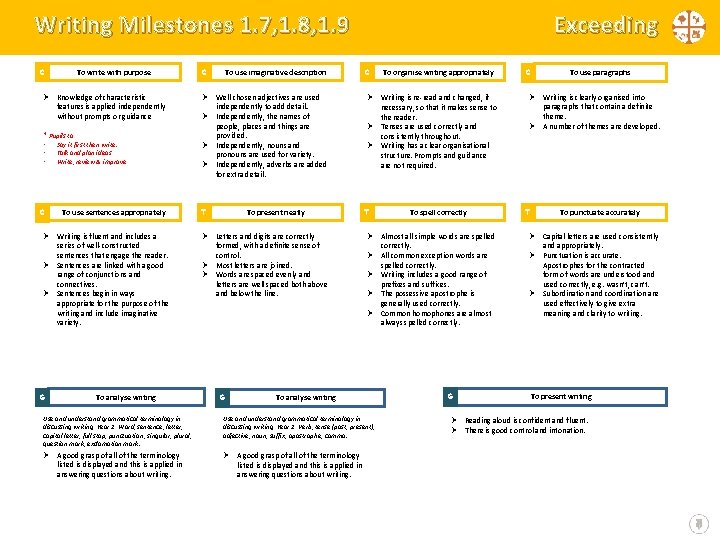
Writing Milestones 1. 7, 1. 8, 1. 9 C To write with purpose Ø Knowledge of characteristic features is applied independently without prompts or guidance * Pupils to: • • • C Say it first then write. Talk and plan ideas Write, review & improve To use sentences appropriately Ø Writing is fluent and includes a series of well-constructed sentences that engage the reader. Ø Sentences are linked with a good range of conjunctions and connectives. Ø Sentences begin in ways appropriate for the purpose of the writing and include imaginative variety. G To analyse writing C To use imaginative description Ø Well-chosen adjectives are used independently to add detail. Ø Independently, the names of people, places and things are provided. Ø Independently, nouns and pronouns are used for variety. Ø Independently, adverbs are added for extra detail. T To present neatly Ø Letters and digits are correctly formed, with a definite sense of control. Ø Most letters are joined. Ø Words are spaced evenly and letters are well spaced both above and below the line. Exceeding C Ø Writing is re-read and changed, if necessary, so that it makes sense to the reader. Ø Tenses are used correctly and consistently throughout. Ø Writing has a clear organisational structure. Prompts and guidance are not required. T Ø Writing is clearly organised into paragraphs that contain a definite theme. Ø A number of themes are developed. T To punctuate accurately Ø Ø Punctuation is accurate. Ø Ø To analyse writing Use and understand grammatical terminology in discussing writing: Year 2: Verb, tense (past, present), adjective, noun, suffix, apostrophe, comma. Ø A good grasp of all of the terminology listed is displayed and this is applied in answering questions about writing. To use paragraphs Ø Capital letters are used consistently Use and understand grammatical terminology in discussing writing: Year 1: Word, sentence, letter, capital letter, full stop, punctuation , singular, plural, question mark, exclamation mark. listed is displayed and this is applied in answering questions about writing. To spell correctly C Ø Almost all simple words are spelled Ø G To organise writing appropriately correctly. All common exception words are spelled correctly. Writing includes a good range of prefixes and suffixes. The possessive apostrophe is generally used correctly. Common homophones are almost always spelled correctly. G and appropriately. Apostrophes for the contracted form of words are understood and used correctly, e. g. wasn’t, can’t. Ø Subordination and coordination are used effectively to give extra meaning and clarity to writing. To present writing Ø Reading aloud is confident and fluent. Ø There is good control and intonation.
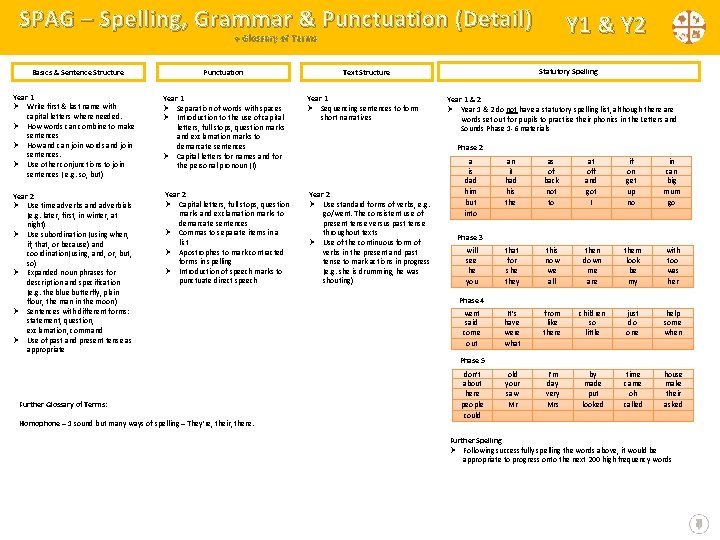
SPAG – Spelling, Grammar & Punctuation (Detail) Y 1 & Y 2 + Glossary of Terms Basics & Sentence Structure Punctuation Statutory Spelling Text Structure Year 1 Ø Write first & last name with capital letters where needed. Ø How words can combine to make sentences Ø How and can join words and join sentences. Ø Use other conjunctions to join sentences ( e. g. so, but) Year 1 Ø Separation of words with spaces Ø Introduction to the use of capital letters, full stops, question marks and exclamation marks to demarcate sentences Ø Capital letters for names and for the personal pronoun (I) Year 1 Ø Sequencing sentences to form short narratives Year 2 Ø Use time adverbs and adverbials (e. g. later, first, in winter, at night) Ø Use subordination (using when, if, that, or because) and coordination(using, and, or, but, so) Ø Expanded noun phrases for description and specification (e. g. the blue butterfly, plain flour, the man in the moon) Ø Sentences with different forms: statement, question, exclamation, command Ø Use of past and present tense as appropriate Year 2 Ø Capital letters, full stops, question marks and exclamation marks to demarcate sentences Ø Commas to separate items in a list Ø Apostrophes to mark contracted forms in spelling Ø Introduction of speech marks to punctuate direct speech Year 2 Ø Use standard forms of verbs, e. g. go/went. The consistent use of present tense versus past tense throughout texts Ø Use of the continuous form of verbs in the present and past tense to mark actions in progress (e. g. she is drumming, he was shouting) Year 1 & 2 Ø Year 1 & 2 do not have a statutory spelling list, although there are words set out for pupils to practise their phonics in the Letters and Sounds Phase 1 -6 materials Phase 2 a is dad him but into an it had his the as of back not to at off and got I if on get up no in can big mum go that for she they this now we all then down me are them look be my with too was her It’s have were what from like there children so little just do one help some when old your saw Mr I’m day very Mrs by made put looked time came oh called house make their asked Phase 3 will see he you Phase 4 went said come out Phase 5 Further Glossary of Terms: Homophone – 1 sound but many ways of spelling – They’re, their, there. don’t about here people could Further Spelling Ø Following successfully spelling the words above, it would be appropriate to progress onto the next 200 high frequency words
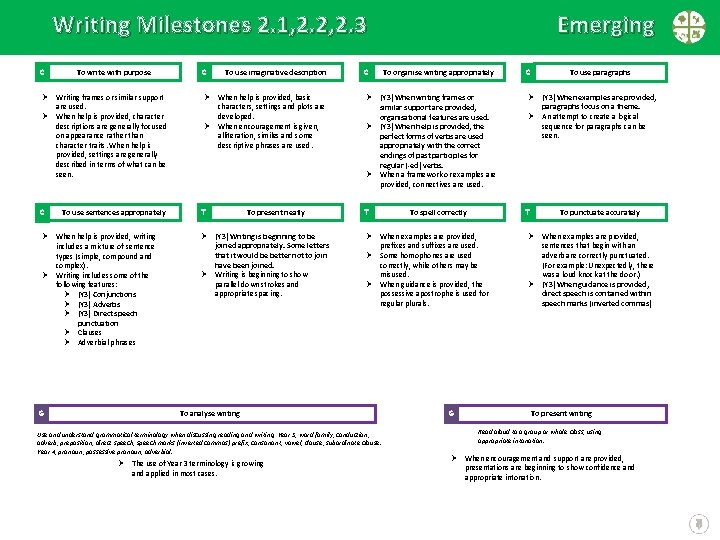
Writing Milestones 2. 1, 2. 2, 2. 3 C To write with purpose Ø Writing frames or similar support are used. Ø When help is provided, character descriptions are generally focused on appearance rather than character traits. When help is provided, settings are generally described in terms of what can be seen. C To use sentences appropriately Ø When help is provided, writing includes a mixture of sentence types (simple, compound and complex). Ø Writing includes some of the following features: Ø (Y 3) Conjunctions Ø (Y 3) Adverbs Ø (Y 3) Direct speech punctuation Ø Clauses Ø Adverbial phrases G C To use imaginative description Ø When help is provided, basic characters, settings and plots are developed. Ø When encouragement is given, alliteration, similes and some descriptive phrases are used. T To present neatly Ø (Y 3) Writing is beginning to be joined appropriately. Some letters that it would be better not to join have been joined. Ø Writing is beginning to show parallel down strokes and appropriate spacing. C T paragraphs focus on a theme. sequence for paragraphs can be seen. To punctuate accurately Ø When examples are provided, prefixes and suffixes are used. Ø Some homophones are used correctly, while others may be misused. Ø When guidance is provided, the possessive apostrophe is used for regular plurals. G To use paragraphs Ø An attempt to create a logical T To spell correctly Ø When examples are provided, C Ø (Y 3) When examples are provided, similar support are provided, organisational features are used. Ø (Y 3) When help is provided, the perfect forms of verbs are used appropriately with the correct endings of past participles for regular (-ed) verbs. Ø When a framework or examples are provided, connectives are used. Use and understand grammatical terminology when discussing reading and writing: Year 3, word family, conduction, adverb, preposition, direct speech, speech marks (inverted commas) prefix, consonant, vowel, clause, subordinate clause. Year 4, pronoun, possessive pronoun, adverbial. and applied in most cases. To organise writing appropriately Ø (Y 3) When writing frames or To analyse writing Ø The use of Year 3 terminology is growing Emerging sentences that begin with an adverb are correctly punctuated. (For example: Unexpectedly, there was a loud knock at the door. ) Ø (Y 3) When guidance is provided, direct speech is contained within speech marks (inverted commas) To present writing Read aloud to a group or whole class, using appropriate intonation. Ø When encouragement and support are provided, presentations are beginning to show confidence and appropriate intonation.
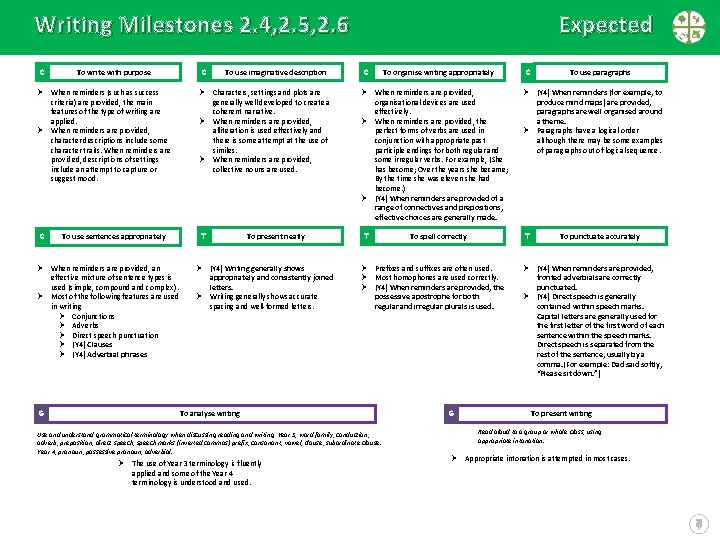
Writing Milestones 2. 4, 2. 5, 2. 6 C To write with purpose C To use imaginative description Ø When reminders (such as success Ø Characters, settings and plots are C T criteria) are provided, the main features of the type of writing are applied. Ø When reminders are provided, character descriptions include some character traits. When reminders are provided, descriptions of settings include an attempt to capture or suggest mood. To use sentences appropriately Ø When reminders are provided, an effective mixture of sentence types is used (simple, compound and complex). Ø Most of the following features are used in writing Ø Conjunctions Ø Adverbs Ø Direct speech punctuation Ø (Y 4) Clauses Ø (Y 4) Adverbial phrases G generally well developed to create a coherent narrative. Ø When reminders are provided, alliteration is used effectively and there is some attempt at the use of similes. Ø When reminders are provided, collective nouns are used. To present neatly Ø (Y 4) Writing generally shows appropriately and consistently joined letters. Ø Writing generally shows accurate spacing and well-formed letters. Expected C To organise writing appropriately Ø When reminders are provided, organisational devices are used effectively. Ø When reminders are provided, the perfect forms of verbs are used in conjunction with appropriate past participle endings for both regular and some irregular verbs. For example, (She has become; Over the years she became; By the time she was eleven she had become. ) Ø (Y 4) When reminders are provided of a range of connectives and prepositions, effective choices are generally made. T Ø Prefixes and suffixes are often used. Ø Most homophones are used correctly. Ø (Y 4) When reminders are provided, the possessive apostrophe for both regular and irregular plurals is used. Use and understand grammatical terminology when discussing reading and writing: Year 3, word family, conduction, adverb, preposition, direct speech, speech marks (inverted commas) prefix, consonant, vowel, clause, subordinate clause. Year 4, pronoun, possessive pronoun, adverbial. Ø The use of Year 3 terminology is fluently applied and some of the Year 4 terminology is understood and used. G To use paragraphs Ø (Y 4) When reminders (for example, to produce mind maps) are provided, paragraphs are well organised around a theme. Ø Paragraphs have a logical order although there may be some examples of paragraphs out of logical sequence. T To spell correctly To analyse writing C To punctuate accurately Ø (Y 4) When reminders are provided, fronted adverbials are correctly punctuated. Ø (Y 4) Direct speech is generally contained within speech marks. Capital letters are generally used for the first letter of the first word of each sentence within the speech marks. Direct speech is separated from the rest of the sentence, usually by a comma. (For example: Dad said softly, “Please sit down. ”) To present writing Read aloud to a group or whole class, using appropriate intonation. Ø Appropriate intonation is attempted in most cases.
Writing Milestones 2. 7, 2. 8, 2. 9 C To write with purpose Ø The main features of a type of writing are generally applied without prompts. Ø Character descriptions include a mixture of appearance and action to convey the nature of the character. Settings are generally conveyed well in terms of appearance, atmosphere and mood. C To use sentences appropriately Ø Writing demonstrates well-chosen and correctly punctuated sentence types (simple, compound and complex). Ø Writing includes all of the following features, as appropriate for the type of writing: Ø Conjunctions Ø Adverbs Ø Direct speech, punctuated accurately Ø Clauses Ø Adverbial phrases G C To use imaginative description Ø Characters and settings are both described well. Plausible plots are developed and sustained throughout the narrative. Ø Well-chosen descriptive phrases are used to enliven the narrative, and alliteration and similes are used appropriately for effect. Ø The sparing but effective use of collective nouns shows a good understanding of their value. (For example: The sheep dispersed as the parliament of owls issued an order to return to normal activities. ) T To present neatly Ø Writing almost always shows fluent, joined letters. Ø Writing is easy to read due to clear and thoughtful spacing and parallel down-strokes Exceeding C Ø Organisational devices are generally used effectively. Ø The perfect forms of verbs are used effectively to show when an event happens. An understanding is demonstrated of how time shifts may be created through the use of language Ø A good range of connectives is used to convey the passing of time, to inject suspense and to shift attention. T are used correctly. Ø Almost all homophones are used correctly. Ø The possessive apostrophe for both regular and irregular plurals is used accurately and consistently. Use and understand grammatical terminology when discussing reading and writing: Year 3, word family, conduction, adverb, preposition, direct speech, speech marks (inverted commas) prefix, consonant, vowel, clause, subordinate clause. Year 4, pronoun, possessive pronoun, adverbial. applied throughout a range of reading and writing activities. G C To use paragraphs Ø A theme is clearly introduced and developed, and remains consistent throughout each paragraph. Ø A clear and logical sequence of paragraphs is evident. T To spell correctly Ø Well-chosen prefixes and suffixes To analyse writing Ø The Year 3 and 4 terminology is fluently To organise writing appropriately To punctuate accurately Ø Fronted adverbials are correctly punctuated. Ø In addition to the fluent use of speech punctuation as outlined in ‘Expected’, the following is used and applied correctly: When breaking direct speech up, by inserting information about who is speaking, capital letters for the first word inside the second set of speech marks are not used. (For example: “If you think you can speak to me like that, ” she said, “you had better think again!” To present writing Read aloud to a group or whole class, using appropriate intonation. Ø Presentation is articulate and intonation, pace and variation in volume show a good awareness of the audience.
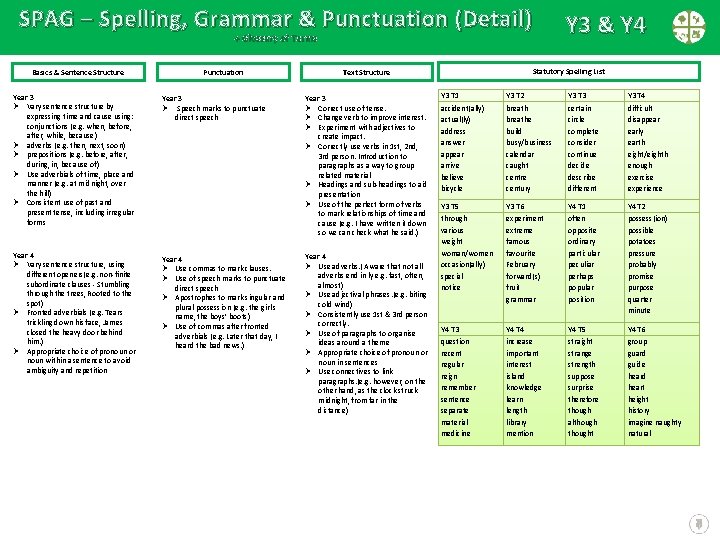
SPAG – Spelling, Grammar & Punctuation (Detail) + Glossary of Terms Basics & Sentence Structure Year 3 Ø Vary sentence structure by expressing time and cause using: conjunctions (e. g. when, before, after, while, because) Ø adverbs (e. g. then, next, soon) Ø prepositions (e. g. before, after, during, in, because of) Ø Use adverbials of time, place and manner (e. g. at midnight, over the hill) Ø Consistent use of past and present tense, including irregular forms Year 4 Ø Vary sentence structure, using different openers(e. g. non-finite subordinate clauses - Stumbling through the trees, Rooted to the spot) Ø Fronted adverbials (e. g. Tears trickling down his face, James closed the heavy door behind him. ) Ø Appropriate choice of pronoun or noun within a sentence to avoid ambiguity and repetition Punctuation Year 3 Ø Speech marks to punctuate direct speech Year 4 Ø Use commas to mark clauses. Ø Use of speech marks to punctuate direct speech Ø Apostrophes to mark singular and plural possession (e. g. the girl’s name, the boys’ boots) Ø Use of commas after fronted adverbials (e. g. Later that day, I heard the bad news. ) Statutory Spelling List Text Structure Year 3 Ø Correct use of tense. Ø Change verb to improve interest. Ø Experiment with adjectives to create impact. Ø Correctly use verbs in 1 st, 2 nd, 3 rd person. Introduction to paragraphs as a way to group related material Ø Headings and sub-headings to aid presentation Ø Use of the perfect form of verbs to mark relationships of time and cause (e. g. I have written it down so we can check what he said. ) Year 4 Ø Use adverbs. ( Aware that not all adverbs end in ly e. g. fast, often, almost) Ø Use adjectival phrases. (e. g. biting cold wind) Ø Consistently use 1 st & 3 rd person correctly. Ø Use of paragraphs to organise ideas around a theme Ø Appropriate choice of pronoun or noun in sentences Ø Use connectives to link paragraphs. (e. g. however, on the other hand, as the clock struck midnight, from far in the distance) Y 3 & Y 4 Y 3 T 1 Y 3 T 2 Y 3 T 3 Y 3 T 4 accident(ally) actual(ly) address answer appear arrive believe bicycle breathe build busy/business calendar caught centre century certain circle complete consider continue decide describe different difficult disappear early earth eight/eighth enough exercise experience Y 3 T 5 Y 3 T 6 Y 4 T 1 Y 4 T 2 through various weight woman/women occasion(ally) special notice experiment extreme famous favourite February forward(s) fruit grammar often opposite ordinary particular peculiar perhaps popular position possess(ion) possible potatoes pressure probably promise purpose quarter minute Y 4 T 3 Y 4 T 4 Y 4 T 5 Y 4 T 6 question recent regular reign remember sentence separate material medicine increase important interest island knowledge learn length library mention straight strange strength suppose surprise therefore though althought group guard guide heard heart height history imagine naughty natural
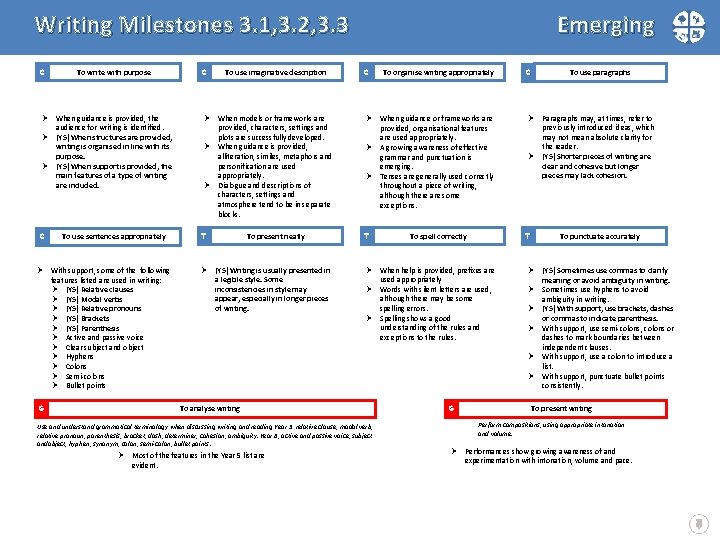
Writing Milestones 3. 1, 3. 2, 3. 3 C To write with purpose Ø When guidance is provided, the audience for writing is identified. Ø (Y 5) When structures are provided, writing is organised in line with its purpose. Ø (Y 5) When support is provided, the main features of a type of writing are included. C To use sentences appropriately Ø With support, some of the following features listed are used in writing: Ø (Y 5) Relative clauses Ø (Y 5) Modal verbs Ø (Y 5) Relative pronouns Ø (Y 5) Brackets Ø (Y 5) Parenthesis Ø Active and passive voice Ø Clear subject and object Ø Hyphens Ø Colons Ø Semi-colons Ø Bullet points G C To use imaginative description Ø When models or frameworks are provided, characters, settings and plots are successfully developed. Ø When guidance is provided, alliteration, similes, metaphors and personification are used appropriately. Ø Dialogue and descriptions of characters, settings and atmosphere tend to be in separate blocks. T To present neatly Ø (Y 5) Writing is usually presented in a legible style. Some inconsistencies in style may appear, especially in longer pieces of writing. Emerging C Ø When guidance or frameworks are provided, organisational features are used appropriately. Ø A growing awareness of effective grammar and punctuation is emerging. Ø Tenses are generally used correctly throughout a piece of writing, although there are some exceptions. T used appropriately Ø Words with silent letters are used, although there may be some spelling errors. Ø Spelling shows a good understanding of the rules and exceptions to the rules. Use and understand grammatical terminology when discussing writing and reading Year 5: relative clause, modal verb, relative pronoun, parenthesis, bracket, dash, determiner, cohesion, ambiguity. Year 6, active and passive voice, subject andobject, hyphen, synonym, colon, semi-colon, bullet points. evident. G C To use paragraphs Ø Paragraphs may, at times, refer to previously introduced ideas, which may not mean absolute clarity for the reader. Ø (Y 5) Shorter pieces of writing are clear and cohesive but longer pieces may lack cohesion. T To spell correctly Ø When help is provided, prefixes are To analyse writing Ø Most of the features in the Year 5 list are To organise writing appropriately To punctuate accurately Ø (Y 5) Sometimes use commas to clarify meaning or avoid ambiguity in writing. Ø Sometimes use hyphens to avoid ambiguity in writing. Ø (Y 5) With support, use brackets, dashes or commas to indicate parenthesis. Ø With support, use semi-colons, colons or dashes to mark boundaries between independent clauses. Ø With support, use a colon to introduce a list. Ø With support, punctuate bullet points consistently. To present writing Perform compositions, using appropriate intonation and volume. Ø Performances show growing awareness of and experimentation with intonation, volume and pace.
Writing Milestones 3. 4, 3. 5, 3. 6 C To write with purpose Ø When reminders are provided, writing shows an awareness of the audience. Ø (Y 6) When reminders are provided, the appropriate form of writing for its intended purpose is chosen. Ø (Y 6) When reminders are provided, the main features of a type of writing are used. C To use sentences appropriately Ø With reminders, most of the following features listed are used in writing: Ø Relative clauses Ø Modal verbs Ø Relative pronouns Ø Brackets Ø Parenthesis Ø (Y 6) Active and passive voice Ø Clear subject and object Ø (Y 6) Hyphens Ø (Y 6) Colons Ø (Y 6) Semi-colons Ø Bullet points G C To use imaginative description Ø When reminders are provided, a good range of techniques is used to create characters, settings and plots. Ø When reminders are provided, writing demonstrates a lively imagination, including the successful and appropriate use of alliteration, similes, metaphors and personification. Ø There is some evidence of an attempt to interweave plot with descriptions of characters and settings T To present neatly Ø (Y 6) Writing is generally fluent with some evidence of a consistent personal style emerging. Expected C Ø When reminders (such as success criteria) are provided, key organisational devices are used appropriately. Connectives are usually well chosen but may appear formulaic. Ø (Y 6) Effective grammar and punctuation are often used. Ø Tenses are used correctly throughout a piece of writing. T prefixes are used appropriately. Ø Some words with silent letters are used and spelled correctly. Ø Most words, including commonly misspelled words, technical or subject specific words are spelled correctly. Use and understand grammatical terminology when discussing writing and reading Year 5: relative clause, modal verb, relative pronoun, parenthesis, bracket, dash, determiner, cohesion, ambiguity. Year 6, active and passive voice, subject andobject, hyphen, synonym, colon, semi-colon, bullet points. evident. G C To use paragraphs Ø Paragraphs generally make sense if read alone. Ø (Y 6) When reminders are provided, pieces of writing, even longer pieces, are generally cohesive. T To spell correctly Ø When reminders are provided, To analyse writing Ø All of the features in the Year 5 list are To organise writing appropriately To punctuate accurately Ø Often use commas to clarify meaning or avoid ambiguity in writing. Ø (Y 6) Often use hyphens to avoid ambiguity in writing. Ø When reminders are provided, use brackets, dashes or commas to indicate parenthesis. Ø (Y 6) When reminders are provided, use semi- colons, colons or dashes to mark boundaries between independent clauses. Ø (Y 6) When reminders are provided, use a colon to introduce a list. Ø When reminders are provided, punctuate bullet points consistently. To present writing Perform compositions, using appropriate intonation and volume. Ø Performances show confidence, appropriate intonation and good pace and volume.
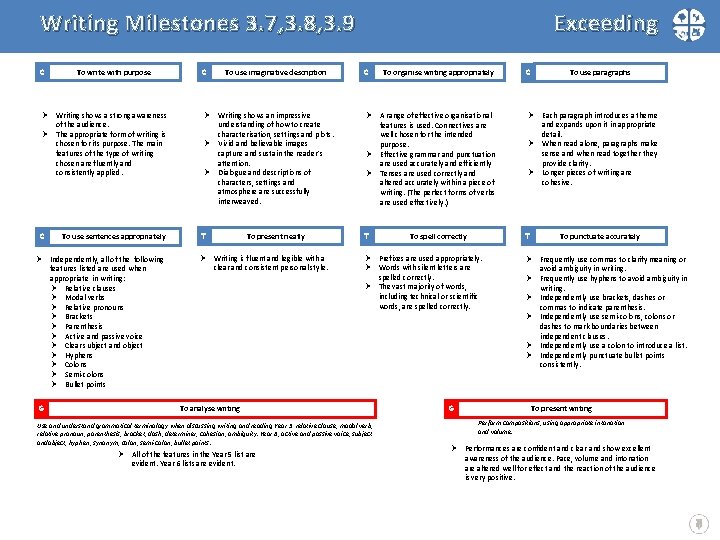
Writing Milestones 3. 7, 3. 8, 3. 9 C To write with purpose Ø Writing shows a strong awareness of the audience. Ø The appropriate form of writing is chosen for its purpose. The main features of the type of writing chosen are fluently and consistently applied. C To use sentences appropriately Ø Independently, all of the following features listed are used when appropriate in writing: Ø Relative clauses Ø Modal verbs Ø Relative pronouns Ø Brackets Ø Parenthesis Ø Active and passive voice Ø Clear subject and object Ø Hyphens Ø Colons Ø Semi-colons Ø Bullet points G C To use imaginative description Ø Writing shows an impressive understanding of how to create characterisation, settings and plots. Ø Vivid and believable images capture and sustain the reader's attention. Ø Dialogue and descriptions of characters, settings and atmosphere are successfully interweaved. T To present neatly Ø Writing is fluent and legible with a clear and consistent personal style. Exceeding C To organise writing appropriately Ø A range of effective organisational features is used. Connectives are well chosen for the intended purpose. Ø Effective grammar and punctuation are used accurately and efficiently Ø Tenses are used correctly and altered accurately within a piece of writing. (The perfect forms of verbs are used effectively. ) T C Ø Each paragraph introduces a theme and expands upon it in appropriate detail. Ø When read alone, paragraphs make sense and when read together they provide clarity. Ø Longer pieces of writing are cohesive. T To spell correctly Ø Prefixes are used appropriately. Ø Words with silent letters are spelled correctly. Ø The vast majority of words, including technical or scientific words, are spelled correctly. To use paragraphs To punctuate accurately Ø Frequently use commas to clarify meaning or avoid ambiguity in writing. Ø Frequently use hyphens to avoid ambiguity in writing. Ø Independently use brackets, dashes or commas to indicate parenthesis. Ø Independently use semi-colons, colons or dashes to mark boundaries between independent clauses. Ø Independently use a colon to introduce a list. Ø Independently punctuate bullet points consistently. To analyse writing Use and understand grammatical terminology when discussing writing and reading Year 5: relative clause, modal verb, relative pronoun, parenthesis, bracket, dash, determiner, cohesion, ambiguity. Year 6, active and passive voice, subject andobject, hyphen, synonym, colon, semi-colon, bullet points. Ø All of the features in the Year 5 list are evident. Year 6 lists are evident. G To present writing Perform compositions, using appropriate intonation and volume. Ø Performances are confident and clear and show excellent awareness of the audience. Pace, volume and intonation are altered well for effect and the reaction of the audience is very positive.
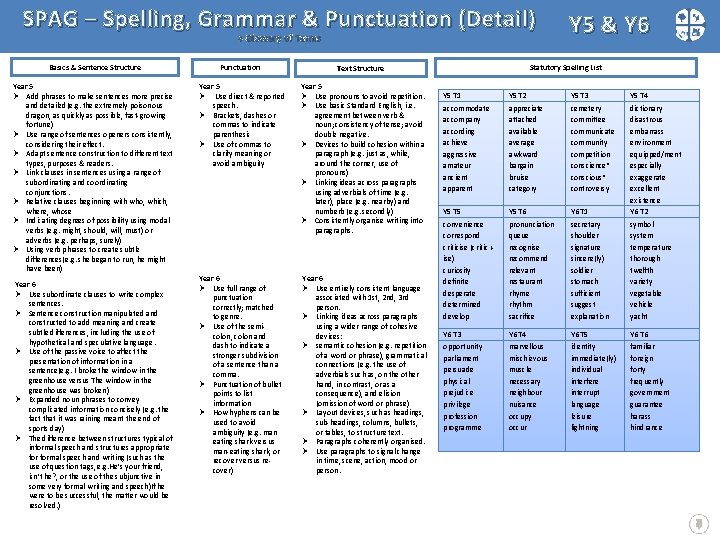
SPAG – Spelling, Grammar & Punctuation (Detail) + Glossary of Terms Basics & Sentence Structure Punctuation Text Structure Year 5 Ø Add phrases to make sentences more precise and detailed(e. g. the extremely poisonous dragon, as quickly as possible, fast-growing fortune) Ø Use range of sentences openers consistently, considering their effect. Ø Adapt sentence construction to different text types, purposes & readers. Ø Link clauses in sentences using a range of subordinating and coordinating conjunctions. Ø Relative clauses beginning with who, which, where, whose Ø Indicating degrees of possibility using modal verbs (e. g. might, should, will, must) or adverbs (e. g. perhaps, surely) Ø Using verb phrases to create subtle differences(e. g. she began to run, he might have been) Year 5 Ø Use direct & reported speech. Ø Brackets, dashes or commas to indicate parenthesis Ø Use of commas to clarify meaning or avoid ambiguity Year 5 Ø Use pronouns to avoid repetition. Ø Use basic Standard English, i. e. agreement between verb & noun; consistency of tense; avoid double negative. Ø Devices to build cohesion within a paragraph (e. g. just as, while, around the corner, use of pronouns) Ø Linking ideas across paragraphs using adverbials of time (e. g. later), place (e. g. nearby) and numberb (e. g. secondly) Ø Consistently organise writing into paragraphs. Year 6 Ø Use subordinate clauses to write complex sentences. Ø Sentence construction manipulated and constructed to add meaning and create subtle differences, including the use of hypothetical and speculative language. Ø Use of the passive voice to affect the presentation of information in a sentence(e. g. I broke the window in the greenhouse versus The window in the greenhouse was broken) Ø Expanded noun phrases to convey complicated information concisely (e. g. the fact that it was raining meant the end of sports day) Ø The difference between structures typical of informal speech and structures appropriate formal speech and writing (such as the use of question tags, e. g. He’s your friend, isn’t he? , or the use of the subjunctive in some very formal writing and speech)If he were to be successful, the matter would be resolved. ) Year 6 Ø Use full range of punctuation correctly; matched to genre. Ø Use of the semicolon, colon and dash to indicate a stronger subdivision of a sentence than a comma. Ø Punctuation of bullet points to list information Ø How hyphens can be used to avoid ambiguity (e. g. man eating shark versus man-eating shark, or recover versus recover) Year 6 Ø Use entirely consistent language associated with 1 st, 2 nd, 3 rd person. Ø Linking ideas across paragraphs using a wider range of cohesive devices: Ø semantic cohesion (e. g. repetition of a word or phrase), grammatical connections (e. g. the use of adverbials such as, on the other hand, in contrast, or as a consequence), and elision (omission of word or phrase) Ø Layout devices, such as headings, sub-headings, columns, bullets, or tables, to structure text. Ø Paragraphs coherently organised. Ø Use paragraphs to signal change in time, scene, action, mood or person. Y 5 & Y 6 Statutory Spelling List Y 5 T 1 Y 5 T 2 Y 5 T 3 Y 5 T 4 accommodate accompany according achieve aggressive amateur ancient apparent appreciate attached available average awkward bargain bruise category cemetery committee communicate community competition conscience* conscious* controversy Y 5 T 5 Y 5 T 6 Y 6 T 1 dictionary disastrous embarrass environment equipped/ment especially exaggerate excellent existence Y 6 T 2 convenience correspond criticise (critic + ise) curiosity definite desperate determined develop pronunciation queue recognise recommend relevant restaurant rhyme rhythm sacrifice secretary shoulder signature sincere(ly) soldier stomach sufficient suggest explanation symbol system temperature thorough twelfth variety vegetable vehicle yacht Y 6 T 3 Y 6 T 4 Y 6 T 5 Y 6 T 6 opportunity parliament persuade physical prejudice privilege profession programme marvellous mischievous muscle necessary neighbour nuisance occupy occur identity immediate(ly) individual interfere interrupt language leisure lightning familiar foreign forty frequently government guarantee harass hindrance
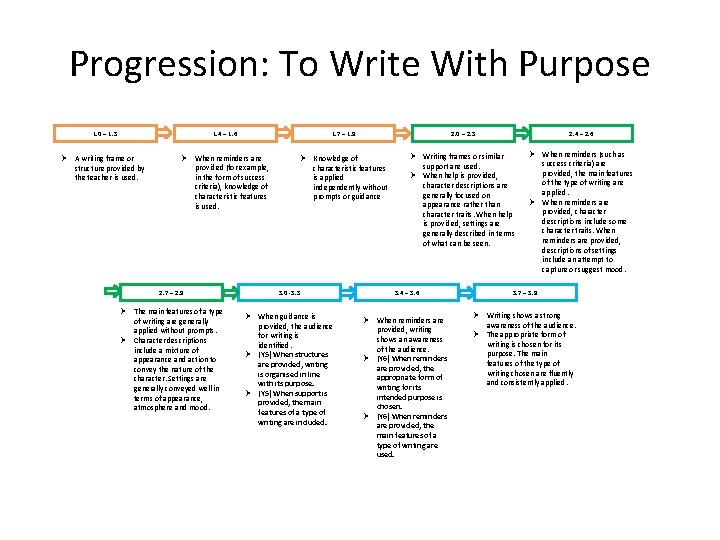
Progression: To Write With Purpose 1. 7 – 1. 9 1. 4 – 1. 6 1. 0 – 1. 3 Ø A writing frame or Ø When reminders are provided (for example, in the form of success criteria), knowledge of characteristic features is used. structure provided by the teacher is used. 2. 7 – 2. 9 Ø The main features of a type of writing are generally applied without prompts. Ø Character descriptions include a mixture of appearance and action to convey the nature of the character. Settings are generally conveyed well in terms of appearance, atmosphere and mood. Ø Knowledge of Ø Writing frames or similar characteristic features is applied independently without prompts or guidance 3. 0 -3. 3 Ø When guidance is provided, the audience for writing is identified. Ø (Y 5) When structures are provided, writing is organised in line with its purpose. Ø (Y 5) When support is provided, the main features of a type of writing are included. 2. 4 – 2. 6 2. 0 – 2. 3 Ø When reminders (such as support are used. Ø When help is provided, character descriptions are generally focused on appearance rather than character traits. When help is provided, settings are generally described in terms of what can be seen. 3. 4 – 3. 6 Ø When reminders are provided, writing shows an awareness of the audience. Ø (Y 6) When reminders are provided, the appropriate form of writing for its intended purpose is chosen. Ø (Y 6) When reminders are provided, the main features of a type of writing are used. success criteria) are provided, the main features of the type of writing are applied. Ø When reminders are provided, character descriptions include some character traits. When reminders are provided, descriptions of settings include an attempt to capture or suggest mood. 3. 7 – 3. 9 Ø Writing shows a strong awareness of the audience. Ø The appropriate form of writing is chosen for its purpose. The main features of the type of writing chosen are fluently and consistently applied.
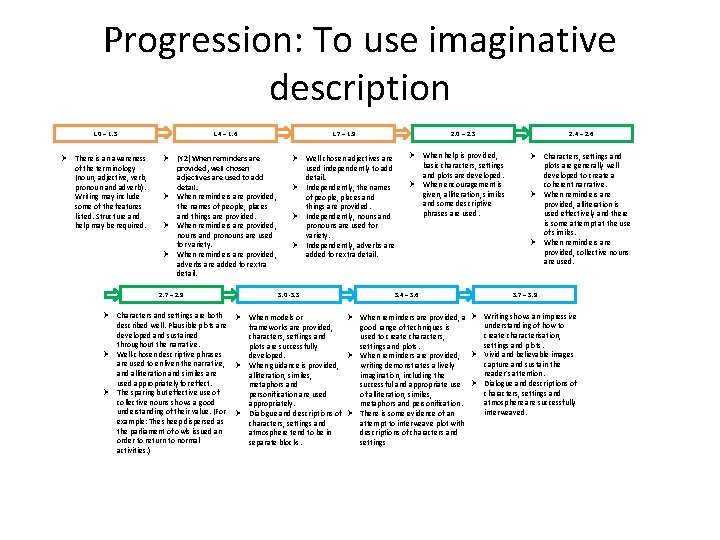
Progression: To use imaginative description 1. 0 – 1. 3 Ø There is an awareness of the terminology (noun, adjective, verb, pronoun and adverb). Writing may include some of the features listed. Structure and help may be required. 1. 4 – 1. 6 Ø (Y 2) When reminders are provided, well chosen adjectives are used to add detail. Ø When reminders are provided, the names of people, places and things are provided. Ø When reminders are provided, nouns and pronouns are used for variety. Ø When reminders are provided, adverbs are added for extra detail. 2. 7 – 2. 9 Ø Characters and settings are both described well. Plausible plots are developed and sustained throughout the narrative. Ø Well-chosen descriptive phrases are used to enliven the narrative, and alliteration and similes are used appropriately for effect. Ø The sparing but effective use of collective nouns shows a good understanding of their value. (For example: The sheep dispersed as the parliament of owls issued an order to return to normal activities. ) 1. 7 – 1. 9 Ø Well-chosen adjectives are Ø When help is provided, used independently to add detail. Ø Independently, the names of people, places and things are provided. Ø Independently, nouns and pronouns are used for variety. Ø Independently, adverbs are added for extra detail. 3. 0 -3. 3 2. 4 – 2. 6 2. 0 – 2. 3 basic characters, settings and plots are developed. Ø When encouragement is given, alliteration, similes and some descriptive phrases are used. 3. 4 – 3. 6 Ø Characters, settings and plots are generally well developed to create a coherent narrative. Ø When reminders are provided, alliteration is used effectively and there is some attempt at the use of similes. Ø When reminders are provided, collective nouns are used. 3. 7 – 3. 9 Ø When reminders are provided, a Ø Writing shows an impressive understanding of how to frameworks are provided, good range of techniques is create characterisation, characters, settings and used to create characters, settings and plots are successfully settings and plots. developed. Ø When reminders are provided, Ø Vivid and believable images capture and sustain the Ø When guidance is provided, writing demonstrates a lively reader's attention. alliteration, similes, imagination, including the metaphors and successful and appropriate use Ø Dialogue and descriptions of characters, settings and personification are used of alliteration, similes, atmosphere are successfully appropriately. metaphors and personification. interweaved. Ø Dialogue and descriptions of Ø There is some evidence of an characters, settings and attempt to interweave plot with atmosphere tend to be in descriptions of characters and separate blocks. settings Ø When models or
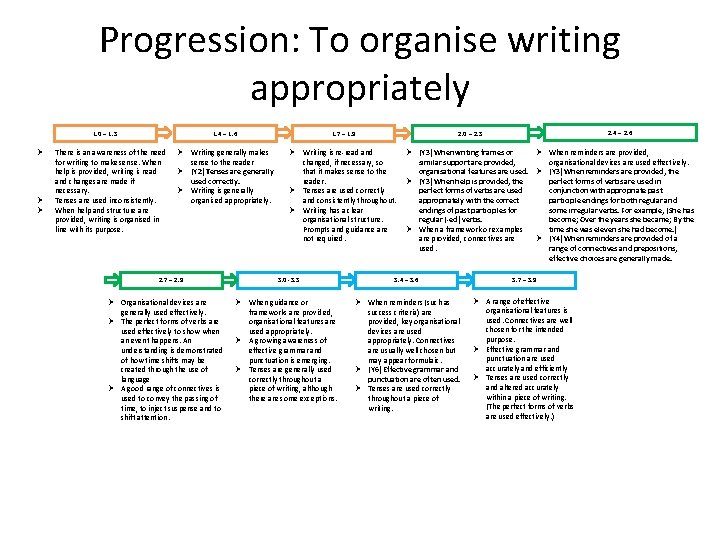
Progression: To organise writing appropriately 1. 0 – 1. 3 Ø Ø Ø 1. 4 – 1. 6 There is an awareness of the need for writing to make sense. When help is provided, writing is read and changes are made if necessary. Tenses are used inconsistently. When help and structure are provided, writing is organised in line with its purpose. Ø Writing generally makes sense to the reader Ø (Y 2) Tenses are generally used correctly. Ø Writing is generally organised appropriately. 2. 7 – 2. 9 Ø Organisational devices are generally used effectively. Ø The perfect forms of verbs are used effectively to show when an event happens. An understanding is demonstrated of how time shifts may be created through the use of language Ø A good range of connectives is used to convey the passing of time, to inject suspense and to shift attention. 1. 7 – 1. 9 Ø Writing is re-read and changed, if necessary, so that it makes sense to the reader. Ø Tenses are used correctly and consistently throughout. Ø Writing has a clear organisational structure. Prompts and guidance are not required. 3. 0 -3. 3 Ø When guidance or frameworks are provided, organisational features are used appropriately. Ø A growing awareness of effective grammar and punctuation is emerging. Ø Tenses are generally used correctly throughout a piece of writing, although there are some exceptions. 2. 4 – 2. 6 2. 0 – 2. 3 Ø (Y 3) When writing frames or Ø When reminders are provided, similar support are provided, organisational devices are used effectively. organisational features are used. Ø (Y 3) When reminders are provided, the Ø (Y 3) When help is provided, the perfect forms of verbs are used in perfect forms of verbs are used conjunction with appropriate past appropriately with the correct participle endings for both regular and endings of past participles for some irregular verbs. For example, (She has regular (-ed) verbs. become; Over the years she became; By the Ø When a framework or examples time she was eleven she had become. ) are provided, connectives are Ø (Y 4) When reminders are provided of a used. range of connectives and prepositions, effective choices are generally made. 3. 4 – 3. 6 Ø When reminders (such as success criteria) are provided, key organisational devices are used appropriately. Connectives are usually well chosen but may appear formulaic. Ø (Y 6) Effective grammar and punctuation are often used. Ø Tenses are used correctly throughout a piece of writing. 3. 7 – 3. 9 Ø A range of effective organisational features is used. Connectives are well chosen for the intended purpose. Ø Effective grammar and punctuation are used accurately and efficiently Ø Tenses are used correctly and altered accurately within a piece of writing. (The perfect forms of verbs are used effectively. )
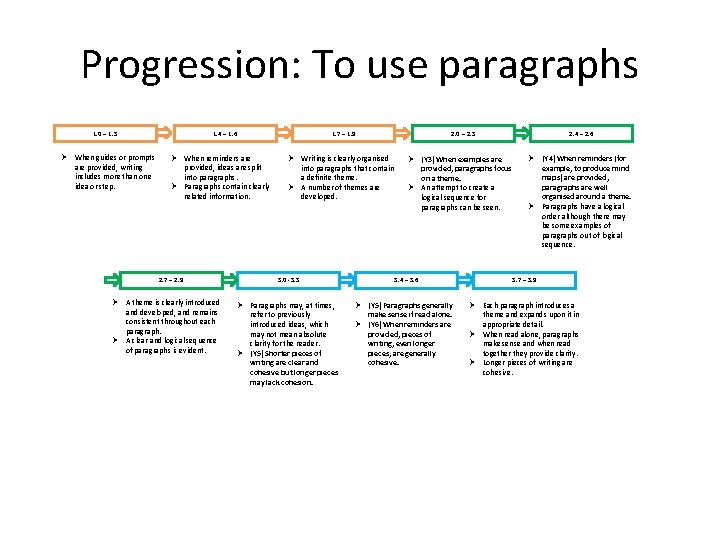
Progression: To use paragraphs 1. 0 – 1. 3 Ø When guides or prompts are provided, writing includes more than one idea or step. 1. 4 – 1. 6 Ø When reminders are provided, ideas are split into paragraphs. Ø Paragraphs contain clearly related information. 2. 7 – 2. 9 Ø A theme is clearly introduced and developed, and remains consistent throughout each paragraph. Ø A clear and logical sequence of paragraphs is evident. 1. 7 – 1. 9 Ø Writing is clearly organised into paragraphs that contain a definite theme. Ø A number of themes are developed. 3. 0 -3. 3 Ø Paragraphs may, at times, refer to previously introduced ideas, which may not mean absolute clarity for the reader. Ø (Y 5) Shorter pieces of writing are clear and cohesive but longer pieces may lack cohesion. 2. 4 – 2. 6 2. 0 – 2. 3 Ø (Y 3) When examples are provided, paragraphs focus on a theme. Ø An attempt to create a logical sequence for paragraphs can be seen. 3. 4 – 3. 6 Ø (Y 5) Paragraphs generally make sense if read alone. Ø (Y 6) When reminders are provided, pieces of writing, even longer pieces, are generally cohesive. Ø (Y 4) When reminders (for example, to produce mind maps) are provided, paragraphs are well organised around a theme. Ø Paragraphs have a logical order although there may be some examples of paragraphs out of logical sequence. 3. 7 – 3. 9 Ø Each paragraph introduces a theme and expands upon it in appropriate detail. Ø When read alone, paragraphs make sense and when read together they provide clarity. Ø Longer pieces of writing are cohesive.
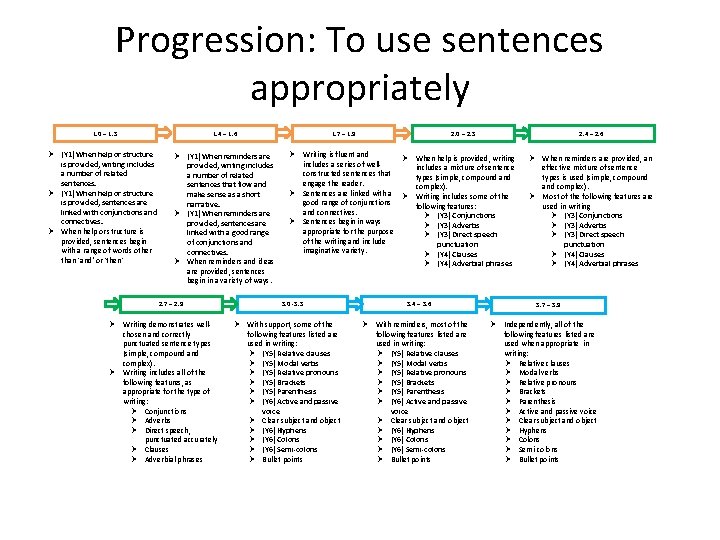
Progression: To use sentences appropriately 1. 0 – 1. 3 Ø (Y 1) When help or structure is provided, writing includes a number of related sentences. Ø (Y 1) When help or structure is provided, sentences are linked with conjunctions and connectives. Ø When help or structure is provided, sentences begin with a range of words other than 'and‘ or 'then' 1. 4 – 1. 6 1. 7 – 1. 9 Ø (Y 1) When reminders are provided, writing includes a number of related sentences that flow and make sense as a short narrative. Ø (Y 1) When reminders are provided, sentences are linked with a good range of conjunctions and connectives. Ø When reminders and ideas are provided, sentences begin in a variety of ways. 2. 7 – 2. 9 Ø Writing demonstrates well- chosen and correctly punctuated sentence types (simple, compound and complex). Ø Writing includes all of the following features, as appropriate for the type of writing: Ø Conjunctions Ø Adverbs Ø Direct speech, punctuated accurately Ø Clauses Ø Adverbial phrases Ø Writing is fluent and includes a series of wellconstructed sentences that engage the reader. Ø Sentences are linked with a good range of conjunctions and connectives. Ø Sentences begin in ways appropriate for the purpose of the writing and include imaginative variety. 3. 0 -3. 3 Ø With support, some of the following features listed are used in writing: Ø (Y 5) Relative clauses Ø (Y 5) Modal verbs Ø (Y 5) Relative pronouns Ø (Y 5) Brackets Ø (Y 5) Parenthesis Ø (Y 6) Active and passive voice Ø Clear subject and object Ø (Y 6) Hyphens Ø (Y 6) Colons Ø (Y 6) Semi-colons Ø Bullet points 2. 4 – 2. 6 2. 0 – 2. 3 Ø When help is provided, writing includes a mixture of sentence types (simple, compound and complex). Ø Writing includes some of the following features: Ø (Y 3) Conjunctions Ø (Y 3) Adverbs Ø (Y 3) Direct speech punctuation Ø (Y 4) Clauses Ø (Y 4) Adverbial phrases 3. 4 – 3. 6 Ø With reminders, most of the following features listed are used in writing: Ø (Y 5) Relative clauses Ø (Y 5) Modal verbs Ø (Y 5) Relative pronouns Ø (Y 5) Brackets Ø (Y 5) Parenthesis Ø (Y 6) Active and passive voice Ø Clear subject and object Ø (Y 6) Hyphens Ø (Y 6) Colons Ø (Y 6) Semi-colons Ø Bullet points Ø When reminders are provided, an effective mixture of sentence types is used (simple, compound and complex). Ø Most of the following features are used in writing Ø (Y 3) Conjunctions Ø (Y 3) Adverbs Ø (Y 3) Direct speech punctuation Ø (Y 4) Clauses Ø (Y 4) Adverbial phrases 3. 7 – 3. 9 Ø Independently, all of the following features listed are used when appropriate in writing: Ø Relative clauses Ø Modal verbs Ø Relative pronouns Ø Brackets Ø Parenthesis Ø Active and passive voice Ø Clear subject and object Ø Hyphens Ø Colons Ø Semi-colons Ø Bullet points
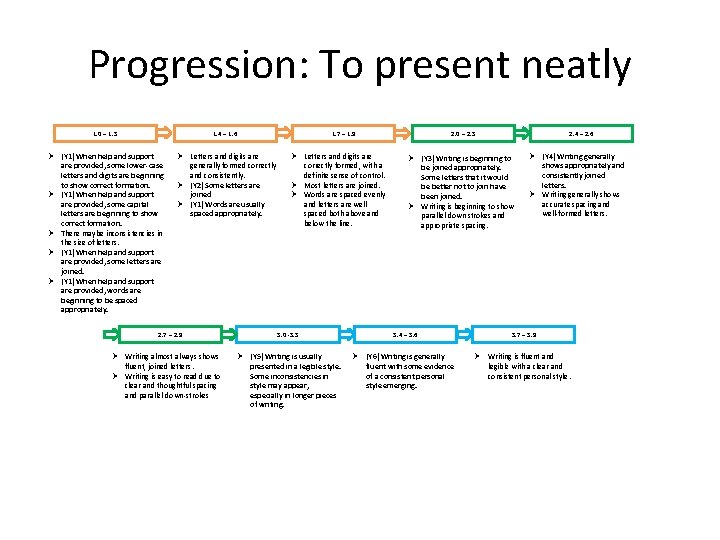
Progression: To present neatly 1. 0 – 1. 3 Ø (Y 1) When help and support Ø Ø 1. 4 – 1. 6 are provided, some lower-case letters and digits are beginning to show correct formation. (Y 1) When help and support are provided, some capital letters are beginning to show correct formation. There maybe inconsistencies in the size of letters. (Y 1) When help and support are provided, some letters are joined. (Y 1) When help and support are provided, words are beginning to be spaced appropriately. 1. 7 – 1. 9 Ø Letters and digits are generally formed correctly and consistently. Ø (Y 2) Some letters are joined Ø (Y 1) Words are usually spaced appropriately. 2. 7 – 2. 9 Ø Writing almost always shows fluent, joined letters. Ø Writing is easy to read due to clear and thoughtful spacing and parallel down-strokes Ø Letters and digits are correctly formed, with a definite sense of control. Ø Most letters are joined. Ø Words are spaced evenly and letters are well spaced both above and below the line. 3. 0 -3. 3 Ø (Y 5) Writing is usually presented in a legible style. Some inconsistencies in style may appear, especially in longer pieces of writing. 2. 4 – 2. 6 2. 0 – 2. 3 Ø (Y 3) Writing is beginning to Ø (Y 4) Writing generally be joined appropriately. Some letters that it would be better not to join have been joined. Ø Writing is beginning to show parallel down strokes and appropriate spacing. 3. 4 – 3. 6 Ø (Y 6) Writing is generally fluent with some evidence of a consistent personal style emerging. shows appropriately and consistently joined letters. Ø Writing generally shows accurate spacing and well-formed letters. 3. 7 – 3. 9 Ø Writing is fluent and legible with a clear and consistent personal style.
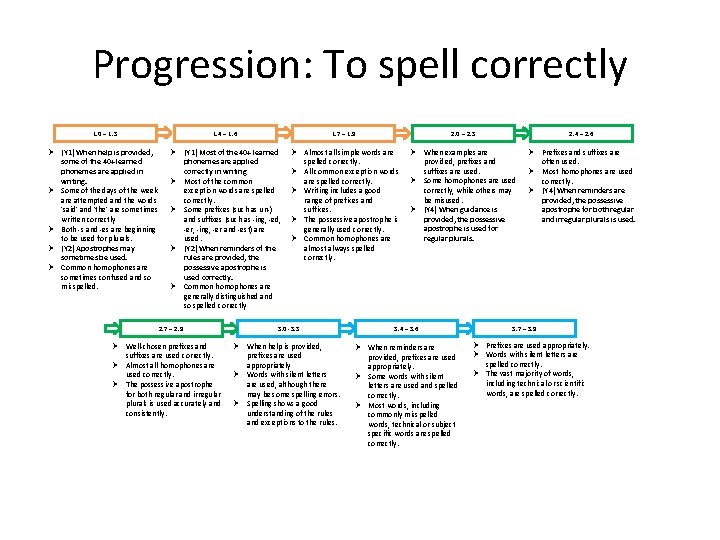
Progression: To spell correctly 1. 0 – 1. 3 Ø (Y 1) When help is provided, Ø Ø some of the 40+ learned phonemes are applied in writing. Some of the days of the week are attempted and the words 'said' and 'the' are sometimes written correctly Both -s and -es are beginning to be used for plurals. (Y 2) Apostrophes may sometimes be used. Common homophones are sometimes confused and so misspelled. 1. 4 – 1. 6 1. 7 – 1. 9 Ø (Y 1) Most of the 40+ learned Ø Almost all simple words are Ø Ø phonemes are applied correctly in writing Most of the common exception words are spelled correctly. Some prefixes (such as un-) and suffixes (such as -ing, -ed, -er, -ing, -er and -est) are used. (Y 2) When reminders of the rules are provided, the possessive apostrophe is used correctly. Common homophones are generally distinguished and so spelled correctly 2. 7 – 2. 9 Ø Well-chosen prefixes and suffixes are used correctly. Ø Almost all homophones are used correctly. Ø The possessive apostrophe for both regular and irregular plurals is used accurately and consistently. Ø Ø spelled correctly. All common exception words are spelled correctly. Writing includes a good range of prefixes and suffixes. The possessive apostrophe is generally used correctly. Common homophones are almost always spelled correctly. 3. 0 -3. 3 Ø When help is provided, prefixes are used appropriately Ø Words with silent letters are used, although there may be some spelling errors. Ø Spelling shows a good understanding of the rules and exceptions to the rules. 2. 4 – 2. 6 2. 0 – 2. 3 Ø When examples are provided, prefixes and suffixes are used. Ø Some homophones are used correctly, while others may be misused. Ø (Y 4) When guidance is provided, the possessive apostrophe is used for regular plurals. 3. 4 – 3. 6 Ø When reminders are provided, prefixes are used appropriately. Ø Some words with silent letters are used and spelled correctly. Ø Most words, including commonly misspelled words, technical or subject specific words are spelled correctly. Ø Prefixes and suffixes are often used. Ø Most homophones are used correctly. Ø (Y 4) When reminders are provided, the possessive apostrophe for both regular and irregular plurals is used. 3. 7 – 3. 9 Ø Prefixes are used appropriately. Ø Words with silent letters are spelled correctly. Ø The vast majority of words, including technical or scientific words, are spelled correctly.
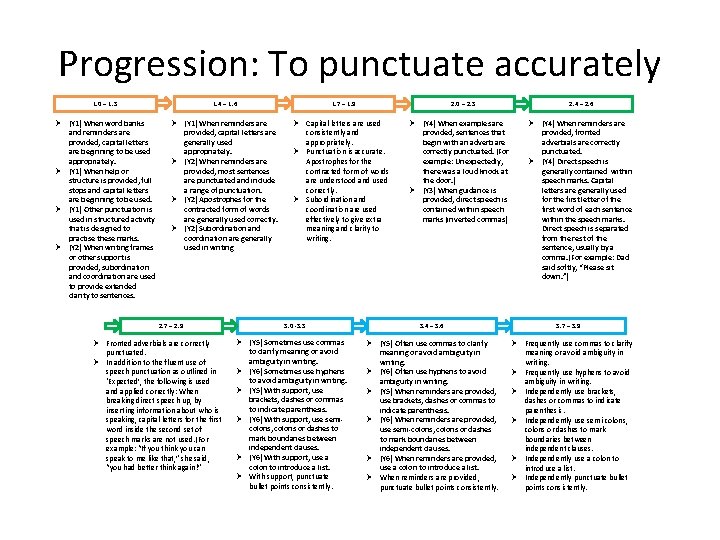
Progression: To punctuate accurately 1. 0 – 1. 3 Ø (Y 1) When word banks and reminders are provided, capital letters are beginning to be used appropriately. Ø (Y 1) When help or structure is provided, full stops and capital letters are beginning to be used. Ø (Y 1) Other punctuation is used in structured activity that is designed to practise these marks. Ø (Y 2) When writing frames or other support is provided, subordination and coordination are used to provide extended clarity to sentences. 1. 4 – 1. 6 1. 7 – 1. 9 Ø (Y 1) When reminders are provided, capital letters are generally used appropriately. Ø (Y 2) When reminders are provided, most sentences are punctuated and include a range of punctuation. Ø (Y 2) Apostrophes for the contracted form of words are generally used correctly. Ø (Y 2) Subordination and coordination are generally used in writing 2. 7 – 2. 9 Ø Fronted adverbials are correctly punctuated. Ø In addition to the fluent use of speech punctuation as outlined in ‘Expected’, the following is used and applied correctly: When breaking direct speech up, by inserting information about who is speaking, capital letters for the first word inside the second set of speech marks are not used. (For example: “If you think you can speak to me like that, ” she said, “you had better think again!” Ø Capital letters are used consistently and appropriately. Ø Punctuation is accurate. Apostrophes for the contracted form of words are understood and used correctly. Ø Subordination and coordination are used effectively to give extra meaning and clarity to writing. Ø Ø Ø to clarify meaning or avoid ambiguity in writing. (Y 6) Sometimes use hyphens to avoid ambiguity in writing. (Y 5) With support, use brackets, dashes or commas to indicate parenthesis. (Y 6) With support, use semicolons, colons or dashes to mark boundaries between independent clauses. (Y 6) With support, use a colon to introduce a list. With support, punctuate bullet points consistently. Ø (Y 4) When examples are Ø (Y 4) When reminders are provided, sentences that begin with an adverb are correctly punctuated. (For example: Unexpectedly, there was a loud knock at the door. ) Ø (Y 3) When guidance is provided, direct speech is contained within speech marks (inverted commas) provided, fronted adverbials are correctly punctuated. Ø (Y 4) Direct speech is generally contained within speech marks. Capital letters are generally used for the first letter of the first word of each sentence within the speech marks. Direct speech is separated from the rest of the sentence, usually by a comma. (For example: Dad said softly, “Please sit down. ”) 3. 4 – 3. 6 3. 0 -3. 3 Ø (Y 5) Sometimes use commas 2. 4 – 2. 6 2. 0 – 2. 3 Ø (Y 5) Often use commas to clarify Ø Ø Ø meaning or avoid ambiguity in writing. (Y 6) Often use hyphens to avoid ambiguity in writing. (Y 5) When reminders are provided, use brackets, dashes or commas to indicate parenthesis. (Y 6) When reminders are provided, use semi-colons, colons or dashes to mark boundaries between independent clauses. (Y 6) When reminders are provided, use a colon to introduce a list. When reminders are provided, punctuate bullet points consistently. 3. 7 – 3. 9 Ø Frequently use commas to clarify Ø Ø Ø meaning or avoid ambiguity in writing. Frequently use hyphens to avoid ambiguity in writing. Independently use brackets, dashes or commas to indicate parenthesis. Independently use semi-colons, colons or dashes to mark boundaries between independent clauses. Independently use a colon to introduce a list. Independently punctuate bullet points consistently.