
Writing art design architecture Aalto University School of

- Slides: 49
Writing art, design & architecture Aalto University School of Arts, Design and Architecture
Session 3 Homework: Writing Activity 2, Exhibition Visit + Draft • Intro to more formal emailing • Writing Process: Generating and Developing Ideas, Structuring Text Paragraph Structure & Development Patchwork writing cont. and Opinions 1/27/15 2
Which of the following statements apply to you? 1. Your email messages often bounce back because of an error in the address? 2. You sometimes wish you could backtrack after sending a message, but it is too late? 3. You sometimes send messages off quickly without a greeting or a sign-off and without checking through for good grammar, spelling and punctuation? 4. You are frequently interrupted throughout the day with a constant flow of emails? 1/27/15 3
If you answered more than one of these items positively, you may need help with your email! 1/27/15 4
Pair work Discuss with your partner: 1)When you read your work/ study-related emails, what are things that bother you in the messages you receive? 2) What are things you find challenging in writing (work/ study-related) emails? 1/27/15 5
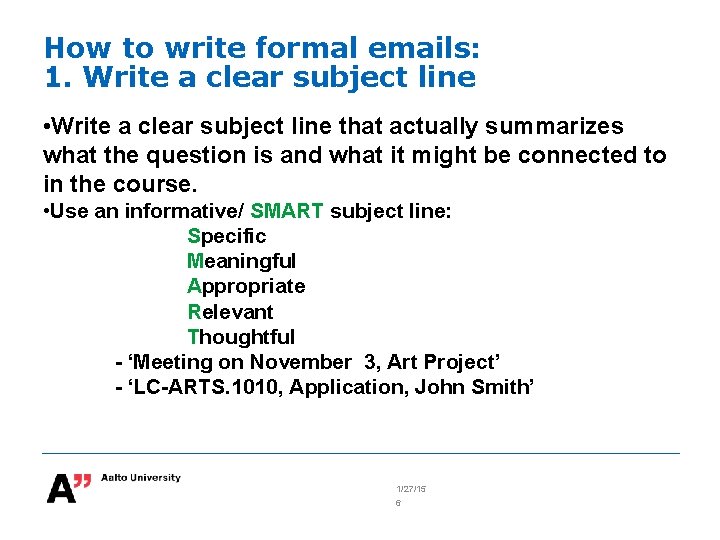
How to write formal emails: 1. Write a clear subject line • Write a clear subject line that actually summarizes what the question is and what it might be connected to in the course. • Use an informative/ SMART subject line: Specific Meaningful Appropriate Relevant Thoughtful - ‘Meeting on November 3, Art Project’ - ‘LC-ARTS. 1010, Application, John Smith’ 1/27/15 6
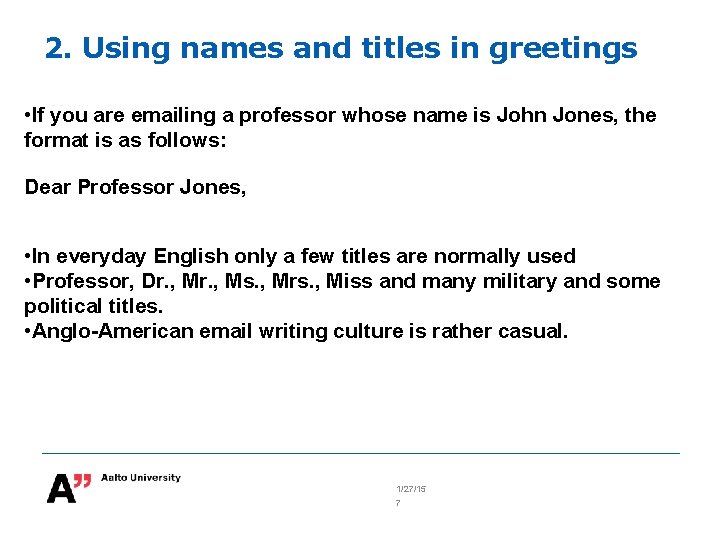
2. Using names and titles in greetings • If you are emailing a professor whose name is John Jones, the format is as follows: Dear Professor Jones, • In everyday English only a few titles are normally used • Professor, Dr. , Ms. , Mrs. , Miss and many military and some political titles. • Anglo-American email writing culture is rather casual. 1/27/15 7
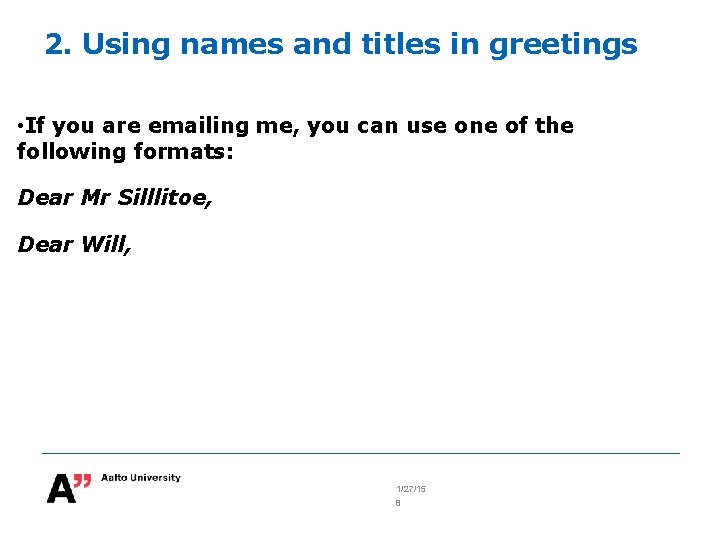
2. Using names and titles in greetings • If you are emailing me, you can use one of the following formats: Dear Mr Silllitoe, Dear Will, 1/27/15 8
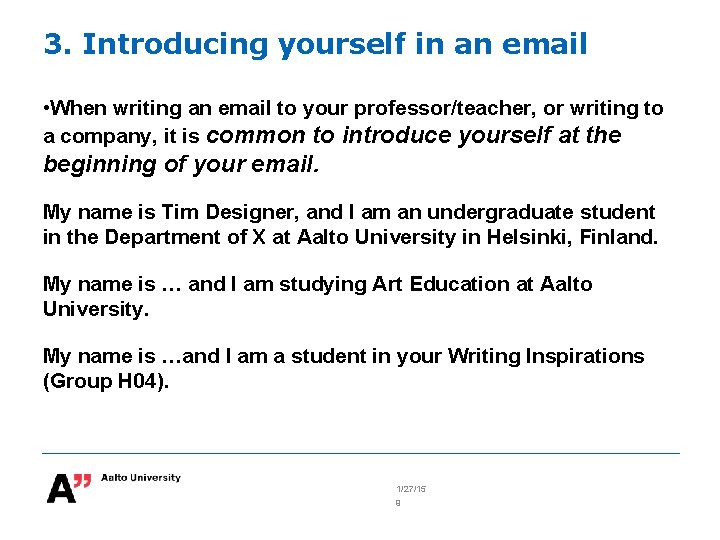
3. Introducing yourself in an email • When writing an email to your professor/teacher, or writing to a company, it is common to introduce yourself at the beginning of your email. My name is Tim Designer, and I am an undergraduate student in the Department of X at Aalto University in Helsinki, Finland. My name is … and I am studying Art Education at Aalto University. My name is …and I am a student in your Writing Inspirations (Group H 04). 1/27/15 9
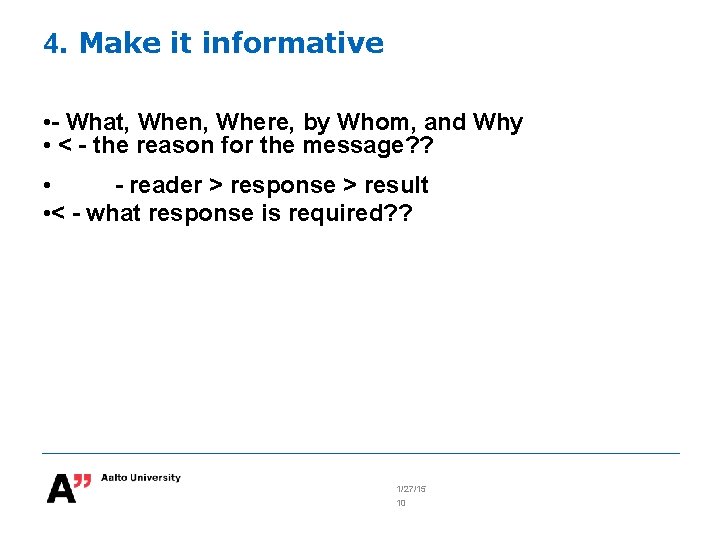
4. Make it informative • - What, When, Where, by Whom, and Why • < - the reason for the message? ? • - reader > response > result • < - what response is required? ? 1/27/15 10
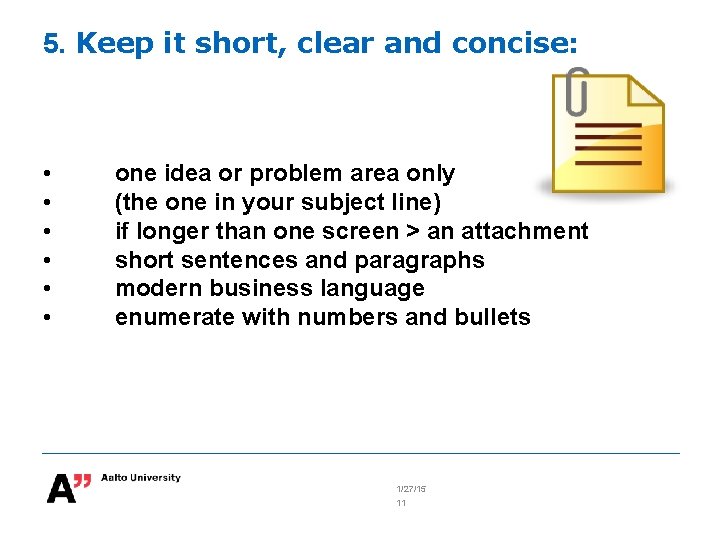
5. Keep it short, clear and concise: • • • one idea or problem area only (the one in your subject line) if longer than one screen > an attachment short sentences and paragraphs modern business language enumerate with numbers and bullets 1/27/15 11
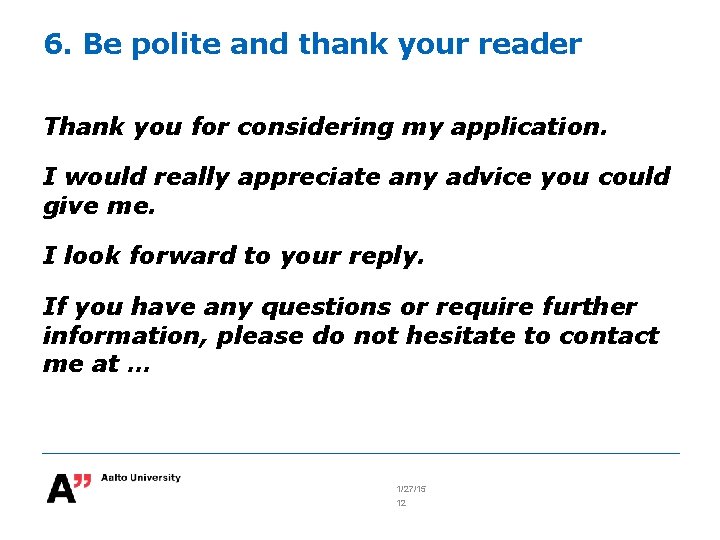
6. Be polite and thank your reader Thank you for considering my application. I would really appreciate any advice you could give me. I look forward to your reply. If you have any questions or require further information, please do not hesitate to contact me at … 1/27/15 12
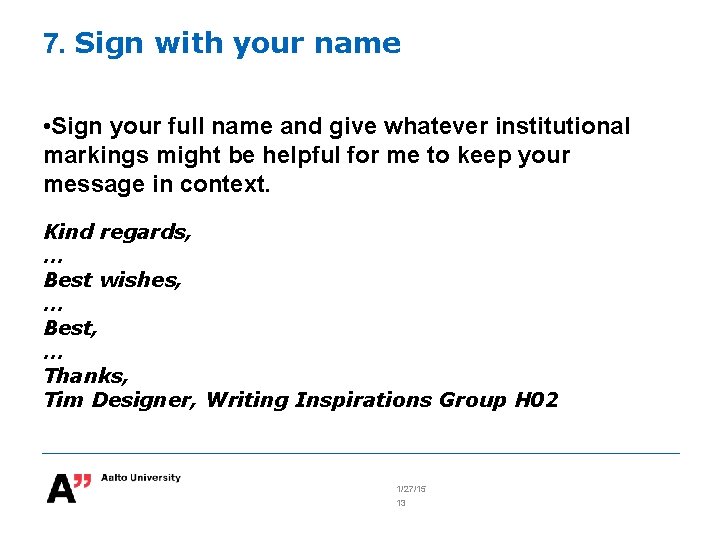
7. Sign with your name • Sign your full name and give whatever institutional markings might be helpful for me to keep your message in context. Kind regards, … Best wishes, … Best, … Thanks, Tim Designer, Writing Inspirations Group H 02 1/27/15 13
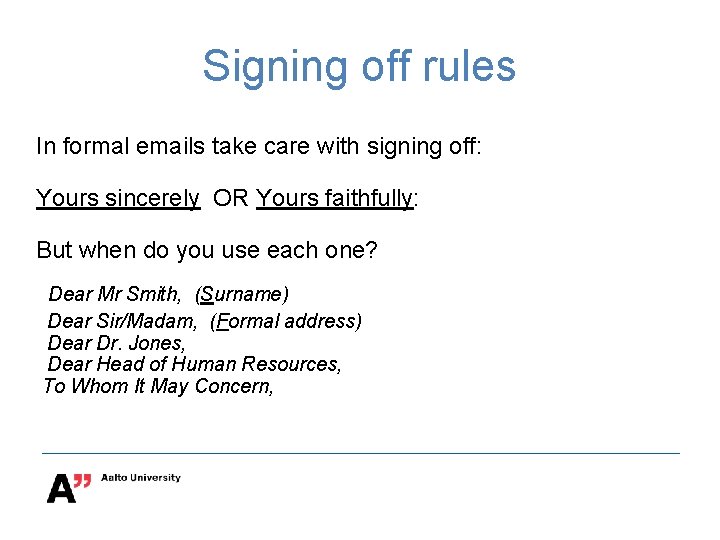
Signing off rules In formal emails take care with signing off: Yours sincerely OR Yours faithfully: But when do you use each one? Dear Mr Smith, (Surname) Dear Sir/Madam, (Formal address) Dear Dr. Jones, Dear Head of Human Resources, To Whom It May Concern,
8. Proof-read your message • your email = you as a professional > haphazard writing = bad work in general? > your image = the image of your company? • blind to our own errors; dyslexia? > use a spell-checker or a peer! 1/27/15 15
Email summary: audience and style -Have I convinced my reader to act? -Have I followed conventions? -salutation & use of name? -formal style? -closing? -Is the tone reasonable, calm, and professional (indirect enough)? -Have I included the relevant facts? -Have I been both thorough and succinct? 1/27/15 16
Analysis of Some Work Emails; Their Good And Bad Points With your partner, analyse the following emails and comment on the following things: 1)Subject line (SMART or vague)? 2)Greeting and sign off? 3)Message: Informative/ vague? 4)Language used (abbreviations, contractions, full/ incomplete sentences) > electronic rapport/tone of voice? 5)In/formality, professionalism? 1/27/15 17
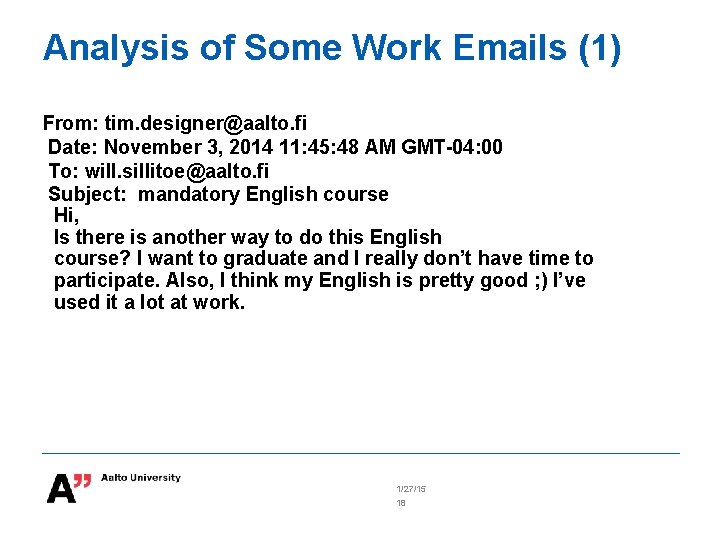
Analysis of Some Work Emails (1) From: tim. designer@aalto. fi Date: November 3, 2014 11: 45: 48 AM GMT-04: 00 To: will. sillitoe@aalto. fi Subject: mandatory English course Hi, Is there is another way to do this English course? I want to graduate and I really don’t have time to participate. Also, I think my English is pretty good ; ) I’ve used it a lot at work. 1/27/15 18
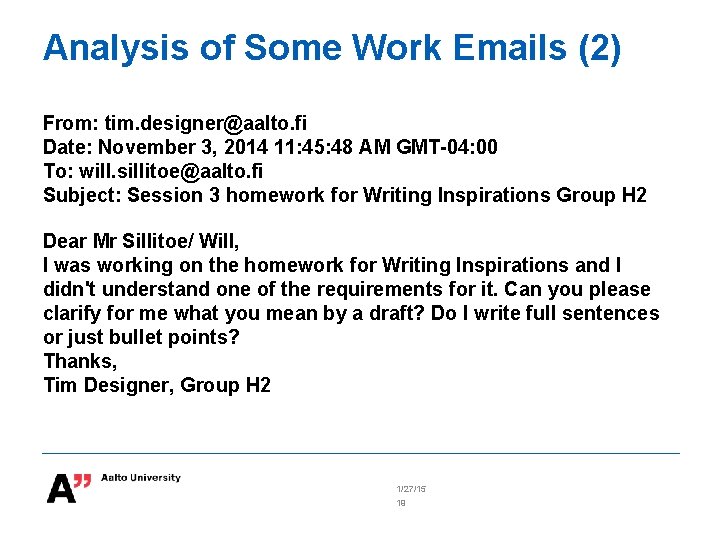
Analysis of Some Work Emails (2) From: tim. designer@aalto. fi Date: November 3, 2014 11: 45: 48 AM GMT-04: 00 To: will. sillitoe@aalto. fi Subject: Session 3 homework for Writing Inspirations Group H 2 Dear Mr Sillitoe/ Will, I was working on the homework for Writing Inspirations and I didn't understand one of the requirements for it. Can you please clarify for me what you mean by a draft? Do I write full sentences or just bullet points? Thanks, Tim Designer, Group H 2 1/27/15 19
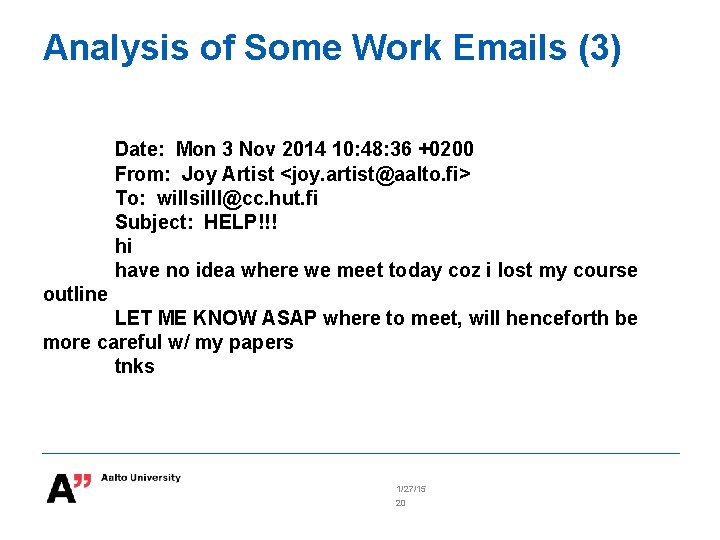
Analysis of Some Work Emails (3) Date: Mon 3 Nov 2014 10: 48: 36 +0200 From: Joy Artist <joy. artist@aalto. fi> To: willsilll@cc. hut. fi Subject: HELP!!! hi have no idea where we meet today coz i lost my course outline LET ME KNOW ASAP where to meet, will henceforth be more careful w/ my papers tnks 1/27/15 20
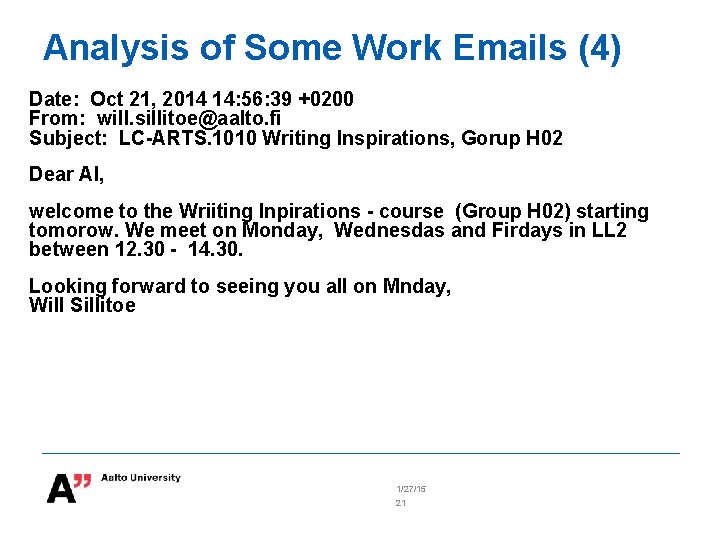
Analysis of Some Work Emails (4) Date: Oct 21, 2014 14: 56: 39 +0200 From: will. sillitoe@aalto. fi Subject: LC-ARTS. 1010 Writing Inspirations, Gorup H 02 Dear Al, welcome to the Wriiting Inpirations - course (Group H 02) starting tomorow. We meet on Monday, Wednesdas and Firdays in LL 2 between 12. 30 - 14. 30. Looking forward to seeing you all on Mnday, Will Sillitoe 1/27/15 21
Applying the emailing conventions Go back to your Writing Activity 1 Now that you know more about emailing conventions, can you identify anything that you would perhaps want to modify/ phrase differently in your email to your teacher? If need be, share your ideas with your neighbor/ teacher. 1/27/15 22
Writing Process Getting started – generating & developing ideas Discuss the following points with your partner/ in small groups: • How do you normally get going with your writing? • How do you generate ideas? And then develop them? • Any similarity between your writing process and your design processes/ art projects? • Share some of your experiences with the whole group. 1/27/15 24
Writing Process Getting started – generating & developing ideas Brainstorming ideas: • Mind mapping • Thought chains • Bullet points • Lists • Etc. ? 1/27/15 25
Writing Process Getting started – generating & developing ideas • Ever frustrated that you are constantly going off at a tangent and getting off the point? ? • Go out, come back, go out again and come back to your main point. • Positive!! Adding to your idea, selecting which ones to follow in more detail. 1/27/15 26
Structures and structuring text As a reader, what sort of structure do you expect from texts, if any? 1/27/15 27
Structures and structuring text • Different structures are needed for different types of writing! newspaper story academic text magazine story 1/27/15 28
Structures and structuring text One generalization: • Beginning (introduction) • Middle (development) • End (conclusion) 1/27/15 29
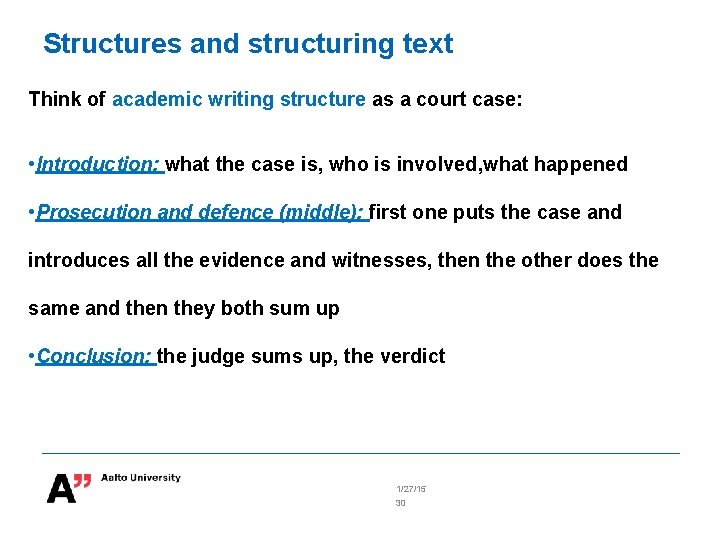
Structures and structuring text Think of academic writing structure as a court case: • Introduction: what the case is, who is involved, what happened • Prosecution and defence (middle): first one puts the case and introduces all the evidence and witnesses, then the other does the same and then they both sum up • Conclusion: the judge sums up, the verdict 1/27/15 30
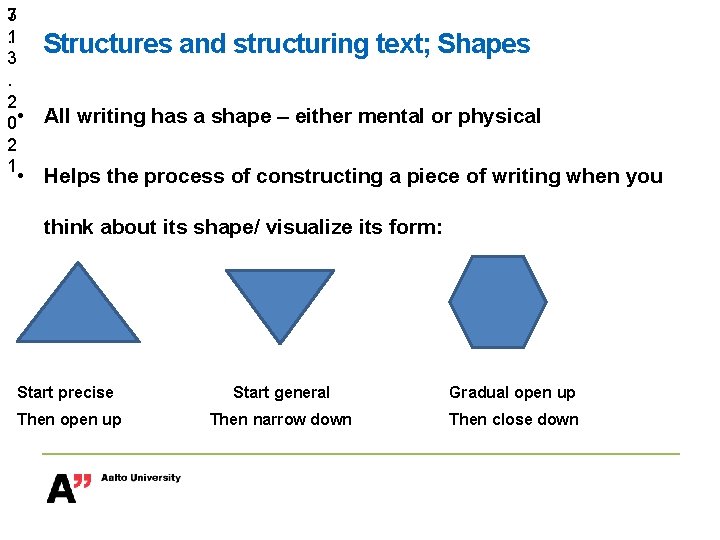
3 7. 1 3. 2 0 • 2 1 Structures and structuring text; Shapes All writing has a shape – either mental or physical • Helps the process of constructing a piece of writing when you think about its shape/ visualize its form: Start precise Then open up Start general Then narrow down Gradual open up Then close down
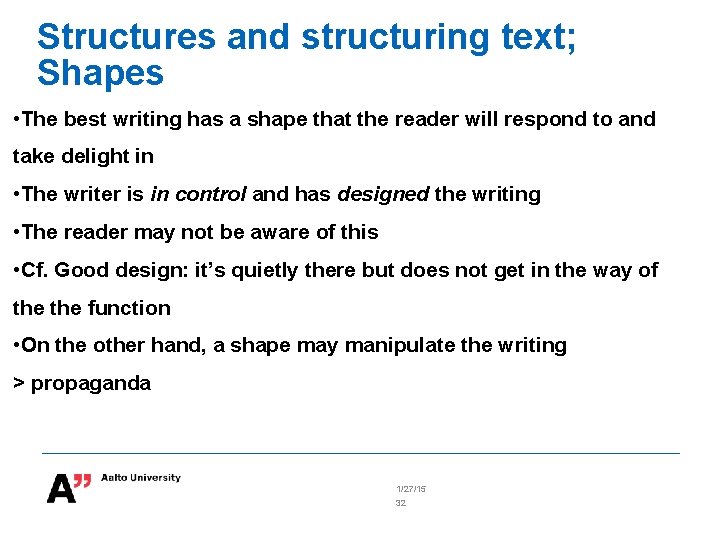
Structures and structuring text; Shapes • The best writing has a shape that the reader will respond to and take delight in • The writer is in control and has designed the writing • The reader may not be aware of this • Cf. Good design: it’s quietly there but does not get in the way of the function • On the other hand, a shape may manipulate the writing > propaganda 1/27/15 32
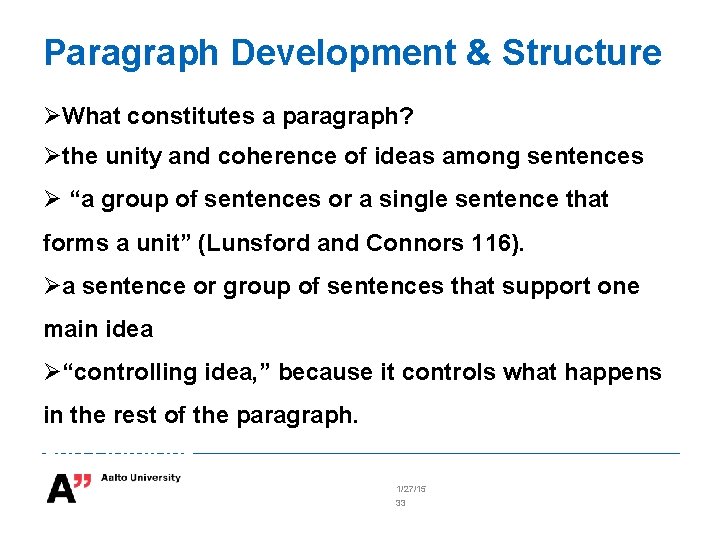
Paragraph Development & Structure What constitutes a paragraph? the unity and coherence of ideas among sentences “a group of sentences or a single sentence that forms a unit” (Lunsford and Connors 116). a sentence or group of sentences that support one main idea “controlling idea, ” because it controls what happens in the rest of the paragraph. and Opinions 1/27/15 33
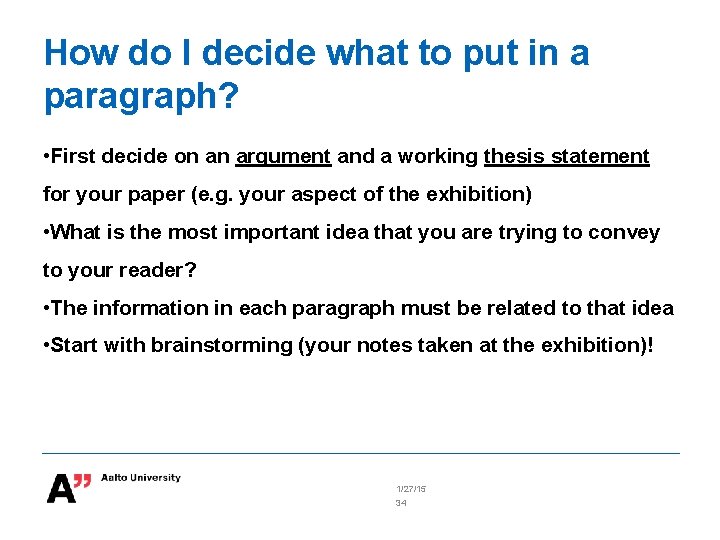
How do I decide what to put in a paragraph? • First decide on an argument and a working thesis statement for your paper (e. g. your aspect of the exhibition) • What is the most important idea that you are trying to convey to your reader? • The information in each paragraph must be related to that idea • Start with brainstorming (your notes taken at the exhibition)! 1/27/15 34
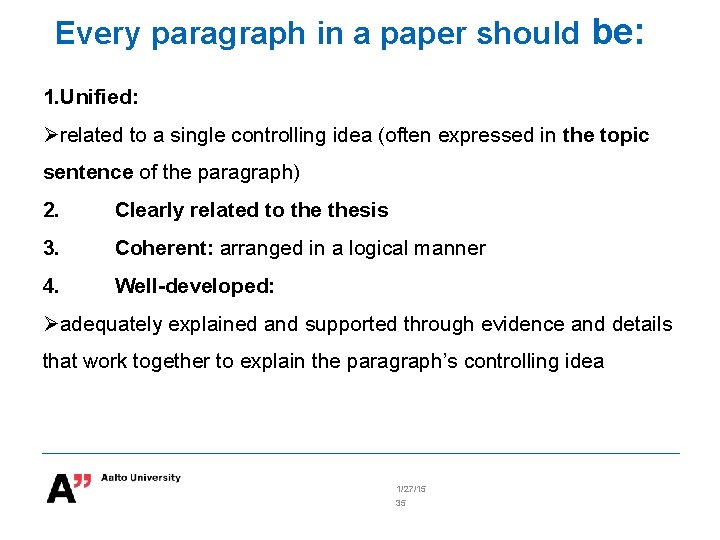
Every paragraph in a paper should be: 1. Unified: related to a single controlling idea (often expressed in the topic sentence of the paragraph) 2. Clearly related to thesis 3. Coherent: arranged in a logical manner 4. Well-developed: adequately explained and supported through evidence and details that work together to explain the paragraph’s controlling idea 1/27/15 35
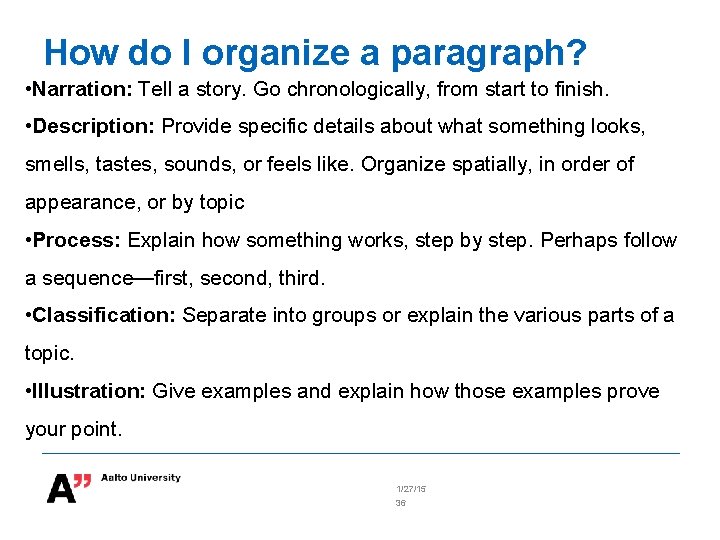
How do I organize a paragraph? • Narration: Tell a story. Go chronologically, from start to finish. • Description: Provide specific details about what something looks, smells, tastes, sounds, or feels like. Organize spatially, in order of appearance, or by topic • Process: Explain how something works, step by step. Perhaps follow a sequence—first, second, third. • Classification: Separate into groups or explain the various parts of a topic. • Illustration: Give examples and explain how those examples prove your point. 1/27/15 36
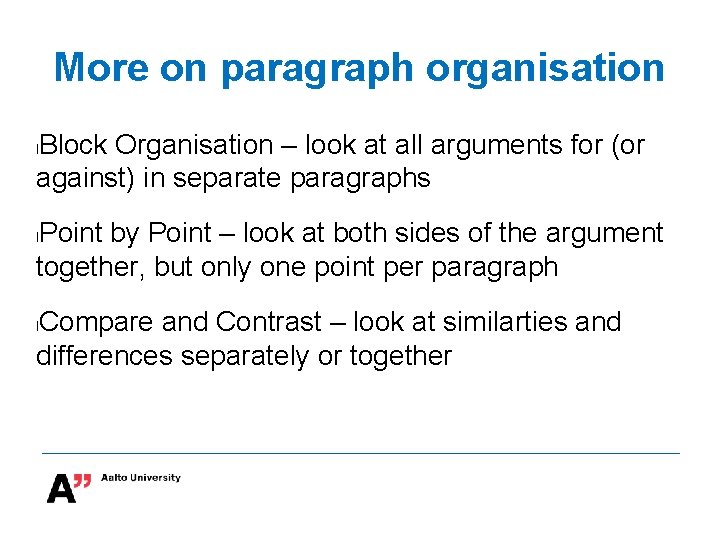
More on paragraph organisation Block Organisation – look at all arguments for (or against) in separate paragraphs l Point by Point – look at both sides of the argument together, but only one point per paragraph l Compare and Contrast – look at similarties and differences separately or together l
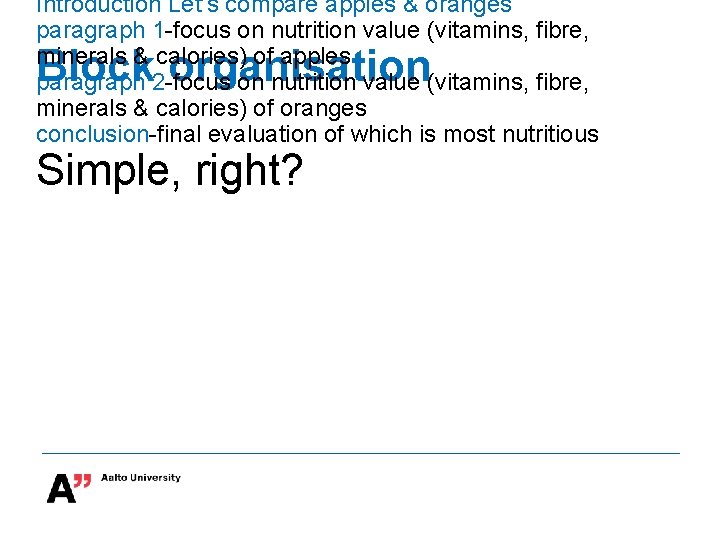
Introduction Let’s compare apples & oranges paragraph 1 -focus on nutrition value (vitamins, fibre, minerals & calories) of apples paragraph 2 -focus on nutrition value (vitamins, fibre, minerals & calories) of oranges conclusion-final evaluation of which is most nutritious Block organisation Simple, right?
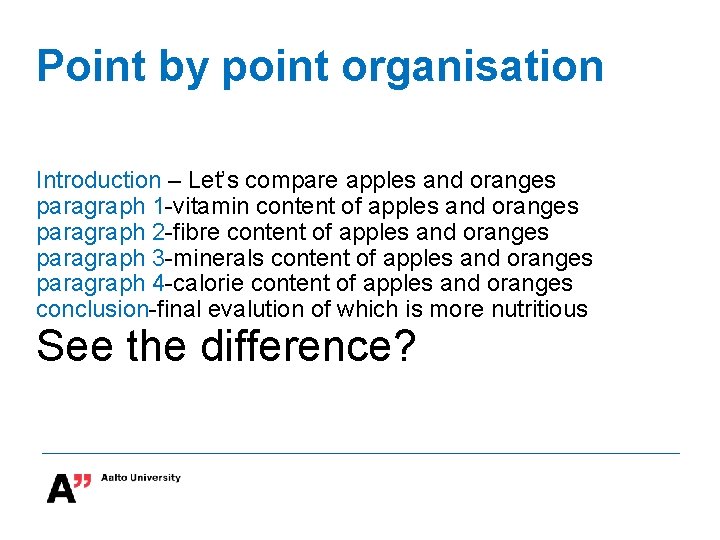
Point by point organisation Introduction – Let’s compare apples and oranges paragraph 1 -vitamin content of apples and oranges paragraph 2 -fibre content of apples and oranges paragraph 3 -minerals content of apples and oranges paragraph 4 -calorie content of apples and oranges conclusion-final evalution of which is more nutritious See the difference?
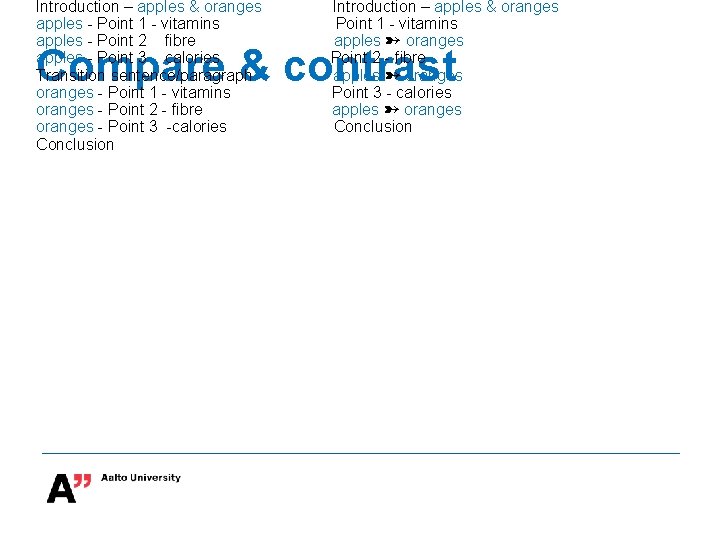
Introduction – apples & oranges Introduction – apples & oranges apples - Point 1 - vitamins Point 1 - vitamins apples - Point 2 fibre apples ➸ oranges apples - Point 3 calories Point 2 - fibre Transition sentence/paragraph apples ➸ oranges - Point 1 - vitamins Point 3 - calories oranges - Point 2 - fibre apples ➸ oranges - Point 3 -calories Conclusion Compare & contrast
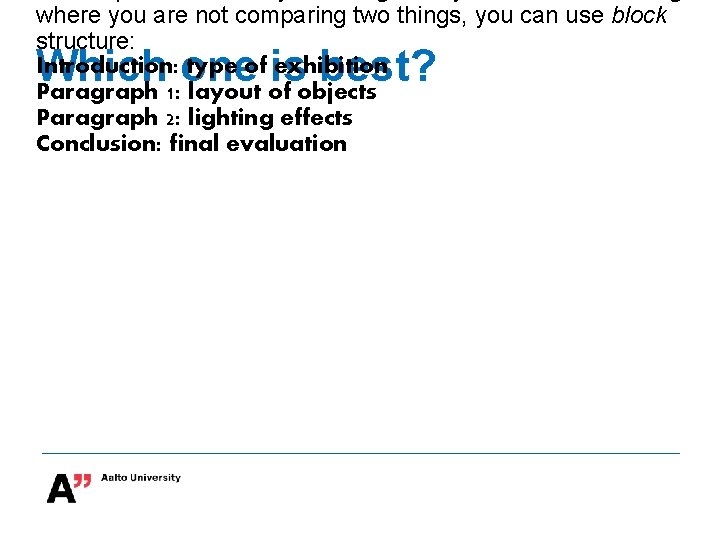
where you are not comparing two things, you can use block structure: Introduction: type of exhibition Paragraph 1: layout of objects Paragraph 2: lighting effects Conclusion: final evaluation Which one is best?
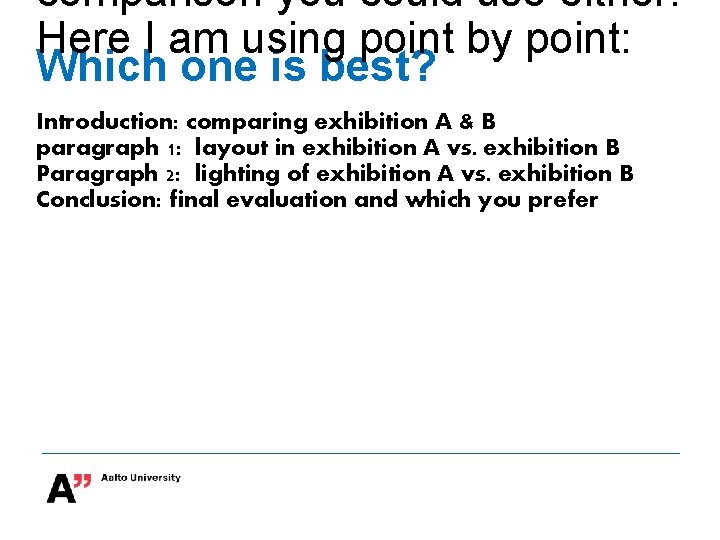
comparison you could use either. Here I am using point by point: Which one is best? Introduction: comparing exhibition A & B paragraph 1: layout in exhibition A vs. exhibition B Paragraph 2: lighting of exhibition A vs. exhibition B Conclusion: final evaluation and which you prefer
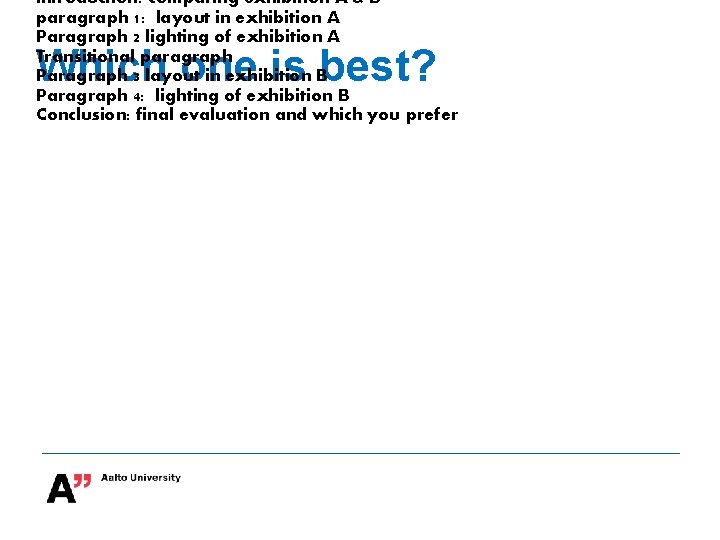
introduction: comparing exhibition A & B paragraph 1: layout in exhibition A Paragraph 2 lighting of exhibition A Transitional paragraph Paragraph 3 layout in exhibition B Paragraph 4: lighting of exhibition B Conclusion: final evaluation and which you prefer Which one is best?
In Mycourses Session 3, • Go to the handout ‘An exercise on paragraph breaks and controlling ideas’ • Divide the text into paragraphs. • Remember that each paragraph should develop a particular theme. 1/27/15 44
sentences & Now let’s look at… Transistional words and phrases & a few other things….
Patchwork writing A description of a layout An observation of the viewers at the exhibition An interview of another exhibition visitor A description of the content Other inspirations (creative, reflective, analytical) Putting the subject in its art-historical context A comparison to other exhibitions Bringing out the negative side of the exhibition Personal feelings, inspirations… Relevance to your own field 1/27/15 46
Paragraph Structure & Development Look at your own notes/ draft. Plan your paragraph structure/ development. Does each paragraph have one central theme/ controlling idea? Does each paragraph have a topic sentence stating the main topic of that paragraph? Is every idea in a paragraph adequately explained and supported through evidence and details? Make changes to your own paper accordingly. 1/27/15 47
Paragraph Structure & Development Swap computers with your neighbor. Have him/ her read your paper and answer these questions: What is the controlling idea in each paragraph? Does each paragraph have a topic sentence stating the main topic of that paragraph? Is every idea in a paragraph adequately explained and supported through evidence and details? 1/27/15 48
Homework: 1. Work on your Patchwork writing at home according to what you learned in class today. • Bring your revised draft to the next class! 2. Study the handout on ”Intro to academic writing” (available in Mycourses Session 3) and do the exercises (8 and 9). 1/27/15 49