
Writing Arguments Chapter 4 Logos Ethos and Pathos

- Slides: 10
Writing Arguments (Chapter 4) Logos, Ethos, and Pathos CS 4001 Mary Jean Harrold 1
Arguments: Claims with Reasons Rhetorical Triangle Logos - internal consistency and clarity, logic of reasons and support (logical appeal) Ethos - credibility of arguer, care in presenting alternate views, writer investment in claims, possibly reputation for honesty and expertise (ethical appeal) Pathos - appealing to audiences imaginative sympathies, making argument palpable and immediate CS 4001 Mary Jean Harrold 3
Arguments: Claims with Reasons Rhetorical Triangle Logos - internal consistency and clarity, logic of reasons and support (logical appeal) Ethos - credibility of arguer, care in presenting alternate views, writer investment in claims, possibly reputation for honesty and expertise (ethical appeal) Pathos - appealing to audiences imaginative sympathies, making argument palpable and immediate CS 4001 Mary Jean Harrold 4
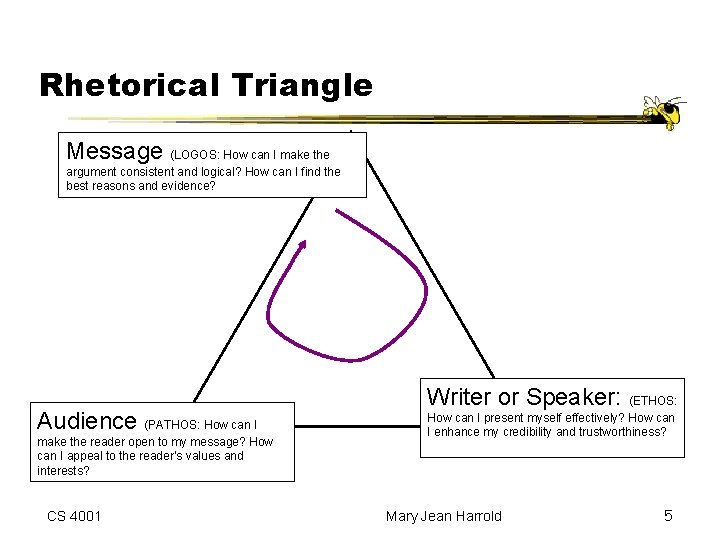
Rhetorical Triangle Message (LOGOS: How can I make the argument consistent and logical? How can I find the best reasons and evidence? Audience (PATHOS: How can I make the reader open to my message? How can I appeal to the reader’s values and interests? CS 4001 Writer or Speaker: (ETHOS: How can I present myself effectively? How can I enhance my credibility and trustworthiness? Mary Jean Harrold 5
Facts What are they? A fact is a non-controversial piece of data that is verifiable through observation or through appeal to communally accepted authorities. Facts can increase persuasiveness by having Recency. What’s the latest data? Representativeness. Are the supporting examples typical rather than extreme or rare. Sufficiency. Are there enough examples to justify the point. (No hasty generalization. ) CS 4001 Mary Jean Harrold 6
Issue Questions are the Basis of Argument Issue question: controversial question that gives rise to alternative answers. Issue versus information questions Some questions merely call for more information, not argument. In answering an information question, you assume the role of a teacher. But if you must assume the role of an advocate, then the question is an issue question. Also if the facts of the answer are controversial, then the question is an issue question. CS 4001 Mary Jean Harrold 7
Issue Questions are the Basis of Argument Issue question: controversial question that gives rise to alternative answers. Issue versus information questions Some questions merely call for more information, not argument. In answering an information question, you assume the role of a teacher. But if you must assume the role of an advocate, then the question is an issue question. Also if the facts of the answer are controversial, then the question is an issue question. CS 4001 Mary Jean Harrold 8
Arguments VS Pseudo Arguments A genuine argument requires CS 4001 Mary Jean Harrold 9
Arguments VS Pseudo Arguments A genuine argument requires Reasonable participants who operate within the conventions of reasonable behavior. Potentially shareable assumptions that can serve as a starting place or foundation for the argument. Otherwise, it is a pseudo-argument: Fanatical believers or fanatical skeptics Lack of shared assumptions CS 4001 Mary Jean Harrold 10
Arguments: Claims Supported by Reasons What is a reason? A reason is a claim used to support another claim. Reasons are usually linked to their claims with words like because, thus, since, consequently, and therefore to underscore their logical connection. Formulating lists of reasons for the competing views can break the persuasive task into more manageable subtasks. A good way to formulate an argument is to create a working thesis statement that summarizes your main reasons as because clauses attached to your claim. However, be aware of the opposing points of view. CS 4001 Mary Jean Harrold 11