
Writing and presenting in science Research Methodology Dr

- Slides: 23
Writing and presenting (in) science Research Methodology Dr. Gabor Zemplen Akos Gyarmathy
Guidelines for presentation • Appr. 5 -7 minutes (NOT more than 7!) Did you practice? • 5 -10 slides: info / „notes” – sent by Sunday 22. 00 via email • Clear focus of the topic • Relevance of Res Meth • The Overview of Your Research (Bibliography) • +1 page with info on: members of the group (2 -3) and % workload • Optional: handout for class / uploadable, max. 2 pages
Why do people write science? • To be revolutionary and write history • To get a degree or two • To contribute to universal human knowledge • To think something through clearly • To get feedback on your work • To discuss your work with the scientific community • To make a living • • Required by the employer university Required to fund expensive research Required to get accepted to top graduate schools Required to get accepted to a good post-doc position
Impact factor as a scientific metric unit for funds ERC Starting Grants in brief Eligibility: researchers of any nationality with 2 -7 years of experience since completion of Ph. D a scientific track record showing great promise and an excellent research proposal Location: research must be conducted in a public or private research organisation (known as a Host Institution /HI). It could be the HI where the applicant already works, or any other HI located in one of the EU Member States or Associated Countrie Funding per grant: up to € 1. 5 million Duration: up to 5 years Sole evaluation criterion: scientific excellence of researcher and research proposal Calls for proposals: published once a year
Impact factor as a scientific metric unit for funds • Applicants for the ERC Starting Grants - called Principal Investigators (PI) must have already shown the potential for research independence and evidence of maturity. • For example, by having produced at least one important publication without the participation of their Ph. D supervisor. • Applicants should also be able to demonstrate a promising track-record of early achievements appropriate to their research field and career stage, including significant publications (as main author) in major international peer-reviewed multidisciplinary scientific journals, or in the leading international peer-reviewed journals of their respective field. • They may also demonstrate a record of invited presentations in wellestablished international conferences, granted patents, awards, prizes etc.
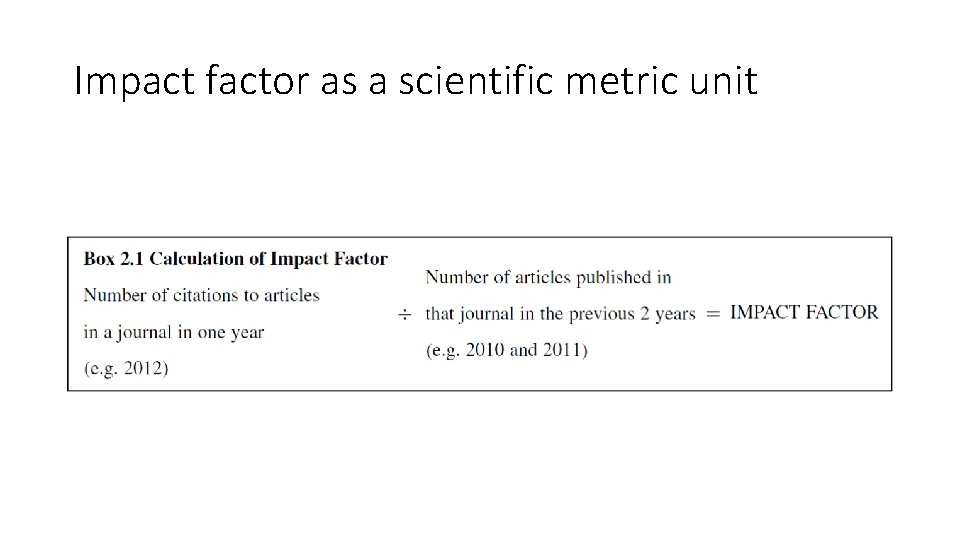
Impact factor as a scientific metric unit
Guidelines for presentation • Appr. 5 -7 minutes (NOT more than 7!) Did you practice? • 5 -10 slides: info / „notes” – sent by Sunday 22. 00 via email • Clear focus of the topic • Relevance of Res Meth • The Overview of Your Research (Bibliography) • +1 page with info on: members of the group (2 -3) and % workload • Optional: handout for class / uploadable, max. 2 pages
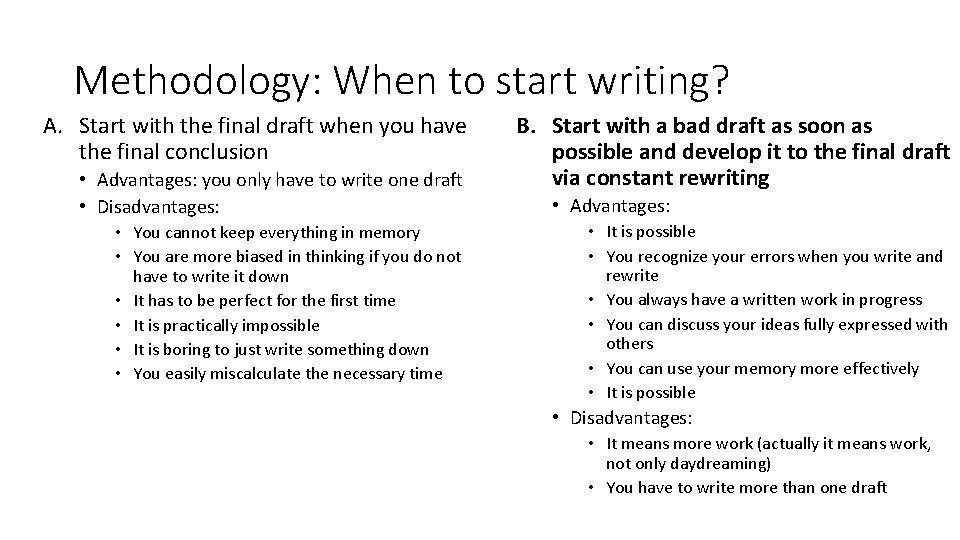
Methodology: When to start writing? A. Start with the final draft when you have the final conclusion • Advantages: you only have to write one draft • Disadvantages: • You cannot keep everything in memory • You are more biased in thinking if you do not have to write it down • It has to be perfect for the first time • It is practically impossible • It is boring to just write something down • You easily miscalculate the necessary time B. Start with a bad draft as soon as possible and develop it to the final draft via constant rewriting • Advantages: • It is possible • You recognize your errors when you write and rewrite • You always have a written work in progress • You can discuss your ideas fully expressed with others • You can use your memory more effectively • It is possible • Disadvantages: • It means more work (actually it means work, not only daydreaming) • You have to write more than one draft
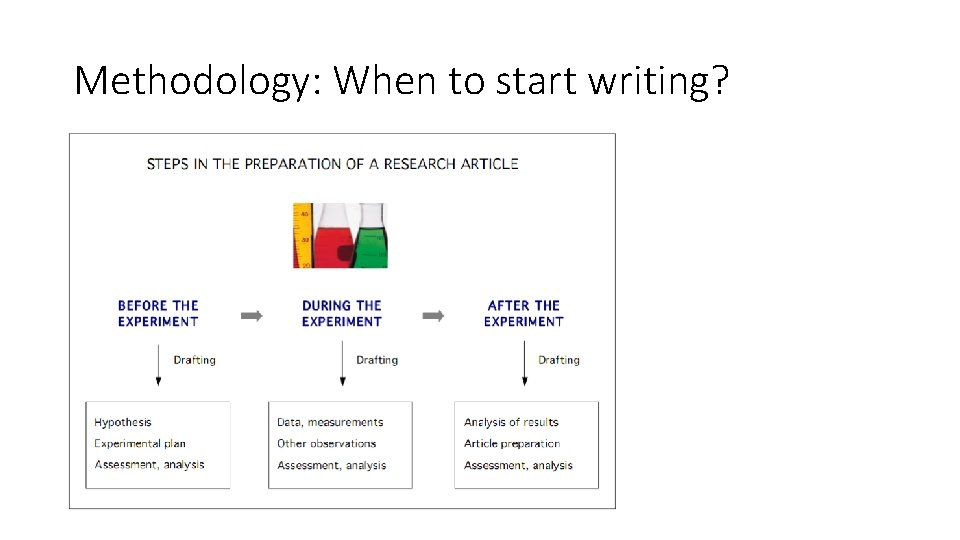
Methodology: When to start writing?
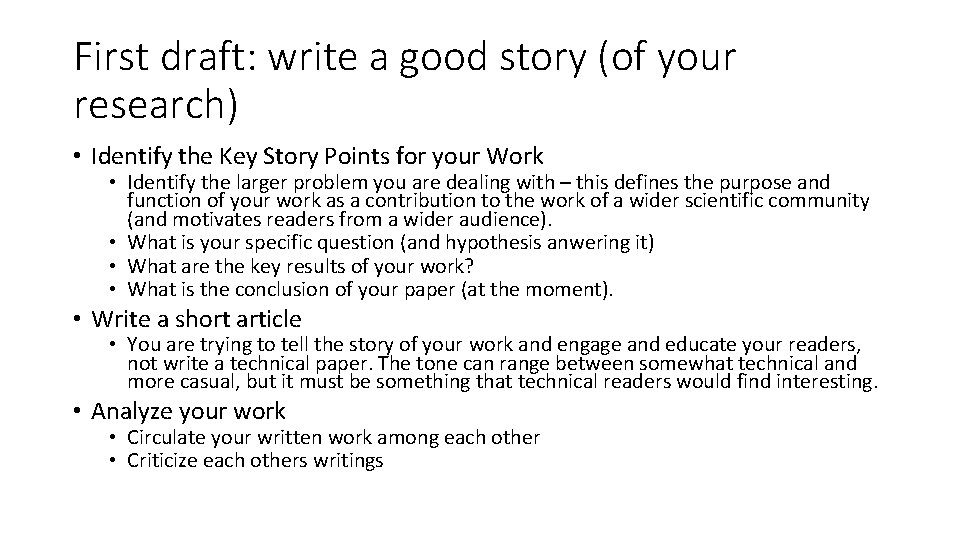
First draft: write a good story (of your research) • Identify the Key Story Points for your Work • Identify the larger problem you are dealing with – this defines the purpose and function of your work as a contribution to the work of a wider scientific community (and motivates readers from a wider audience). • What is your specific question (and hypothesis anwering it) • What are the key results of your work? • What is the conclusion of your paper (at the moment). • Write a short article • You are trying to tell the story of your work and engage and educate your readers, not write a technical paper. The tone can range between somewhat technical and more casual, but it must be something that technical readers would find interesting. • Analyze your work • Circulate your written work among each other • Criticize each others writings
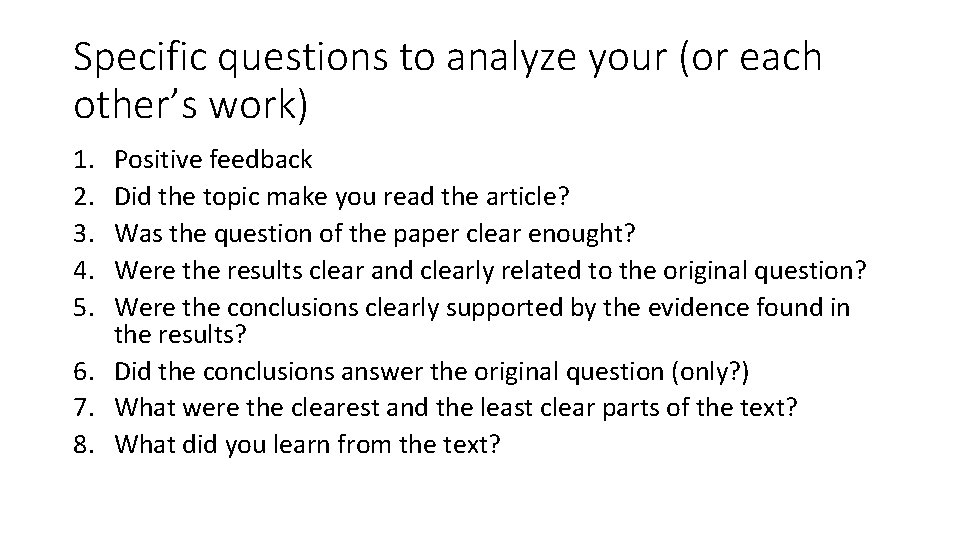
Specific questions to analyze your (or each other’s work) 1. 2. 3. 4. 5. Positive feedback Did the topic make you read the article? Was the question of the paper clear enought? Were the results clear and clearly related to the original question? Were the conclusions clearly supported by the evidence found in the results? 6. Did the conclusions answer the original question (only? ) 7. What were the clearest and the least clear parts of the text? 8. What did you learn from the text?
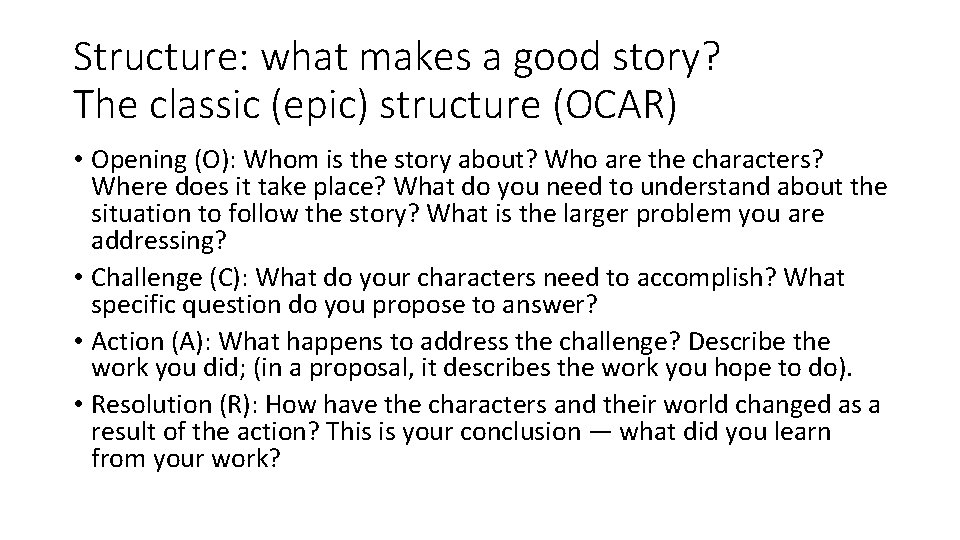
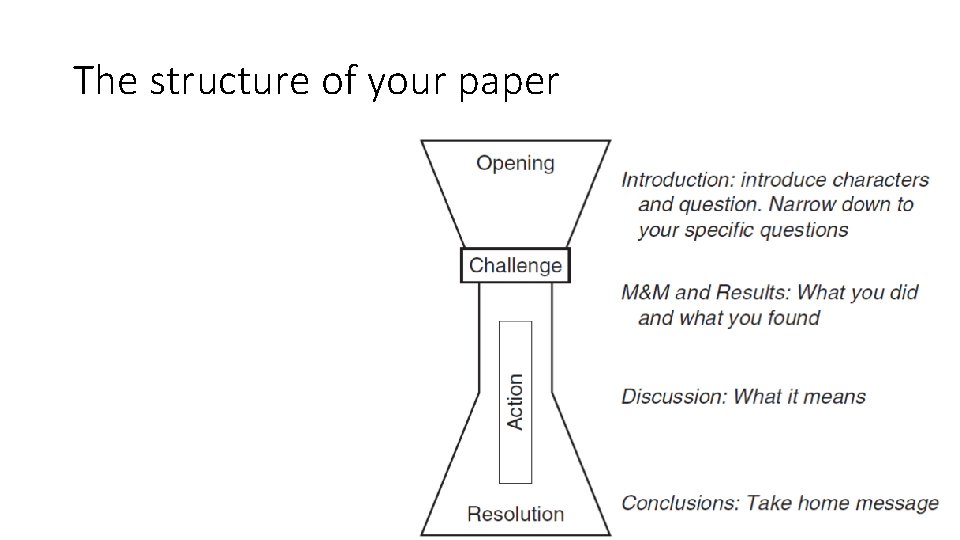
Structure: what makes a good story? The classic (epic) structure (OCAR) • Opening (O): Whom is the story about? Who are the characters? Where does it take place? What do you need to understand about the situation to follow the story? What is the larger problem you are addressing? • Challenge (C): What do your characters need to accomplish? What specific question do you propose to answer? • Action (A): What happens to address the challenge? Describe the work you did; (in a proposal, it describes the work you hope to do). • Resolution (R): How have the characters and their world changed as a result of the action? This is your conclusion — what did you learn from your work?
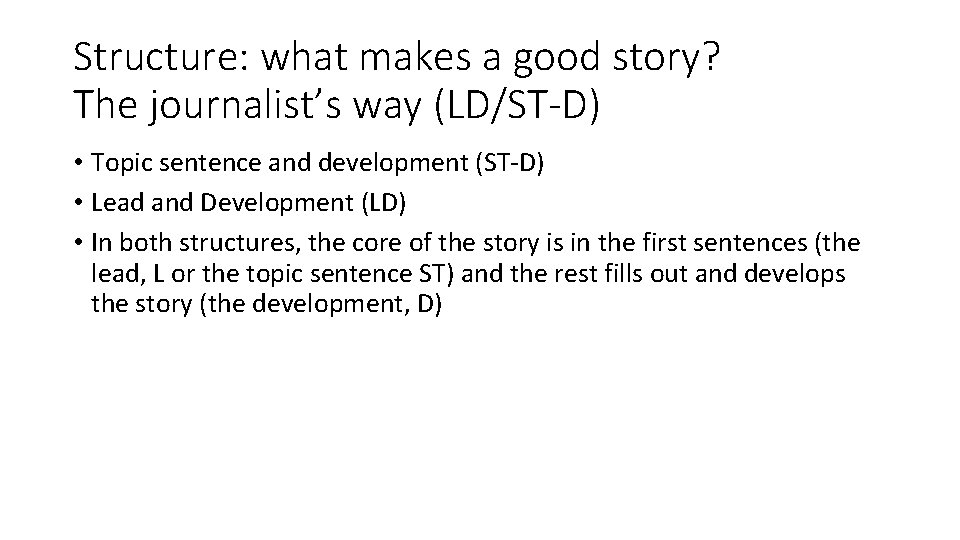
Structure: what makes a good story? The journalist’s way (LD/ST-D) • Topic sentence and development (ST-D) • Lead and Development (LD) • In both structures, the core of the story is in the first sentences (the lead, L or the topic sentence ST) and the rest fills out and develops the story (the development, D)
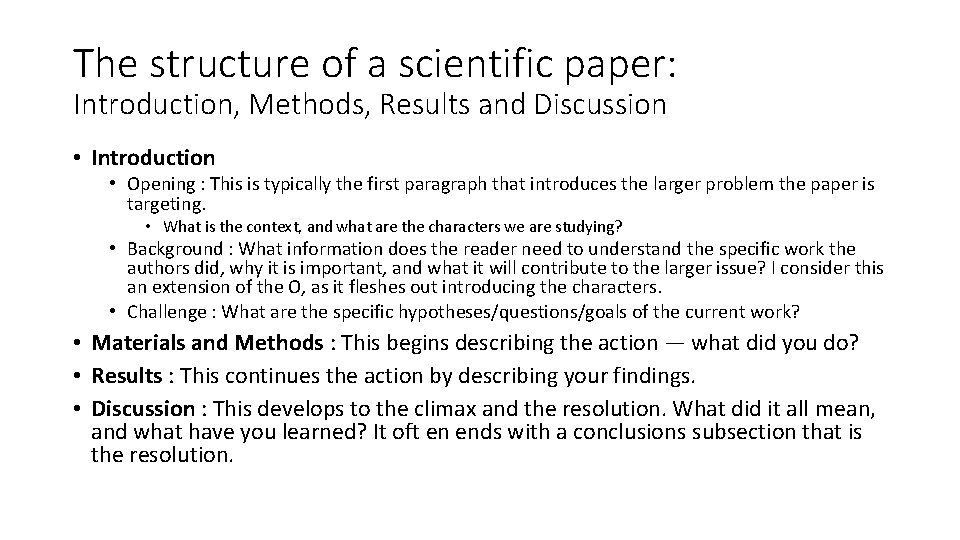
The structure of a scientific paper: Introduction, Methods, Results and Discussion • Introduction • Opening : This is typically the first paragraph that introduces the larger problem the paper is targeting. • What is the context, and what are the characters we are studying? • Background : What information does the reader need to understand the specific work the authors did, why it is important, and what it will contribute to the larger issue? I consider this an extension of the O, as it fleshes out introducing the characters. • Challenge : What are the specific hypotheses/questions/goals of the current work? • Materials and Methods : This begins describing the action — what did you do? • Results : This continues the action by describing your findings. • Discussion : This develops to the climax and the resolution. What did it all mean, and what have you learned? It oft en ends with a conclusions subsection that is the resolution.
The structure of your paper
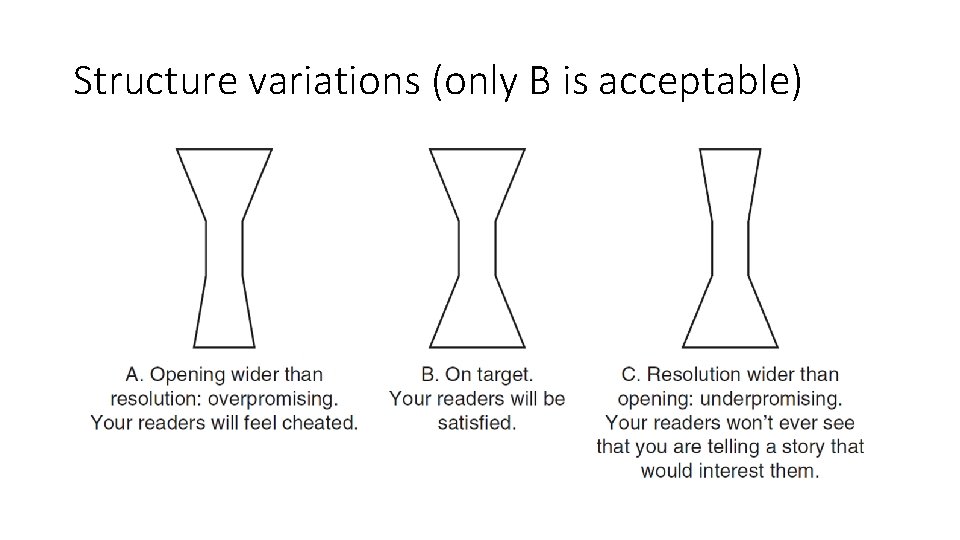
Structure variations (only B is acceptable)
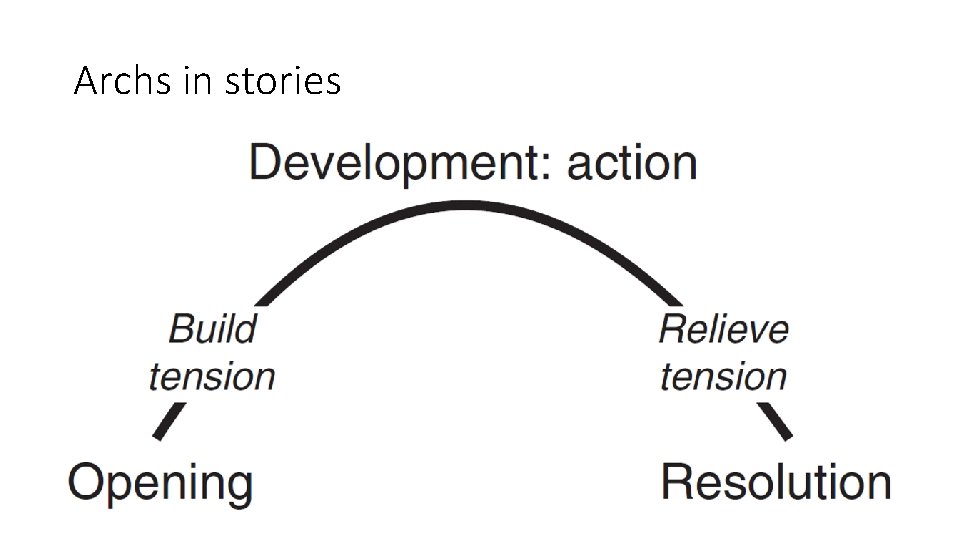
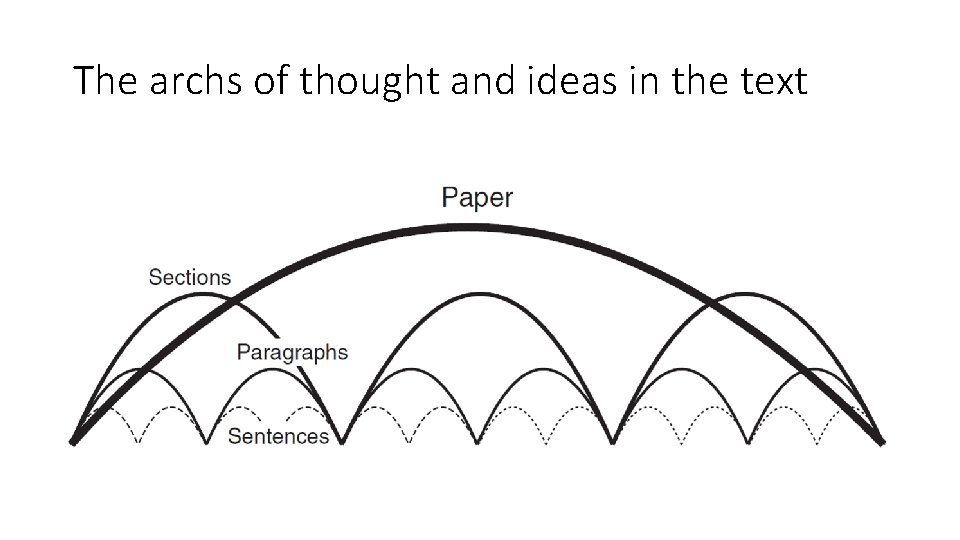
Archs in stories
The archs of thought and ideas in the text
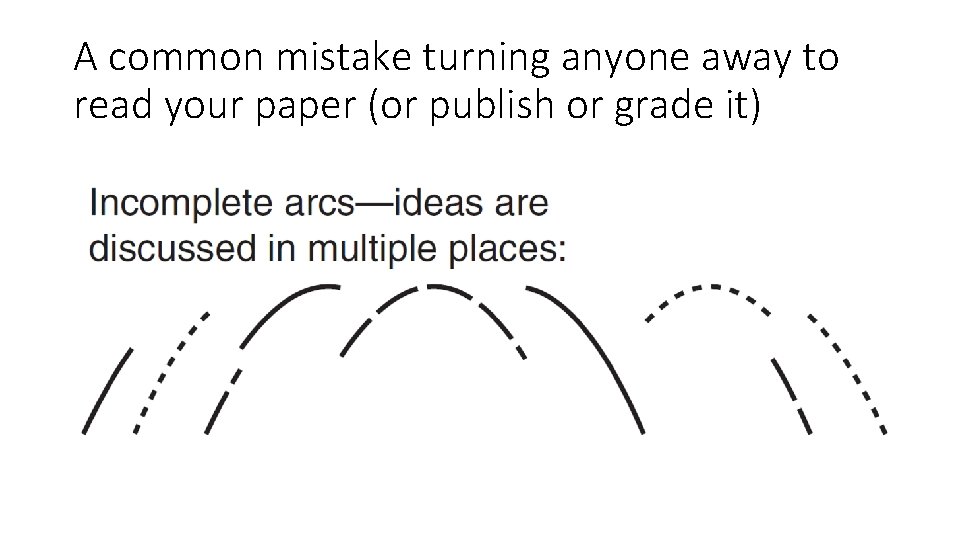
A common mistake turning anyone away to read your paper (or publish or grade it)
Paragraphs Point first paragraphs • Topic sentence and development • Lead development • first frame the major point or pattern, then flesh out the detail • Don’t present all the details! Without a framework, readers struggle with details.
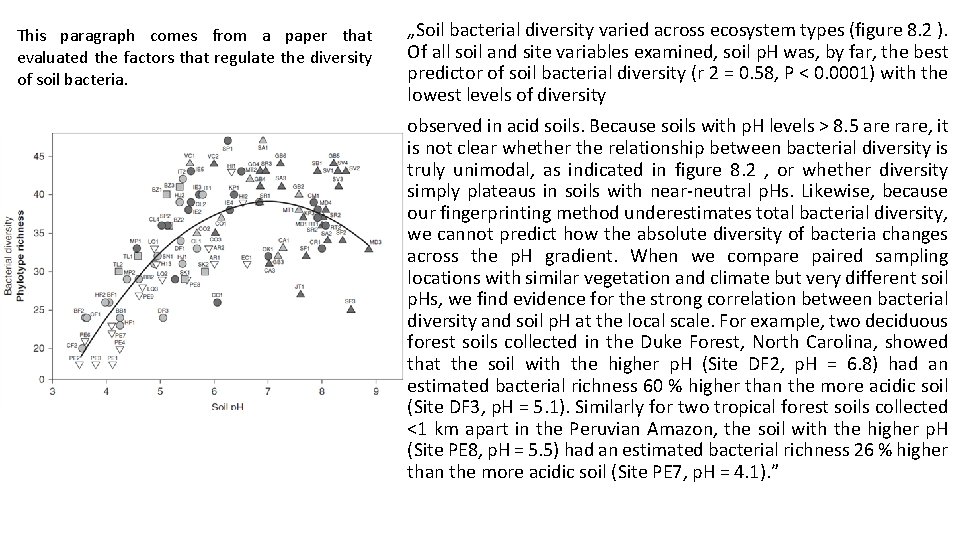
This paragraph comes from a paper that evaluated the factors that regulate the diversity of soil bacteria. „Soil bacterial diversity varied across ecosystem types (figure 8. 2 ). Of all soil and site variables examined, soil p. H was, by far, the best predictor of soil bacterial diversity (r 2 = 0. 58, P < 0. 0001) with the lowest levels of diversity observed in acid soils. Because soils with p. H levels > 8. 5 are rare, it is not clear whether the relationship between bacterial diversity is truly unimodal, as indicated in figure 8. 2 , or whether diversity simply plateaus in soils with near-neutral p. Hs. Likewise, because our fingerprinting method underestimates total bacterial diversity, we cannot predict how the absolute diversity of bacteria changes across the p. H gradient. When we compare paired sampling locations with similar vegetation and climate but very different soil p. Hs, we find evidence for the strong correlation between bacterial diversity and soil p. H at the local scale. For example, two deciduous forest soils collected in the Duke Forest, North Carolina, showed that the soil with the higher p. H (Site DF 2, p. H = 6. 8) had an estimated bacterial richness 60 % higher than the more acidic soil (Site DF 3, p. H = 5. 1). Similarly for two tropical forest soils collected <1 km apart in the Peruvian Amazon, the soil with the higher p. H (Site PE 8, p. H = 5. 5) had an estimated bacterial richness 26 % higher than the more acidic soil (Site PE 7, p. H = 4. 1). ”
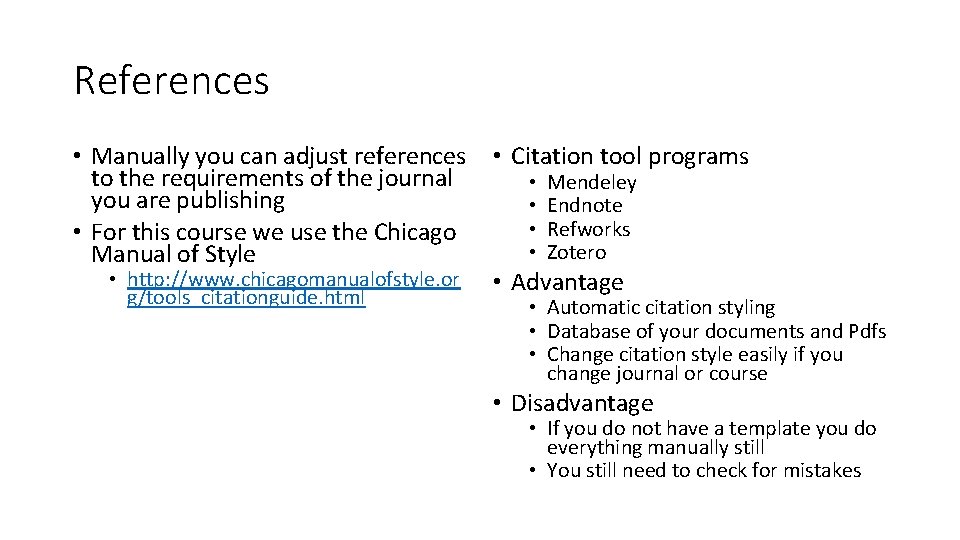
References • Manually you can adjust references to the requirements of the journal you are publishing • For this course we use the Chicago Manual of Style • http: //www. chicagomanualofstyle. or g/tools_citationguide. html • Citation tool programs • • Mendeley Endnote Refworks Zotero • Advantage • Automatic citation styling • Database of your documents and Pdfs • Change citation style easily if you change journal or course • Disadvantage • If you do not have a template you do everything manually still • You still need to check for mistakes
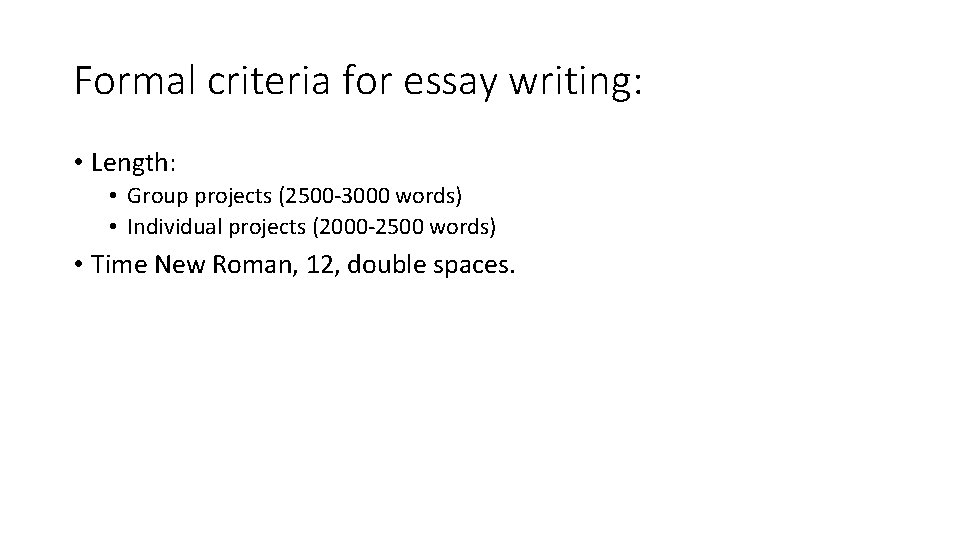
Formal criteria for essay writing: • Length: • Group projects (2500 -3000 words) • Individual projects (2000 -2500 words) • Time New Roman, 12, double spaces.