
Writing and Completing Reports and Proposals Copyright 2010
- Slides: 38
Writing and Completing Reports and Proposals Copyright © 2010 Pearson Education, Inc. publishing as Prentice Hall 1
Reports and Proposals • Long message formats • Effective visual support Copyright © 2010 Pearson Education, Inc. publishing as Prentice Hall 2
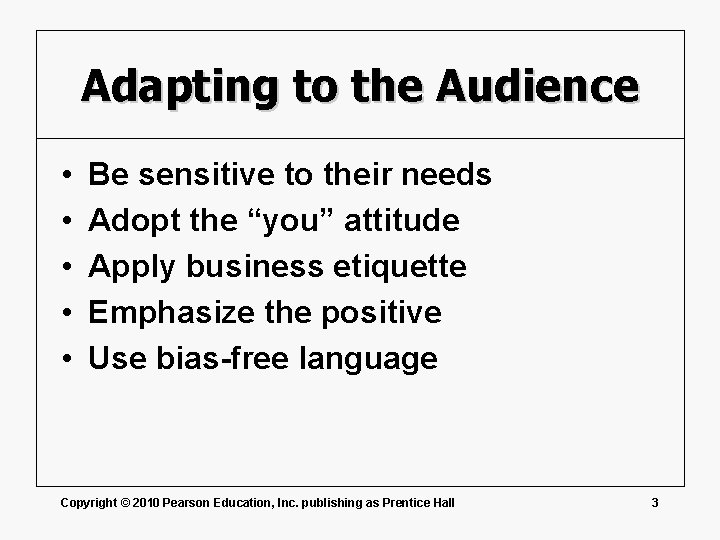
Adapting to the Audience • • • Be sensitive to their needs Adopt the “you” attitude Apply business etiquette Emphasize the positive Use bias-free language Copyright © 2010 Pearson Education, Inc. publishing as Prentice Hall 3
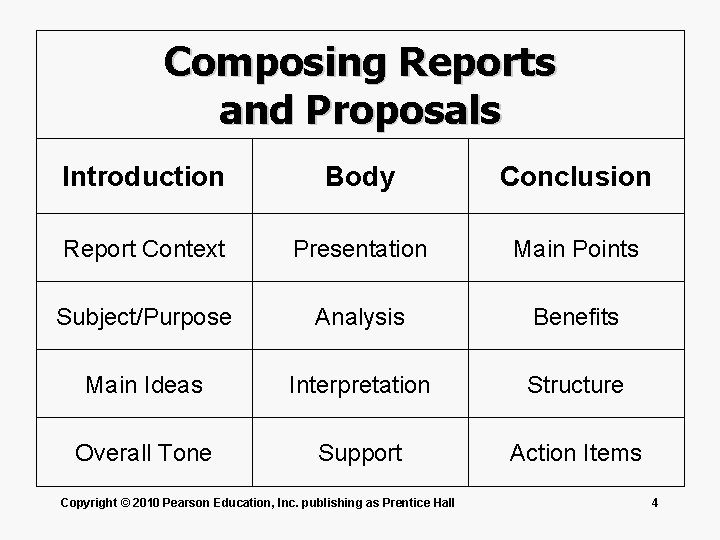
Composing Reports and Proposals Introduction Body Conclusion Report Context Presentation Main Points Subject/Purpose Analysis Benefits Main Ideas Interpretation Structure Overall Tone Support Action Items Copyright © 2010 Pearson Education, Inc. publishing as Prentice Hall 4
Drafting Report Content • Accurate • Complete • Balanced • Clear and logical • Documented Copyright © 2010 Pearson Education, Inc. publishing as Prentice Hall 5
Report Introduction Authorization Opportunity or Purpose Scope of Coverage Background Sources and Methods Terms and Definitions Limitations Report Organization Copyright © 2010 Pearson Education, Inc. publishing as Prentice Hall 6
The Report Body ü Explanations of problem or opportunity ü Facts, statistics, and trends ü Results of studies or investigations ü Discussion and analysis of potential actions ü Advantages, disadvantages, costs, and Copyright © 2010 Pearson Education, Inc. publishing as Prentice Hall 7
The Report Body ü Procedures or steps in a process ü Methods and approaches ü Criteria for evaluating options ü Conclusions and recommendations ü Support for conclusions and recommendations Copyright © 2010 Pearson Education, Inc. publishing as Prentice Hall 8
The Report Closing • Summary • Conclusions • Recommendations • Action plans Copyright © 2010 Pearson Education, Inc. publishing as Prentice Hall 9
Strategies for Successful Proposals • Demonstrate your knowledge • Provide concrete examples • Research the competition • Prove that your proposal is workable • Relate to the reader’s needs • Package your proposal attractively Copyright © 2010 Pearson Education, Inc. publishing as Prentice Hall 10
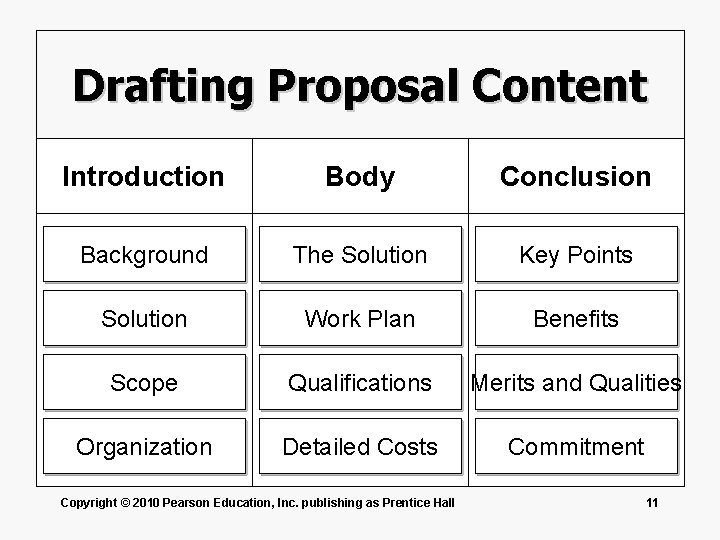
Drafting Proposal Content Introduction Body Conclusion Background The Solution Key Points Solution Work Plan Benefits Scope Qualifications Merits and Qualities Organization Detailed Costs Commitment Copyright © 2010 Pearson Education, Inc. publishing as Prentice Hall 11
Drafting Online Content 1. Build trust with intended audiences 2. Adapt content for global audience 3. Include reader-oriented content 4. Use a concise, skimmable format 5. Include effective links Copyright © 2010 Pearson Education, Inc. publishing as Prentice Hall 12
Guiding the Readers • Headings and subheadings • Transitional devices • Previews and reviews Copyright © 2010 Pearson Education, Inc. publishing as Prentice Hall 13
Technology for Reports and Proposals • • • Templates Embedded and linked documents Electronic forms Multimedia documents Electronic documents Proposal-writing software Copyright © 2010 Pearson Education, Inc. publishing as Prentice Hall 14
Visual Literacy • Consistency • Contrast • Balance • Emphasis • Convention • Simplicity Copyright © 2010 Pearson Education, Inc. publishing as Prentice Hall 15
Pick the Right Visuals • Data and information • Concepts and ideas Copyright © 2010 Pearson Education, Inc. publishing as Prentice Hall 16
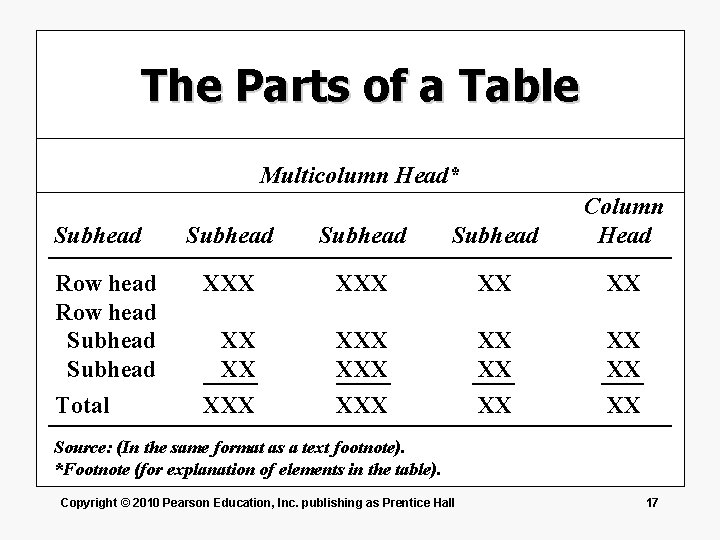
The Parts of a Table Multicolumn Head* Subhead Row head Subhead Total Subhead Column Head XXX XXX XXX XX Source: (In the same format as a text footnote). *Footnote (for explanation of elements in the table). Copyright © 2010 Pearson Education, Inc. publishing as Prentice Hall 17
Preparing Data Tables • Use common, clearly identified units • Round off all items in columns • Label column headings • Separate rows and columns • Don’t overload the table with data • Document data sources Copyright © 2010 Pearson Education, Inc. publishing as Prentice Hall 18
Line and Surface Charts • Trends • Variables • Relationships Copyright © 2010 Pearson Education, Inc. publishing as Prentice Hall 19
Using Bar Charts • Compare items • Show changes • Indicate composition • Show relative sizes Copyright © 2010 Pearson Education, Inc. publishing as Prentice Hall 20
Using Pie Charts • Limit the number of slices • Arrange slices clockwise • Use a variety of colors • Show numbers or percentages Copyright © 2010 Pearson Education, Inc. publishing as Prentice Hall 21
Data Visualization • Countless data points • Wide graphical variety • Complex dynamic data Copyright © 2010 Pearson Education, Inc. publishing as Prentice Hall 22
Flow Charts • Processes • Procedures • Sequences Copyright © 2010 Pearson Education, Inc. publishing as Prentice Hall 23
Organization Charts • Positions • Units • Functions Copyright © 2010 Pearson Education, Inc. publishing as Prentice Hall 24
Other Business Graphics • • Maps Drawings Diagrams Photographs Copyright © 2010 Pearson Education, Inc. publishing as Prentice Hall 25
Animation and Video • Shapes and text • Computer animation • Digital video Copyright © 2010 Pearson Education, Inc. publishing as Prentice Hall 26
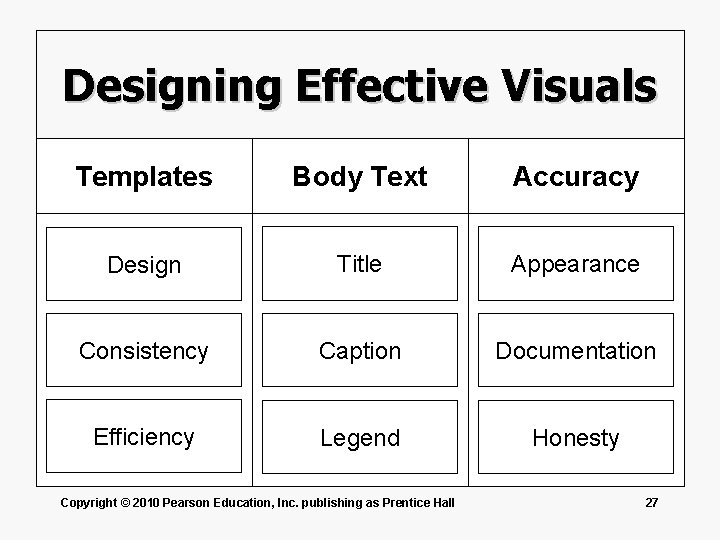
Designing Effective Visuals Templates Body Text Accuracy Design Title Appearance Consistency Caption Documentation Efficiency Legend Honesty Copyright © 2010 Pearson Education, Inc. publishing as Prentice Hall 27
Completing Reports and Proposals • • Revising Producing Proofreading Distributing Copyright © 2010 Pearson Education, Inc. publishing as Prentice Hall 28
Revising Reports and Proposals • • Content Readability Organization Style and tone Copyright © 2010 Pearson Education, Inc. publishing as Prentice Hall 29
Integrate Text and Visuals • Clear introductions • Careful placement • Clear references • Use titles, captions, and legends • Check for accuracy Copyright © 2010 Pearson Education, Inc. publishing as Prentice Hall 30
Producing Formal Reports • Prefatory parts • Text of the report • Supplementary parts Copyright © 2010 Pearson Education, Inc. publishing as Prentice Hall 31
The Prefatory Parts • Report cover • Table of contents • Title fly/title page • List of visuals • Authorization letter • Synopsis/abstract • Transmittal letter • Executive summary Copyright © 2010 Pearson Education, Inc. publishing as Prentice Hall 32
The Text of the Report • Introduction • Body • Closing Copyright © 2010 Pearson Education, Inc. publishing as Prentice Hall 33
Supplementary Parts • Appendixes • Bibliography • Index Copyright © 2010 Pearson Education, Inc. publishing as Prentice Hall 34
Formal Proposals • Copy of the RFP • Synopsis/Executive summary • Transmittal document Copyright © 2010 Pearson Education, Inc. publishing as Prentice Hall 35
Text of a Proposal • Introduction • Body • Closing Copyright © 2010 Pearson Education, Inc. publishing as Prentice Hall 36
Proofreading Reports and Proposals • Inconsistencies • Errors and omissions • Missing components Copyright © 2010 Pearson Education, Inc. publishing as Prentice Hall 37
Distributing Reports and Proposals • Physical • Electronic • Web-based Copyright © 2010 Pearson Education, Inc. publishing as Prentice Hall 38