
Writing an Exercise Prescription in Older People Strategies
- Slides: 32
Writing an Exercise Prescription in Older People Strategies for Increasing Success, Compliance, and Safety Bree Johnston and Louise Aronson Division of Geriatrics, Department of Medicine SF VAMC and UC San Francisco
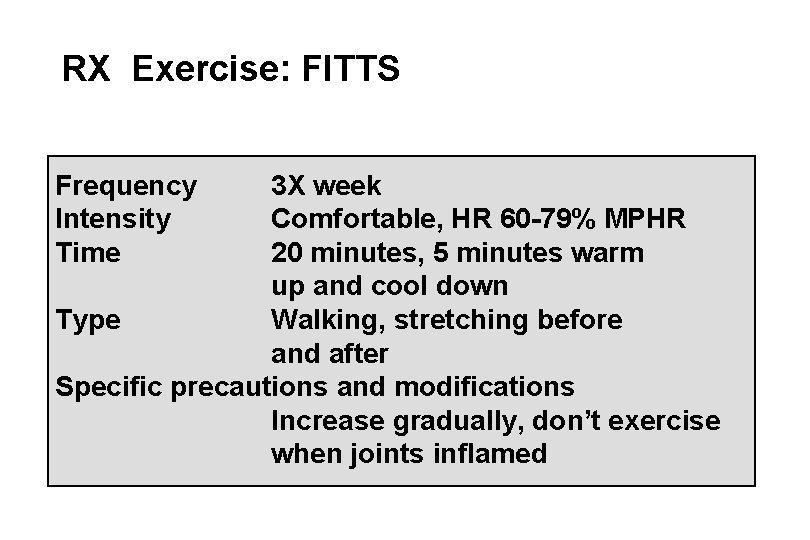
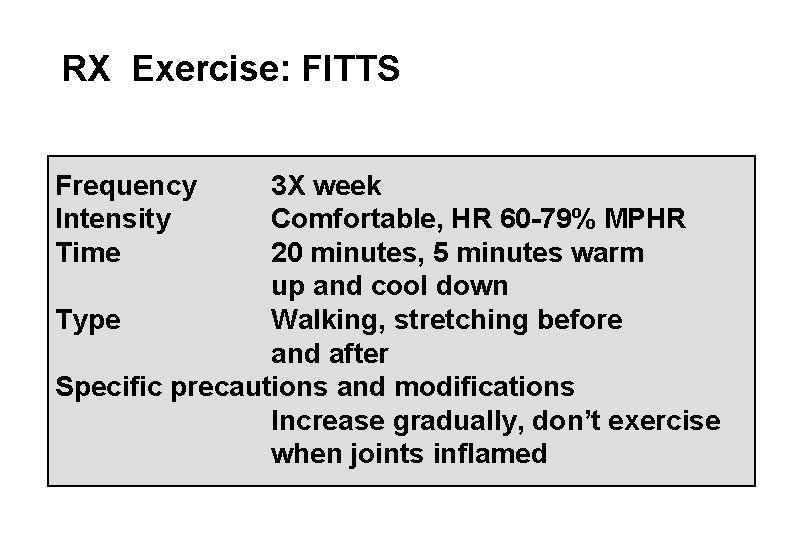
RX Exercise: FITTS Frequency Intensity Time 3 X week Comfortable, HR 60 -79% MPHR 20 minutes, 5 minutes warm up and cool down Type Walking, stretching before and after Specific precautions and modifications Increase gradually, don’t exercise when joints inflamed
Writing an Exercise prescription • Approaches to increasing exercise – Does writing a prescription increase exercise? • Improving compliance with Rx • FITTS – – – Frequency Intensity Time Type (warmup, exercise, cooldown) Specific precautions and modifications
Writing an Exercise prescription • Approaches to increasing exercise – Does writing a prescription increase exercise? • Improving compliance with Rx • FITTS – – – Frequency Intensity Time Type (warmup, exercise, cooldown) Specific precautions and modifications
Strategies • Public Health Strategy • Primary Care Strategy – Primary Care Providers will routinely assess and counsel patients on frequency, duration, type, and intensity of physical activity • Health Systems strategy – Combines public health and primary care models
Does MD advice make a difference? • Factors predicting enrollment in a community based exercise program for seniors • Seniors who had “ever” been prescribed exercise by a physician were 60% more likely to enroll in an exercise program than those who had “never” been prescribed Stewart et al Annals of Behavioral Med 1999
Does MD advice make a difference? • RCT of educational program on health promotion for older people • 42 general practitioners and 267 patients followed for 1 year • Intervention group exercised about 45 minutes more per week than control group • Another study suggests writing Rx increases likelihood of exercising Kerse et al. BMJ September 1999
US Preventive Health Service Task Force “We found it difficult to assess the efficacy or effectiveness of the interventions examined. Although research suggests that counseling can be effective in some specific situations, the evidence is insufficient to generally conclude that counseling is effective. Existing studies do not provide a clear picture of the specific features of counseling that relate to its effectiveness. ” Eden KB Ann Intern Med 2002; 137: 208 -15.
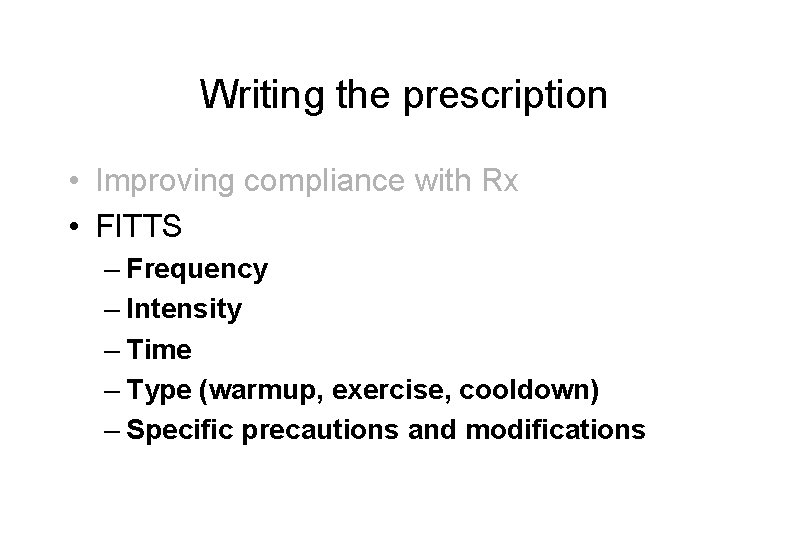
Writing the prescription • Approaches to increasing exercise • Improving compliance with Rx • FITTS – Frequency – Intensity – Time – Type (warmup, exercise, cooldown) – Specific precautions and modifications
Understand your patient’s values and goals • Function: What activities do you value? • What benefit will you achieve? • How much social and emotional support do you have (or need) to be active? • What barriers to reaching your goals do you see? • What lifestyle changes are you willing to make?
Stages of Change Model • • • Precontemplative Contemplative Preparation Action Maintenance Relapse
Precontemplative • What, me exercise? • Identify barriers • Identify patient’s conception of physical activity • Provide information/education • “Think about becoming active, think about what benefits you might gain, talk to other people who are active”
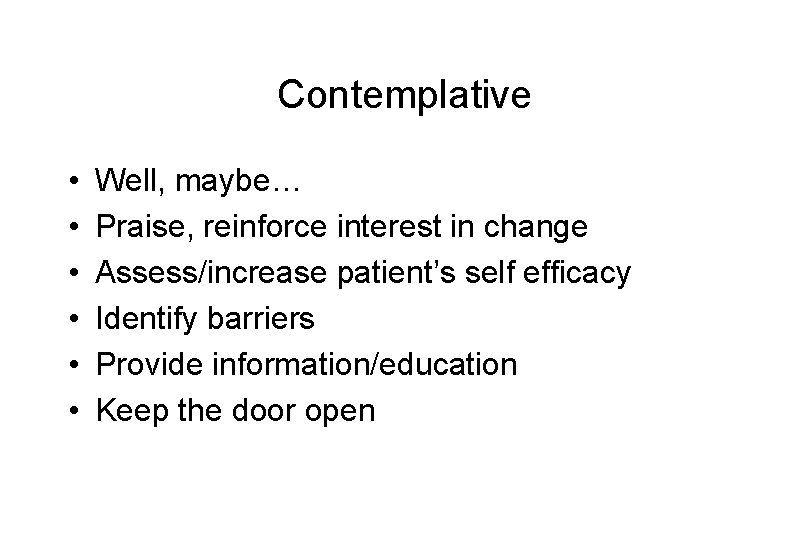
Contemplative • • • Well, maybe… Praise, reinforce interest in change Assess/increase patient’s self efficacy Identify barriers Provide information/education Keep the door open
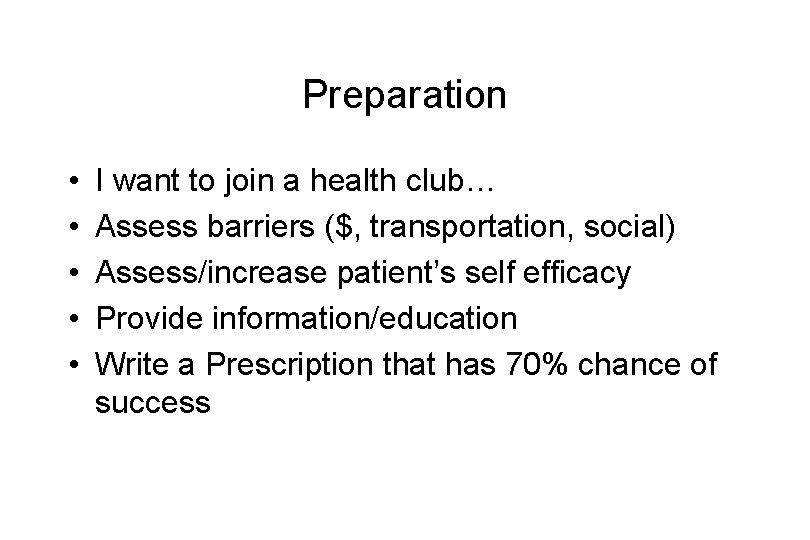
Preparation • • • I want to join a health club… Assess barriers ($, transportation, social) Assess/increase patient’s self efficacy Provide information/education Write a Prescription that has 70% chance of success
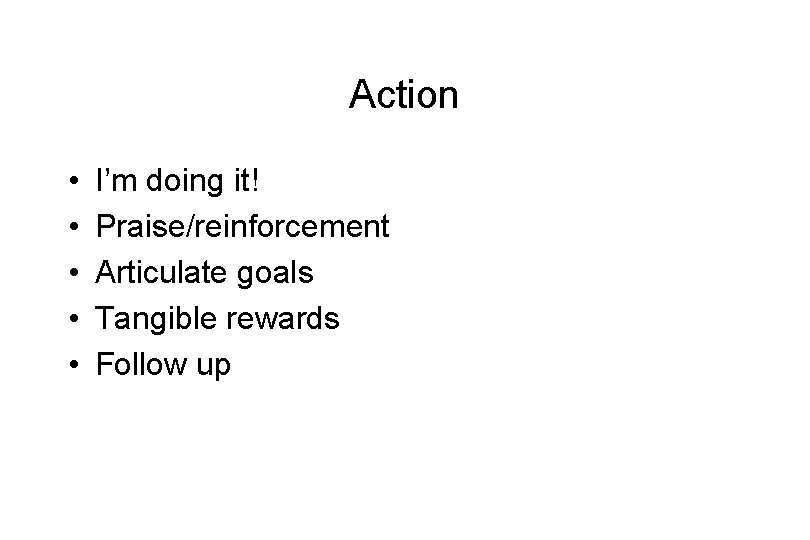
Action • • • I’m doing it! Praise/reinforcement Articulate goals Tangible rewards Follow up
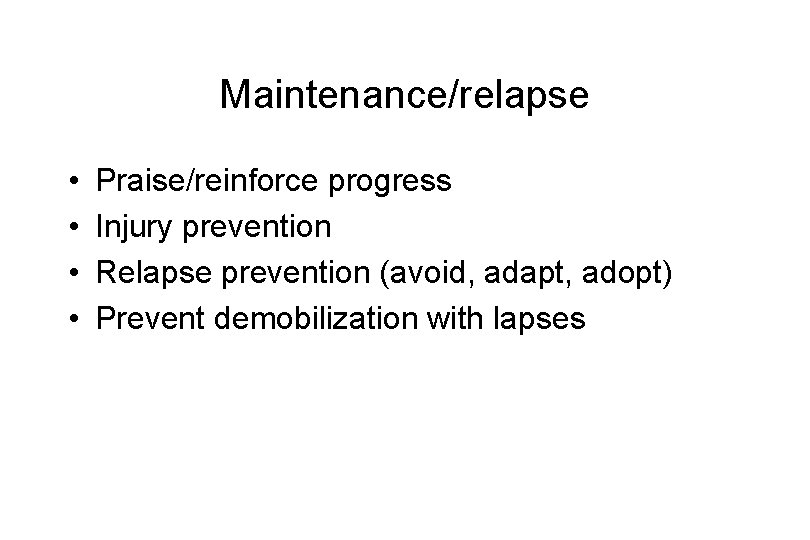
Maintenance/relapse • • Praise/reinforce progress Injury prevention Relapse prevention (avoid, adapt, adopt) Prevent demobilization with lapses
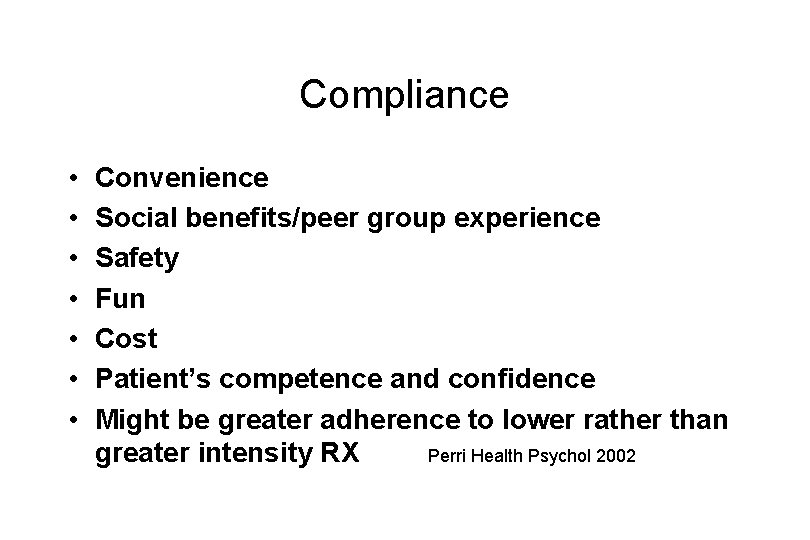
Compliance • • Convenience Social benefits/peer group experience Safety Fun Cost Patient’s competence and confidence Might be greater adherence to lower rather than greater intensity RX Perri Health Psychol 2002
“As I like to point out, a dog is the only exercise machine you cannot decide to skip when you don’t feel like it. The houses of my friends are cluttered with exercise machines and often sit ignored…but late every morning, however I am feeling, Bianca and I have our walk. ”
Writing the prescription • Improving compliance with Rx • FITTS – Frequency – Intensity – Time – Type (warmup, exercise, cooldown) – Specific precautions and modifications
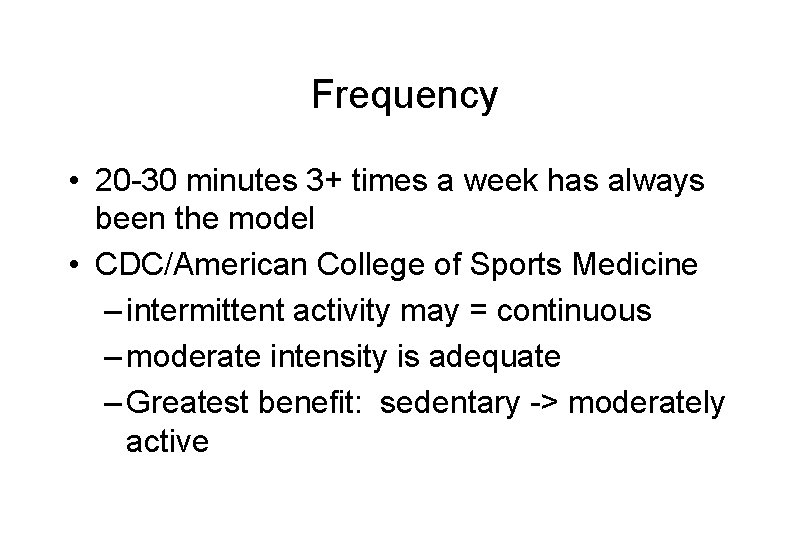
Frequency • 20 -30 minutes 3+ times a week has always been the model • CDC/American College of Sports Medicine – intermittent activity may = continuous – moderate intensity is adequate – Greatest benefit: sedentary -> moderately active
Intensity • Start gradually, especially in frail elders Moderate Exercise • Moderate exercise can usually be prescribed safely without an ETT (more on this later) • Moderate exercise = 60 -79% MPHR (MPHR is 220 – age) • 3 -4 MPH walk, comfortable, can continue more than 20 minutes
Intensity Vigorous Exercise • May require ETT first (see other presentation) • Vigorous exercise = 80 -90% MPHR (MPHR is 220 – age) • Untrained person cannot sustain longer than 20 minutes • Can talk but not sing
Types of Exercise • Stretching • Resistance training – contraction of muscle groups few times against moderate to high resistance • Endurance training – rhythmic use of large muscle groups with many repetitions at low resistance • Balance training
Exercise: Stretching • To combat muscle and tendon tightening and achieve cardiorespiratory readiness • For the very deconditioned, stretching equals exercise • Static stretch of 30 seconds/muscle group • Pull, not pain, no bounce • Daily to ROM and before exercise
Exercise: Resistance Training • strength and muscle mass • Cross training effect • lean body mass • tendon strength, flexibility, ROM • May improve balance • May be required before endurance training possible
Resistance Training • Dynamic better than static • < or = 80% maximum lift, no use of momentum • <6 muscle groups • 8 -12 repetitions/set (set = until fatigue) • Benefit in 6 -8 weeks • Benefit rapidly lost after stopping
Exercise: Endurance training • Improves all age-related changes except maximum HR • Improved body composition • Little effect on strength or balance • Magnitude of response similar in older and younger persons
Endurance Training • Start low and go slow • Intensity related to speed, # muscles used, resistance • Increase duration before intensity • Goals – 20 -30 minutes at least 3 X per week – aim for anaerobic threshold/dyspnea – More modest goals appropriate for many individuals • Individualize to maximize compliance
Exercise: Balance • Most studies use high-tech/multimodal interventions • Unclear which type of exercise is best • Tai Chi promising and available • Emphasize movements needed for function • Beware fall risk
Exercise: Cool Down • Goal = gradual decrease in vasodilatation and heat to decrease risk of dizziness and syncope • Especially important in patients with CAD • 5 -10 minutes • Slow walking or stretching
Specific Precautions and modifications • Worrisome signs and symptoms • Drug-exercise interactions – diuretics – vasodilators – beta-blockers – insulin – sympathomimetics • Adjust for illness, climate changes • Risks of exercise
RX Exercise: FITTS Frequency Intensity Time 3 X week Comfortable, HR 60 -79% MPHR 20 minutes, 5 minutes warm up and cool down Type Walking, stretching before and after Specific precautions and modifications Increase gradually, don’t exercise when joints inflamed