
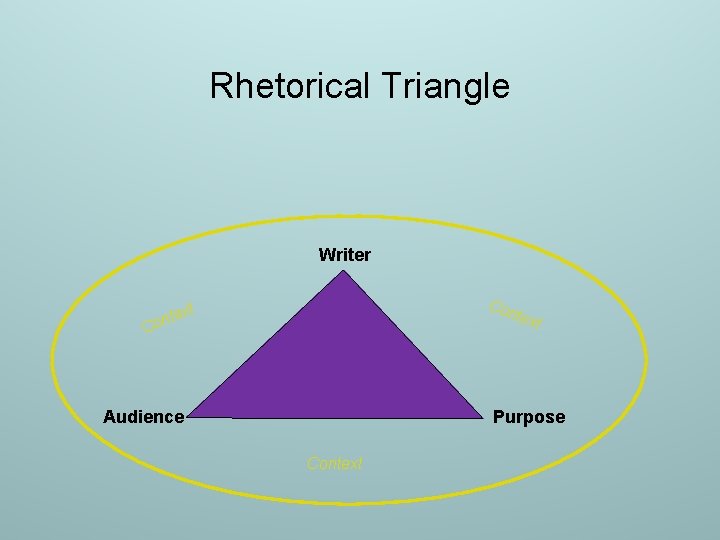
Writing an Argument Rhetorical Triangle Writer Con ext

- Slides: 20
Writing an Argument
Rhetorical Triangle Writer Con ext t n o text C Audience Purpose Context
Argument • A logical representation of how a writer sees an issue, problem, or subject, supported by valid reasons and evidence.
Using your hw article…. . • Write the argument topic in the left hand box of your notes sheet. A topic is a word of phrase such as…… – School Dress Code – Driving Age – Texting and Driving
Claim • A statement that asserts a point, belief or truth that requires supporting evidence. • 3 parts: Issue + Major Claim + Convincing Reasons
Reasons • a statement that supports the claim; it provides the answer to why the claim is valid.
Examples: Issue Major Claim Convincing Reasons Two years of national service or volunteerism should be required of high school graduates to provide much needed service to communities; to provide job skills and training for young adults; and to build life-long, service- minded citizens.
Look At School Week Article…. • Write to the left in the box labeled CLAIM…. . – The claim Dr. Hill makes; be sure to include the issue, major claim, and convincing reasons in one sentence. – Sound like a thesis? Because it is!
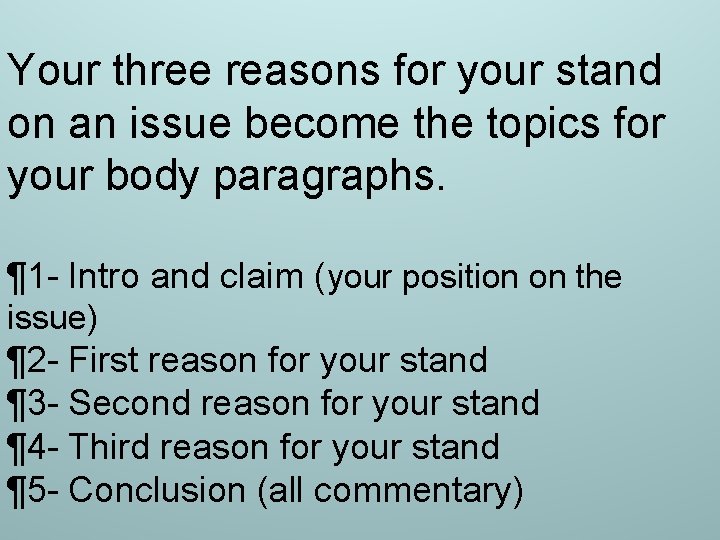
Your three reasons for your stand on an issue become the topics for your body paragraphs. ¶ 1 - Intro and claim (your position on the issue) ¶ 2 - First reason for your stand ¶ 3 - Second reason for your stand ¶ 4 - Third reason for your stand ¶ 5 - Conclusion (all commentary)
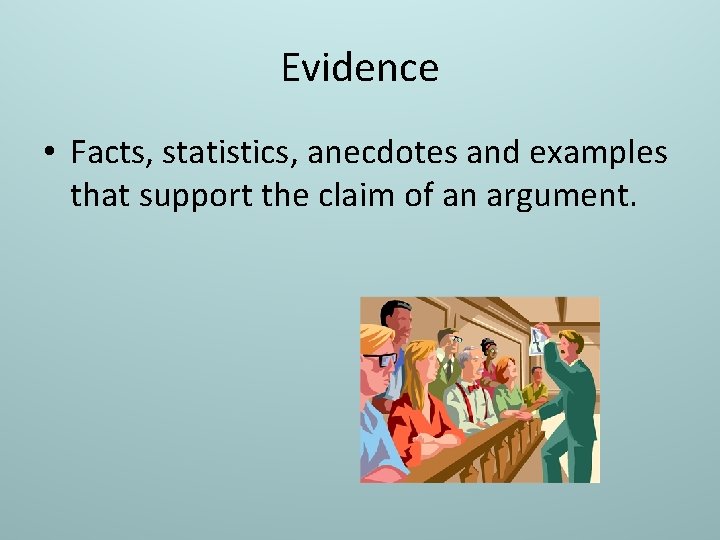
Evidence • Facts, statistics, anecdotes and examples that support the claim of an argument.
Types of Evidence 1. Explanations 10. Concessions to parts of a 2. Examples counterargument or 3. Illustrations opposing point of 4. Anecdotes view 5. Quotations 6. Analogies 7. Opposites 8. Compare/Contrast 9. Classification
Explanations Examples Illustrations • Develop your claims with: 1. observations and personal experiences 2. historical or current events 3. literature 4. Facts from research
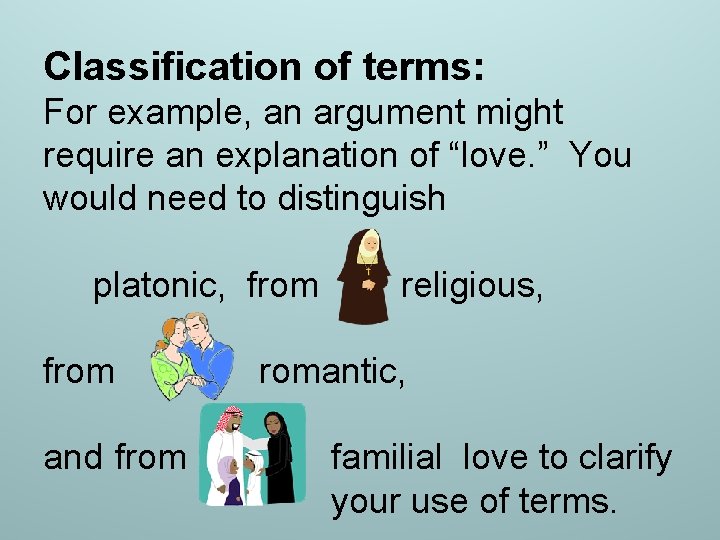
Classification of terms: For example, an argument might require an explanation of “love. ” You would need to distinguish platonic, from and from religious, romantic, familial love to clarify your use of terms.
Narrate a short anecdote. Use a short anecdote (story) to support or illustrate a feature of an argument.
Concessions Why would a concession help YOUR argument? • To concede means to admit reluctantly that something is true. • A concession is admitting that part of the opposing argument is true. EX: “It is true that animal testing can be cruel. ”
Using your hw article……. • Fill out the Reason/Evidence boxes with textual evidence provided by the author and Dr. Hill. Then, label which type of evidence is present. • Find four different, separate types of evidence. (1 Quotation, 1 Analogy, 1 Example, etc. )
Counterclaim A claim that negates or disagrees with thesis or original claim.
Using your hw article • Find an example of a counterclaim. Give the paragraph number and a quote.
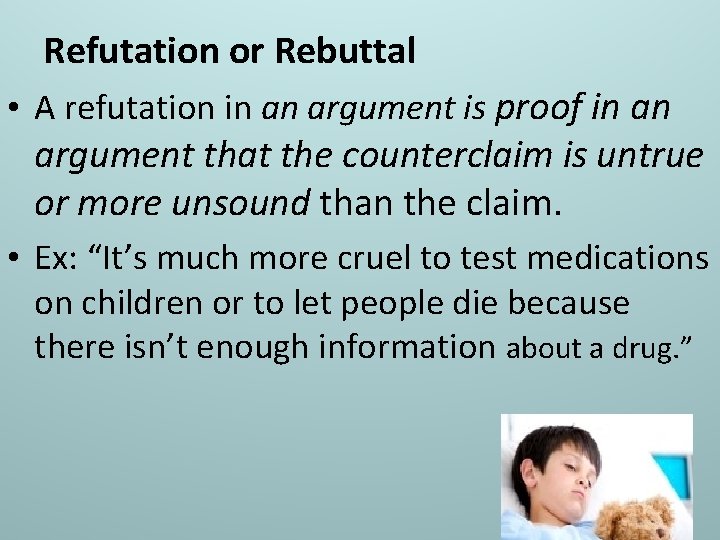
Refutation or Rebuttal • A refutation in an argument is proof in an argument that the counterclaim is untrue or more unsound than the claim. • Ex: “It’s much more cruel to test medications on children or to let people die because there isn’t enough information about a drug. ”
Using your hw article • Find an example of a refutation. Give the paragraph number and a quote.