
Writing an Abstract Research Conference Dr Paula C
Writing an Abstract (Research Conference) Dr. Paula C. Bernaschina p. bernaschina@mdx. ac. uk Academic Writing and Language Learning Enhancement Team (LET)
Plan • Introductions (10 minutes)* • The requirements (5 minutes) • Abstract structure (10 minutes) • Guided freewriting (15 minutes) • Pair/group work (peer feedback) (10 minutes) • Questions/comments (10 minutes) *Approximate timings © Middlesex University

Abstract requirements • Should be between 200 -350 words • It should contain the following sections: – Title – Author(s) – Type of contribution: (a) presentation; (b) poster; (c) performance; (d) video screening with commentary – Names of supervisory team – Degree start date – Stage of research where applicable (e. g. registration, transferred, writing up) – Department – Indicate that the abstract has been reviewed and approved by your supervisory team © Middlesex University
Writing an Abstract Theme: ‘Research in a Changing World’ • Consider this theme • How does the ‘changing world’ interact with your research area. Submission is now open and will close at 5 pm on Tuesday 6 th April 2021. © Middlesex University
Abstract Your language needs to be concise and precise Think about: • What are you doing? • Why are you doing it? • What is happening? • What have you found? © Middlesex University
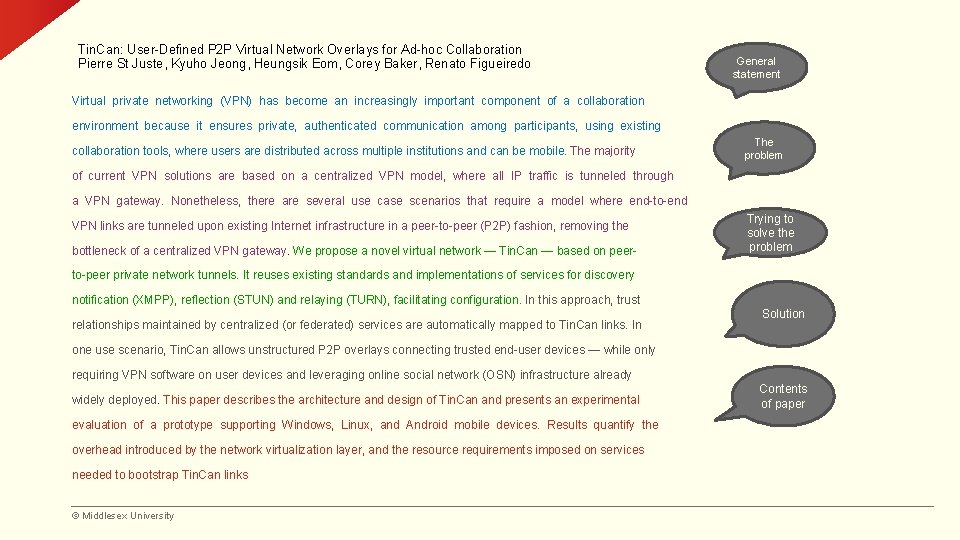
Tin. Can: User-Defined P 2 P Virtual Network Overlays for Ad-hoc Collaboration Pierre St Juste, Kyuho Jeong, Heungsik Eom, Corey Baker, Renato Figueiredo General statement Virtual private networking (VPN) has become an increasingly important component of a collaboration environment because it ensures private, authenticated communication among participants, using existing collaboration tools, where users are distributed across multiple institutions and can be mobile. The majority The problem of current VPN solutions are based on a centralized VPN model, where all IP traffic is tunneled through a VPN gateway. Nonetheless, there are several use case scenarios that require a model where end-to-end VPN links are tunneled upon existing Internet infrastructure in a peer-to-peer (P 2 P) fashion, removing the bottleneck of a centralized VPN gateway. We propose a novel virtual network — Tin. Can — based on peer- Trying to solve the problem to-peer private network tunnels. It reuses existing standards and implementations of services for discovery notification (XMPP), reflection (STUN) and relaying (TURN), facilitating configuration. In this approach, trust relationships maintained by centralized (or federated) services are automatically mapped to Tin. Can links. In Solution one use scenario, Tin. Can allows unstructured P 2 P overlays connecting trusted end-user devices — while only requiring VPN software on user devices and leveraging online social network (OSN) infrastructure already widely deployed. This paper describes the architecture and design of Tin. Can and presents an experimental evaluation of a prototype supporting Windows, Linux, and Android mobile devices. Results quantify the overhead introduced by the network virtualization layer, and the resource requirements imposed on services needed to bootstrap Tin. Can links © Middlesex University Contents of paper

Abstract The basic approach and methodology, usually in one sentence The conclusion (briefly) and the broad implications of it WHY, HOW, WHAT, SO WHAT The reason behind the research being done © Middlesex University The main findings (results) in very few sentences
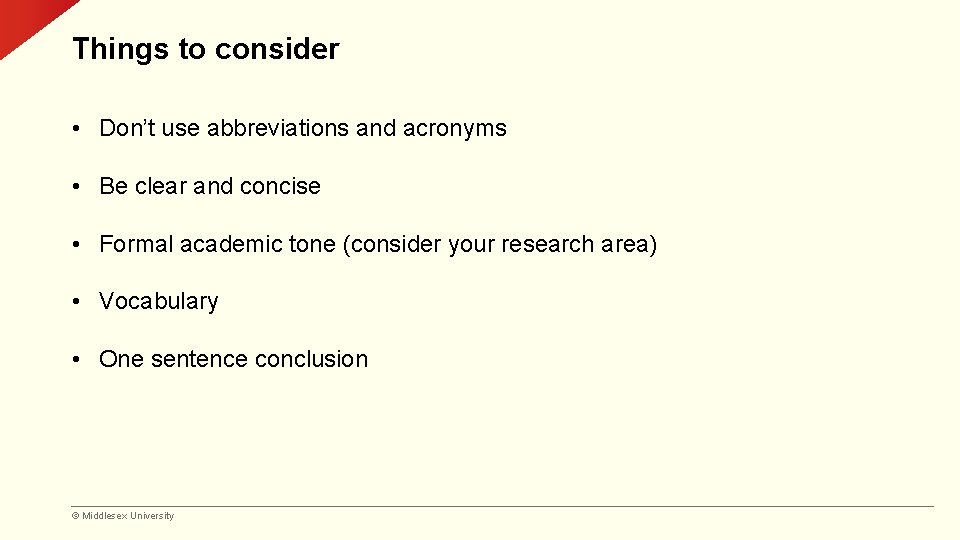
Things to consider • Don’t use abbreviations and acronyms • Be clear and concise • Formal academic tone (consider your research area) • Vocabulary • One sentence conclusion © Middlesex University

Freewriting • Helps to gather ideas • Warms up the brain • Breaks down writer’s block © Middlesex University
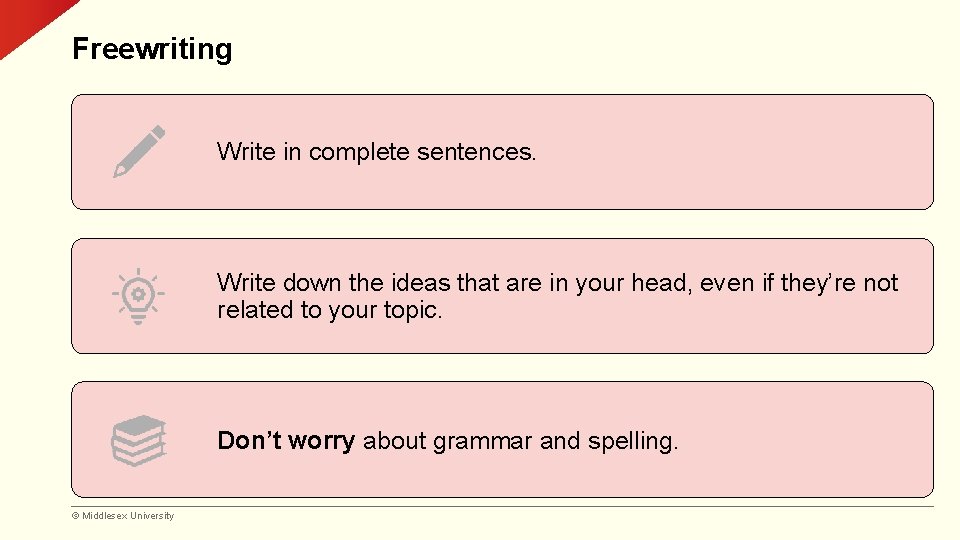
Freewriting Write in complete sentences. Write down the ideas that are in your head, even if they’re not related to your topic. Don’t worry about grammar and spelling. © Middlesex University
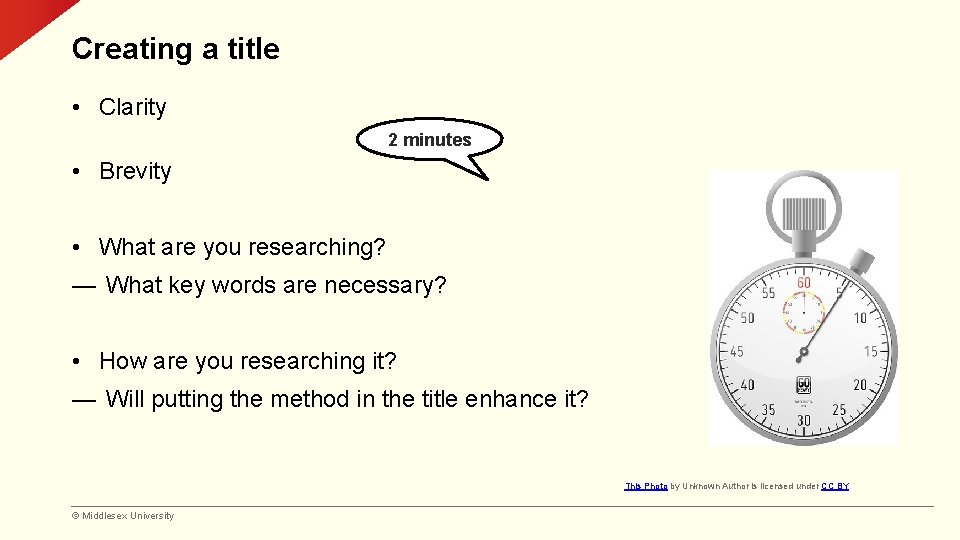
Creating a title • Clarity 2 minutes • Brevity • What are you researching? — What key words are necessary? • How are you researching it? — Will putting the method in the title enhance it? This Photo by Unknown Author is licensed under CC BY © Middlesex University
Aim of your research 2 minutes Explain the primary aim or purpose of the study What is it that you’re going to do? For example: investigate compare develop determine examine replicate evaluate This Photo by Unknown Author is licensed under CC BY © Middlesex University
Research method(s) • What is your method? 2 minutes • Briefly explain the method — What is it that we need to know about the method? This Photo by Unknown Author is licensed under CC BY © Middlesex University
Current findings/Expected contribution • What have you found out so far? 2 minutes • What contributions do you expect to make to your research area? This Photo by Unknown Author is licensed under CC BY © Middlesex University
Research in a Changing World 2 minutes How does the ‘changing world’ interact with your research? • How might this occur? • In what ways might your research respond to this changing world? • How do you know this? • Will there be an impact? • Are you able to measure the impact? This Photo by Unknown Author is licensed under CC BY © Middlesex University
Peer feedback Discuss what you have written Ask each other questions about your research areas • Are you able to follow the ideas? • Do more details need to be included? © Middlesex University

Questions/Comments This Photo by Unknown Author is licensed under CC BY-SA © Middlesex University This Photo by Unknown Author is licensed under CC BY-SA
- Slides: 17