
Writing Across Grade Levels and Content Areas Continuity





- Slides: 25
Writing Across Grade Levels and Content Areas Continuity in Standards and Expectations As you come in, please complete the DO-NOW prompt at your seat.
Common Core State Standards • 10 CCSS writing standards at each grade level • CCSS emphasizes that students need to be able to write arguments (rather than persuasion); informative/explanatory writing examining complex ideas and information; narratives of real and imagined experiences • CCSS emphasizes writing processes • CCSS emphasizes technology (for research and to produce and publish writing) • NGSS reference CCSS literacy standards • Language of IL Social Science Standards suit more writing
Writing about Text • Past standards have emphasized writing as a free-standing subject or skill • Students have been expected to be able to write texts requiring low information (or only the use of widely available background knowledge) • The common core puts greater emphasis on the use of evidence in writing • Thus, the major emphasis shifts from writing stories or opinion pieces to writing about the ideas in text in all content areas
But Why the Shift? • Studies have shown the importance of writing in the workplace and for academic study. Writing from sources is the writing done in those settings. • Writing about text has been shown to have positive impacts on both reading and writing achievement. • Writing about texts also improves other academic performance.
Evidence on Writing about Reading • Graham & Hebert (2010): Meta-analyses of experimental studies show that writing about text can have a powerful impact on writing and reading achievement • 93% of studies in which students wrote about text had a positive impact (grades 2 -12) • When students were taught explicitly how to write (not just assigned writing), then these impacts were equally large with poor readers • Writing about text was more powerful than just reading or reading and rereading/studying /discussing
Skills Involved in Summary Writing • Comprehension of text • Identification of key ideas and details • Identification of the text structure • Ability to paraphrase and translate ideas into your own words • Ability to combine sub-points into generalizations
Writing To Text Models • Good writers usually become good writers because they imitate when they write • They imitate structure, style, language • Writing on the basis of models –that is trying to imitate features of what we read—can both improve reading and writing benefits • To do this requires analytical reading that looks carefully at how the text was composed • And for the writer it provides valuable scaffolding
Text Modeling • Select strong text examples • Read and reread the text trying to identify or describe its features • Decide which features need to be repeated • Then try to compose your own text by varying the key features • Re-read the original text and revise
Analyzing and Critiquing Text • Students can write about the ideas in text, usually in response to teacher questions • Text questions that require elaborate answers rather than questions that require short, specific answers • Studies show that writing answers to questions has a greater impact on learning than just orally answering the questions • However, extended writing leads to more learning than is stimulated by writing short answers – especially true for older students • Writing about text more extensively encourages deeper and more thorough thinking about the text ideas which increases learning
Analyzing and Critiquing Texts • Determination of merit, worth, or value through reasoning or judgment • Comparative evaluation • Independent choices and going beyond what others have expressed • Attempt to move beyond subjective to objective (reasoned judgment, reasoned argument) • Making these kinds of judgments connects information to prior knowledge, increases motivation (socializes knowledge), and increases learning
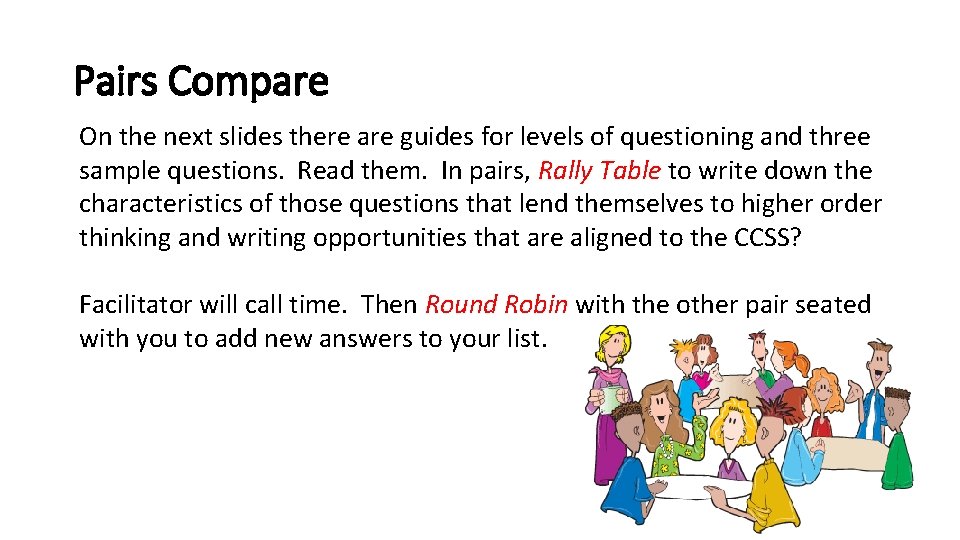
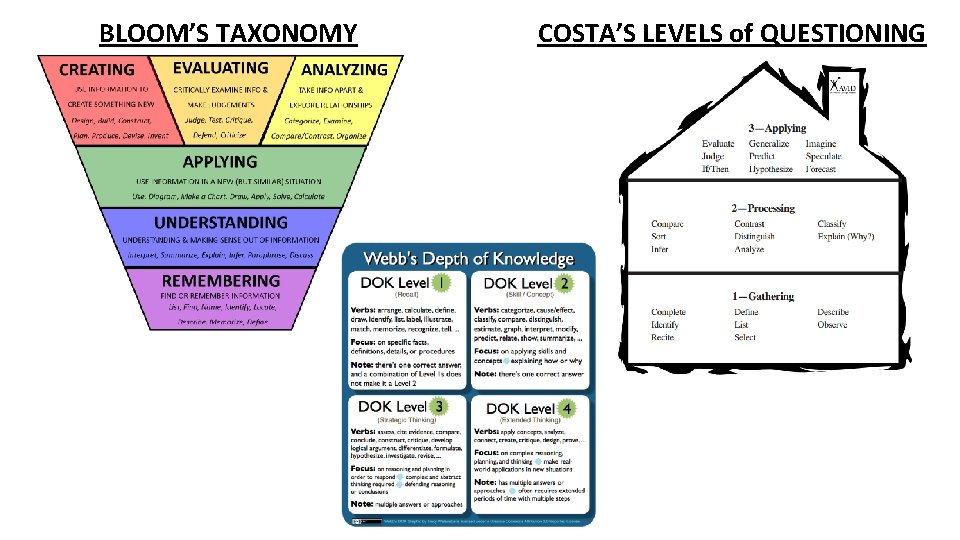
Pairs Compare On the next slides there are guides for levels of questioning and three sample questions. Read them. In pairs, Rally Table to write down the characteristics of those questions that lend themselves to higher order thinking and writing opportunities that are aligned to the CCSS? Facilitator will call time. Then Round Robin with the other pair seated with you to add new answers to your list.
BLOOM’S TAXONOMY COSTA’S LEVELS of QUESTIONING
Analyzing and Critiquing Texts Questioning • If you could only save one character from the book in the event of a disaster, which one would it be and why? Use evidence from the story. • Is the title a good one or a poor one and why? Use evidence to support your argument. • Which type of pollution is the most serious for the central region of Illinois at this time? Use evidence to make your case.
Analyzing and Critiquing Text Questioning Which is better? • What is a character trait that you share with one of the characters in the story? • Which character was the most sympathetic in the story? Give two examples and explain your answer.
Analyzing and Critiquing Text Questioning Which is better? • Compare the responsibilities of the federal and the state government, and explain why having these different layers of government (rather than a single level) is a good idea? • What are three levels of government in the U. S. ?
Question Generating Think of one of your upcoming texts/topics. Generate a question that requires students to form an argument and to support the argument with evidence. Force students to go beyond what is explicitly stated in the text. Write it on a piece provided for you at your table.
Inside-Outside Circle Depending on the size of the group you may have to form more than one Inside/Outside circle. • Half form inside circle, half form outside circle – face one another • Inside person reads question • Outside person provides feedback • What level of questioning? • How does it align to rigor of CCSS? • Do you feel it appropriate for grade level expectations? Why? • Rotate inside circle. After a few rounds switch roles.
Synthesis of Texts • Research skills of identifying relevant and appropriate sources of information • Critical reading and analysis skills to determine the value and soundness of sources • Ability to adequately summarize information and paraphrase information from sources (avoiding plagiarism) • Ability to recognize uniqueness and redundancy of information across texts (and to reveal or resolve contradiction) • Synthesis requires explicit use of evidence and citation or crediting of sources • All of these skills are challenging and all of them require specific explicit teaching over a long period of time in order to master
Writing about Text Implications • Writing needs to be more closely integrated with reading comprehension instruction in all content areas • The amount of writing about what students read needs to increase • Greater emphasis on summarization, writing to models, critical analysis, and synthesis of information than in the past • Greater attention to precision, accuracy, clarity, and use of evidence
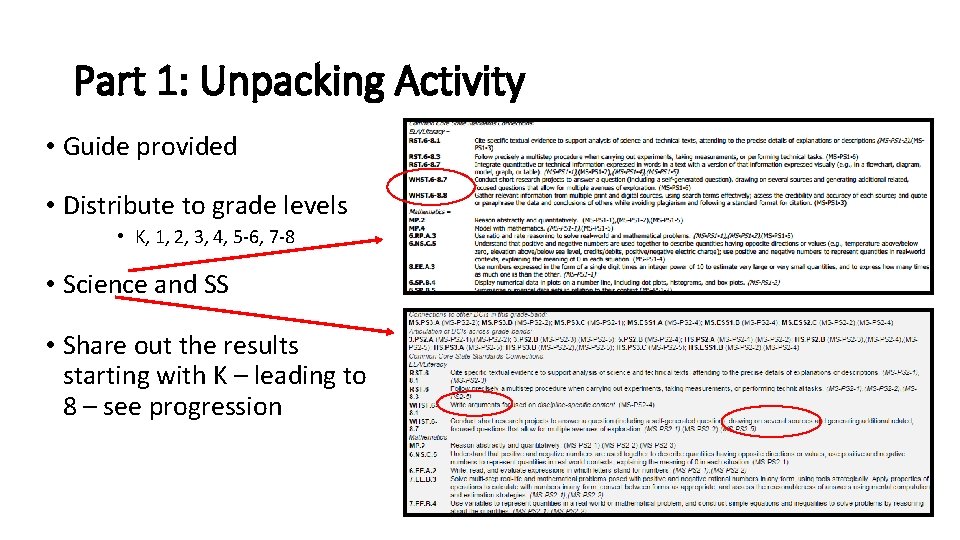
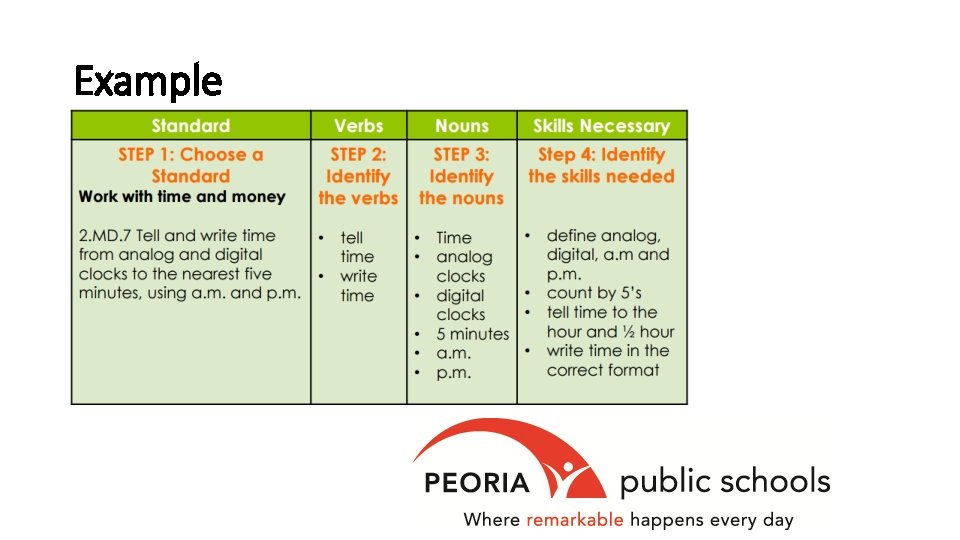
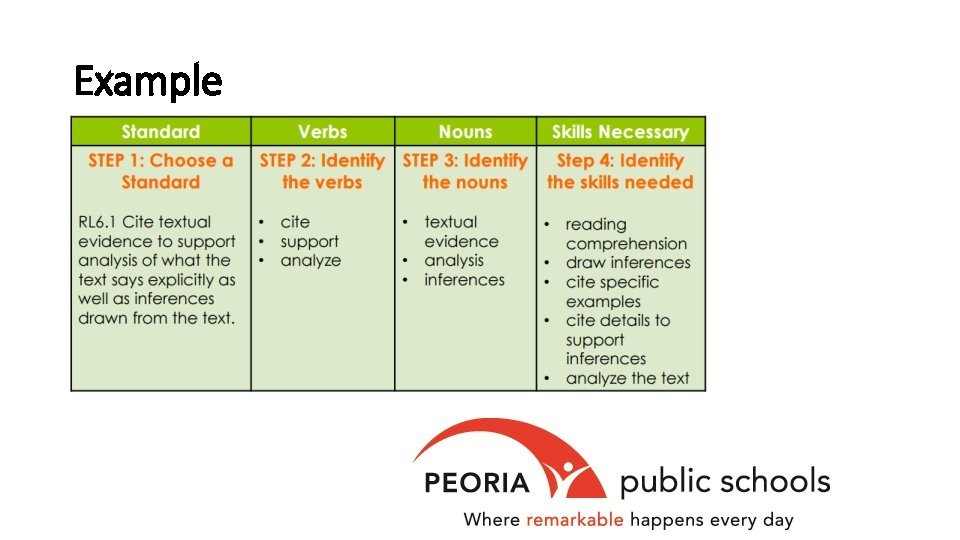
Part 1: Unpacking Activity • Guide provided • Distribute to grade levels • K, 1, 2, 3, 4, 5 -6, 7 -8 • Science and SS • Share out the results starting with K – leading to 8 – see progression
Example
Example
Example
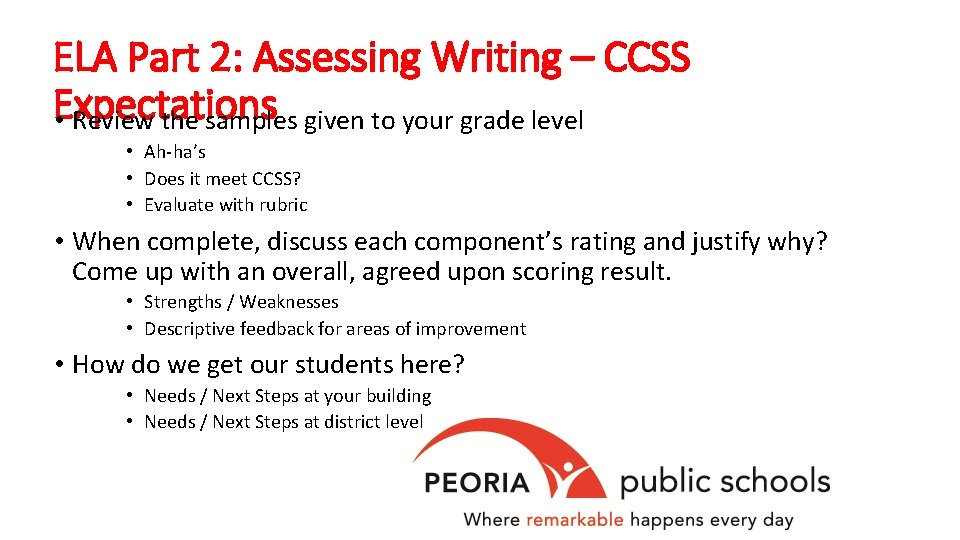
ELA Part 2: Assessing Writing – CCSS Expectations • Review the samples given to your grade level • Ah-ha’s • Does it meet CCSS? • Evaluate with rubric • When complete, discuss each component’s rating and justify why? Come up with an overall, agreed upon scoring result. • Strengths / Weaknesses • Descriptive feedback for areas of improvement • How do we get our students here? • Needs / Next Steps at your building • Needs / Next Steps at district level
Sources Collins, J. L. , & Gunning, T. (Eds. ), Building struggling students' higher level literacy. Newark, DE: International Reading Association. De La Paz, S. (2005). Effects of historical reasoning instruction and writing strategy mastery in culturally and academically diverse middle school classrooms. Journal of Educational Psychology, 97, 139 -156. Graham, S. , & Hebert, M. (2010). Writing to read: Evidence of how writing can improve reading. Washington, DC: Alliance for Excellent Education. Graham, S. , & Perin, D. (2007). A meta-analysis of writing instruction for adolescent students. Journal of Educational Psychology, 99, 445– 476) Jetton, T. , & Shanahan, C. (Eds. ). (2012). Adolescent literacy in the academic disciplines: General principles and practical strategies. New York: Guilford. Shanahan, T. (2004). Overcoming the dominance of communication: Writing to think and learn. In T. L. Jetton & J. A. Dole (Eds. ), Adolescent literacy research and practice. New York: Guilford Press. Shanahan, T. (2008). Relations among oral language, reading, and writing development. In C. A. Mac. Arthur, S. Graham, & J. Fitzgerald (Eds. ), Handbook of Writing Research (pp. 171 -186). New York: Guilford Press. Shanahan, T. (2013). Best practices in writing about text. In S. Graham, C. A. Mac. Arthur, & Jill Fitzgerald (Eds. ), Best practices in writing instruction. New York: Guilford. Shanahan, T. (In press). Common Core State Standards: A new role for writing. Elementary School Journal. Spatt, B. (2010). Writing from sources (8 th ed. ). Boston: Bedford/St. Martins. Tierney, R. J. , & Shanahan, T. (1991). Research on the reading-writing relationship: Interactions, transactions, and outcomes. In R. Barr, M. L. Kamil, P. Mosenthal, P. D. Pearson (Eds. ), Handbook of Reading Research (pp. 246 -280). New York: Longman.