
Writing about graphs Miss Fifa miss nur afifah
Writing about graphs Miss Fifa
miss nur afifah abd halim 2010
Before you begin • Underline key words. • Write related words - turn nouns into verbs, verbs into nouns, adjectives into adverbs, etc. • Write opposite words, similar words, synonyms, etc.
Before you begin • • Circle and highlight the graph. Use arrows. Make notes. Circle the biggest, the smallest. stable or unchanging parts, sudden increases, etc.
Before you begin • Identify trends. A trend is the overall idea of the graph – what is happening/what happened – the main change over time – the most noticeable thing about the graph – the pattern over time – the pattern for different places or groups or people.
• Most graphs will have two trends, or there will be two graphs with a trend in each. • You could write about the two trends in two separate paragraphs. • Make sure you have identified the trends in the graph.
Planning stage • • Time/Tense: Topic: General trend: Conclusion:
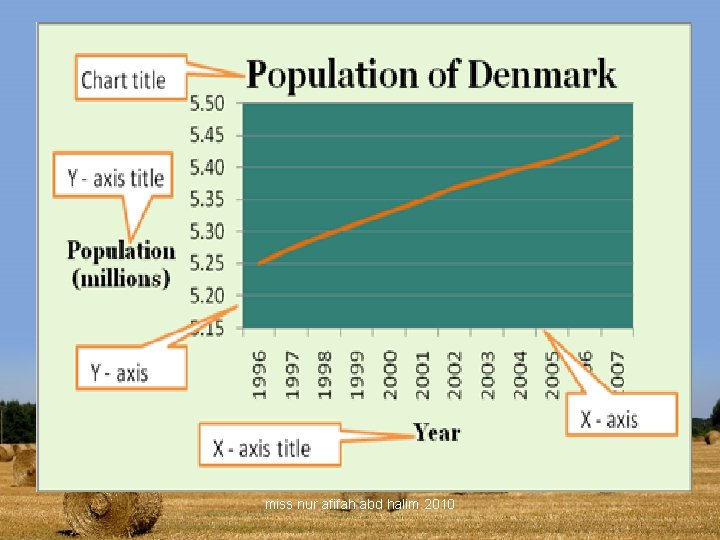
While You Write: Some Don’ts • Don’t describe the X and Y axis. Give the information. • Don’t write about everything on the graph. Pick the biggest, the smallest, the main points, the main trends. Group similar things together
While You Write: Some Don’ts • Don’t write about the line or the bar: “The line went up, ” “The bar went down. ” Instead, write about the idea. • “The number of people going to work by train increased gradually. ” “Oil production shot up in 1965”
While You Write: Some Don’ts • Make sure you write about the idea. Don’t use shorthand: “Men went up. ” “Women went down. ” • Instead, write about the real data: “The number of men at university fell dramatically, ” “The percentage of female students getting a degree rose suddenly. ”
While You Write: Some Don’ts • Don’t use “I feel”, “as I have written, ” “as you can see, ” etc. Keep it academic. • Don’t start sentences with But, So, Also, And, For, Since, Because, Although
While you write - layout Introduction • First sentence: Describe the graph. • You can use some slightly different words or word forms from those on the question paper, but be careful to give the full information. • Start "The graph shows”
• Second sentence: This gives the trend or trends. • You can put two trends in this sentence or only one - you could keep the other one for the conclusion. • Start "Overall, . . . ”
Paragraph 2: Trend 1 • Start with a sentence with no number. “City size increased sharply over the period. ” • “The most obvious trend in the graph is that women are having fewer babies. ” • “Oil production has increased slightly in all the countries in the graph”
• Follow this sentence with an example (sentence with number) and perhaps another example (another sentence with number). Keep alternating.
Paragraph 3: Trend 2 • Start with a sentence with no number. “City size increased sharply over the period. ” • Give an example (sentence with number) and perhaps another example (Sentence with number)
Conclusion • Finish by repeating the main trends, or identify a second trend. • Use different vocabulary. • Don't have any numbers in the conclusion (you could use words like "most", "the majority" "a minority", "a small number"). • Don’t give an opinion.
Word length • Make sure you have 150 words. You should have some short sentences (about 6 -10 words) and some long ones (12 -18) words, but your average should be about 12 or 13 words per sentence. • A sentence without a number will usually be short. Use a mix - a sentence without a number followed by a sentence or two with a number.
- Slides: 18