
Writing about a topical language issue Gender Friday
Writing about a topical language issue: Gender Friday 26 February 2021
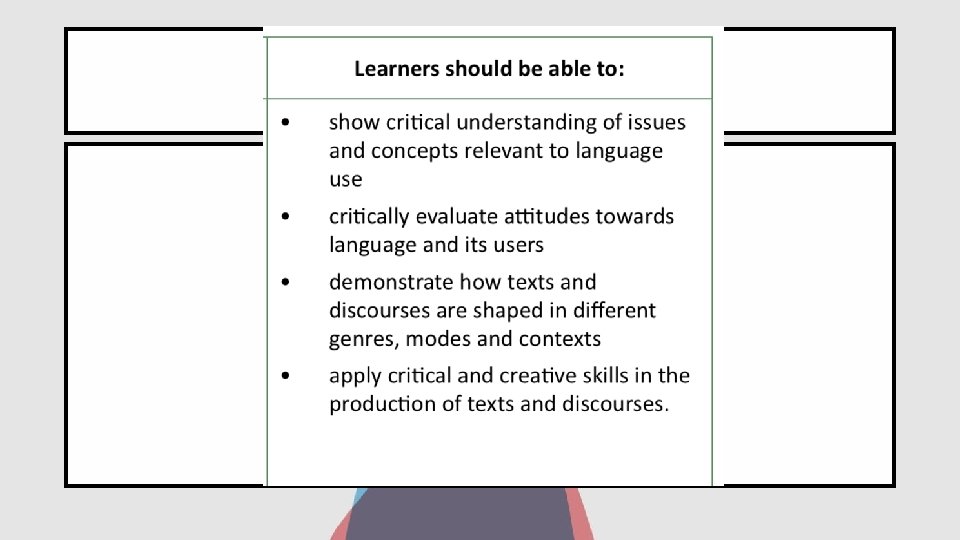
Learning Purposes • To understand the exam requirements of the ‘Writing about a topical language issue’ component of the exam • To explore linguistic concepts in relation to ‘Language and Gender’ • To produce a piece of topical writing Link to previous learning Ø What is instrumental power and influential power? Ø How has technology affected language use? Future learning Ø Exploration into topical language issues (gender/power/technology) Ø Developing ability to write effectively, taking into consideration the audience and genre.
Exam specification • Section B of your Component 01 exam: Exploring Language • This section focuses on an issue or concept related to language in use and gives you the opportunity to present and explore your ideas and attitudes towards language issues in a short piece of original writing. • A real-world purpose, form and audience for the writing will be given in the task. There are 24 marks available for this task.
Writing about a topical language issue You will be given a statement and then asked to write a written response for a particular audience, purpose and context/form. ‘Modern Technology is destroying the English Language. ’ Write a short talk to be delivered to a non-specialist, reasonably welleducated audience, which critically engages with the statement and persuades the audience of a particular point of view
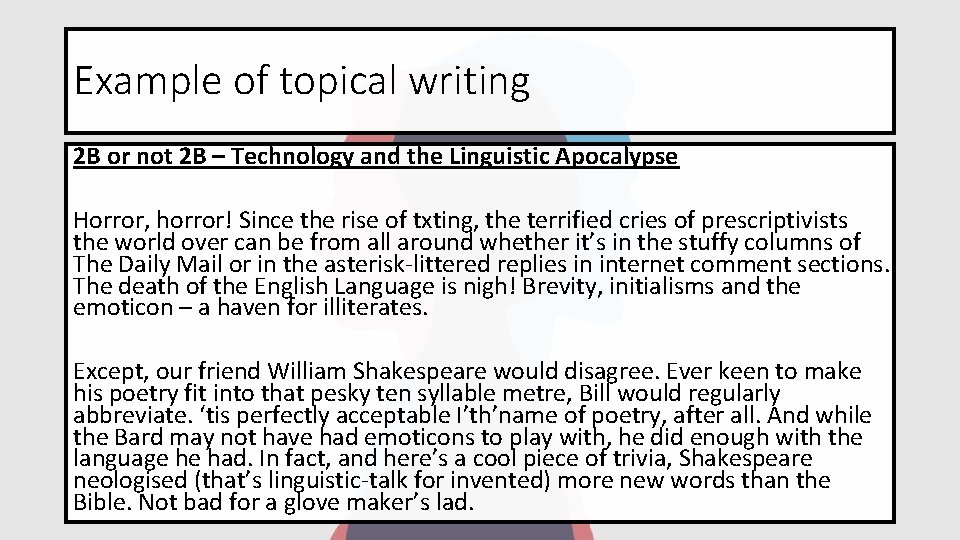
Example of topical writing 2 B or not 2 B – Technology and the Linguistic Apocalypse Horror, horror! Since the rise of txting, the terrified cries of prescriptivists the world over can be from all around whether it’s in the stuffy columns of The Daily Mail or in the asterisk-littered replies in internet comment sections. The death of the English Language is nigh! Brevity, initialisms and the emoticon – a haven for illiterates. Except, our friend William Shakespeare would disagree. Ever keen to make his poetry fit into that pesky ten syllable metre, Bill would regularly abbreviate. ‘tis perfectly acceptable I’th’name of poetry, after all. And while the Bard may not have had emoticons to play with, he did enough with the language he had. In fact, and here’s a cool piece of trivia, Shakespeare neologised (that’s linguistic-talk for invented) more new words than the Bible. Not bad for a glove maker’s lad.
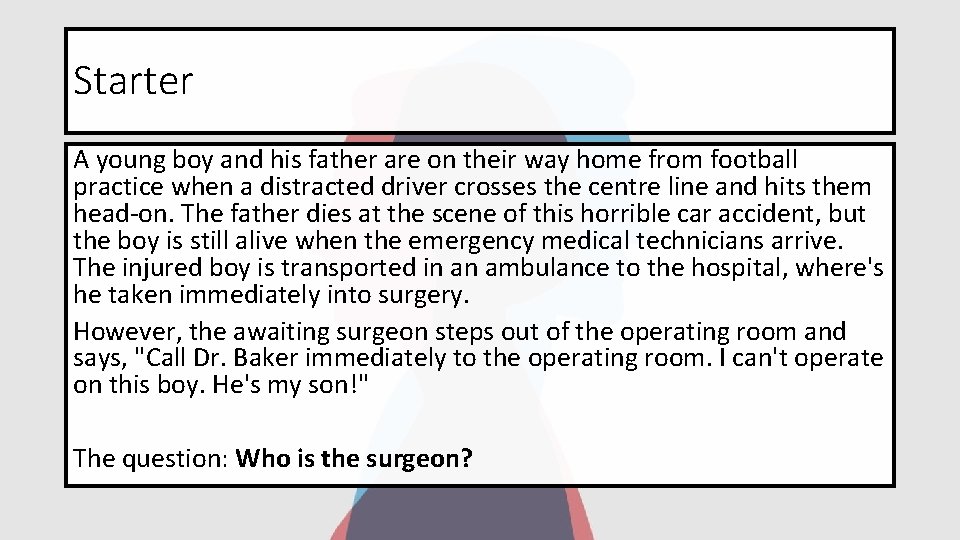
Starter A young boy and his father are on their way home from football practice when a distracted driver crosses the centre line and hits them head-on. The father dies at the scene of this horrible car accident, but the boy is still alive when the emergency medical technicians arrive. The injured boy is transported in an ambulance to the hospital, where's he taken immediately into surgery. However, the awaiting surgeon steps out of the operating room and says, "Call Dr. Baker immediately to the operating room. I can't operate on this boy. He's my son!" The question: Who is the surgeon?
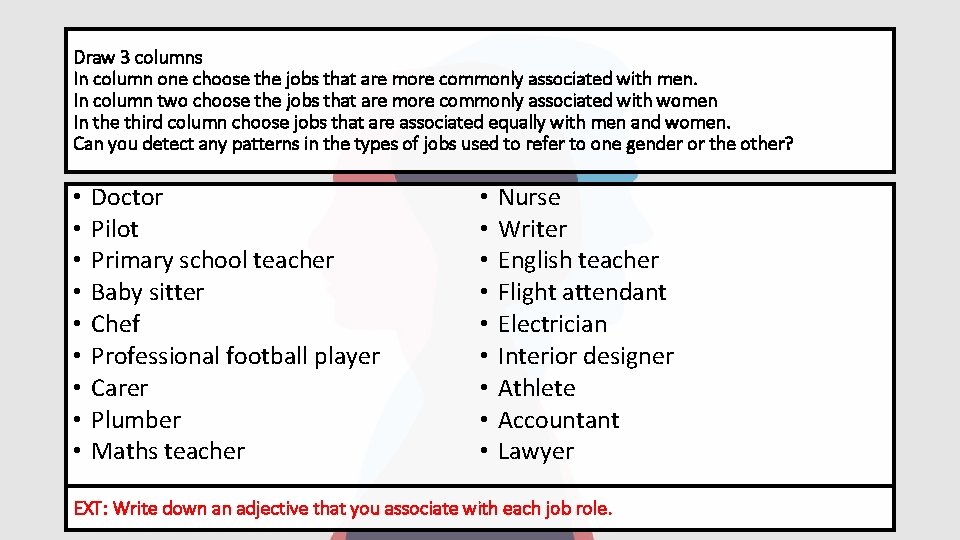
Draw 3 columns In column one choose the jobs that are more commonly associated with men. In column two choose the jobs that are more commonly associated with women In the third column choose jobs that are associated equally with men and women. Can you detect any patterns in the types of jobs used to refer to one gender or the other? • • • Doctor Pilot Primary school teacher Baby sitter Chef Professional football player Carer Plumber Maths teacher • • • Nurse Writer English teacher Flight attendant Electrician Interior designer Athlete Accountant Lawyer EXT: Write down an adjective that you associate with each job role.
Discussion question Do you think that the English Language is sexist? Write a short paragraph justifying your opinion.
Lexical asymmetry The two terms Mr and Mrs are asymmetrical – unequal. For the male term, the status of the man is disclosed, but the female term marks her out as married or unmarried: Miss/Mrs. Gender marking – certain terms are marked for gender TASK: Write down as many job roles that have gender marking.
Read the article: You should basically stop using gendered nouns – The Washington Post. After you have read this, answer the following questions: 1. Which lexemes are still used that could show gender bias? 2. For what reason may the noun ‘Latina’ be viewed differently to other gender marked terms? 3. Make notes about the Wycliffe Bible and some terms that were included – why is this significant? 4. Make notes about Chaucer and Shakespeare’s use of marked terms. 5. Which other suffixes have been used to mark terms? Write down examples for each.
Watch the video and make notes about the key ideas discussed. https: //www. youtube. com/watch? v=n. Pmek 4 s. Qtms
Key words Pejoration – a word takes on more negative meanings over time Can you think of any examples? Amelioration – a word takes on more positive meanings over time Can you think of any examples?
Read the article: Eight words that reveal the sexism at the heart of the English language TASK: Create a table showing how the eight words that have undergone pejoration over time. One has been done for you: Word Original meaning Pejorative meaning Hussy One neutral term meaning female 17 th century onwards : a head of a housewife. Contraction disreputable woman of improper of ‘husewif’ (13 th century) behaviour.
Read the article: Is it time that we got a gender neutral pronoun? Read the article and consider the key ideas discussed. Make notes about the inclusion of gender neutral pronouns.
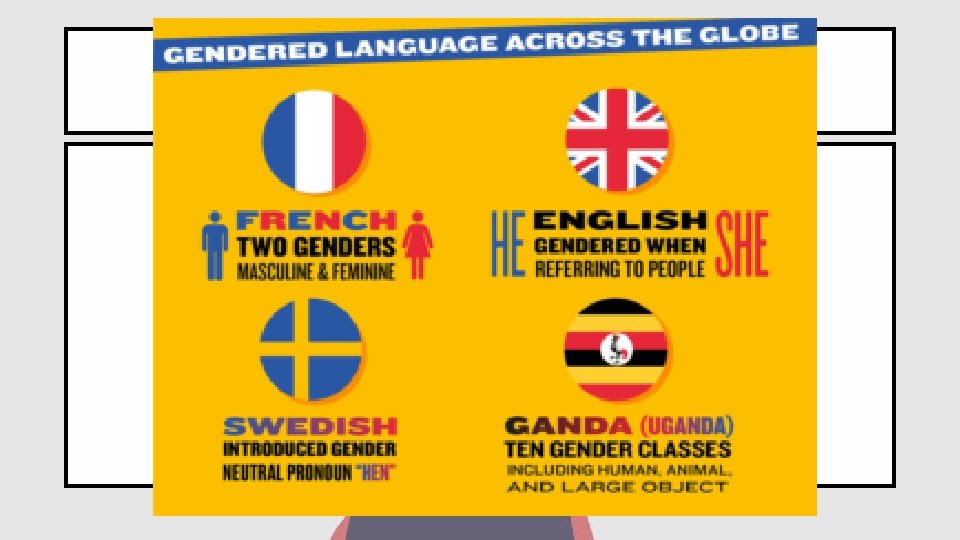
Gender neutral pronouns in other languages • In 2015, Sweden introduced the gender neutral personal pronoun Hen as an alternative to having to use “he” or “she. ” • “The pronoun was ‘created’ in Swedish as an alternative to ‘han’ (he), and ‘hon’ (she), ”. The need for such a word was first recognised in the ’ 60 s, when a Swedish linguist discussed the need for a new pronoun in a local newspaper, having been inspired by the Finnish pronoun ‘hän’, which translates as both he and she. • ‘Hen’ was then dormant for a long time, but in the 2000 s, the word started to be used in LGBTQ communities and within the gender studies academia, as a pronoun for non-binary people and as an alternative to he/she. ”
Is the English Language a sexist language? If a woman is swept off a ship into the water, the cry is Man overboard. If she is killed by a hit-and-run driver, the charge is manslaughter. If she is injured on the job, the coverage is workmen‘s compensation. But if she arrives at the threshold marked Men Only, she knows the admonition is not intended to bar animals or plants or inanimate objects. It is meant for her.
The English Language is sexist. (500 word) Write a short talk to be delivered to a Sixth Form debating society which critically engages with the statement above and persuades the audience of a particular point of view. It should be no more than 500 words long. What are the requirements of this question? What is the purpose/audience/form? What linguistic features would we expect in this form of writing?
- Slides: 19