
Writing a Textual Analysis Essay analysis na detailed
- Slides: 8
Writing a Textual Analysis Essay analysis (n)—a detailed examination of the elements or structure of something, typically as a basis for discussion or interpretation. THUS, A textual analysis is created to examine a text by breaking it down to its component parts to help one better understand it.
A textual analysis must include… 1. An introduction that develops interest and provides context. 2. A clear thesis statement. 3. Textual evidence – Direct quotations and/or paraphrases. 4. Interpretations of textual evidence – Every evidence must clearly contribute to your thesis/overall central idea. 5. A conclusion that wraps things up effectively.
Introductory Paragraph 1. Attention getter (1 -3 sentences): Used to pique reader interest. – – Interesting quote from text Famous quote (identify source) Interesting/thought provoking observation Interesting/thought provoking fact or statistic 2. Connector (2 -3 sentences): Used to provide context for reader and lead into thesis. – – Title, author, brief summary of text Logical lead into thesis 3. Thesis Statement (1 sentence): States central idea of essay in one clear, concise sentence – This time, we are NOT listing “three things. ”
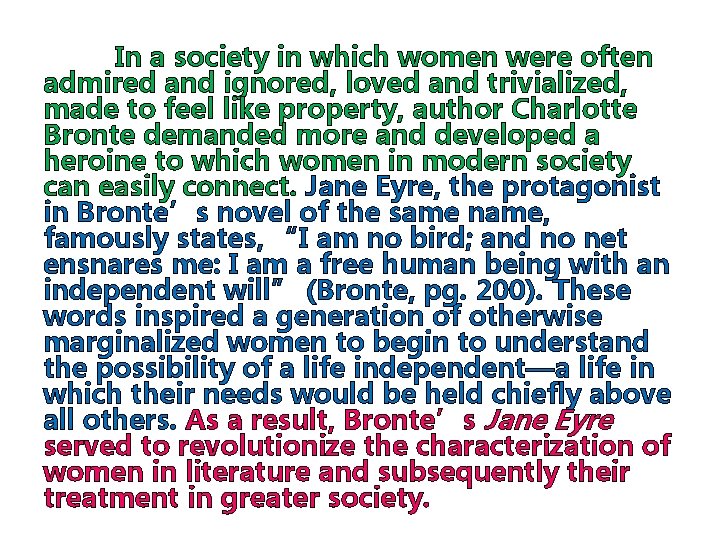
In a society in which women were often admired and ignored, loved and trivialized, made to feel like property, author Charlotte Bronte demanded more and developed a heroine to which women in modern society can easily connect. Jane Eyre, the protagonist in Bronte’s novel of the same name, famously states, “I am no bird; and no net ensnares me: I am a free human being with an independent will” (Bronte, pg. 200). These words inspired a generation of otherwise marginalized women to begin to understand the possibility of a life independent—a life in which their needs would be held chiefly above all others. As a result, Bronte’s Jane Eyre served to revolutionize the characterization of women in literature and subsequently their treatment in greater society.
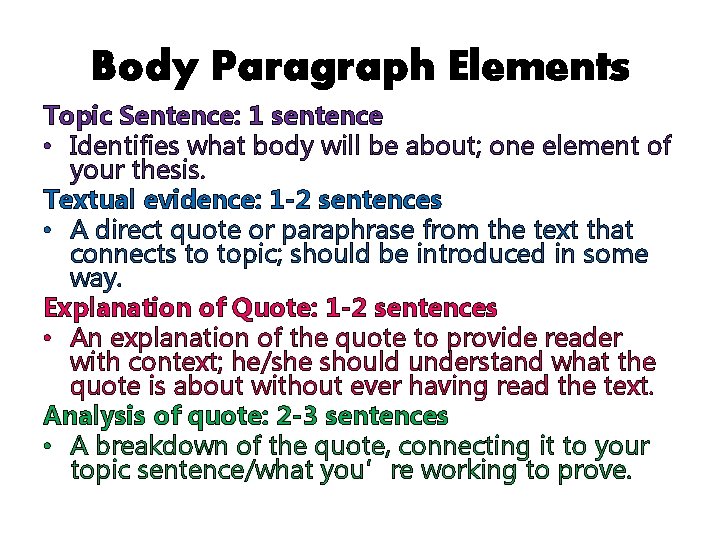
Body Paragraph Elements Topic Sentence: 1 sentence • Identifies what body will be about; one element of your thesis. Textual evidence: 1 -2 sentences • A direct quote or paraphrase from the text that connects to topic; should be introduced in some way. Explanation of Quote: 1 -2 sentences • An explanation of the quote to provide reader with context; he/she should understand what the quote is about without ever having read the text. Analysis of quote: 2 -3 sentences • A breakdown of the quote, connecting it to your topic sentence/what you’re working to prove.
Body Paragraph Setup 1. Topic Sentence 2. Textual evidence #1 3. Explanation #1 4. Analysis #1 5. Textual Evidence #2 6. Explanation #2 7. Analysis #2 Paragraphs will be anywhere from 1115 sentences. Woot!
MLA Parenthetical Citations What you need: • Author last name • Page number • Parentheses What it looks like: “I would always rather be happy than dignified” (Bronte 125). In Bronte’s novel of the same name, Jane Eyre quite famously states, “I care for myself. The more solitary, the more friendless, the more unsustained I am, the more I will respect myself” (67).
Concluding Paragraph Should do the following: • Review overall message/purpose of essay • Convey a sense of completeness and closure • Leave a positive impression on the reader