
Writing a Summary Notetaking for writing a research
- Slides: 6
Writing a Summary (Notetaking for writing a research paper)
How to write a summary: • Read the article to be summarized and be sure you understand it. • Outline the article. Note the major points. • Write a first draft of the summary without looking at the article. • Always use paraphrase when writing a summary. (If you do copy a phrase from the original be sure it is a very important phrase that is necessary and cannot be paraphrased. In this case put "quotation marks" around the phrase. ) • Target the summary for approximately 1/4 the length of the original.
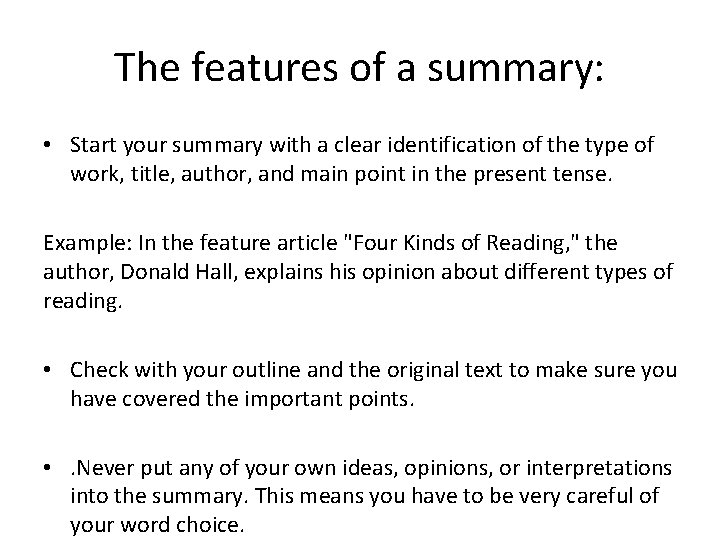
The features of a summary: • Start your summary with a clear identification of the type of work, title, author, and main point in the present tense. Example: In the feature article "Four Kinds of Reading, " the author, Donald Hall, explains his opinion about different types of reading.
The features of a summary: • Check with your outline and the original text to make sure you have covered the important points. • . Never put any of your own ideas, opinions, or interpretations into the summary. This means you have to be very careful of your word choice. • Write using "summarizing language. " Periodically remind your reader that this is a summary by using phrases such as the article claims, the author suggests, etc. • 4. Write a complete bibliographic citation at the beginning of your summary. A complete bibliographic citation includes as a
The features of a summary: • Start your summary with a clear identification of the type of work, title, author, and main point in the present tense. Example: In the feature article "Four Kinds of Reading, " the author, Donald Hall, explains his opinion about different types of reading. • Check with your outline and the original text to make sure you have covered the important points. • . Never put any of your own ideas, opinions, or interpretations into the summary. This means you have to be very careful of your word choice.
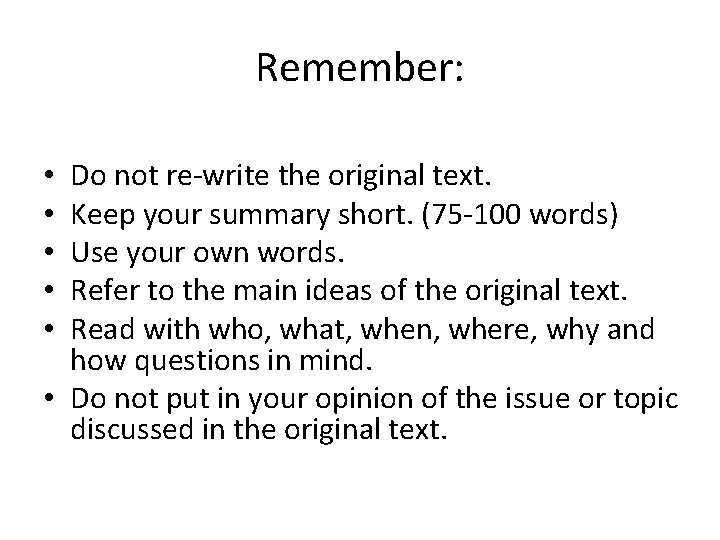
Remember: Do not re-write the original text. Keep your summary short. (75 -100 words) Use your own words. Refer to the main ideas of the original text. Read with who, what, when, where, why and how questions in mind. • Do not put in your opinion of the issue or topic discussed in the original text. • • •