
Writing a SMART Goal for Fitness And OFITT

- Slides: 21
Writing a SMART Goal for Fitness
And… OFITT Principle and the OOverload Principle OProgression Principle
FITT O Necessary information needs to be present with an exercise regimen. With the FITT principle, you need to know how often you exercise, the level of effort needed, how much time each workout, and the type of exercise performed. O FITT refers to Frequency, Intensity, Time and Type
Overload Principle O In order to improve your level of fitness, you must increase the amount of activity/exercise you normally do. O If not, you will plateau.
Progression Principle OIncrease your time and amounts slowly to avoid injuries and disappointments.
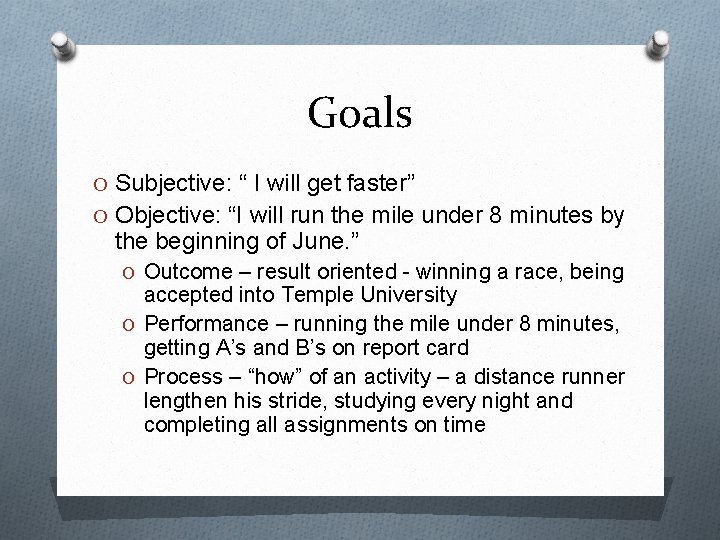
Goals O Subjective: “ I will get faster” O Objective: “I will run the mile under 8 minutes by the beginning of June. ” O Outcome – result oriented - winning a race, being accepted into Temple University O Performance – running the mile under 8 minutes, getting A’s and B’s on report card O Process – “how” of an activity – a distance runner lengthen his stride, studying every night and completing all assignments on time
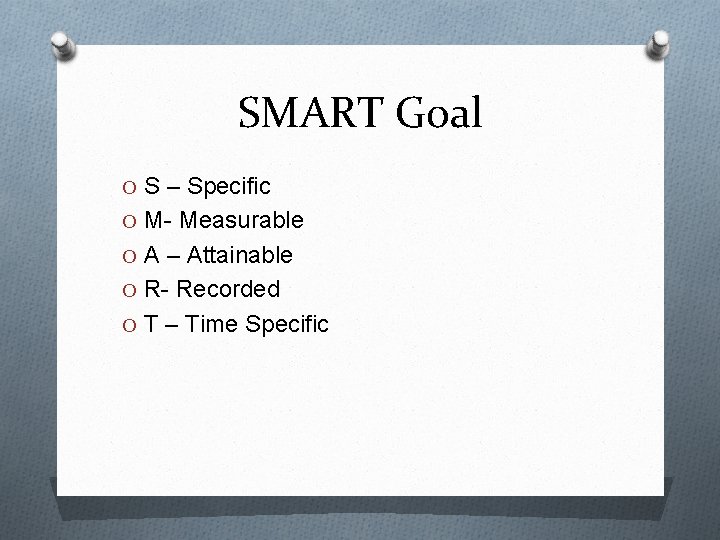
SMART Goal O S – Specific O M- Measurable O A – Attainable O R- Recorded O T – Time Specific
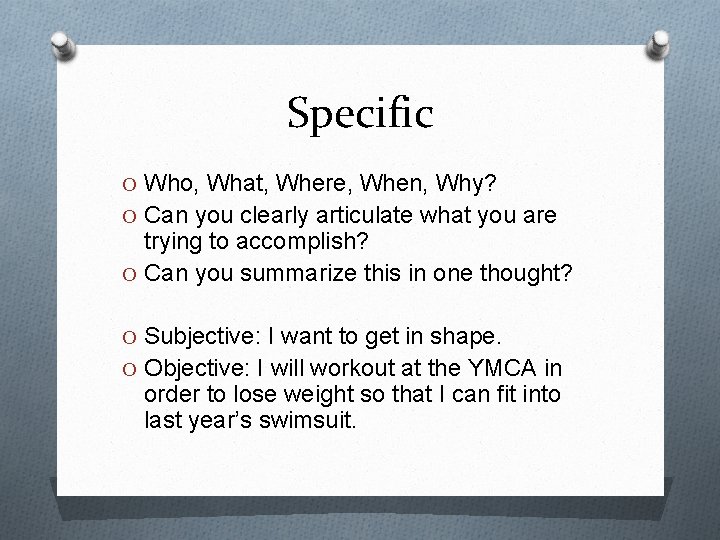
Specific O Who, What, Where, When, Why? O Can you clearly articulate what you are trying to accomplish? O Can you summarize this in one thought? O Subjective: I want to get in shape. O Objective: I will workout at the YMCA in order to lose weight so that I can fit into last year’s swimsuit.
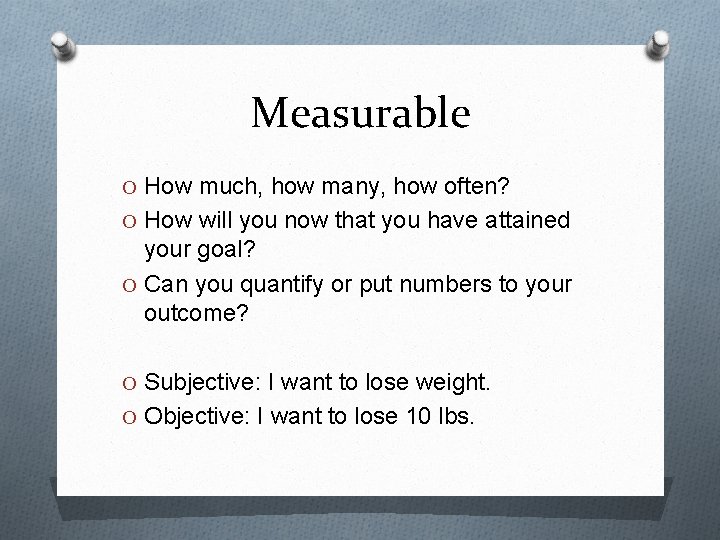
Measurable O How much, how many, how often? O How will you now that you have attained your goal? O Can you quantify or put numbers to your outcome? O Subjective: I want to lose weight. O Objective: I want to lose 10 lbs.
Attainable Attitude, ability, financial capacity Is this goal realistic? Is this goal dependent on someone else? Can you rephrase the goal so it only depends on you and not others? O Are there any things that would prevent you from accomplishing your goal? O Subjective: I want to lose weight by this weekend. O Objective: I want to lose 2 lbs each month until June. O O
Recorded O How will you remind yourself of the goal? O How will you record progress. O Subjective: I have the goal in “my head”. O Objective: I will log all my training sessions through the Polar Flow app.
Time Specific O When will you reach your goal? O Can you give it a time limit? O How long will it take to create a sustainable habit? O Subjective: I will lose 10 lbs asap. O Objective: Starting January 1 st, I will workout at the YMCA 5 days a week. This will help me to reach my goal by May 31 st, 2016.
Mile Time *SMART Goal *FITT Principle *Overload Principle *Progression Principle
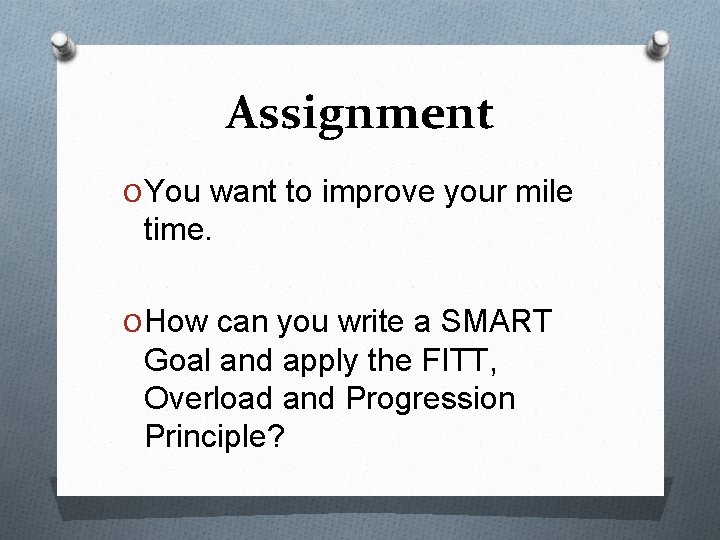
Assignment O You want to improve your mile time. O How can you write a SMART Goal and apply the FITT, Overload and Progression Principle?
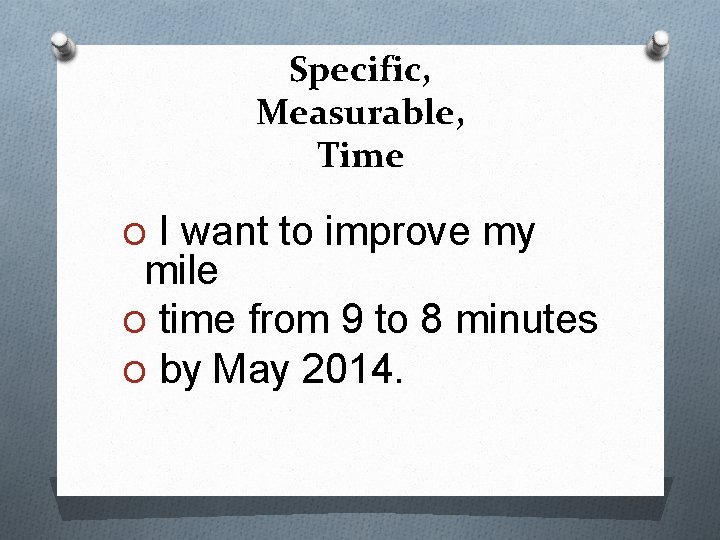
Specific, Measurable, Time O I want to improve my mile O time from 9 to 8 minutes O by May 2014.
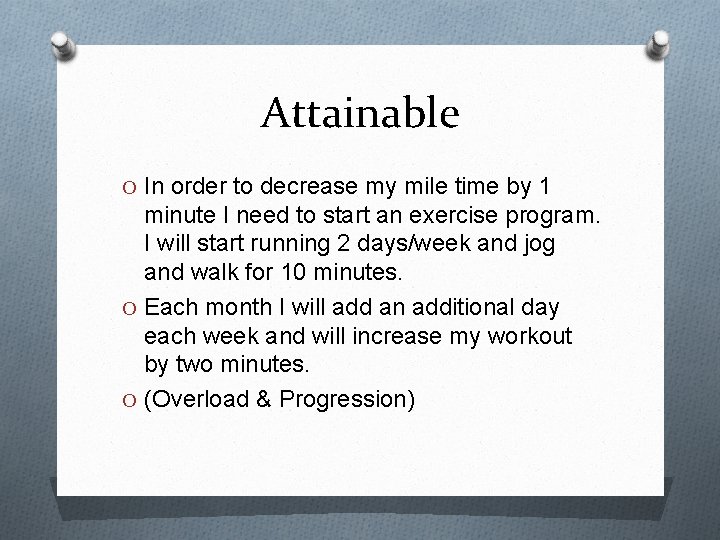
Attainable O In order to decrease my mile time by 1 minute I need to start an exercise program. I will start running 2 days/week and jog and walk for 10 minutes. O Each month I will add an additional day each week and will increase my workout by two minutes. O (Overload & Progression)
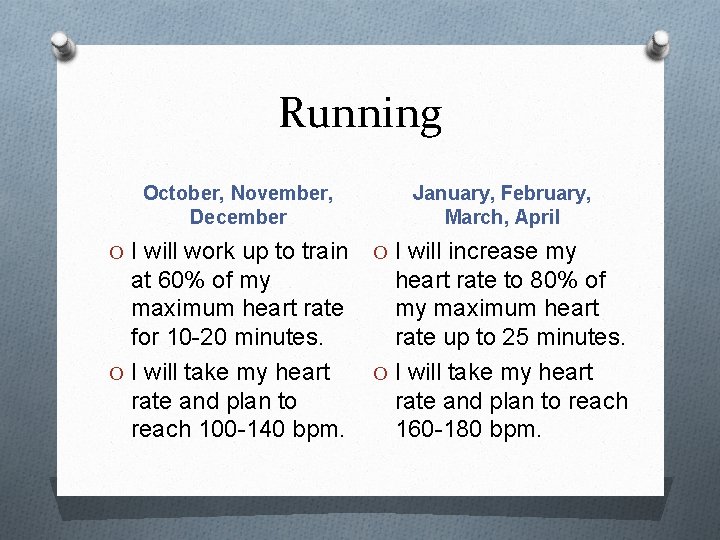
Running October, November, December January, February, March, April O I will work up to train O I will increase my at 60% of my maximum heart rate for 10 -20 minutes. O I will take my heart rate and plan to reach 100 -140 bpm. heart rate to 80% of my maximum heart rate up to 25 minutes. O I will take my heart rate and plan to reach 160 -180 bpm.
Recorded O I will chart my workouts. O I will make adjustments as needed due to obstacles or progressing sooner than expected. O I will retake the mile time every other month.
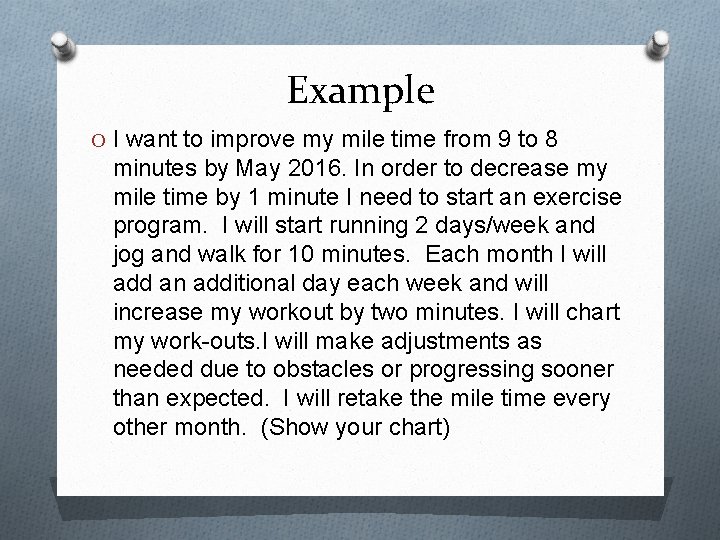
Example O I want to improve my mile time from 9 to 8 minutes by May 2016. In order to decrease my mile time by 1 minute I need to start an exercise program. I will start running 2 days/week and jog and walk for 10 minutes. Each month I will add an additional day each week and will increase my workout by two minutes. I will chart my work-outs. I will make adjustments as needed due to obstacles or progressing sooner than expected. I will retake the mile time every other month. (Show your chart)
Show your understanding O Write a SMART Goal to decrease your mile time and apply the FITT, Overload and Progression Principles. O Submit your work through Google Classroom using Google Docs.
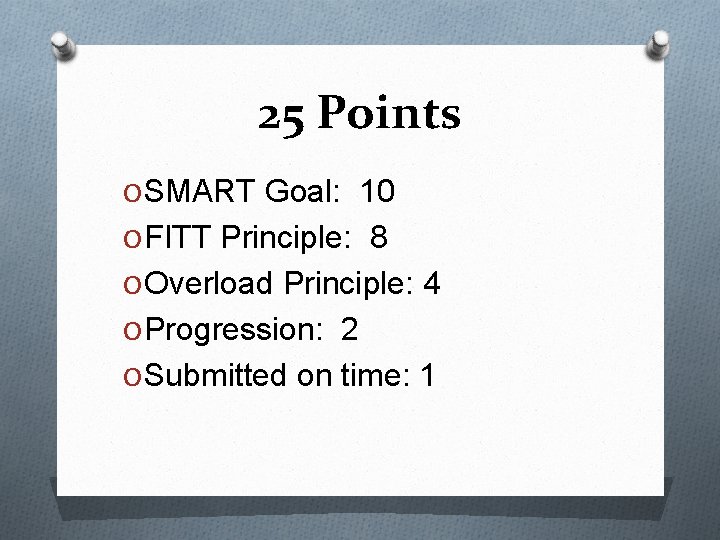
25 Points O SMART Goal: 10 O FITT Principle: 8 O Overload Principle: 4 O Progression: 2 O Submitted on time: 1