
Writing a Short Story Mythological Myth Some Literary
- Slides: 13
Writing a Short Story Mythological Myth
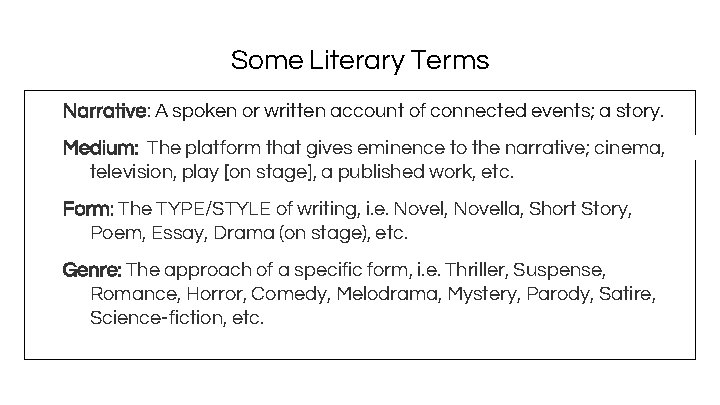
Some Literary Terms Narrative: A spoken or written account of connected events; a story. Medium: The platform that gives eminence to the narrative; cinema, television, play [on stage], a published work, etc. Form: The TYPE/STYLE of writing, i. e. Novel, Novella, Short Story, Poem, Essay, Drama (on stage), etc. Genre: The approach of a specific form, i. e. Thriller, Suspense, Romance, Horror, Comedy, Melodrama, Mystery, Parody, Satire, Science-fiction, etc.
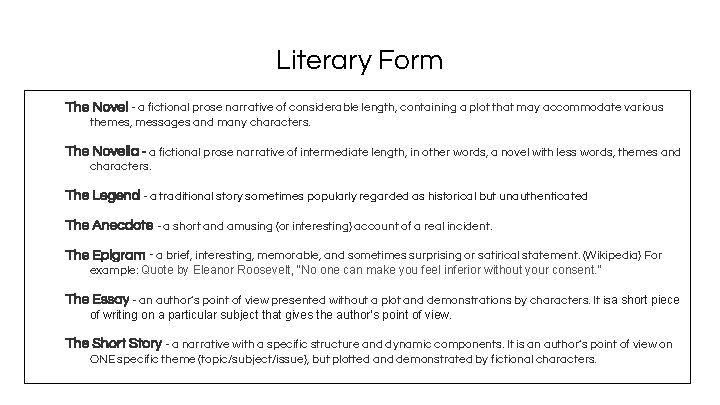
Literary Form The Novel - a fictional prose narrative of considerable length, containing a plot that may accommodate various themes, messages and many characters. The Novella - a fictional prose narrative of intermediate length, in other words, a novel with less words, themes and characters. The Legend - a traditional story sometimes popularly regarded as historical but unauthenticated The Anecdote - a short and amusing (or interesting) account of a real incident. The Epigram - a brief, interesting, memorable, and sometimes surprising or satirical statement. (Wikipedia) For example: Quote by Eleanor Roosevelt, “No one can make you feel inferior without your consent. ” The Essay - an author’s point of view presented without a plot and demonstrations by characters. It isa short piece of writing on a particular subject that gives the author’s point of view. The Short Story - a narrative with a specific structure and dynamic components. It is an author’s point of view on ONE specific theme (topic/subject/issue), but plotted and demonstrated by fictional characters.
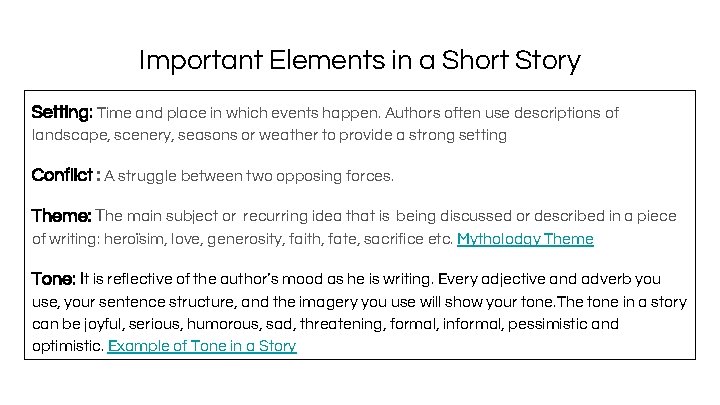
Important Elements in a Short Story Setting: Time and place in which events happen. Authors often use descriptions of landscape, scenery, seasons or weather to provide a strong setting Conflict : A struggle between two opposing forces. Theme: The main subject or recurring idea that is being discussed or described in a piece of writing: heroïsim, love, generosity, faith, fate, sacrifice etc. Mytholodgy Theme Tone: It is reflective of the author’s mood as he is writing. Every adjective and adverb you use, your sentence structure, and the imagery you use will show your tone. The tone in a story can be joyful, serious, humorous, sad, threatening, formal, informal, pessimistic and optimistic. Example of Tone in a Story
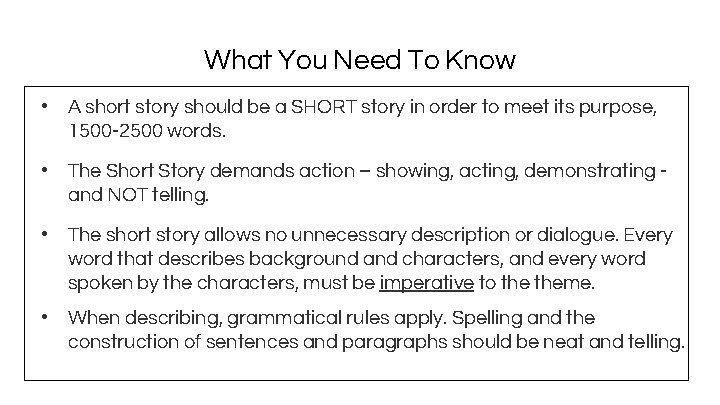
What You Need To Know • A short story should be a SHORT story in order to meet its purpose, 1500 -2500 words. • The Short Story demands action – showing, acting, demonstrating and NOT telling. • The short story allows no unnecessary description or dialogue. Every word that describes background and characters, and every word spoken by the characters, must be imperative to theme. • When describing, grammatical rules apply. Spelling and the construction of sentences and paragraphs should be neat and telling.
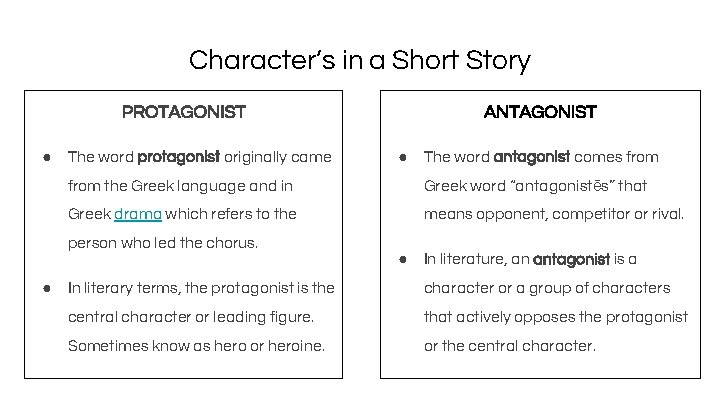
Character’s in a Short Story PROTAGONIST ● The word protagonist originally came ANTAGONIST ● The word antagonist comes from the Greek language and in Greek word “antagonistēs” that Greek drama which refers to the means opponent, competitor or rival. person who led the chorus. ● In literary terms, the protagonist is the ● In literature, an antagonist is a character or a group of characters central character or leading figure. that actively opposes the protagonist Sometimes know as hero or heroine. or the central character.
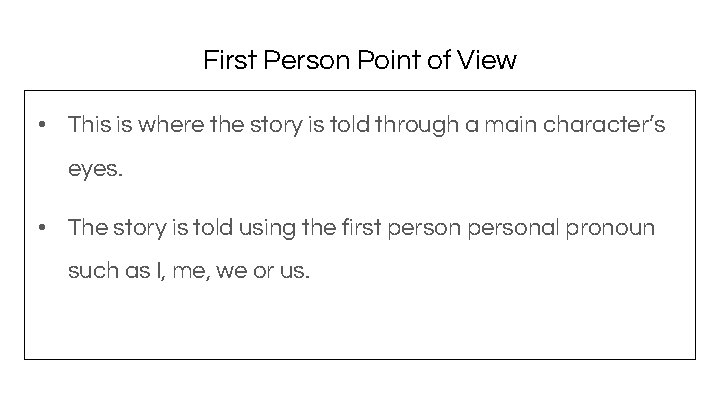
First Person Point of View • This is where the story is told through a main character’s eyes. • The story is told using the first personal pronoun such as I, me, we or us.
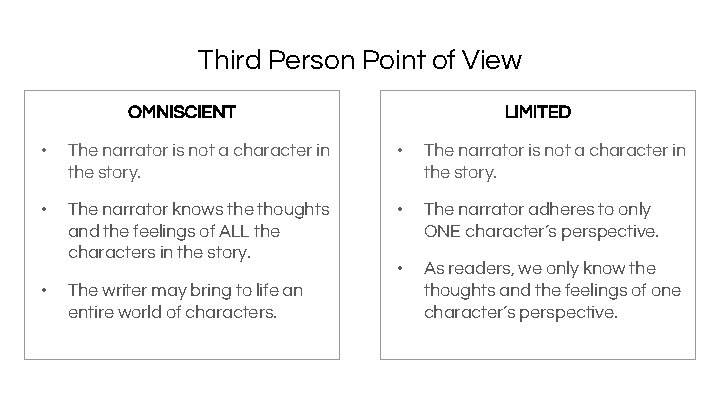
Third Person Point of View OMNISCIENT LIMITED • The narrator is not a character in the story. • The narrator knows the thoughts and the feelings of ALL the characters in the story. • The narrator adheres to only ONE character’s perspective. • As readers, we only know the thoughts and the feelings of one character’s perspective. • The writer may bring to life an entire world of characters.
Structure of a Short Story
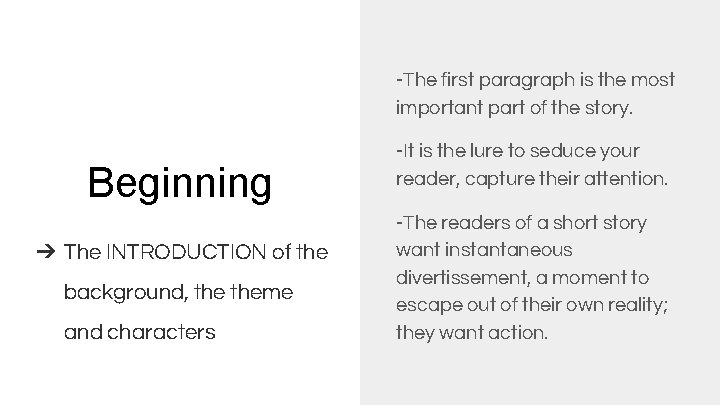
-The first paragraph is the most important part of the story. Beginning ➔ The INTRODUCTION of the background, theme and characters -It is the lure to seduce your reader, capture their attention. -The readers of a short story want instantaneous divertissement, a moment to escape out of their own reality; they want action.
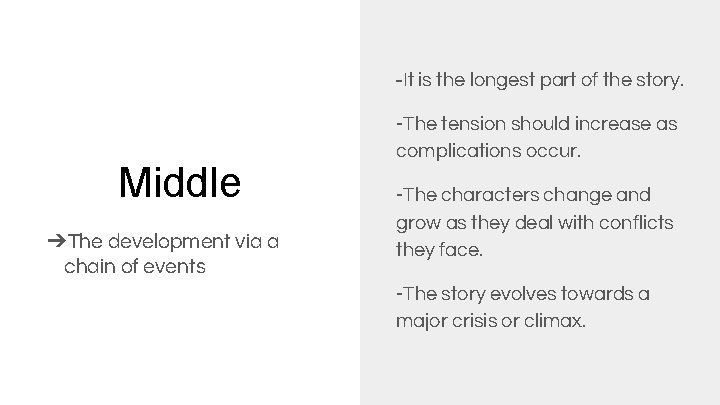
-It is the longest part of the story. Middle ➔The development via a chain of events -The tension should increase as complications occur. -The characters change and grow as they deal with conflicts they face. -The story evolves towards a major crisis or climax.
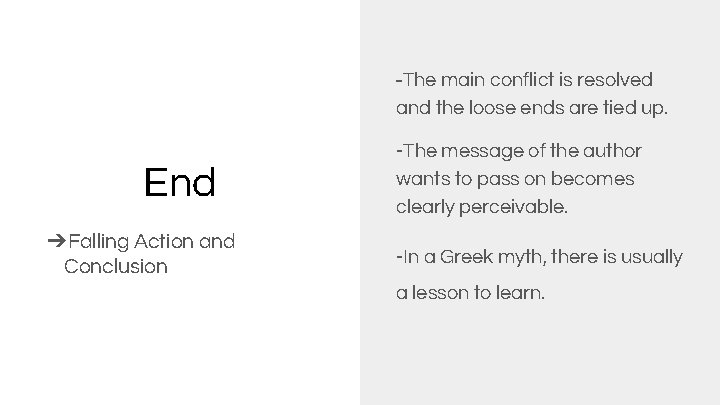
-The main conflict is resolved and the loose ends are tied up. End ➔Falling Action and Conclusion -The message of the author wants to pass on becomes clearly perceivable. -In a Greek myth, there is usually a lesson to learn.
Interesting WEB Sites Myth Stories The Writing Place The Character of a Short Story Character Trait Checklist Thesaurus Dictionnary