
Writing a Research Paper Scaffolding a Thesis What




- Slides: 17
Writing a Research Paper: Scaffolding a Thesis
What are the differences between a regular paper and a thesis?
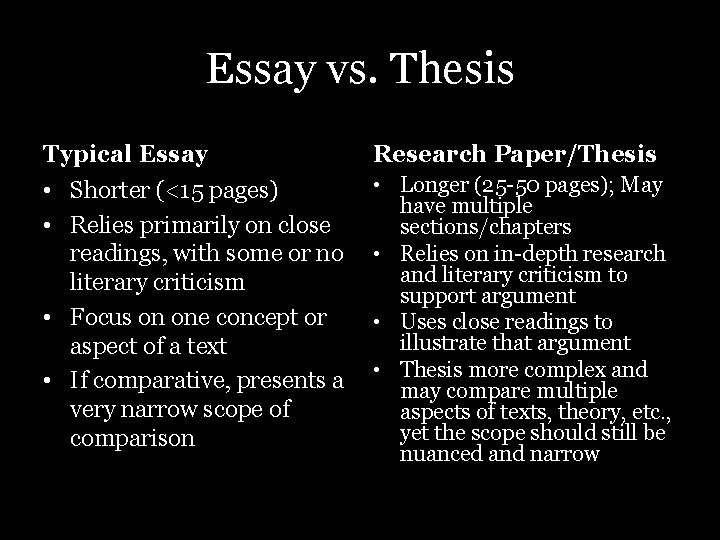
Essay vs. Thesis Typical Essay Research Paper/Thesis • Shorter (<15 pages) • Relies primarily on close readings, with some or no literary criticism • Focus on one concept or aspect of a text • If comparative, presents a very narrow scope of comparison • Longer (25 -50 pages); May have multiple sections/chapters • Relies on in-depth research and literary criticism to support argument • Uses close readings to illustrate that argument • Thesis more complex and may compare multiple aspects of texts, theory, etc. , yet the scope should still be nuanced and narrow
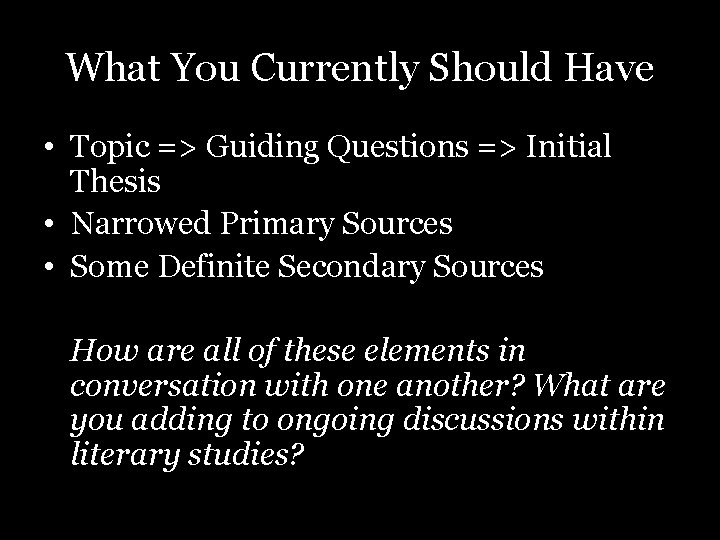
What You Currently Should Have • Topic => Guiding Questions => Initial Thesis • Narrowed Primary Sources • Some Definite Secondary Sources How are all of these elements in conversation with one another? What are you adding to ongoing discussions within literary studies?
Building Your Framework After the Research Proposal
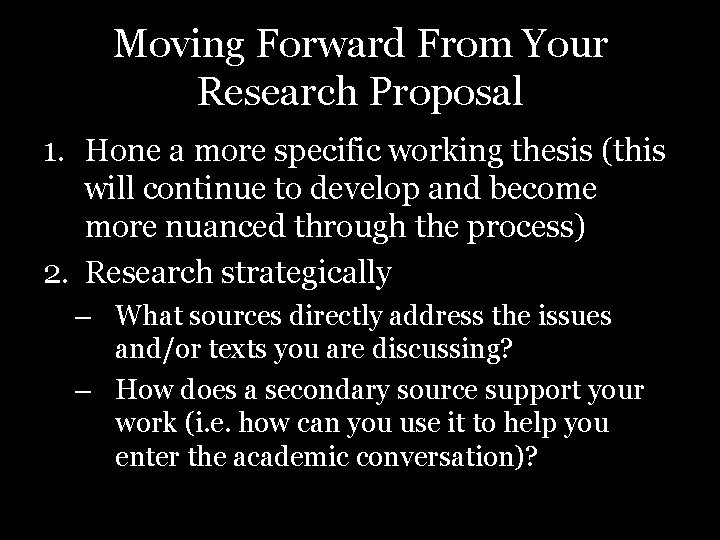
Moving Forward From Your Research Proposal 1. Hone a more specific working thesis (this will continue to develop and become more nuanced through the process) 2. Research strategically – What sources directly address the issues and/or texts you are discussing? – How does a secondary source support your work (i. e. how can you use it to help you enter the academic conversation)?
Moving Forward From Your Research Proposal Cont. 3. Pivot • • • Even if a secondary source does not specifically address your exact primary text or the exact same issue, you can still use it to help build your theoretical argument. Because you are building an original document, you will need to collect different pieces to build an argument rather than finding one secondary source that holds the answer Be flexible – you want your argument to develop with your research; you do not want to “force” an argument or simply bend sources to fit an idea that isn’t working Be active – Remember your research questions and think about how your sources respond or fit into that question. Constantly remind yourself of what you’re asking and interested in.
Refining Secondary Sources Topic/Themes: Spy narratives, contemporary film/tv, neoliberalism, globalism, masculinity, technology Working Thesis: Contemporary film /tv spy narratives continue to present the spy as a figure that upholds certain mid-20 th c ideas of masculinity (i. e. the spy must always be masculine regardless of gender identity). Instead of upholding Cold War politics, this new spy must uphold neoliberalism, globalization, and capitalism. However this rift between the spy viewed as a form of “technology” by the state and the spy’s own individuality create conflict and the impossiblity of ever being a “good” spy Primary Sources: Skyfall, The Bourne Identity, and Homeland Secondary Sources: Foucault’s The History of Sexuality, Allan Hepburn’s Intrigue: Espionage and Culture
Finding More Refined Secondary Sources • UCSB Library Search • Keyterms including “And” “Or” parameters • Subject Lists • MLA • Project Muse Be strategic when you read sources! Always look at the table of contents and intro first to see if this will be a good source. Take good notes. You may need a something from a source later, so it’s always good to keep track of the work you’ve already done
What is the Structure of a Research Paper/Thesis? • Similar format to other essays with a distinct intro, body, and conclusion except expanded • Clear sections that are thematically broken up or subtitled • Intro should present topic and thesis AND introduce the major criticism you are drawing from and how it contributes to your argument
Examples of Past English Theses • Rodolfo Centano, “Decolonizing the Mestizo: Postcolonial Approaches to Latino Identity in Chicano Literature” • Juan Valencia, “The House Settling: Race, Housing, and Wealth in the Post. Recession Horror Film” • Nadia Saleh, “La Petit Mort: Female Vampirism, the Abject, and Sexuality”
The Poster Your posters should present the “project in progress” (i. e. your current argument and your work up to that point) The poster is in many ways an expanded research proposal. Think of it as a way to convince your audience of why your ideas are interesting, original, and worth further investigation! Doing the scaffolding for a longer thesis will help you have a more robust idea and examples to use when you make your poster.
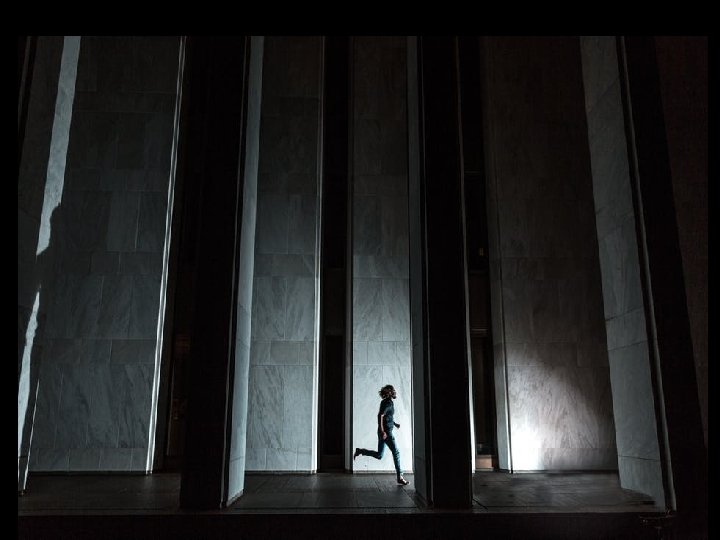
The Runner Metaphor Writing a thesis is a marathon not a sprint. The more “training” you do now, the easier the process will be
Writing Exercise Take ten minutes to write on the following questions: 1. Describe your current project as you are thinking about it right now. What topics and themes are you working with? 2. What are the new issues that are coming up in your research? 3. What kind of hypothesis/argument do you see? This can build from what you proposed in your research proposal, but think about how it has evolved and try to write a more nuanced and specific thesis.
Supplemental Exercise for Scaffolding Project 1. Primary sources: summarize and describe why they are important to your project in a few sentences. 2. Describe what each secondary source adds to your project and how it answers your research questions (it could be a definition, a theory, a counterargument, etc. ) 3. Write a counterargument to your thesis. Try to find the holes in your current argument/ideas.