
Writing a Research Paper Part 4 Introduction Conclusion
- Slides: 17
Writing a Research Paper – Part 4: Introduction, Conclusion, and Body Paragraphs Mr. White’s History Class
Objectives �What do we want to know how to do? �Write an introduction �Write a conclusion �Write body paragraphs
Paragraphs – What are they? �To understand how to write a paragraph, we must first understand what a paragraph’s purpose is. �A paragraph is a collection of related sentences that deals with a single topic (Purdue OWL). �A paragraph is not determined by length.
What makes a paragraph? �A paragraph has the following qualities: �Unity – stick to one topic �Coherence – the paragraph is understandable to the reader �A topic sentence – this tells the reader what the paragraph will talk about �Adequate development (what determines if a paragraph is “long” enough): �The topic should be discussed fully and adequately �Two or three sentences is probably not enough – it probably doesn’t develop the idea fully and adaquately �Taken from Purdue Online Writing Lab
Section 1: Introductions What the purpose of an introduction is, how to write it.
Introductions - Purpose �The purpose of an introduction is to give to the reader: �Your main thesis question, topic, area of comparison, etc. �Your thesis statement – a statement describing what you’ve found through your research �A general overview of how you will take the reader to your eventual conclusion �Briefly explain what kinds of smaller questions you will ask �Briefly explain what types of information you will provide to support your opinion �It does not need to be limited to a paragraph – it can be several paragraphs, or even a whole chapter (in the case of a book)
How to write an introduction �Start with a “hook” – an interesting statement or question that grabs the reader’s interest (it doesn’t have to be too fancy) and is related to your topic �Introduce your thesis question and thesis statement by stating them directly �Explain to the reader how you will use your research to support your thesis statement
Section 2: Conclusions What the purpose of a conclusion is, how to write it.
Conclusion - Purpose �The purpose of a conclusion is: �To restate your thesis �To recap and retrace for the reader how you went about proving it, and the evidence you presented �To bring a logical conclusion to your paper �As with an introduction, a conclusion is not limited to a paragraph – it can be several paragraphs or even a chapter
How to Write a Conclusion �Restate your original question and thesis to the reader. �Briefly retrace and summarize the major arguments and evidence you presented to prove your main point �Explain how those points support your main idea.
Section 3: Body Paragraphs What the purpose of a body paragraph is, how to write one.
Body Paragraph - Purpose �The purpose of a body paragraph is to introduce pieces of information, explain them, and use them to support your main idea. �A body paragraph will use a piece of information that you’ve gathered, explain it further, give your own interpretation, and tie it into the main idea �Body paragraphs should have a logic to their organization �Chronological – sequence of events �Topical – different topics �Compare and contrast
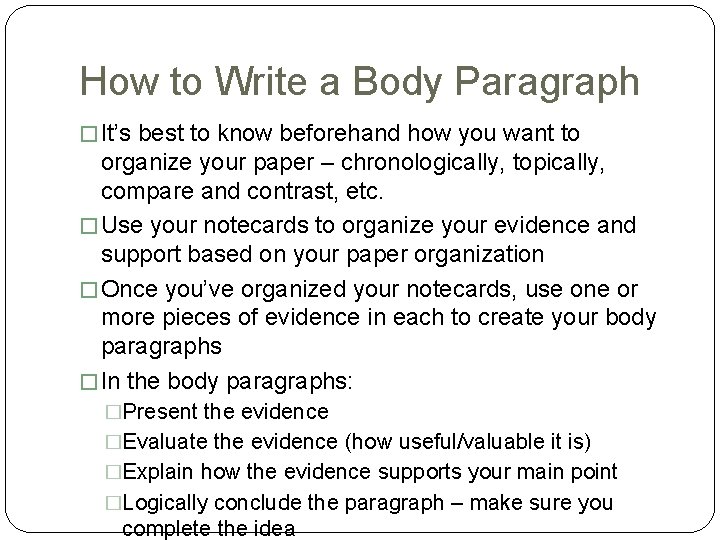
How to Write a Body Paragraph � It’s best to know beforehand how you want to organize your paper – chronologically, topically, compare and contrast, etc. � Use your notecards to organize your evidence and support based on your paper organization � Once you’ve organized your notecards, use one or more pieces of evidence in each to create your body paragraphs � In the body paragraphs: �Present the evidence �Evaluate the evidence (how useful/valuable it is) �Explain how the evidence supports your main point �Logically conclude the paragraph – make sure you complete the idea
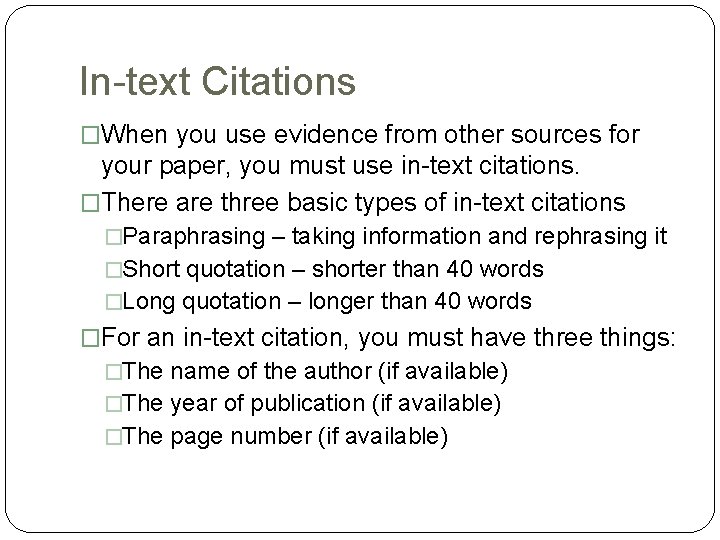
In-text Citations �When you use evidence from other sources for your paper, you must use in-text citations. �There are three basic types of in-text citations �Paraphrasing – taking information and rephrasing it �Short quotation – shorter than 40 words �Long quotation – longer than 40 words �For an in-text citation, you must have three things: �The name of the author (if available) �The year of publication (if available) �The page number (if available)
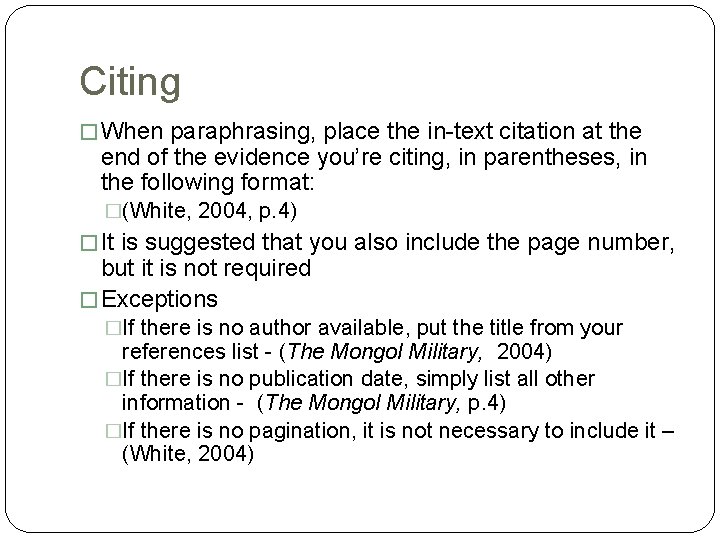
Citing � When paraphrasing, place the in-text citation at the end of the evidence you’re citing, in parentheses, in the following format: �(White, 2004, p. 4) � It is suggested that you also include the page number, but it is not required � Exceptions �If there is no author available, put the title from your references list - (The Mongol Military, 2004) �If there is no publication date, simply list all other information - (The Mongol Military, p. 4) �If there is no pagination, it is not necessary to include it – (White, 2004)
Assignment �Make sure: �Your introduction, conclusion, and body paragraph all meet the conditions above �Your introduction and conclusion are closely related, and outline where your paper will go
Sources �“Paragraphs and Paragraphing. ” Purdue Online Writing Lab. Purdue University. Web. 30 Nov. 2010.