
WRITING A NARRATIVE ESSAY Quest Preparatory Academy English
- Slides: 32
WRITING A NARRATIVE ESSAY Quest Preparatory Academy English 7
Narrative Essay Assignment 1. 2. 3. 4. Write a Narrative Essay about a significant event in your life. Your essay should include the following: A full introduction (one paragraph) with a specific Thesis Statement At least four body paragraphs which develop your story A full conclusion (one paragraph) in which you summarize your event and tell why it was significant Rough Draft Due Friday, April 1
4 Writing Purposes Expository – provides information or an explanation about a topic Narrative – tells a story Descriptive – describes a subject using sensory details Persuasive – attempts to change someone’s viewpoint about a subject
Personal Narratives A personal narrative re-creates a specific experience or event in your life. To write an effective narrative, select an experience that you feel strongly about.
Be Selective with Details Although you are telling a story, you will still be using sensory details to paint a mental picture for your readers. It is important to include specific details. However, a reader doesn’t need to know every little thing. Select details that are important to retelling the story.
Understanding Your Goals for Writing a Personal Narrative Ideas – clear ideas that re-create life experiences Organization – retell the story in chronological order with a strong beginning, middle, and end Transitions – words that show the reader where you are in the story (first, next, finally, etc. ) Voice – you want to sound natural, believable, and interested in your own topic (try to use dialogue when possible)
Understanding Your Goals for Writing a Personal Narrative (continued) Word Choice – choose appropriate words based on their connotations (the feelings associated with a word) Sentence Fluency – make each sentence move smoothly into the next Conventions – correct any spelling, punctuation, capitalization, and grammar errors before turning in your final draft (edit and spell check)
The First Step
Keys to Effective Prewriting Look for writing ideas: Select a writing idea for public writing. Not every life experience is appropriate for sharing publicly. Make good choices at the beginning. List your goals for the assignment. Recalling Freewriting Ask others who were there What do you want to accomplish? How will you know if you are successful? Identify your audience. Who will be reading this? Do you need to adjust your way of writing to fit this audience?
Keys to Effective Prewriting Gather specific details about your chosen life experience. Actions – relate what you (and others) did in a situation. Sensory details – show what you saw, smelled, heard, tasted, or touched. Personal thoughts – reveal what you thought during your experience.
Keys to Effective Prewriting Organize your ideas chronologically. Memorable narratives are suspenseful; they make the reader want to know what happens next. Start with a problem (conflict) – some type of physical or mental obstacle in your way. Work in actions that respond to the problem – each action should build suspense in the story. Build toward the climax or high point – this is the most exciting part in which the writer does or does not overcome the challenge. This should happen at the end of the narrative.
Keys to Effective Prewriting Use dialogue to add personality to your writing. Dialogue should do three things: Show a speaker’s personality Keep the action moving Add information
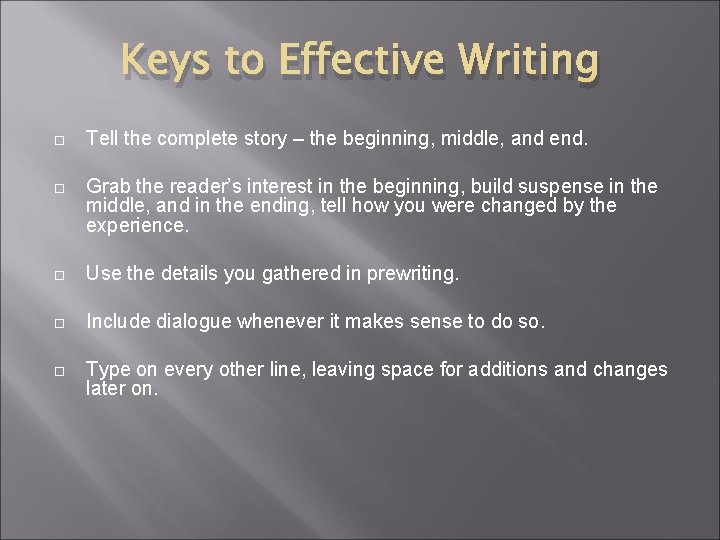
Keys to Effective Writing Tell the complete story – the beginning, middle, and end. Grab the reader’s interest in the beginning, build suspense in the middle, and in the ending, tell how you were changed by the experience. Use the details you gathered in prewriting. Include dialogue whenever it makes sense to do so. Type on every other line, leaving space for additions and changes later on.
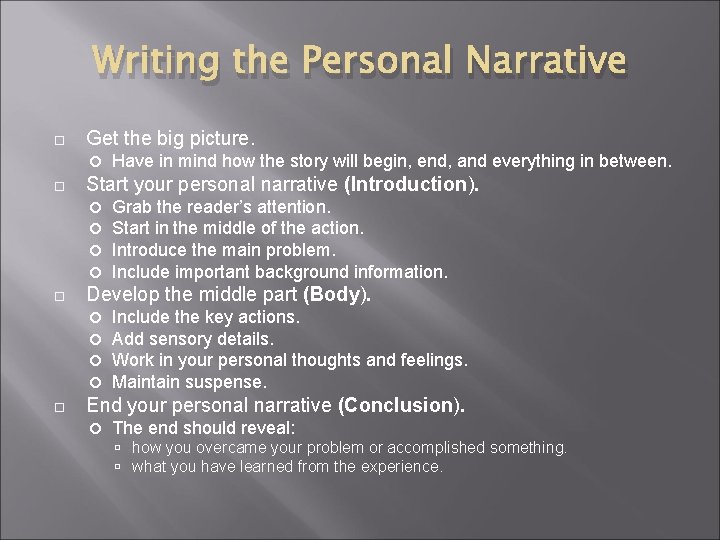
Writing the Personal Narrative Get the big picture. Start your personal narrative (Introduction). Grab the reader’s attention. Start in the middle of the action. Introduce the main problem. Include important background information. Develop the middle part (Body). Have in mind how the story will begin, end, and everything in between. Include the key actions. Add sensory details. Work in your personal thoughts and feelings. Maintain suspense. End your personal narrative (Conclusion). The end should reveal: how you overcame your problem or accomplished something. what you have learned from the experience.
Revising the Personal Narrative Your first draft is your first look at a developing narrative. During the revising step, you improve your first draft by adding to, rewriting, or reorganizing different parts. Focus on these traits when you revise: Ideas Organization Voice Word Choice Sentence Fluency
Keys to Effective Revising 1. Set aside your first draft for a day or two, if possible, before you review your writing. 2. Be sure each main part—the beginning, the middle, and the ending—works well. 3. Revise any parts that seem confusing or incomplete. 4. Pay special attention to your writing voice. Do you sound truly interested in the experience? 5. Use specific words that reflect your feelings about the experience. 6. Be sure your sentences read smoothly.
Revising for Ideas Be sure your narrative “shows” your experience, not just “tells” it. Details make the narrative clear. Do I show rather than tell in my narrative? Your narrative shows if sentences contain action, sensory details, dialogue, and your personal thoughts and feelings. Have I included enough details? Use the 5 W’s and H — who? what? when? where? why? and how?
Revising for Organization Be sure all parts of your narrative work smoothly together. Does my beginning grab the reader’s attention? It does if it does one of the following: 1. Starts in the middle of the action. 2. Creates a clear image with sensory details. 3. Opens with a personal thought.
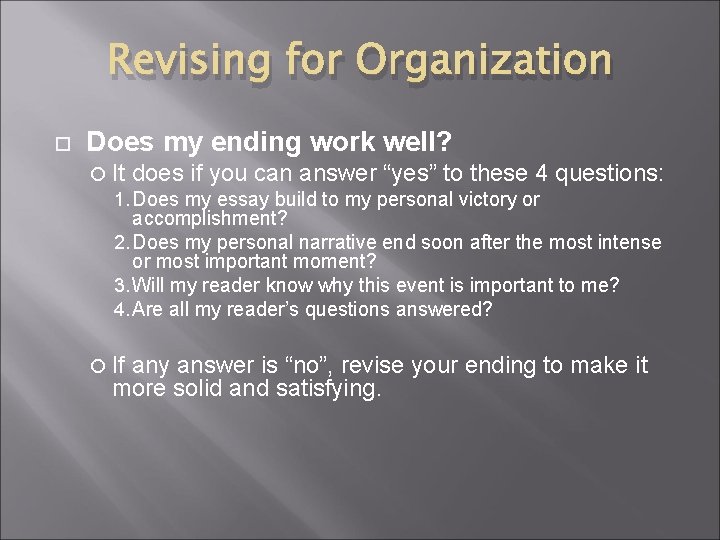
Revising for Organization Does my ending work well? It does if you can answer “yes” to these 4 questions: 1. Does my essay build to my personal victory or accomplishment? 2. Does my personal narrative end soon after the most intense or most important moment? 3. Will my reader know why this event is important to me? 4. Are all my reader’s questions answered? If any answer is “no”, revise your ending to make it more solid and satisfying.
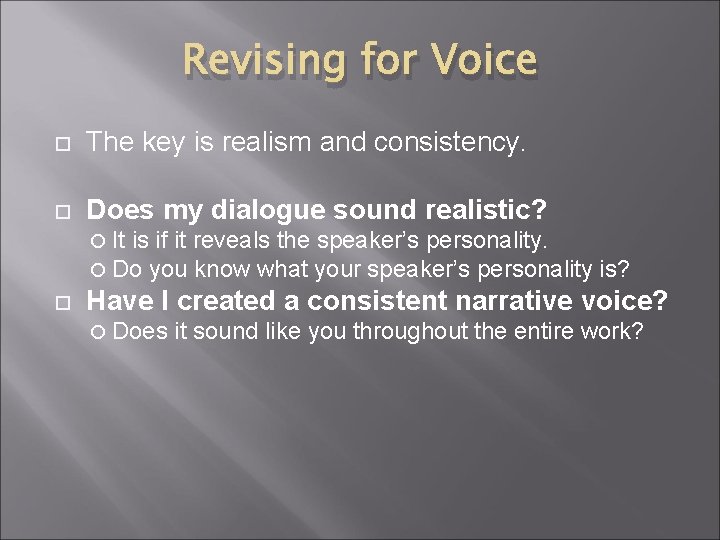
Revising for Voice The key is realism and consistency. Does my dialogue sound realistic? It is if it reveals the speaker’s personality. Do you know what your speaker’s personality is? Have I created a consistent narrative voice? Does it sound like you throughout the entire work?
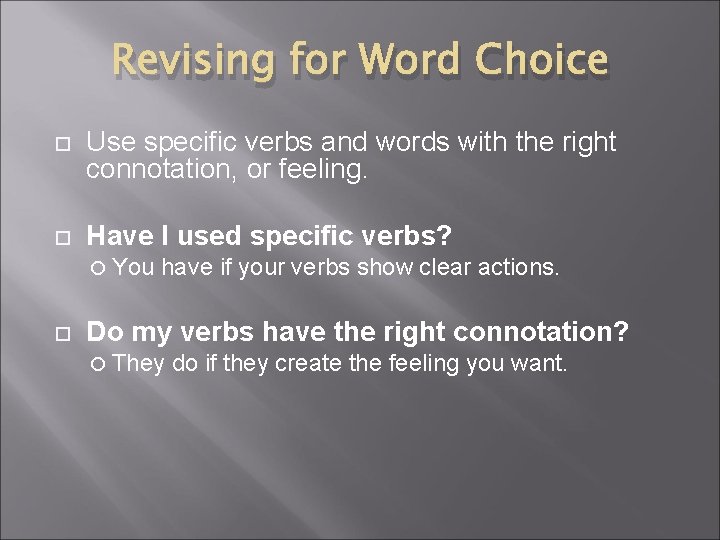
Revising for Word Choice Use specific verbs and words with the right connotation, or feeling. Have I used specific verbs? You have if your verbs show clear actions. Do my verbs have the right connotation? They do if they create the feeling you want.
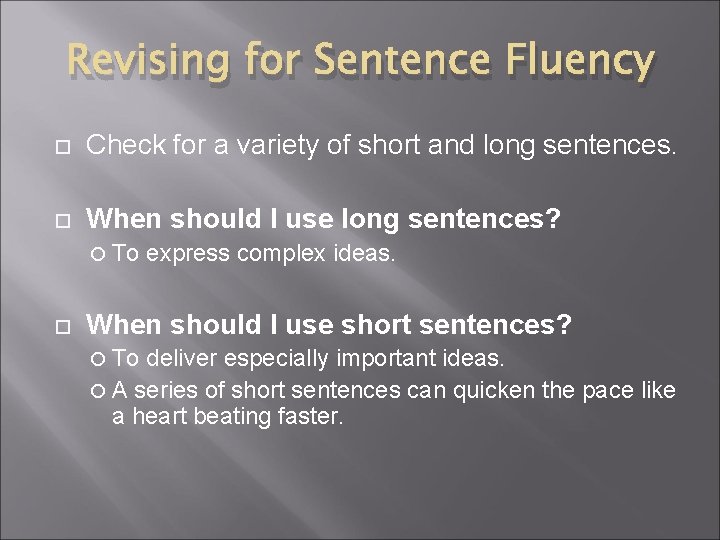
Revising for Sentence Fluency Check for a variety of short and long sentences. When should I use long sentences? To express complex ideas. When should I use short sentences? To deliver especially important ideas. A series of short sentences can quicken the pace like a heart beating faster.
Editing your Personal Narrative Keys to Effective Editing: 1. Use a dictionary and a thesaurus to guide your corrections. 2. Check for any words or phrases that may be confusing to the reader. 3. Check your narrative for correct use of punctuation, capitalization, spelling, and grammar. 4. Edit on a printed computer copy and then enter your changes on the computer.
Editing for Conventions Have I punctuated dialogue correctly? Follow these rules: 1. Use a comma to set off a speaker’s exact words from the rest of the sentence. 2. Place periods and commas inside quotation marks. 3. Place an exclamation point or a question mark outside quotation marks when it punctuates the main sentence, and inside when it punctuates the quotation. Have I used pronouns correctly? You have if the pronouns agree with their antecedents in all of the following: Number Gender Person
Publishing your Personal Narrative Make a neat final copy to share. Other ideas: Recording your narrative. Presenting it in a class blog. Reading it to a group of your peers. Focus on presentation: Use blue or black ink and write neatly or type your essay. Write your name in the upper left-hand corner of page 1. Double-space your narrative. Indent every paragraph and leave a one-inch margin on all four sides. Write your last name and the page number in the upper right-hand corner of every page after the first one.
Reflecting on Your Writing You’ve worked hard on your personal narrative. NOW – think about your writing! Complete each of the following statements about your narrative: 1. 2. 3. 4. 5. The strongest part of my personal narrative is… The part that still needs work is… The main thing I learned about writing a personal narrative is… In my next personal narrative, I would like to… One question I still have about writing personal narratives is…
Assignment 1. Write a six-paragraph Narrative Essay 2. Clearly describe an event that actually happened to you. 3. Your essay should include the following: an introduction, at least four body paragraphs, and a conclusion. 4. The Rough Draft is due on Friday, April 1 5. The Final Draft is due on Monday, April 4
Right Now Do some Prewriting and come up with an important event from your life that you could write about.