
Writing a dissertation A stepbystep guide to structure
Writing a dissertation A step-by-step guide to structure
What is a dissertation?
A dissertation is. . . ● A long piece of academic writing ● Based on original research ● Usually submitted at the end of a degree ● Tests your capacity for independent research ● Sometimes called a thesis
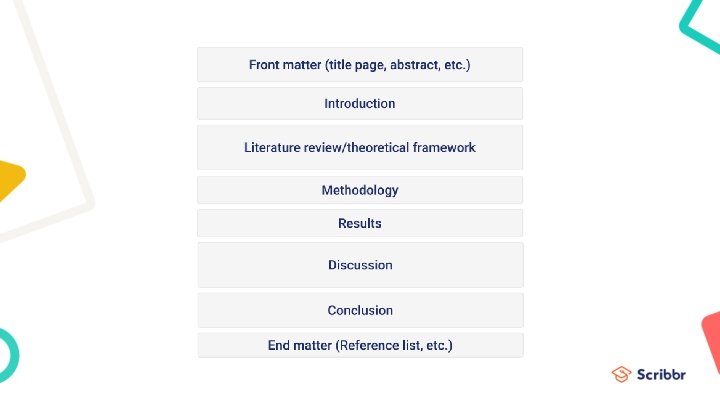
What sections does a dissertation contain?
Check your guidelines! ● The sections included vary ● They may change based on your field… ●. . . and the nature of your specific research ● Check any guidelines you are given ● Ask your supervisor if you’re unsure

Front matter
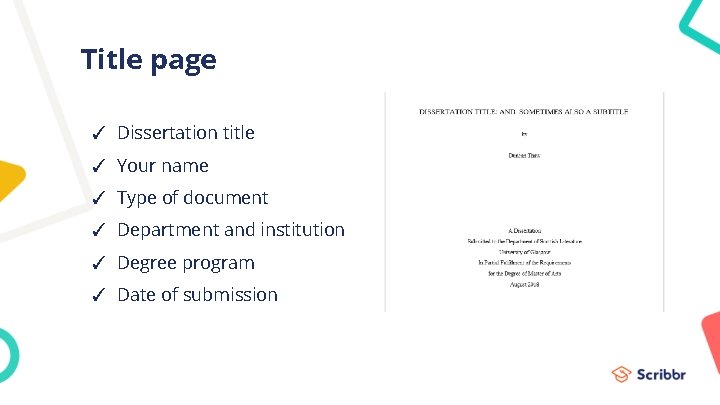
Title page ✓ Dissertation title ✓ Your name ✓ Type of document ✓ Department and institution ✓ Degree program ✓ Date of submission
Acknowledgements ● Less formal, more personal ● No longer than a page ● Thank people who helped you complete your dissertation ● E. g. supervisors, friends and family, pets!
Abstract ✓ State the main topic and aims of your research ✓ Describe the methods you used ✓ Summarize the main results ✓ State your conclusions X Not an introduction but a summary
Table of contents ● Lists all sections that come after it ● Can be auto-generated in Word ● Clear, consistent headings
Lists of figures and tables ● Include if your dissertation has a lot of tables and figures ● Tables and figures listed and numbered separately ● Make sure all tables and figures are included ● List in the order they appear in the text
List of abbreviations ● Include if you use a lot of abbreviations ● Define abbreviations here and in the main text ● List alphabetically ● Very well-known abbreviations not included
Glossary ● Include if you use a lot of specialist terms ● List terms alphabetically ● Include a brief definition of each term ● Consult with your supervisor to determine what terms you should define

The main text
Introduction ✓ Establish your research topic ✓ Provide background information ✓ Define the scope of your research ✓ Show your work’s relevance ✓ State your research questionsand objectives ✓ Give an overview of your structure
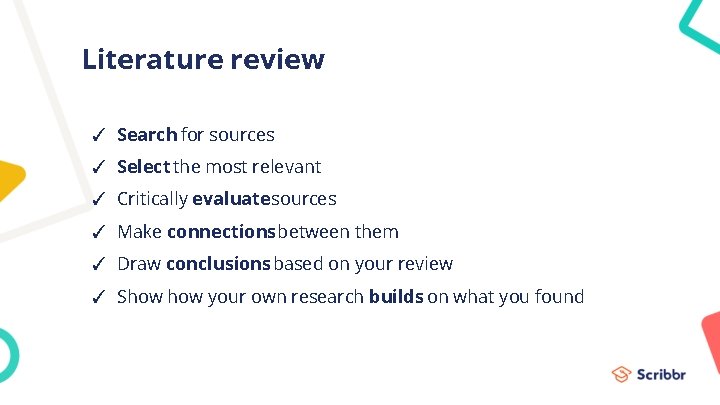
Literature review ✓ Search for sources ✓ Select the most relevant ✓ Critically evaluatesources ✓ Make connections between them ✓ Draw conclusions based on your review ✓ Show your own research builds on what you found
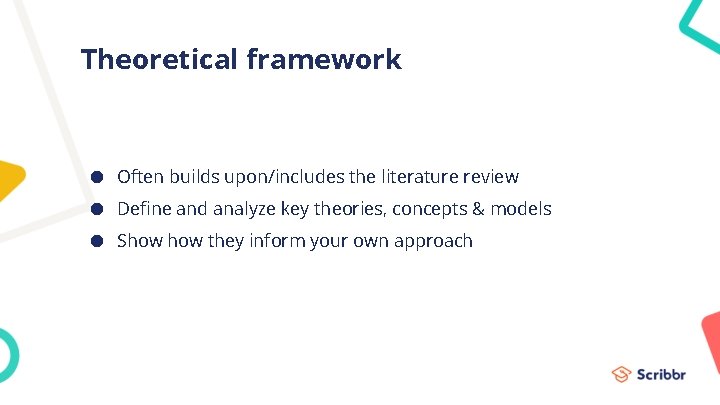
Theoretical framework ● Often builds upon/includes the literature review ● Define and analyze key theories, concepts & models ● Show they inform your own approach
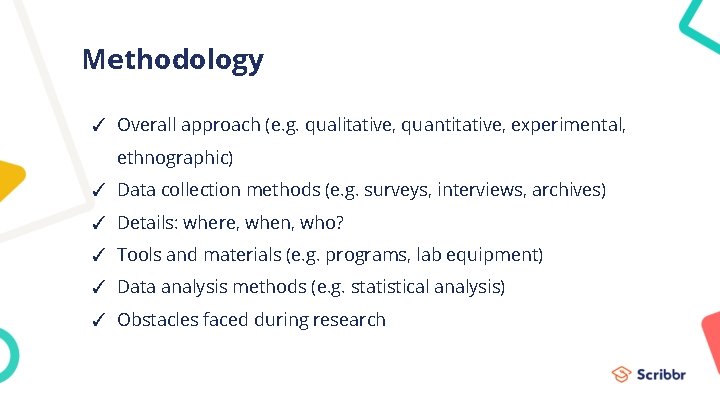
Methodology ✓ Overall approach (e. g. qualitative, quantitative, experimental, ethnographic) ✓ Data collection methods (e. g. surveys, interviews, archives) ✓ Details: where, when, who? ✓ Tools and materials (e. g. programs, lab equipment) ✓ Data analysis methods (e. g. statistical analysis) ✓ Obstacles faced during research
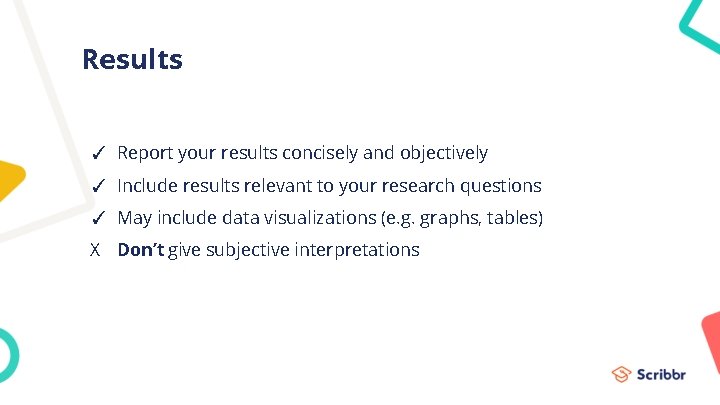
Results ✓ Report your results concisely and objectively ✓ Include results relevant to your research questions ✓ May include data visualizations (e. g. graphs, tables) X Don’t give subjective interpretations
Discussion ● Interpret your results ● Did they meet your expectations? ● Did they fit the established framework? ● What factors might have influenced any unexpected results? ● Consider alternative interpretations ● Acknowledge limitations
Conclusion ✓ Answer your main research question ✓ Make suggestions for future research ✓ Show what you have contributed ✓ Emphasize the importance of your research X Don’t introduce any new data, interpretations, or arguments

End matter
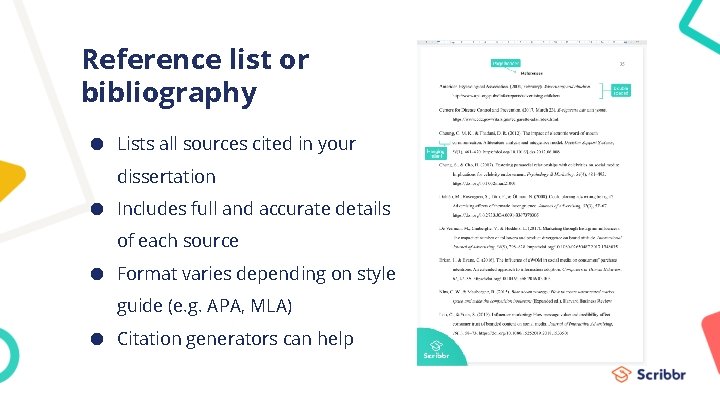
Reference list or bibliography ● Lists all sources cited in your dissertation ● Includes full and accurate details of each source ● Format varies depending on style guide (e. g. APA, MLA) ● Citation generators can help
Appendices ● Present additional data or documents not included in your main text ● E. g. interview transcripts, survey questions, tables of data ● If you have multiple appendices, they are numbered (Appendix 1, Appendix 2…)
Recommended resources
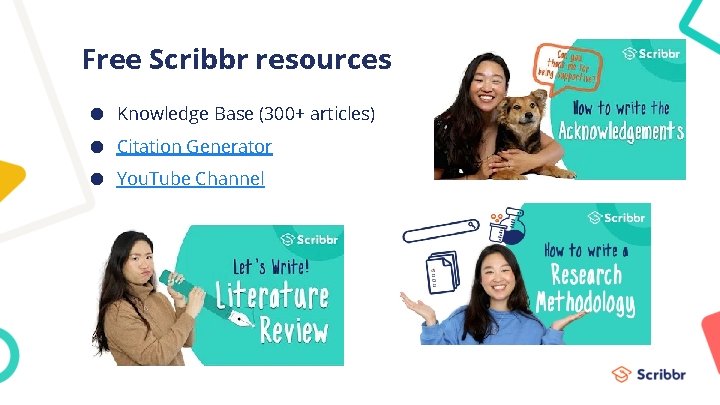
Free Scribbr resources ● Knowledge Base (300+ articles) ● Citation Generator ● You. Tube Channel
Hi, we’re Scribbr�� We are a team of 60 people in Amsterdam, and we partner with more than 500 freelance editors across the globe to help students graduate and become better academic writers. Every day, we work hard on our Proofreading & Editing service, Plagiarism Checker, Citation Generator, Knowledge Base and educational You. Tube channel.
Guidelines for using this presentation This presentation can be freely used and modified for educational purposes. You may: ✓ Display this presentation in a classroom environment ✓ Modify, add, or delete slides ✓ Distribute this presentation in print or in private student environments (e. g. Moodle, Black. Board, Google Classroom) Please do give credit to Scribbr for creating this resource. Questions or feedback? Email shona@scribbr. com and we’ll be in touch!
- Slides: 32